Showing posts with label Biotheology. Show all posts

2012-09-19

The Path of Salvation

If there is an instinctive bond between humans and other living systems -- if deep affiliation with nature is rooted in human biology -- then salvation, for humans and for life itself, lies in the cultivating the connections that we subconsciously seek with the rest of life.
  • We are drawn to baby faces of any mammal -- we find them universally cute and adorable. Our positive emotional response toward baby mammals across species helps increase the survival rates of all mammals.
  • We keep plants and flowers in and around our homes. Our natural love for life leads us to sustain life. (Since most fruits begin as flowers, it was crucial for our ancestors to detect and remember plants that would later provide food.)
  • Researchers are finding that a nurturing relationship with animals is important in early and middle childhood development. (Myers and Saunders in Children and Nature: Psychological, Sociocultural, and Evolutionary Investigations, 2002.)
  • Richard Louv finds that modern urban living is producing children with “nature-deficit disorder.” Attention disorders, obesity, depression, and dampened creativity, he argues, result from children spending more hours indoors and fewer hours in unstructured, solitary contact with the natural world. (Last Child in the Woods: Saving Our Children from Nature-Deficit Disorder, 2005.)
What if we took seriously a commitment to do the work of cultivating the fuller flourishing of our spirits through contact with more of the diversity of nature?

David Cockrell asks us to:
“Imagine for a moment a church community that had a fundamental, bottom-line commitment to living in harmony with the earth. The program of such a church would be continuously infused with environmental ideas, actions, and spiritual ceremonies. There would be at least one children's religious education curriculum taught each year on the environment. The adults in this church, all of them, would gather in small groups to help each work out and implement lives that minimize their footprints on the planet. There would be field trips to sites of environmental concern and to places of great natural beauty. Community meals would emphasize locally-grown sustainable foods, free of biocides, with nothing wasted. Worship would normally invoke elements of the earth and our human connectedness to it.”
The building and grounds would utilize renewable energy, and native plants requiring no chemicals and no watering.
“The administration would be mindful of conservation in all its policies. Church investments would emphasize socially and environmentally responsible funds.”
Recognizing that ecospirituality calls for ecojustice, we would
“recognize that poor people and people of color are the first victims of environmental poisons and natural disasters, that the problems of the ecosystem cannot be solved without facing the problems of inequality.”
Its members would organize to confront irresponsible action by industry or government, protect habitats, and reduce consumption. (David Cockrell, "Greening Liberal Religious Communities," UUWorld, 2005).

Many Unitarian Universalist congregations have begun to approximate that kind of church community. Yet we have farther to go.

It’s our built-in need as humans, but that doesn’t mean humans will do it. We don’t know yet how to live in real joy, in harmony with this earth – this planet to which we are given every bit as much as it is given to us. We have hard work to do to understand and follow the biophilia path.

Biotheology (an approach to the issues of theology grounded in biological and evolutionary understanding) includes a soteriology (teachings about salvation). Our salvation emerges from our connection with great diversity of life. The joy of biophilia might lead you to bicycle more, set the thermostat lower in winter and higher in summer, eat strictly local and vegan, rely exclusively on second-hand thrift-shops for clothing, or look into the possibility of tofu shoes -- or it might not. What is your path toward the salvation of reconnection to life?

Our Universalist heritage began over 200 years ago with a radical soteriology: salvation is for everyone, and there is no hell of eternal damnation. The Universalists were not saying that we don’t pay the price for our sins. We do pay the price for small-souledness; for thoughtless deeds that diminish the light from the spark of divinity within us; for not loving ourselves and our neighbor as our selves; for not recognizing kinship and not accepting difference; for not connecting with diverse life. But that price is paid here, in this life and on this earth.

Salvation is universal, but that doesn't mean we're off the hook for doing the spiritual work we are called to do. Grace is free, but it ain't cheap. On the other hand, the work is not a grim, joyless duty to sacrifice. Indeed, visitations of joy in the heart are our clearest indicator that we're on the right path.
"Meanwhile the wild geese, high in the clean blue air,
are heading home again.
Whoever you are, no matter how lonely,
the world offers itself to your imagination,
calls to you like the wild geese, harsh and exciting --
over and over announcing your place
in the family of things." (Mary Oliver)
Life is repeatedly, incessantly, announcing our place in the family of things. But we’re just babies, and we don’t understand. We are as toddlers, with built-in impulses in the right direction, but just beginning to learn our potty-training.

Amen.
* * *
This is part 6 of 6 of "Soteriology: Biophilia"
Previous: Part 5: "Small Islands"
Beginning: Part 1: "Drawing the Line"

2012-09-18

Small Islands

E.O. Wilson’s Biophilia argues that humans subconsciously seek connections with the rest of life. Consider the elements of a savannah habitat: open spaces with clear views, scattered clumps of trees, and a smattering of lakes and rivers.
“Put these three elements together: it seems that whenever people are given a free choice, they move to open tree-studded land on prominences overlooking water. Psychologists have noticed that people entering unfamiliar places tend to move toward towers and other large objects breaking the skyline. Given lesiure time, they stroll along shores and river banks…. When people are confined to crowded cities or featureless land, they go to considerable lengths to recreate an intermediate terrain, something that can tentatively be called the savanna gestalt” (110-11)
In addition to scattered trees or shrubs, and the occasional pool or fountain, the savanna had one other feature that we have come to be genetically encoded to be attracted toward: abundant and diverse life.

Cyril Smith compared the most attractive patterns of the physical world and technology to artistic representations of plants and animals.
"People react more quickly and fully to organisms than to machines. They will walk into nature, to explore, hunt, and garden, if given the chance. They prefer entities that are complicated, growing, and sufficiently unpredictable to be interesting. They are inclined to treat their most formidable contraptions as living things.” (116)
We have an "urge to affiliate with other forms of life," and we need lots of diversity of life around us. This means, it turns out, that the idea that we could do quite well living in space stations is problematic. Wilson explains in some technical detail why smaller islands in the ocean necessarily have less diversity than larger islands. It takes a lot of space to allow for the initial species to interact enough in ways that create further niches for new species.

In other words: imagine a space station. It's not hard to imagine that, more-or-less with our present technological capability, we could create a space station with artificial gravity (from the the centrifugal force of spinning), eternally cycling water, microorganisms, and plants. We could create a stable ecosystem in space that could sustain a small human population indefinitely. We could survive. We could not, however, Wilson argues, be fully realized as human beings in such a setting -- not unless it were a very, very large space station.
“People can grow up with the outward appearance of normality in an environment largely stripped of plants and animals....Yet something vitally important would be missing, not merely the knowledge and pleasure that can be imagined and might have been, but a wide array of experiences that the human brain is peculiarly equipped to receive.” (118)
If we don’t occasionally glimpse a swallow-tailed kite, or a fox – or at least an alligator, robin, and squirrel -- if we aren't exposed to a wide variety of life forms -- we can still live, but not flourish. Small, isolated islands cannot develop or maintain much diversity. Our psyches, our spirits, crave to be around more complexity, more different forms of life than any space station smaller than, say, Vermont could sustain.

Within the evolutionary story, then, there is a moral. It is a story about what kind of being we are, and in what our flourishing, healing, wholeness, reconnection -- that is, our salvation -- consists. It is also a story that calls for a conservation ethic arising from our inborn spiritual need for nature’s diversity. Without more intentional conservation, we are losing species diversity: even our largest land masses are becoming as small islands. Wilson writes:
“...if no country pulls the trigger [and begins a nuclear war] the worst thing that will probably happen – in fact is already well underway – is not energy depletion, economic collapse, conventional war, or even the expansion of totalitarian governments. As tragic as these catastrophes would be for us, they can be repaired within a few generations. The one process now going on that will take millions of years to correct is the loss of genetic and species diversity by the destruction of natural habitats. This is the folly our descendants are least likely to forgive us.” (121)
 * * *
This is part 5 of 6 of "Soteriology: Biophilia"
Next: Part 6: "The Path of Salvation"
Previous: Part 4: "Soteriology and Biophilia"
Beginning: Part 1: "Drawing the Line"

2012-09-17

Soteriology and Biophilia

The Lake Chalice “Biotheology” project has sought to address the traditional questions and issues of theology in a way informed by the biological sciences. Our eschatology series (study of the end times), looked at the question of whether species evolution has a direction – an “end” it is aimed toward. Our ecclesiology series (study of the structure and function of the church), looked at evolutionary origins of the human need for faith community. Our theodicy series (traditionally, “justifying God’s ways to man” – i.e. explaining the presence of evil), looked at recent research on sociopathy: why our genome predisposes about 2 percent of humans to be sociopaths, and what would be the best way to respond.

Soteriology (from the Greek, “soteria,” meaning salvation) is the branch of theology that deals with salvation. What does it mean to be saved? By what is salvation brought about? From the root of the word “salvation,” we also have the word, “salve.” Salvation is what heals our wounds and brings us to wholeness. Indeed, when the Greek “soteria” appears in the New Testament, it more frequently means to save from suffering than to save from sin. Suffering and sin are connected, of course. Our soteriological task is to indicate what will heal our pain and reconnect us with the sacred. We are asking, that is, about spiritual health and cultivating our connection with the widest possible reality.

The religious impulse is to love and revere life – often represented as loving God, understood as the creator of life. Harvard biologist Edward O. Wilson offers a single word that sums up the impulse to love life and the healing and reconnection toward which that impulse leads: biophilia (love for life).

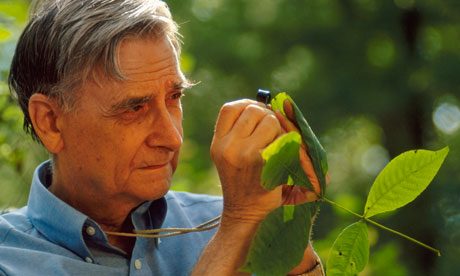
E. O. Wilson
The science of the 20th and 21st century includes a detailed description of the intricacy the interconnection of all things. And more than that: this science also gives us new material for describing our own yearning to be in connection. Wilson argues that evolution has built into us an affinity for life, biophilia:
“To explore and affiliate with life is a deep and complicated process in mental development. To an extent still undervalued in philosophy and religion, our existence depends on this propensity, our spirit is woven from it, hope rises on its currents.” (Wilson 1)
We are drawn toward life; we want it to be around us:
“Life of any kind is infinitely more interesting than almost any conceivable variety of inanimate matter.” (84)
This attraction toward living things is innate, wired into to us by millions of years of natural selection. It’s who we are, and we cannot build fulfilling and meaningful lives for ourselves – we cannot flourish – without a lot of life around: goldfish and houseplants at the least.
“We are in the fullest sense a biological species and will find little ultimate meaning apart from the remainder of life.” (Wilson 81)
Consider the way that humans, whatever their religious background, select habitat for themselves.
“For most of two million years human beings lived on the savannas of Africa, and subsequently those of Europe and Asia, vast, parklike grasslands dotted by groves and scattered trees.” (Wilson 109)
The right sort of habitat -- the habitat we were "made for" -- tells us about what is needed for human healing and reconnection. The savanna may not be the only spiritually wholesome habitat for humans, but it does contain these key features: wide open spaces affording a clear view for detecting animals and rival bands at long distance; a few cliffs, hillocks, and ridges which allowed still more distant surveillance and which provided overhangs and caves for shelter at night; scattered clumps of trees; lakes and rivers offering fish, mollusks, and new kinds of edible plants.

* * *
This is part 4 of 6 of "Soteriology: Biophilia"
Next: Part 5: "Small Islands"
Previous: Part 3: "Out from Under Over and Above"
Beginning: Part 1: "Drawing the Line"

2012-09-16

Out from Under Over and Above

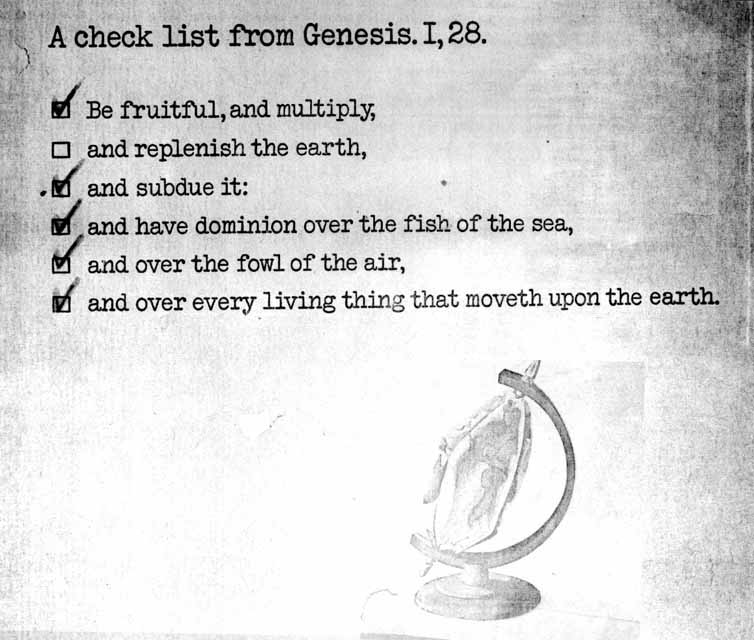
The part of our brain wired for what can be called “spiritual experience,” gives us a sense of our place in the web of life and the web of existence. Some religio-cultural traditions – like the historical Western religions – interpreted that feeling of place, of belonging, as meaning that we humans were on top: that we have dominion, are top dog, and all of nature is a bounty just for us. Genesis, chapter 1, tells us:
"God said, let us make man in our image, after our likeness, let them have dominion over the fish of the sea, and over the fowl of the air, and over the cattle, and over all the earth, and over every creeping thing that creepeth upon the earth. So God created man in his own image, in the image of God created he him; male and female created he them. And God blessed them, and God said unto them, Be fruitful, and multiply, and replenish the earth, and subdue it: and have dominion over the fish of the sea, and over the fowl of the air, and over every living thing that moveth upon the earth." (Gen. 1:26-28)
Darwin alone does not dislodge this habit of thinking of the human species as properly dominating all other species. Early Darwinists – and some people to this day who have no doubt about evolution as a force of nature – see evolution as aiming all along at producing humans.

(While evolution does tend toward complexity, it does not tend toward the human form of it. Moreover, it’s not clear how to measure complexity. For instance, while humans have the biggest brain-volume-to-body-mass ratio, dolphin brains have about as many total neurons and 40 percent more cerebral cortex than humans, part of which allows them to process sounds, as well as make sounds, much faster and in more detail than we can, so they can send and receive three-dimensional audio “images.” So are dolphins "more complex"? Hard to say. But whether humans count as the most complex kid on the block today, nothing’s to say that we – and the dolphins -- won’t, in the end, be surpassed by an even more complex species emerging from, say, descendents of the African gray parrot.)

On the one hand, we didn’t used to know that our lives are totally dependent upon bacteria – comparatively simple organisms. On the other hand, spiritual experience has always included a sense of humility. Given our ancient capacities and our recent knowledge, we can now say it is a good spiritual practice to remind ourselves that we are totally dependent upon bacteria for our very lives and sustenance. Knowledge gleaned from modern science is available to take on spiritual significance, if we let it.

Other religio-cultural traditions – like many Native American ones – interpreted our sense of place and belonging in nonhierarchical terms to begin with. For us westerners, modern science is at last correcting one particular mistake that certain nonwestern peoples never made. For westerners, it takes science, it seems, to help us understand that we are enmeshed in the web of life, and this web created us and sustains us. We have our role to play – just as every species does – in maintaining that web. In the web of interconnection, there truly is no "top," and no relation of "dominion."

Yet these teachings of science have not yet been very well or widely learned. In our culture, an inaccurate account of the self continues. We continue to find emphasis on a picture of
“the personal self in competition with and in opposition to nature. But if we destroy our environment, we are destroying what is in fact our larger self.” (Freya Matthews)
For modern westerners, the emergence of ecospirituality today is bringing together (a) our ancient and universal human capacity for spiritual response to the natural world around us, and (b) the descriptions of that nature only recently available to us through our science. This emergence, however, remains nascent for us. We are only beginning to come out from under the shadow of long cultural assumptions that the relationship between humans and the rest of nature is one of opposition and dominion or the attempt to dominate.

* * *
This is part 3 of 6 of "Soteriology: Biophilia"
Next: Part 4: "Soteriology and Biophilia"
Previous: Part 2: "Sacrifice"
Beginning: Part 1: "Drawing the Line"
2012-09-15

Sacrifice

Material things don’t make us happy. Within six months, at the longest, after even the most exciting material acquisition, a person's overall happiness is back to its baseline level. While we know that material things don't make us happy, it's also true that forcing ourselves to give them up before it feels right to do so won’t make us happy either. Mohandas Gandhi reminds us:
"No sacrifice is worth the name unless it is a joy. Sacrifice and a long face go ill together."
Many religious traditions recognize sacrifice as a spiritual practice. Our early ancestors noticed thousands of years ago that, while there is a certain satisfaction in acquiring things, it also, sometimes, feels good to give some of them up. Other times, the prospect of sacrificing doesn't feel so good -- in which case, as Gandhi cautions us, sacrifice isn't much good as a spiritual practice:
"Service which is rendered without joy helps neither the servant nor the served. As long as you derive inner help and comfort from anything, you should keep it. If you were to give it up in a mood of self-sacrifice or out of a stern sense of duty, you would continue to want it back, and that unsatisfied want would make trouble for you. Only give up a thing when you want some other condition so much that the thing no longer has any attraction for you."
Environmentalism runs into the question of sacrifice: what to give up, and how. This is a practical question (What will it take for human life on Earth to be sustainable?) as well as a spiritual one. Approaching it as spiritual may help us find and live with the practical answers.

Ecospirituality

Ecospirituality is the deliberate attention to those connections between the well-being of Morther Earth and our spiritual joy. It attunes us to hear the call to joy in our own path, however small our steps, toward better protecting this planet home of ours. It
“means that our experience of the divine comes through the natural world” (Jeanne Mackey).
Those who have been exploring this religion of nature, and have been developing a growing literature articulating it, are finding that the religion of nature is indeed the religion that is natural to us.
“The universe is the primary revelation of the divine, the primary scripture, the primary locus of divine-human communion” (Thomas Berry).
We can now discern a common basic wiring: a capacity for a certain kind of experience that we recognize as spiritual experience regardless of whatever cultural form it appears in, and for that experience to involve connection with nature. We’re also finding that a sense of contact with nature, with diversity of life forms, is an essential part of our health, whatever our religion.

Ecospirituality has pre-scientific and the post-scientific forms. At one level, ecospirituality doesn’t need science. It’s a transcultural imperative for any human and any time – before or after the scientific revolution. At another level, certain contents of our ecospirituality are available to us only recently, incorporating what modern science tells us about ecology, and the universe.

Humans have always looked to the natural universe. Only now do we have science’s sort of understanding of why we do so – and what it is we’re seeing when we look.

* * *
This is part 2 of 6 of "Soteriology: Biophilia"
Next: Part 3: "Out from Under Over and Above"
Previous: Part 1: "Drawing the Line"

2012-09-14

Drawing the Line

One hundred-thousand years, humans have been around as the species homo sapiens -- which makes us, as a species, very young. Still practically brand new. Our neighbors here in Florida, the alligators, have been around at least 100 times that long. This is a point made in a "Rustle the Leaf" comic strip.

Rustle the leaf and his acorn side-kick are talking as they look over a trash-despoiled wetland.

Acorn: “Stupid humans. “It’s like they have an obsession for trashing every corner of the planet.”

Rustle the Leaf: “Don’t be too hard on the human species. In geologic time, they’re just babies.”

Acorn ponders this, looks at the trash, and says: “How much longer ‘til they’re potty-trained?”

It would be nice to "grow up" -- or at least reach the stage of being potty-trained. But what exactly does that entail? How far do you and I need to go to be mature, responsible stewards of our planet home? The difficulty of the question was illustrated in another comic strip. A couple years ago my mother had a point to make about my environmental concerns and the actions I take out of that concern. She clipped out and mailed to me a Sunday comic strip of “Zits.”

Jeremy asks his friend, Pierce, “Why aren’t you wearing your boots today, Pierce?”

Pierce: “Can’t. I’m boycotting leather in support of animal rights.”

Jeremy: “Then couldn’t you just wear your sneakers?”

Pierce: “Nope. The rubber soles are made with petroleum-based plasticizers, and I’m against arctic drilling.”

Jeremy: “What about your wooden sandals?”

Pierce: “And support deforestation? Not likely. I’m an activist, Jeremy. I have to set an example to show others that there is a better way to live.”

In the last panel, we finally see Pierce’s footwear, as Jeremy says: “Hence, the tofu shoes.”

Pierce: “Teriyaki flavor. Want some?”

Sometimes the quest to do the right thing with our purchasing decisions can just seem silly.

I wrote back to Mom:
"It’s worse than that. Tofu is made from soybeans, and if the soybeans aren’t organic, there’s the harm of nitrogen-based fertilizers, and there’s pesticides. Even if it’s all organic, there may have been monoculture growing, without proper crop rotation and variation. Finally, even if you fix all that, there’s almost certainly some oppressed labor somewhere along the way. So, Mom, where do you draw the line? Do you so thoroughly trust your government as to figure that anything they haven’t outlawed has got to be morally and environmentally OK to participate in?”
She never answered. When I saw her some months later at Christmas, I asked her about it. "I assumed the question was rhetorical," she said.

I can imagine my children writing to me with that question: “Well, OK, Dad, where do you draw the line?” I don’t know if I’d answer either.

I am a vegetarian. Also, for the last dozen years all my clothes – all outerwear except socks – has come from second-hand thrift stores, and the occasional gift. I bicycle to work -- sometimes. So I draw the line somewhere north of supporting the environmental degradation of the meat industry and the labor oppression of the textile trade, at least directly. But I draw it somewhere south of driving a car, at least sometimes; flying in airplanes; using heating in the winter, air conditioning in the summer, and electric lights all year around; eating eggs and dairy (though I've cut way down); buying foods that are processed, packaged, and imported; and wearing shoes that aren’t even tofu.

I try to draw the line where it seems joyous to do so, where the gladness of simplicity calls. I urge you to use the same method for discerning where to draw the line -- though I expect your results from employing that method will differ from mine. Though the method of following where the spirit’s joy calls yields different results for different people, it is not an altogether easy method. "Follow your bliss" (as Joseph Campbell put it) is a rigorous path and a lot harder than, "Just do any old thing you happen to feel like."

* * *
This is part 1 of 6 of "Soteriology: Biophilia"
Next: Part 2: "Sacrifice"

2012-07-19

The Wound that Cuts Through Every Human Heart

Primary sociopaths. Secondary sociopaths. What about you and me (assuming neither of us is sociopathic)?

Aleksandr Solzhenitsyn said:
"If only there were evil people somewhere insidiously committing evil deeds, and it were necessary only to separate them from the rest of us and destroy them. But the line dividing good and evil cuts through the heart of every human being. And who is willing to destroy a piece of his own heart?"
Again with the evil-and-must-be-destroyed idea! Still, there's an important point here. If we drop the concept "evil" and replace it with "sociopath," the implication (an implication which yesterday's Lake Chalice fostered and which today we shall seek to correct) is that we need only make appropriate arrangements for dealing with sociopaths. Yet there is something -- something that Solzhenitsyn calls "evil" -- which "cuts through the heart of every human being." If we seek a liberal theology of theodicy, then an understanding of sociopathy, however accurate and compelling, is incomplete. We must also name the tendency to unmindfulness to which all flesh (and spirit) is heir.

Scott Peck's book on evil -- People of the Lie: The Hope for Healing Human Evil -- speaks of the opposite of "evil" as mental health. His notion of mental health seems to me to encompass spiritual health as well. He defines mental health as:
“an ongoing process of dedication to reality at all costs.”
Peck
We are ever called to an ongoing process of dedication to reality at all costs. The reality to which we are called to dedicate ourselves is that we are interconnected, all made up of the same stuff. Dedication to that reality means practicing to keep that truth ever before us. The people for whom Peck uses the word "evil" are people who obscure from themselves, in one way or another, a clear view of reality. And that tendency to obscure reality from ourselves does, as Solzhenitsyn put it, cut through the heart of every one of us.

As I read the case studies that Scott Peck presented, I noticed that the people he called "evil" were deficient in two connected and overlapping areas in their way of relating to other people. They lacked sincere gratitude, and lacked any clear sense of personal responsibility. When things go well, the patients Peck describes seem to believe they did it all themselves. And when things go awry, it’s always someone else’s fault. These patients, as I see them, are suffering from a sense of division. They feel separated from the world, they have a definite divide between an always-virtuous “me,” and an often-thwarting “out there.”

I believe that the very act of calling them evil perpetuates exactly the same false divide. Buddhists say “drop those attachments that are distorting your perception – and see things exactly as they are.” This isn’t easy. It is, just as Peck says, an ongoing process of dedication to reality at all costs. With that dedication to wholeness comes gratitude and humility -- the salve (thence, salv-ation) for healing that wound cutting through every human heart.

Morn, in Nashville
If we drop the concept evil, it doesn’t mean that harmful actions disappear. We have to respond to actions that harm, whether those actions result from intent or from negligence. Our response must include:
“mindfulness concerning the ways we ourselves and those around us dehumanize others, perpetuate evil by categorizing others as less than human.” (Rev. Mary Katherine Morn, who was once my minister, back in Nashville, TN)
We cannot stand for spiritual wholeness while demonizing those who lack realization of that wholeness. We must celebrate and be aware. Celebrate the whole of creation. Be aware of the constantly surrounding beauty and love, and cultivate gratitude and humility.

We must do this. Whatever else we may do to respond to that which would negate celebration and awareness, we must also do this: celebrate the whole of creation, and be aware of the constantly surrounding beauty and awe.

Amen.

* * *
This part 6 of 6 of "Theodicy: Addressing Evil"
Previous: Part 5: "Answer Evil with Justice and Community"
Beginning: Part 1: "The Evil Thought-Stopper"

2012-07-18

Answer Evil with Justice and Community

Assuming we can avoid the "evil-and-must-be-destroyed" mindset, what is the best response to sociopaths?

For primary sociopaths, as part of the genetic package that equips them to occupy the niche in our world that they do, along with an inability to have the “social emotions that normally contribute to behavioral motivation and inhibition,” they also are “high on novelty-seeking, low on harm-avoidance, and low on reward-dependence.” They’re thrill-seekers – looking for high levels of physiological arousal – perhaps because that’s the only way to feel alive in a reality where they can’t pick up on anybody’s feelings but their own. You put all that together, and you can see where the Charles Mansons and the Jeffrey Dahmers come from.

Primary sociopaths can’t empathize, but they can reason. They can calculate their own self-interest. Suggests sociologist Linda Mealey:
"The appropriate social response is to modify the criminal justice system in ways that increase the costs of antisocial behavior, while simultaneously creating alternatives to crime which could satisfy the psychopysiological arousal needs.” (Mealey, L. [1995]. The sociobiology of sociopathy: An integrated evolutionary model. Behavioral and Brain Sciences 18 [3]: 523-599. See here.)
When we say increase the costs of antisocial behavior, remember that research indicates that increasing the probability of being caught is the primary deterrent. Increasing the severity of the punishment itself does almost nothing. When we speak of alternatives that could satisfy the psychophysiological arousal needs, we’re talking about finding these people appropriate jobs. They don’t empathize, but they often get quite good at pretending to, so they can make good novelists, screenplay writers, talk-show hosts, and disk jockeys.

randomly chosen talk-show host
Sociopaths also seek high levels of excitement, so they can make good stunt men, explorers, race-car drivers, and sky-diving exhibitionists.

Let’s find a way to use the gifts they have, instead of labeling them evil. Find a productive use for them, and they won’t have to use destructive outlets.

The secondary sociopaths call for a different strategy. Here we can aim to reduce the carrying capacity of the “cheater” niche. For secondary sociopaths:
“The appropriate social response is to implement programs which reduce social stratification, anonymity, and competition, intervene in high-risk settings with specialized parent education and support; and increase the availability of rewarding, prosocial opportunities for at-risk youth.” (Mealey)
In other words, we need justice, we need community, we need cooperation-fostering frameworks, we need education, and fair opportunity.

We don’t need the word or the concept, “evil.”

There’s also a spiritual reason for dropping the concept. When I invoke the concept “evil,” I draw a line, and put myself on one side – because no one ever thinks they themselves are evil – and some other part of creation on the other side. It divides the whole, and what our spirits long for is connection with the whole: all of creation, the earth, the stars, and the grasses, and the rivers – including the water bugs that dissolve frog innards, and people who vote differently from us, and even sociopaths, and Charles Manson and Jeffrey Dahmer. Our spirits long to be made whole.

Ultimately, as an early Taoist text says, “life and death are one, right and wrong are the same.” The same. Seeing this frees one from handicaps and fetters. With spiritual healing we perceive the vast whole as deeply good, and every part of creation is an integral and necessary part.

* * *
This is part 5 of 6 of "Theodicy: Addressing Evil"
Next: Part 6: "The Wound that Cuts Through Every Human Heart"
Previous: Part 4: "Primary Sociopaths and Secondary Sociopaths"
Beginning: Part 1: "The Evil Thought-Stopper"

2012-07-17

Primary Sociopaths and Secondary Sociopaths

The social evolution of humankind has been a gradual process of working out social arrangements to allow us to escape from the prisoner's dilemma created when each of us is on our own to pursue our own self-interest -- social arrangements, that is, that allow for greater and greater levels of cooperation. Setting up a police force and a legal system, for example, is one step toward working out the conundrum. Establishing outside enforcement allows us to make contracts with some reassurance that we aren’t being suckered: there’s a system to enforce compliance.

In human evolutionary history, it turns out that about 2 percent of us will find noncooperation a viable strategy. There’s a social contract, and these are the people who cheat on the social contract. Around 2 percent. This is what research indicates is the equilibrium point. About two percent is usually the carrying capacity of the “cheater” niche in our social ecology. If the number of cheaters falls to much less than 2 percent, then the rest of us get very trusting and naïve, and we become a population ripe for con men and various ne’er-do-wells to have a field day with us, running roughshod over our trusting ways. In such a context, being a noncooperator has a high pay-off, which breeds more noncooperators. As the number of noncooperators goes up, the rest of us become increasingly aware of the threat. We put up our guard; we put energy into protecting ourselves from scams, and catching and prosecuting criminals. Then the benefit-to-risk balance doesn't favor noncooperation so much, and the number drops again. It settles into an equilibrium.

I’m not so much talking about modern society, but across the millions of years of human evolution, there tends toward an equilibrium at around 2 percent of the population noncooperating – that is, being sociopaths. And if sociopathy is your strategy, then it helps you carry out that strategy if you are genetically unable to empathize.

The reason we have sociopaths is that for millions of years that niche has been there for a small percent of the human population – a niche where anti-social behavior is a successful strategy for staying alive and having offspring. As a result, the human genome produces a small percentage of folks genetically equipped to occupy that niche. These are the “primary sociopaths” -- born genetically unable to empathize. They can feel the basic emotions – such as anger, fear, sadness, disgust, surprise, joy, acceptance, and anticipation – but cannot feel what are called the social emotions. They don’t experience love, or guilt, or shame, or remorse.

Linda Mealey,
1955 - 2002
The genetic tendency to sociopathy is normally distributed – it’s not a simple on-off switch, all-or-nothing. Next to the primary sociopaths on the bell curve are people who might or might not fall into the sociopath strategy, depending on whether the environment teaches them that’s their best bet. These are the “secondary sociopaths.”
“Secondary sociopaths are not as gentically predisposed to their behavior; rather, they are more responsive to environmental cues and risk factors, becoming sociopathic ‘phenocopies’ or ‘mimics’ when the carrying capacity of the ‘cheater’ niche grows.” (Sociologist Linda Mealey. See here.)
We could call these people evil – implying that there’s an imperative to destroy them. But once we understand sociopathy, we can begin seeing other alternatives.

* * * * *
This is part 4 of 6 of "Theodicy: Addressing Evil"
Next: Part 5: "Answer Evil with Justice and Community"
Previous: Part 3: "From Evil to Sociopathy"
Beginning: Part 1: "The Evil Thought-Stopper"

2012-07-15

From Evil to Sociopathy

If we just dropped the concept, "evil," what would replace it?

"Biotheology" explores ways that biology and evolution and science can shed light on the traditional issues and questions of theology. A biotheology of theodicy looks to biology and medicine to shed light on human proclivities for doing harm. Of the conceptual space occupied by "evil," the largest area could be replaced with “anti-social behavior.”

According to the Diagnostic and Statistical Manual of Mental Disorders (DSM IV), the standard reference work in the mental health field, sociopathy is a pervasive pattern of disregard for and violation of the rights of others as indicated by any three or more of the following seven:
  • failure to conform to social norms with respect to lawful behaviors as indicated by repeatedly performing acts that are grounds for arrest;
  • deceitfulness, as indicated by repeated lying, use of aliases, or conning others for personal profit or pleasure;
  • impulsivity or failure to plan ahead;
  • irritability and aggressiveness, as indicated by repeated physical fights or assaults;
  • reckless disregard for safety of self or others;
  • consistent irresponsibility, as indicated by repeated failure to sustain steady work or honor financial obligations;
  • lack of remorse, as indicated by being indifferent to or rationalizing having hurt, mistreated, or stolen from another.
I think we do wrong if we fail to try to understand. This is not a matter of justifying harmful behaviors. It’s a matter of seeing what’s really going on so that we can make some response more effective than a blind urge to destroy.

Why are there sociopaths? There are sociopaths because sociopathy is and has been a successful strategy for a certain percent of the population -- i.e., there's a niche for the sociopath in the ecology of human society. It takes a lot of empathetic skill for the cooperation and coordination it takes to develop, design, build, and fuel a truck. But once it's built, there's space for a "free rider" to hop on. That's the sociopath's niche.

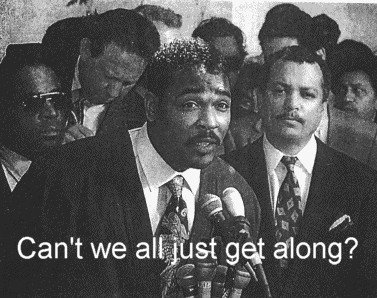
To unpack this a bit, let us put to ourselves the question Rodney King asked: "Can’t we all just get along?"

The answer, Rodney, is that we don’t want to get taken advantage of. Throughout our dealings with one another, we constantly face what are called prisoner’s dilemma situations. The classic prisoner’s dilemma gets its name from a scenario in which two prisoners, captured after being in cahoots with each other on some crime, are in separate rooms, each faced with deciding whether to keep mum or turn state’s evidence and rat on their partner. Betraying their partner is in their self-interest, but if they each betray the other, they’ll both be convicted. The overall benefit to the two prisoners combined is highest when they both keep mum – but if one goes out on a limb (keeps mum) for the other, and the other turns state's evidence, then the one who kept mum gets the maximum sentence while the fink gets off scot-free. The strategy of each pursuing their self-interest leads them to an outcome which is not in their self interest.

The social world presents us with analogous situations: we’ll all be better off if we cooperate with each other, but often we’re rightfully hesitant to cooperate because we can be taken advantage of, suckered, conned, exploited.

Why can’t we all just get along? Because we’re trapped in this prisoners’ dilemma.

Cooperation is inherently difficult and risky. Yet proto-humans and humans have been slowly developing ways to provide us with the protections we need in order to cooperate. As our cooperation has grown more extensive and elaborate, we inevitably created space for the free riders and "cheaters on the social contract."

* * *
This is part 3 of 6 of "Theodicy: Addressing Evil"
Next: Part 4: "Primary Sociopaths and Secondary Sociopaths"
Previous: Part 2: "Evil and Must Be Destroyed"
Beginning: Part 1: "The Evil Thought-Stopper"

2012-07-13

Evil and Must Be Destroyed

Sometimes people cause harm to other people. Sometimes we do so in truly horrible ways. Why do we do it? Do we do it because some – or maybe all – of us are evil?

That answer stops further inquiry. So I'm going to say I think we could get along better without the concept "evil." The concept does more harm than good. That’s not the same thing as saying I think there’s no such thing as evil. Both affirming a concept’s instantiation, and denying it, are ways of holding on to the concept. I’m saying this particular concept – evil – can just be dropped.

If we call some one "evil," we have dismissed that person. We’ve given ourselves something that feels like an explanation. It actually explains nothing at all, but because we have the illusion of explanation, it can serve to stop us from digging further into the matter. In fact, any further exploration of the matter can be met with outright hostility: "you’re not justifying what they do are you? They’re evil, end of story, nothing further to understand!"

"Evil" has become a word we use when we have become afraid of understanding. When we hate something so much that we become afraid that if we understood it, we wouldn’t be able to hate it anymore, then we call it "evil." Calling it evil is a strategy designed to prevent understanding, so that the hatred we covet will not be threatened.

If something is evil, it is not to be understood -- it is only to be destroyed. In fact, the word “evil,” and the phrase “must be destroyed” go together. “It is evil and must be destroyed,” was once the stuff of Saturday morning cartoon dialog.

In the 1989 film, Steel Magnolias, Ouiser (Shirley Maclaine) rebukes her friend Clairee (Olympia Dukakis), and tells her, “you are evil and must be destroyed.” It was a funny line. Since then a lot of things have been designated as “evil and must be destroyed.”

Interested in the popular culture’s tendency to link the concept evil with an imperative to destroy, I turned to my trusty internet search engine, and typed in the phrase “evil and must be destroyed.” I read the claim that 40% of the population believes that liberals are evil and must be destroyed. On a Star Wars blog, I read that the Sith are evil and must be destroyed. On historyexplained.org, we read that the United States has historically, in effect, insisted that dictators are evil and must be destroyed. On a web site devoted to a recently popular TV show about a vampire slayer, I read: “Buffy’s new roommate irons her jeans. Clearly she is evil and must be destroyed.”

Evil and must be destroyed?
Cincinnati, the font Papyrus, bacon-wrapped jalapeno thingies, sweet popcorn, the University of Wisconsin at Milwaukee, the handvac, the mainstream media, Newt Gingrich, Lady Gaga, dogs, cats, wasps, inheritance, derivatives, emulators, cartels, college football’s Bowl Champion Series, and everyone who isn’t part of Glenn Beck’s army of God have all been publically declared, by someone, “evil and must be destroyed.”

“Evil” and “must be destroyed” seem to be pretty tightly connected in the popular mind.

Destroying might be the best response to an invasive plant species like buckthorn in Minnesota or ardisia here in Florida, but it is rarely the best response to any of the human behaviors that get called evil.

If we just drop the concept of evil, what will replace it?

* * *
This is part 2 of 6 of "Theodicy: Addressing Evil"
Next: Part 3: "From Evil to Sociopathy"
Previous: Part 1: "The Evil Thought-Stopper"

2012-07-12

The Evil Thought-Stopper

What is evil? What are we saying when we call something "evil"?

LoraKim and I lived in Minnesota for one year, 2000-2001. There is an invasive species of plant there called “buckthorn.” There was a member of the Rochester, Minnesota congregation who had made it his mission to combat the prolific encroachment of this bush. I heard from him how buckthorn was pushing out native plants, displacing habitats for native animals, upsetting the prairie ecology of the region, and how great lengths have to be taken to kill it or it will spring right back. “Buckthorn is evil,” he said. He looked like he meant it.

Or consider this. There is a certain sort of water bug that swims up under small frogs and injects a virulent poison that dissolves the living frog from the inside, allowing the bug to suck out the nutrients, leaving only an empty skin floating in the water. Do you kinda want to call that evil?

Evil has been a regularly invoked concept in US foreign policy. Ronald Reagan called the Soviet Union the Evil Empire. In 2002, President Bush named Iran, Iraq, and North Korea an “Axis of Evil.” Remember that? Andrew Marlatt was prompted to write a satirical news piece:
“Bitter after being snubbed for membership in the ‘Axis of Evil,’ Libya, China, and Syria today announced they had formed the 'Axis of Just as Evil,' which they said would be way eviler than that stupid Iran-Iraq-North Korea axis. . . . Elsewhere, peer-conscious nations rushed to gain triumvirate status in what became a game of geopolitical chairs. Cuba, Sudan, and Serbia said they had formed the Axis of Somewhat Evil, forcing Somalia to join with Uganda and Myanmar in the Axis of Occasionally Evil, while Bulgaria, Indonesia and Russia established the Axis of Not So Much Evil Really As Just Generally Disagreeable. Canada, Mexico, and Australia formed the Axis of Nations That Are Actually Quite Nice But Secretly Have Nasty Thoughts About" the US. (Full column: see here.)
In traditional theology, the problem of evil is one of the thorniest issues. If God made everything, didn’t God make evil, too – and if so, why? She gave us free will – but she’s omniscient, so she knows how we’ll use our free will. Why did she make us that way? (There are a lot of different ways to be good. We'd still have free will if we used it only to choose among various ways of being good. We can all have free will without anybody being evil.) "Theodicy" is the field of theology that aims to address the problem of evil and reconcile God's omnibenevolence, omniscience, and omnipotence with the occurrence of evil in the world.

Just because we are religiously liberal doesn’t mean that we, too, don’t wrestle with what evil is, and why. We may not frame the issue in the traditional way, but theodicy -- the challenge to offer some accounting of evil -- is an issue for everyone.

So what is evil? Let's first notice the way the concept is invoked.

I was working as a hospital chaplain in North Carolina in 2001 when terrorists flew hijacked 747s into New York’s Twin Towers. At the next morning's gathering of the hospital’s five chaplains and our supervisor, I said I wished I understood better what might lead someone to fly an airplane into a building. One of my colleagues asked, “You do believe in evil don’t you?”

I stammered, “sure,” but the truth is I don’t know whether I do or not. I have a hard time with “believe in” questions. I can tell you what I believe -- well, sometimes -- but I have harder time with what I believe in. Do I believe in God? Do I believe in evil? Do I believe in peanut butter? Basically, I don’t believe in believing in.

I do notice that the word, the concept, “evil” is often a thought-stopper. I see it used to stop thought. We say something’s evil, and we’re off the hook to look into the matter any more deeply. "It’s evil – what more do you need to know? End of story." End of thinking.

* * *
This is part 1 of 6 of "Theodicy: Addressing Evil"
Next: Part 2: "Evil and Must Be Destroyed"

2012-05-29

The Church We Need Now

Yesterday's Lake Chalice looked at some aspects of Europe. Jeremy Rifkin's description of Europe -- a continent imbued with ecospiritual wisdom where almost everyone is a part of Civil Society Organization that functions like the best possible church -- is provocative. It's a picture worth looking at, even as we must also recognize its distortions. Europe does have strands of the sort of orientation that Rifkin describes, and those strands are a bit thicker than in the US, yet much of day-to-day life is essentially similar. As the US frets about immigration issues, so does Europe -- and European xenophobia about Muslim immigrants is not so different, qualitatively or quantitatively, from US xenophobia about Hispanics. It's not clear that Europe is terrific at celebrating cultural diversity while mitigating assimilationist pressures, nor that the US is much worse at either. Moreover, what Rifkin sees as homey and congenial emphasis on community relationships would feel to many Americans -- as it does to some Europeans -- like a stifling pressure to conform. If honoring and celebrating cultural diversity is a desideratum, what is the optimal level of cultural mobility (the ability of an individual to choose a cultural, or any, identity other than the one they were born into) for a society?

The European example does not, alas, provide us with a final answer on the best way for our postmodern world to address human needs for faith community and spiritual fitness. Given Europe's very low attendance at traditional Catholic and Protestant churches, any of several different hypotheses might be argued:
  • Europeans are not meeting their faith community and spiritual fitness needs -- and that's good. Europe is doing much better than the US on measures of social health, which shows that faith community and spiritual fitness aren't really all that important.
  • Europeans are not meeting their faith community or spiritual fitness needs -- and that's bad. This failure is connected with various social problems and anomie in Europe. (Or: Europeans' civic lives partly meet their religious needs, but a more robust attention to communities and practices cultivating the spiritual values would do them good.)
  • Europeans are meeting their faith community and spiritual fitness needs through a spiritually imbued civic life -- and that's good. That's why Europe is doing so well on measures of social health.
  • Europeans meet faith needs through civic life -- and that's bad. This kind of community formation is harmful to what Europeans most need -- more respect for individual autonomy and less tribal loyalty.
(And what are "faith community and spiritual fitness needs"? See the earlier posts in this "Ecclesiology" series, as well as the "Spiritual Practice" series that begins here.)

Religion came to early humans as both a blessing and a curse. Faith community provided a feeling of connection, of at-home-ness, of being with our people, and in a world that made sense, just where we belonged. This blessing made early communities cohesive, and that cohesiveness proved essential to survival. At the same time, the US-ness of tribal identification also entailed a THEM-ness of antipathy toward those outside one's community. We need the blessing today as much as ever: overcoming alienation with community belonging and overcoming stress and greed with greater spiritual awakening. At the same time, we need forms of religion that minimize the concomitants of tribalism: intolerance and distrust of outsiders. The situation in Europe offers us some clues, but no ultimate blueprint.

Religion Must Now Transcend Its Origins

"Ecclesiology" is the branch of theology that deals with the origin of the church, the church's proper role in human life, what it is needed for, and what form it should take (governance, leadership, organizational structure) to best meet its purpose. This Lake Chalice series on ecclesiology has been looking at the light that anthropology and evolutionary psychology shed on the purpose and challenge for "the church" -- broadened to include any form of faith community -- in the 21st century. From the standpoint of biotheology -- that is, an approach to religious questions grounded in and integrated with our understanding of ourselves as revealed in the biological sciences -- what sort of ecclesiology is called for? A relatively new clarity is available to us now about the need and value of faith community, but we are just beginning to discern some clues about what forms of faith community best amplify religion's blessing and best mitigate its curse.

Seeing the origin of religion, it’s easy to see how religion can become evil – how the yearning for a shared story becomes a commitment to absolutes. But the future holds to us the possibility of expanding the circle. We can learn to take our sense of US-ness that evolution wired into us, and keep expanding it until it takes in . . . well, everything. And there is no THEM left.

Just as nature wired into us a need for faith community, so it wired into us a propensity for going further with that capacity. Our inherited structures that made us able to bind together for war are available to be appropriated to connect us to live in peace and justice, without domination, or mastery, or hegemony. What evolution created for one purpose can now be put to a new purpose. This is nature’s method of transcendence, and the history of life on this planet is full of examples.

Mammalian forelimbs turned into bat wings – or, going another direction, into dolphin fins. Insect antennae turned into mandibles. A jaw bone in dinosaurs, fish, and reptiles was appropriated and made into an auditory bone in mammals. An ancestor of wasps and bees had an ovipositor (egg-laying tube) that was appropriated and made into a stinger. Before there were land animals, certain fish developed a swim bladder, which they could fill with gas, usually air. This allowed the fish to stay at a given depth without expending energy on swimming. The swim bladder probably was, in some species, also helpful for stability, and maybe also as a resonating chamber to produce or receive sound. The swim bladder evolved into the lung of the earliest lungfish – and from there into the lungs of land animals. Something that evolved for one purpose or set of purposes (buoyancy, stability, sonic resonance) was appropriated for a very different purpose (breathing air). A device for staying at a given depth in water turned into the essential step for moving onto land!

Structures that served one purpose get put to very different purposes. Happens all the time. The fact that we evolved with a given structure or tendency does not obligate us to continue the purpose for which that structure or tendency evolved. Genetic evolution is under no such constraint; if it were, then swim bladders would never have turned into lungs, and we’d all still be fishes.

Building upon its inheritance, the lungfish transcended that inheritance and became a new thing on this earth. Bats and dolphins, mandibular and stinging insects, mammalian auditory systems -- and, one way or another, ultimately every complex feature of every species -- built upon its inheritance to transcend that inheritance and become a new thing on this earth.

Let us do likewise. Transcend our inheritance: put the wiring that enabled cohesive war-fighting to a new use, building peace. The wiring that finds such comfort and delight in the company of friends, the wiring that gets active during spiritual experience, orients us to live in peace within our group. That same wiring is available for being universalized beyond our group. With a little training of the neural structures of social orientation that are already there, we can keep expanding our perceived circle of "us" until there is no “them.” Building upon our inheritance, we can transcend that inheritance and become a new thing on this earth.

Our spiritual perception can plumb more deeply, can see more than just what selective pressures once needed our ancestors to see. My awareness can be trained to know, more thoroughly than cognition alone can know, that all humans are I, all sentient beings are I; all bugs and plants, all amoebas, paramecia, bacteria, and fungi are I; all rocks and dirt, rivers and oceans; air and fire; sun, moon, and stars are I.

Church, huh? What is it good for? “Arms to hold us when we falter. A circle of healing. A circle of friends. Someplace where we can be free.” And strength that joins our strength to do the work of building “a land that binds up the broken, where the captive go free, where justice shall roll down like waters, and peace like an everflowing stream.”

What is it good for? Absolutely everything.

* * *
This is part 5 of 5 of "Ecclesiology: What Is Church Good For"
Previous: Part 4: "How's Europe?"
Beginning: Part 1: "Church! Huh! What Is It Good For?"

Audio (with some nice slides) of an edited excerpt of an earlier version of "Ecclesiology." Thanks to Shelby Havens for putting together the slides and creating this Youtube video:

2012-05-28

How's Europe?

Jeremy Rifkin
The emergence of religion was a vital functional adaptation that met necessary human needs. We need community, connection, and contexts of accountability, all bound and held together by ritual (because the mind believes and better remembers what it sees the body doing) and narratives of purpose and meaning. We need faith community.

Our world, however, is no longer the one for which religion was originally such a crucial adaptation. Many of us belong in various ways to a number of "tribes" -- and our survival does not depend on cohesive loyalty with just one. High levels of religiosity now correlate with low levels of social health and well-being by such measures as homicides, juvenile and early adult mortality, STD rates, teen pregnancies, abortions, and imprisonment rates.

Europe scores lower than the US on measures of religiosity and higher than the US on measures of social health and well-being. In Europe, a lot fewer people are in prison and a lot fewer people are in church. This begs the question: How do Europeans meet the need for moral and cohesive community, interconnection, and transcendence?

Jeremy Rifkin's book, The European Dream, contrasts Europe's with America's dream of unbounded consumeristic indulgence.
“The European Dream emphasizes community relationships over individual autonomy, cultural diversity over assimilation, quality of life over the accumulation of wealth, sustainable development over unlimited material growth, deep play over unrelenting toil, universal human rights and the rights of nature over property rights, and global cooperation over the unilateral exercise of power.” (Rifkin 3)
Wow. That's my agenda. Those are the values I try to preach, with my lips and my life. It's a very Unitarian Universalist agenda. Rifkin's book gives the impression the whole continent of Europe is like one big Unitarian Universalist congregation with 455 million members.

Rifkin says the European dream is to
“connect the human race to a new shared story, clothed in the garb of universal human rights and the intrinsic rights of nature – what we call a global consciousness.... What becomes important in the new European vision of the future is personal transformation rather than individual material accumulation. The new dream is focused not on amassing wealth but, rather, on elevating the human spirit. The European Dream seeks to expand human empathy, not territory...For Europeans, freedom is not found in autonomy but in embeddedness. To be free is to have access to a myriad of interdependent relationships with others.” (7, 8, 13)
Rifkin's language is ecospiritual. He speaks of re-participating in the body of nature, of the Earth as an organism consisting of interdependent relationships. This is spiritual, theological talk.
“We are on the cusp of the third great stage in human consciousness – the stage where we make a self-aware choice to re-participate with the body of nature....European intellectuals, scientists, and visionaries...increasingly view the world as an indivisible living entity deserving of respect and care....The Earth is a living organism made up of interdependent relationships and...we each survive and flourish by stewarding the larger communities of which we are a part. The solution to our dilemma lies in integrating the life instinct and death instinct in a new unity....We can't really begin to live until we first accept the fact that one day we will die. How do we come to terms with our own death and make the choice to live? By making a self-aware decision to leave the death instinct behind, to no longer seek mastery, control, or domination over nature, including human nature, as a means of fending off death. Instead, accept death as part of life and make a choice to re-participate with the body of nature. Cross over from self to the other, and reunite in an empathic bond with the totality of relationships that together make up the Earth's indivisible living community....The life instinct can be rekindled only by really living life, and living life means deep participation in the life of the other that surrounds us.”
If religion is, as Unitarian Universalist minister Forest Church says, our response to the twin realities of being alive and having to die, then Rifkin is describing a religion when he speaks of learning to live by accepting the fact of death and seeking not mastery or domination, but re-participation with nature, reuniting in an empathic bond with the totality of relationships. Truly “living life,” he said, “means deep participation in the life of the other that surrounds us.”

That's what we Unitarian Universalists preach, and what we try to practice. It's our faith.

Relatively few Europeans darken the doorstep of their local church or synagogue. They form other CSOs: Civil Society Organizations: not-for-profits and non-governmental organizations. Civil society is a third socio-political force, co-equal with market commerce and government. For Europeans, it seems, CSOs are basically church.
“The civil society is the meeting place for reproducing culture in all of its various forms. It is where people engage in 'deep play' to create social capital and establish codes of conduct and behavioral norms....In a globalized economy of impersonal market forces, the civil society has become an important social refuge. It is the place where people create a sense of intimacy and trust, shared purpose and collective identity. The civil society sector is the antidote to a world increasingly defined in strictly commercial terms.” (Rifkin 234-35, 238)
Members of such a CSO share a faith. They come together in community, generating social cohesion through shared practices and stories, and maintaining a moral order of “codes of conduct and behavioral norms.” There seems to be a spiritual ethic there of re-participation with nature as a means of interconnection transcending ego and personality.

In Europe, there seem to be ways of doing Unitarian Universalism without calling it that. In the US, however, Unitarian Universalism happens to be the place to be to affirm our connectedness, feed our spirits, and build a land of peace, justice, and reverence for earth.

* * *
This is part 4 of 5 of "Ecclesiology: What Is Church Good For?"
Next: Part 5: "The Church We Need Now"
Previous: Part 3: "When Religion Goes Bad"
Beginning: Part 1: "Chuch! Huh! What Is It Good For?"

2012-05-25

When Religion Goes Bad

We Have Religion Because We Had War

Religion gives us a sense of US-ness. The dark side is that it also gives us a sense of THEM-ness – a feeling that those who don’t participate with us in our rituals and story-telling are different, are other, and dangerous. In other words: We have religion because we had war.

War, whether you're attacking or defending, places a premium on group cohesion, and “religion” is our name for the rituals and sacred story telling that produced what was needed. War! (Huh!) Church! (Huh!) What are they good for? Each other, apparently.

Thus, human history is filled with wars over religion. This fact once seemed to me, as perhaps to you, strangely and deeply perverse. Why do people have wars over religion, when the religion on both sides teaches peace? In the light of recent thinking in evolutionary archeology and psychology, religious warfare is exactly what we would expect. It's hardly surprising that an adaptation for succeeding in war would play a role in prompting us to go to war.

When Religion Goes Bad

Faith community meets real human needs. It feeds people spiritually. But people can be fed by way of fortifying them for destructive activity. We see that in the active religiosity of some terrorists. In fact, what goes by the name of religion these days is more often unhealthy than healthy.

A recent study in The Journal of Religion and Society did a large-scale cross-cultural comparative analysis, taking into account key indicators of societal well-being for 800 million people in the U.S., Japan, and western Europe. The study found that higher levels of religiosity correlated with lower levels of social well-being. The U.S., where church attendance is high, has had more school shootings than all of Europe and Japan combined. The study found:
“in general, higher rates of belief in and worship of a creator correlate with higher rates of homicide, juvenile and early adult mortality, STD infection rates, teen pregnancy, and abortion. The most theistic prosperous democracy, the U.S., is . . . almost always the most dysfunctional of the developing democracies, sometimes spectacularly so. The view of the U.S. as a ‘shining city on the hill’ to the rest of the world is falsified when it comes to basic measures of societal health.” (Gregory S. Paul, “Cross-National Correlations of Quantifiable Societal Health with Popular Religiosity and Secularism in the Prosperous Democracies,” The Journal of Religion and Society, 7, 2005. View complete article: click here.)
Moreover:
“...Spending on health care [in the US] is much higher as a portion of the GDP and per capita, by a factor of a third to two or more, than in any other developing democracy. The U.S. is therefore the least efficient western nation in terms of converting wealth into cultural and physical health.” (Gregory Paul)
Religion reinforces a moral code, binds members into community through ritual and story, and triggers our brains to perceive a transcendent, interconnected whole beyond and more deeply satisfying than the concerns of personality and ego. But sometimes it does so in a way that is counter-productive to other values.

What the researchers in this study counted as “religiosity” is apparently not the form of faith community that the 21st century needs. We do need to meet those human needs for moral and cohesive community, for interconnection and transcendence. But the Protestant or Catholic church, in the forms that were typical through the 20th century, appears not to be the best way to do it.

* * *
This is part 3 of 5 of "Ecclesiology: What Is Church Good For?"
Next: Part 4: "How's Europe?"
Previous: Part 2: "Gossip, Agency, and the Lesson of Communes"
Beginning: Part 1: "Church! Huh! What Is It Good For?"

2012-05-24

Gossip, Agency, and the Lesson of Communes

The Origin of Morality

Religion has always been intimately connected with the promulgation of moral systems. In a context of competition between bands and tribes, the survival of a complexly social primate species depends on communicable rules that function to keep most of the members more-or-less in line. If too many members of a group are lying, cheating, stealing, or murdering within the group, then that group won't be unified and able to defeat the pack on the other side of the hill.

These selective pressures turned our ancestors into the sorts of beings with a facility for learning moral rules. Language allowed us to keep tabs on more and more of each other, which let us maintain a larger group, which allowed a more cohesive and larger fighting force and a better chance of defeating rival groups.

Our ancestors learned a technique that we readily recognize and still use, though sometimes we say we don't like it: we call it gossip. That is, our ancestors met in small groups to monitor others' behavior and moralize about it. Gossip emerged among early humans because it worked. Through gossip, a group kept track of who was trustworthy, reinforced both the social ties of the gossipers and the moral rules of the tribe. There are good reproductive reasons why we humans are attracted to gossip and gossiping. It’s a part of the system of maintaining the social order.

There is, however, a limit to how far gossip can go. Researchers find that moral rules reinforced through gossip can maintain unity up to about 150 members. Larger groups need to be held together with something else. That's where religion comes in.

Religion, argues William Irons, anthropologist at Northwestern, facilitates cooperation among a group's members by serving to reinforce commitments to each other in a recognizable way. Participating in a group's rituals psychologically reinforces your actual commitment to the group and also lets the group know you're committed to them.

Eugene Aquili's research shows
“participation in a ritual tends to alter individuals' brain states and to cause them to feel emotions of identity with a group more strongly and to hold this feeling more firmly in memory.” (The Spectrum of Ritual, 1979)
Reciting and listening to sacred stories works the same way.
“People who frequently participate together in religious rituals achieve a feeling of community that enhances their ability to cooperate and avoid conflict. Even though they may not be conscious of it, they also are able to monitor one another for the sincerity of their commitment, thus making participation in religious rituals a credible signal of commitment.” (William Irons, 2001, 364)
That's where religion comes from.

Why Communes Last or Don’t

The power of religion to develop and maintain group loyalty is illustrated in our experiments with communes in the 19th and 20th centuries. Richard Stosis studied communities that hold property in common. If you were a young adult in the 1960s, you may have some direct experience of this: communes often do not last long. They tend to fall apart because the level of trust and cooperation required is just so difficult to maintain.

Stosis found that “communes that base their existence on religious ideals tend to last roughly four times as long on average as do those that base their existence on a secular ideology.” Groups with shared rituals and sacred stories cohere better.

"Supernatural"?

The previous sentence characterized religion as composed of two elements: shared rituals and shared sacred stories. There's a third element of primal religion. If I asked you to guess it, you might guess belief in supernatural beings and forces. That's close, but I don't think that's the best way to put it. Early peoples  didn't have the distinction that has come to be so central to modern religious thinking: the distinction between an account of reality that includes "the supernatural" and one that denies "anything supernatural." Modern people are divided on whether there are any supernatural forces or entities, but both sides tacitly regard the natural-supernatural distinction as coherent. The two sides each assume they know what they are disagreeing about. Those who affirm as well as those who deny the existence of "the supernatural" assume that "supernatural" is a meaningful, coherent concept (or else why would anyone bother either to deny or to affirm that there was such a thing?) Early humans made no such conceptual distinction between "natural" and "supernatural." It is, then, a kind of conceptual anachronism for us to speak of the role of "supernatural beings" in the religion of early humans: they didn't have a concept of "supernatural" as distinct from "natural."

While "supernatural" is a vague and probably ultimately incoherent concept, I think "agency" will do the job we want. Rather than saying, "they believed in supernatural forces and entities," let us say early humans attributed a stronger sense of agency than most modern humans do to trees, rivers, mountains, animals, sky, and, perhaps, "reality as a whole." They understood these features of their world to have beliefs, desires, and various means for effecting their desires. Trees and rocks and sky, in their understanding, were watching them. This probably triggered the same parts of the brain that account for gossip's effectiveness. Feeling watched made them more likely to "stay in line." Early human "religion" (what we would call "religion," and which, for them, was not separable from the kind of knowledge we'd call "factual," "empirical," or "scientific") provided the feeling of a relationship of accountability even when no other humans were around.

Why, then, do communes based on "religious ideals" last much longer than those based on "secular ideology"? What do a group of Christians or Muslims have that a group of Marxists or Skinnerian Behaviorists don't have? The religious group has:
  1. Shared rituals, including music, drumming, and dance, and a variety of ritual behaviors to perform and watch others perform.
  2. Shared narratives that support the group's moral code and reinforce the group's identity.
  3. An understanding of extra-human agency to which members stand in a relationship of accountability even when out of sight of people.
These are powerful factors in generating group loyalty and conformity. Religion is an adaptive strategy fostering group cohesion in larger groups than gossip can manage. After all, the very word religion is from the Latin verb, religere, meaning to bind together.

* * * * *
This is part 2 of 5 of "Ecclesiology: What Is Church Good For?"
Next: Part 3: "When Religion Goes Bad"
Previous: Part 1: "Church! Huh! What Is It Good For?"