Showing posts with label Soteriology: Biophilia. Show all posts

2012-09-19

The Path of Salvation

If there is an instinctive bond between humans and other living systems -- if deep affiliation with nature is rooted in human biology -- then salvation, for humans and for life itself, lies in the cultivating the connections that we subconsciously seek with the rest of life.
  • We are drawn to baby faces of any mammal -- we find them universally cute and adorable. Our positive emotional response toward baby mammals across species helps increase the survival rates of all mammals.
  • We keep plants and flowers in and around our homes. Our natural love for life leads us to sustain life. (Since most fruits begin as flowers, it was crucial for our ancestors to detect and remember plants that would later provide food.)
  • Researchers are finding that a nurturing relationship with animals is important in early and middle childhood development. (Myers and Saunders in Children and Nature: Psychological, Sociocultural, and Evolutionary Investigations, 2002.)
  • Richard Louv finds that modern urban living is producing children with “nature-deficit disorder.” Attention disorders, obesity, depression, and dampened creativity, he argues, result from children spending more hours indoors and fewer hours in unstructured, solitary contact with the natural world. (Last Child in the Woods: Saving Our Children from Nature-Deficit Disorder, 2005.)
What if we took seriously a commitment to do the work of cultivating the fuller flourishing of our spirits through contact with more of the diversity of nature?

David Cockrell asks us to:
“Imagine for a moment a church community that had a fundamental, bottom-line commitment to living in harmony with the earth. The program of such a church would be continuously infused with environmental ideas, actions, and spiritual ceremonies. There would be at least one children's religious education curriculum taught each year on the environment. The adults in this church, all of them, would gather in small groups to help each work out and implement lives that minimize their footprints on the planet. There would be field trips to sites of environmental concern and to places of great natural beauty. Community meals would emphasize locally-grown sustainable foods, free of biocides, with nothing wasted. Worship would normally invoke elements of the earth and our human connectedness to it.”
The building and grounds would utilize renewable energy, and native plants requiring no chemicals and no watering.
“The administration would be mindful of conservation in all its policies. Church investments would emphasize socially and environmentally responsible funds.”
Recognizing that ecospirituality calls for ecojustice, we would
“recognize that poor people and people of color are the first victims of environmental poisons and natural disasters, that the problems of the ecosystem cannot be solved without facing the problems of inequality.”
Its members would organize to confront irresponsible action by industry or government, protect habitats, and reduce consumption. (David Cockrell, "Greening Liberal Religious Communities," UUWorld, 2005).

Many Unitarian Universalist congregations have begun to approximate that kind of church community. Yet we have farther to go.

It’s our built-in need as humans, but that doesn’t mean humans will do it. We don’t know yet how to live in real joy, in harmony with this earth – this planet to which we are given every bit as much as it is given to us. We have hard work to do to understand and follow the biophilia path.

Biotheology (an approach to the issues of theology grounded in biological and evolutionary understanding) includes a soteriology (teachings about salvation). Our salvation emerges from our connection with great diversity of life. The joy of biophilia might lead you to bicycle more, set the thermostat lower in winter and higher in summer, eat strictly local and vegan, rely exclusively on second-hand thrift-shops for clothing, or look into the possibility of tofu shoes -- or it might not. What is your path toward the salvation of reconnection to life?

Our Universalist heritage began over 200 years ago with a radical soteriology: salvation is for everyone, and there is no hell of eternal damnation. The Universalists were not saying that we don’t pay the price for our sins. We do pay the price for small-souledness; for thoughtless deeds that diminish the light from the spark of divinity within us; for not loving ourselves and our neighbor as our selves; for not recognizing kinship and not accepting difference; for not connecting with diverse life. But that price is paid here, in this life and on this earth.

Salvation is universal, but that doesn't mean we're off the hook for doing the spiritual work we are called to do. Grace is free, but it ain't cheap. On the other hand, the work is not a grim, joyless duty to sacrifice. Indeed, visitations of joy in the heart are our clearest indicator that we're on the right path.
"Meanwhile the wild geese, high in the clean blue air,
are heading home again.
Whoever you are, no matter how lonely,
the world offers itself to your imagination,
calls to you like the wild geese, harsh and exciting --
over and over announcing your place
in the family of things." (Mary Oliver)
Life is repeatedly, incessantly, announcing our place in the family of things. But we’re just babies, and we don’t understand. We are as toddlers, with built-in impulses in the right direction, but just beginning to learn our potty-training.

Amen.
* * *
This is part 6 of 6 of "Soteriology: Biophilia"
Previous: Part 5: "Small Islands"
Beginning: Part 1: "Drawing the Line"

2012-09-18

Small Islands

E.O. Wilson’s Biophilia argues that humans subconsciously seek connections with the rest of life. Consider the elements of a savannah habitat: open spaces with clear views, scattered clumps of trees, and a smattering of lakes and rivers.
“Put these three elements together: it seems that whenever people are given a free choice, they move to open tree-studded land on prominences overlooking water. Psychologists have noticed that people entering unfamiliar places tend to move toward towers and other large objects breaking the skyline. Given lesiure time, they stroll along shores and river banks…. When people are confined to crowded cities or featureless land, they go to considerable lengths to recreate an intermediate terrain, something that can tentatively be called the savanna gestalt” (110-11)
In addition to scattered trees or shrubs, and the occasional pool or fountain, the savanna had one other feature that we have come to be genetically encoded to be attracted toward: abundant and diverse life.

Cyril Smith compared the most attractive patterns of the physical world and technology to artistic representations of plants and animals.
"People react more quickly and fully to organisms than to machines. They will walk into nature, to explore, hunt, and garden, if given the chance. They prefer entities that are complicated, growing, and sufficiently unpredictable to be interesting. They are inclined to treat their most formidable contraptions as living things.” (116)
We have an "urge to affiliate with other forms of life," and we need lots of diversity of life around us. This means, it turns out, that the idea that we could do quite well living in space stations is problematic. Wilson explains in some technical detail why smaller islands in the ocean necessarily have less diversity than larger islands. It takes a lot of space to allow for the initial species to interact enough in ways that create further niches for new species.

In other words: imagine a space station. It's not hard to imagine that, more-or-less with our present technological capability, we could create a space station with artificial gravity (from the the centrifugal force of spinning), eternally cycling water, microorganisms, and plants. We could create a stable ecosystem in space that could sustain a small human population indefinitely. We could survive. We could not, however, Wilson argues, be fully realized as human beings in such a setting -- not unless it were a very, very large space station.
“People can grow up with the outward appearance of normality in an environment largely stripped of plants and animals....Yet something vitally important would be missing, not merely the knowledge and pleasure that can be imagined and might have been, but a wide array of experiences that the human brain is peculiarly equipped to receive.” (118)
If we don’t occasionally glimpse a swallow-tailed kite, or a fox – or at least an alligator, robin, and squirrel -- if we aren't exposed to a wide variety of life forms -- we can still live, but not flourish. Small, isolated islands cannot develop or maintain much diversity. Our psyches, our spirits, crave to be around more complexity, more different forms of life than any space station smaller than, say, Vermont could sustain.

Within the evolutionary story, then, there is a moral. It is a story about what kind of being we are, and in what our flourishing, healing, wholeness, reconnection -- that is, our salvation -- consists. It is also a story that calls for a conservation ethic arising from our inborn spiritual need for nature’s diversity. Without more intentional conservation, we are losing species diversity: even our largest land masses are becoming as small islands. Wilson writes:
“...if no country pulls the trigger [and begins a nuclear war] the worst thing that will probably happen – in fact is already well underway – is not energy depletion, economic collapse, conventional war, or even the expansion of totalitarian governments. As tragic as these catastrophes would be for us, they can be repaired within a few generations. The one process now going on that will take millions of years to correct is the loss of genetic and species diversity by the destruction of natural habitats. This is the folly our descendants are least likely to forgive us.” (121)
 * * *
This is part 5 of 6 of "Soteriology: Biophilia"
Next: Part 6: "The Path of Salvation"
Previous: Part 4: "Soteriology and Biophilia"
Beginning: Part 1: "Drawing the Line"

2012-09-17

Soteriology and Biophilia

The Lake Chalice “Biotheology” project has sought to address the traditional questions and issues of theology in a way informed by the biological sciences. Our eschatology series (study of the end times), looked at the question of whether species evolution has a direction – an “end” it is aimed toward. Our ecclesiology series (study of the structure and function of the church), looked at evolutionary origins of the human need for faith community. Our theodicy series (traditionally, “justifying God’s ways to man” – i.e. explaining the presence of evil), looked at recent research on sociopathy: why our genome predisposes about 2 percent of humans to be sociopaths, and what would be the best way to respond.

Soteriology (from the Greek, “soteria,” meaning salvation) is the branch of theology that deals with salvation. What does it mean to be saved? By what is salvation brought about? From the root of the word “salvation,” we also have the word, “salve.” Salvation is what heals our wounds and brings us to wholeness. Indeed, when the Greek “soteria” appears in the New Testament, it more frequently means to save from suffering than to save from sin. Suffering and sin are connected, of course. Our soteriological task is to indicate what will heal our pain and reconnect us with the sacred. We are asking, that is, about spiritual health and cultivating our connection with the widest possible reality.

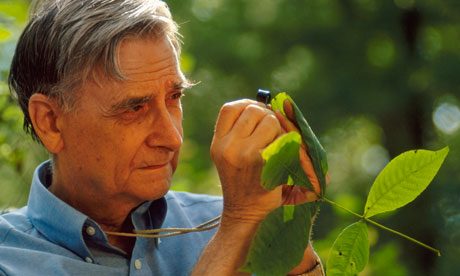
The religious impulse is to love and revere life – often represented as loving God, understood as the creator of life. Harvard biologist Edward O. Wilson offers a single word that sums up the impulse to love life and the healing and reconnection toward which that impulse leads: biophilia (love for life).

E. O. Wilson
The science of the 20th and 21st century includes a detailed description of the intricacy the interconnection of all things. And more than that: this science also gives us new material for describing our own yearning to be in connection. Wilson argues that evolution has built into us an affinity for life, biophilia:
“To explore and affiliate with life is a deep and complicated process in mental development. To an extent still undervalued in philosophy and religion, our existence depends on this propensity, our spirit is woven from it, hope rises on its currents.” (Wilson 1)
We are drawn toward life; we want it to be around us:
“Life of any kind is infinitely more interesting than almost any conceivable variety of inanimate matter.” (84)
This attraction toward living things is innate, wired into to us by millions of years of natural selection. It’s who we are, and we cannot build fulfilling and meaningful lives for ourselves – we cannot flourish – without a lot of life around: goldfish and houseplants at the least.
“We are in the fullest sense a biological species and will find little ultimate meaning apart from the remainder of life.” (Wilson 81)
Consider the way that humans, whatever their religious background, select habitat for themselves.
“For most of two million years human beings lived on the savannas of Africa, and subsequently those of Europe and Asia, vast, parklike grasslands dotted by groves and scattered trees.” (Wilson 109)
The right sort of habitat -- the habitat we were "made for" -- tells us about what is needed for human healing and reconnection. The savanna may not be the only spiritually wholesome habitat for humans, but it does contain these key features: wide open spaces affording a clear view for detecting animals and rival bands at long distance; a few cliffs, hillocks, and ridges which allowed still more distant surveillance and which provided overhangs and caves for shelter at night; scattered clumps of trees; lakes and rivers offering fish, mollusks, and new kinds of edible plants.

* * *
This is part 4 of 6 of "Soteriology: Biophilia"
Next: Part 5: "Small Islands"
Previous: Part 3: "Out from Under Over and Above"
Beginning: Part 1: "Drawing the Line"

2012-09-16

Out from Under Over and Above

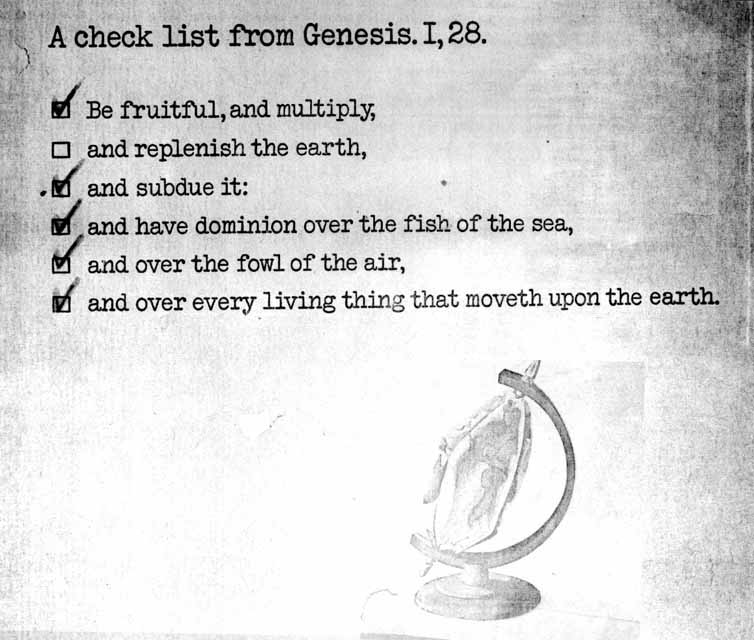
The part of our brain wired for what can be called “spiritual experience,” gives us a sense of our place in the web of life and the web of existence. Some religio-cultural traditions – like the historical Western religions – interpreted that feeling of place, of belonging, as meaning that we humans were on top: that we have dominion, are top dog, and all of nature is a bounty just for us. Genesis, chapter 1, tells us:
"God said, let us make man in our image, after our likeness, let them have dominion over the fish of the sea, and over the fowl of the air, and over the cattle, and over all the earth, and over every creeping thing that creepeth upon the earth. So God created man in his own image, in the image of God created he him; male and female created he them. And God blessed them, and God said unto them, Be fruitful, and multiply, and replenish the earth, and subdue it: and have dominion over the fish of the sea, and over the fowl of the air, and over every living thing that moveth upon the earth." (Gen. 1:26-28)
Darwin alone does not dislodge this habit of thinking of the human species as properly dominating all other species. Early Darwinists – and some people to this day who have no doubt about evolution as a force of nature – see evolution as aiming all along at producing humans.

(While evolution does tend toward complexity, it does not tend toward the human form of it. Moreover, it’s not clear how to measure complexity. For instance, while humans have the biggest brain-volume-to-body-mass ratio, dolphin brains have about as many total neurons and 40 percent more cerebral cortex than humans, part of which allows them to process sounds, as well as make sounds, much faster and in more detail than we can, so they can send and receive three-dimensional audio “images.” So are dolphins "more complex"? Hard to say. But whether humans count as the most complex kid on the block today, nothing’s to say that we – and the dolphins -- won’t, in the end, be surpassed by an even more complex species emerging from, say, descendents of the African gray parrot.)

On the one hand, we didn’t used to know that our lives are totally dependent upon bacteria – comparatively simple organisms. On the other hand, spiritual experience has always included a sense of humility. Given our ancient capacities and our recent knowledge, we can now say it is a good spiritual practice to remind ourselves that we are totally dependent upon bacteria for our very lives and sustenance. Knowledge gleaned from modern science is available to take on spiritual significance, if we let it.

Other religio-cultural traditions – like many Native American ones – interpreted our sense of place and belonging in nonhierarchical terms to begin with. For us westerners, modern science is at last correcting one particular mistake that certain nonwestern peoples never made. For westerners, it takes science, it seems, to help us understand that we are enmeshed in the web of life, and this web created us and sustains us. We have our role to play – just as every species does – in maintaining that web. In the web of interconnection, there truly is no "top," and no relation of "dominion."

Yet these teachings of science have not yet been very well or widely learned. In our culture, an inaccurate account of the self continues. We continue to find emphasis on a picture of
“the personal self in competition with and in opposition to nature. But if we destroy our environment, we are destroying what is in fact our larger self.” (Freya Matthews)
For modern westerners, the emergence of ecospirituality today is bringing together (a) our ancient and universal human capacity for spiritual response to the natural world around us, and (b) the descriptions of that nature only recently available to us through our science. This emergence, however, remains nascent for us. We are only beginning to come out from under the shadow of long cultural assumptions that the relationship between humans and the rest of nature is one of opposition and dominion or the attempt to dominate.

* * *
This is part 3 of 6 of "Soteriology: Biophilia"
Next: Part 4: "Soteriology and Biophilia"
Previous: Part 2: "Sacrifice"
Beginning: Part 1: "Drawing the Line"
2012-09-15

Sacrifice

Material things don’t make us happy. Within six months, at the longest, after even the most exciting material acquisition, a person's overall happiness is back to its baseline level. While we know that material things don't make us happy, it's also true that forcing ourselves to give them up before it feels right to do so won’t make us happy either. Mohandas Gandhi reminds us:
"No sacrifice is worth the name unless it is a joy. Sacrifice and a long face go ill together."
Many religious traditions recognize sacrifice as a spiritual practice. Our early ancestors noticed thousands of years ago that, while there is a certain satisfaction in acquiring things, it also, sometimes, feels good to give some of them up. Other times, the prospect of sacrificing doesn't feel so good -- in which case, as Gandhi cautions us, sacrifice isn't much good as a spiritual practice:
"Service which is rendered without joy helps neither the servant nor the served. As long as you derive inner help and comfort from anything, you should keep it. If you were to give it up in a mood of self-sacrifice or out of a stern sense of duty, you would continue to want it back, and that unsatisfied want would make trouble for you. Only give up a thing when you want some other condition so much that the thing no longer has any attraction for you."
Environmentalism runs into the question of sacrifice: what to give up, and how. This is a practical question (What will it take for human life on Earth to be sustainable?) as well as a spiritual one. Approaching it as spiritual may help us find and live with the practical answers.

Ecospirituality

Ecospirituality is the deliberate attention to those connections between the well-being of Morther Earth and our spiritual joy. It attunes us to hear the call to joy in our own path, however small our steps, toward better protecting this planet home of ours. It
“means that our experience of the divine comes through the natural world” (Jeanne Mackey).
Those who have been exploring this religion of nature, and have been developing a growing literature articulating it, are finding that the religion of nature is indeed the religion that is natural to us.
“The universe is the primary revelation of the divine, the primary scripture, the primary locus of divine-human communion” (Thomas Berry).
We can now discern a common basic wiring: a capacity for a certain kind of experience that we recognize as spiritual experience regardless of whatever cultural form it appears in, and for that experience to involve connection with nature. We’re also finding that a sense of contact with nature, with diversity of life forms, is an essential part of our health, whatever our religion.

Ecospirituality has pre-scientific and the post-scientific forms. At one level, ecospirituality doesn’t need science. It’s a transcultural imperative for any human and any time – before or after the scientific revolution. At another level, certain contents of our ecospirituality are available to us only recently, incorporating what modern science tells us about ecology, and the universe.

Humans have always looked to the natural universe. Only now do we have science’s sort of understanding of why we do so – and what it is we’re seeing when we look.

* * *
This is part 2 of 6 of "Soteriology: Biophilia"
Next: Part 3: "Out from Under Over and Above"
Previous: Part 1: "Drawing the Line"

2012-09-14

Drawing the Line

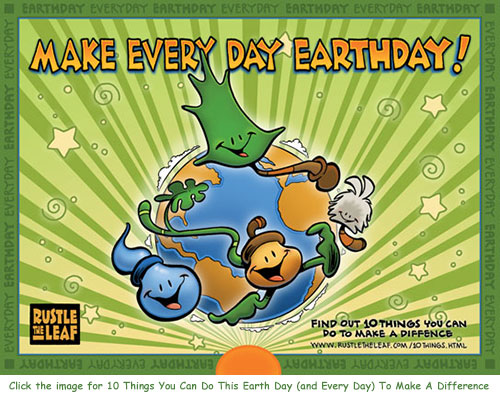
One hundred-thousand years, humans have been around as the species homo sapiens -- which makes us, as a species, very young. Still practically brand new. Our neighbors here in Florida, the alligators, have been around at least 100 times that long. This is a point made in a "Rustle the Leaf" comic strip.

Rustle the leaf and his acorn side-kick are talking as they look over a trash-despoiled wetland.

Acorn: “Stupid humans. “It’s like they have an obsession for trashing every corner of the planet.”

Rustle the Leaf: “Don’t be too hard on the human species. In geologic time, they’re just babies.”

Acorn ponders this, looks at the trash, and says: “How much longer ‘til they’re potty-trained?”

It would be nice to "grow up" -- or at least reach the stage of being potty-trained. But what exactly does that entail? How far do you and I need to go to be mature, responsible stewards of our planet home? The difficulty of the question was illustrated in another comic strip. A couple years ago my mother had a point to make about my environmental concerns and the actions I take out of that concern. She clipped out and mailed to me a Sunday comic strip of “Zits.”

Jeremy asks his friend, Pierce, “Why aren’t you wearing your boots today, Pierce?”

Pierce: “Can’t. I’m boycotting leather in support of animal rights.”

Jeremy: “Then couldn’t you just wear your sneakers?”

Pierce: “Nope. The rubber soles are made with petroleum-based plasticizers, and I’m against arctic drilling.”

Jeremy: “What about your wooden sandals?”

Pierce: “And support deforestation? Not likely. I’m an activist, Jeremy. I have to set an example to show others that there is a better way to live.”

In the last panel, we finally see Pierce’s footwear, as Jeremy says: “Hence, the tofu shoes.”

Pierce: “Teriyaki flavor. Want some?”

Sometimes the quest to do the right thing with our purchasing decisions can just seem silly.

I wrote back to Mom:
"It’s worse than that. Tofu is made from soybeans, and if the soybeans aren’t organic, there’s the harm of nitrogen-based fertilizers, and there’s pesticides. Even if it’s all organic, there may have been monoculture growing, without proper crop rotation and variation. Finally, even if you fix all that, there’s almost certainly some oppressed labor somewhere along the way. So, Mom, where do you draw the line? Do you so thoroughly trust your government as to figure that anything they haven’t outlawed has got to be morally and environmentally OK to participate in?”
She never answered. When I saw her some months later at Christmas, I asked her about it. "I assumed the question was rhetorical," she said.

I can imagine my children writing to me with that question: “Well, OK, Dad, where do you draw the line?” I don’t know if I’d answer either.

I am a vegetarian. Also, for the last dozen years all my clothes – all outerwear except socks – has come from second-hand thrift stores, and the occasional gift. I bicycle to work -- sometimes. So I draw the line somewhere north of supporting the environmental degradation of the meat industry and the labor oppression of the textile trade, at least directly. But I draw it somewhere south of driving a car, at least sometimes; flying in airplanes; using heating in the winter, air conditioning in the summer, and electric lights all year around; eating eggs and dairy (though I've cut way down); buying foods that are processed, packaged, and imported; and wearing shoes that aren’t even tofu.

I try to draw the line where it seems joyous to do so, where the gladness of simplicity calls. I urge you to use the same method for discerning where to draw the line -- though I expect your results from employing that method will differ from mine. Though the method of following where the spirit’s joy calls yields different results for different people, it is not an altogether easy method. "Follow your bliss" (as Joseph Campbell put it) is a rigorous path and a lot harder than, "Just do any old thing you happen to feel like."

* * *
This is part 1 of 6 of "Soteriology: Biophilia"
Next: Part 2: "Sacrifice"