Showing posts with label Desire. Show all posts

2012-09-09

To Have All You Want, Want All You Have

Noticing our desires, holding them in the gaze of attention, often softens their grip. Many times, they simply vanish.

I had a friend once who discovered one day that she thought it would be really cool to own a hummer – one of those tank-like vehicles that were unaccountably popular for a while. After a week of dragging her friends around to showrooms to gaze lovingly at these beasts, some of those friends were able, gently, to muse with her about where that desire was coming from. When she carefully examined it, it just vanished. Not all our desires will do that – and we wouldn’t want them to – but some of them will, and those are the ones for which we are better off if they do vanish.

Gaining liberation from the desires that don’t make our life better takes some time, some effort, some work. In the end, though, it will take less time, effort, and work, than pouring our lives into the desire treadmill that never satisfies.

As the philosopher William Irvine argues:
“If we like what the Zen Buddhists have to say about mastering desire, we might want to spend hours in silent meditation. If we like what the Amish say, we might want to join an Amish community (if they will have us). If we like what the Stoic philosophers say, we might want to spend time studying their writings. But having said this, I should add that the time and effort we spend trying to master desire are probably considerably less than the time and effort we will expend if we instead capitulate to our desires and spend our days, as so many people do, working incessantly to fulfill whatever desires float into our head.” (On Desire 8).
So what do you want? Your first thought might be, like the James Earl Jones character in Field of Dreams, to start listing off your frustrations. Occasionally, you are able to relax into enjoying a simple pleasure: “Oh. A dog and a beer.”

There’s another desire in there – so often buried under the constant scream of various other day-to-day desire – and that’s why, I think, we’re here, whether we quite consciously know it or not. We probably understand, cognitively, that the path to happiness, well-being, contentment is not to get what we want but to want what we have. To really do that, though -- to want all and only what one has -- is a rare thing. To perceive sacred mystery in what we have right here, to catch a whiff of the holiness of life, helps us get to that place of wanting just what we have.

Maybe you’re a single mom who had a particularly frazzled week. Your child had a sore throat this week, which made you late for work, where the boss scolded you, and you were so grumpy you started an argument with a secretary. Now it's the evening or weekend and you've found a few moments taking a look at Lake Chalice, maybe hoping for some tips or strategies for holding together the competing demands on your life. Or maybe you seek some spiritual entertainment to distract you from the insanity of your week.

What Lake Chalice would like to offer you, at the end of this five-part ramble through the terrain of human desire, is that life is shot through with sacred mystery. You might not be accustomed to hearing that your frazzled days of rush and frustration are holy, just as they are.

The best thing about desire is that it energizes us to engage with this wonderful, wonderful world. The worst thing about desire is that its constant screaming obscures from us the wonder of what we have.

Standing in the place of wonder, of love for just what is, a new and peaceful strength comes to us. Desires arise, then, and do not so instantly seize control, but await our assessment: Is that really going to make my life better? If so, OK. If not, let’s put that one on hold. To open to the presence of holiness all around us is our quietest, greatest, most important yet most easily ignored, desire.

Amen.

* * *
This is part 5 of 5 of "Desire!"

Previous: Part 4: "Your Inner Whining Child"
Beginning: Part 1: "Fields of Dreams, Streetcars of Desire"

2012-09-08

Your Inner Whining Child

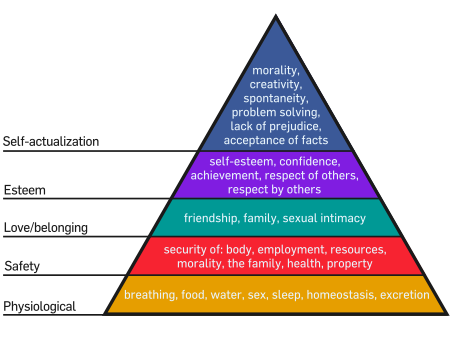
The psychologist Abraham Maslow developed a pyramid of human needs. At the base are physiological desires: breathing, food, water, sleep, sex, homeostasis. Next up are safety desires: security of body, resources, family, health, property. Third level are desires for love and belonging: friendship, family, intimacy. Fourth are desires for esteem: for confidence, achievement, the respect of others. And the top level is desire for self-actualization: the desire to be creative, accepting, nonprejudicial, serene.

Maslow’s idea was that we work on the lower-level desires first, and when those are met, we move up to pursue the next higher level of desire. But that can’t be quite right. Sleep, for example, is a first-level, basic physiological desire. Yet lots of us are sleep deprived – and we gave up sleep to put in longer hours at work to better meet those higher-level esteem needs. Some of us even give up sleep, food, comforts, security in order to pursue self-actualization desires to be creative, compassionate, and at peace. Experience seems to show that those desires at the top of Maslow’s pyramid do not, in fact, depend on the lower desires first being met.

You might say that the story of Siddhartha, who became the Buddha, fits the basic picture. He was a prince, grew up in luxury and high status, and, with those lower needs not occupying his worry, moved on to seek self-actualization. On the other hand, the story of Jesus, who became the Christ, is story of a person in poverty and very low status who turned to self-actualization without ever really nailing down those security desires. We also know that most people who are plenty wealthy enough to have the first four levels of need met do not move on to the kind of self-actualization that Jesus and Siddhartha did. So meeting the supposedly lower-level desires turns out to be neither necessary nor sufficient for pursuing the very highest-level desires.

Most of us do sacrifice a lot for status – for the admiration, respect, and even, if possible, the envy of other people. We work hard to project that image calculated to induce other people to think well of us. To finance all this image-projection, we might spend our adult life in a job we hate – pretending to love it, because, after all, it’s not very admirable to be stuck in a job you hate.

Arthur Schopenhauer, a 19th-century German philosopher, wrote that
“almost all our sufferings spring from having to do with other people.”
He adds that
“The [Greek philosophers known as the] Cynics renounced all private property in order to attain the bliss of having nothing to trouble them; and to renounce society with the same object is the wisest thing [one] can do.”
Our desires are like an ultra-headstrong five-year-old inside our psyche: a child who “never tires of whining, whose whining can’t be avoided” (Irvine). We are like the parents who give-in, who find that the only way life will be tolerable is to give the child what it wants most of the time. Good parenting, though, we know, while it does mean saying ‘yes,’ a lot, it also means standing fast on ‘no,’ sometimes – for the sake of the child’s and the family’s long-term good. And, often, it involves skillful negotiated substitution.
“No, you can’t have that candy bar now. You’ve already had one today. I want to respect that you are hungry. I hear that, and I share your concern about that. We do have fruit available. And, you may have another candy bar tomorrow.”
Or we bargain:
“Tell you what, if you’ll clean up your room and empty all the trashcans in the house, you can have the candy bar.”
Learning to wisely live with our desires is a lot like learning to wisely live with a demanding five-year-old. To get good at it means getting good at recognizing when indulging is unwise, and, in those cases, getting good at using substitution and bargaining.

For many adults, that whining inner child is whining for more success – which means recognition by others of accomplishment.
“Success is very much like a drug: it makes you feel good; you don’t know what your are missing until you experience it; once you experience it, you want more; and in your attempts to recapture that first high, you will have to resort to ever bigger ‘doses.’ And if success is like a drug, some drugs are like success: a cocaine high, [as I understand], very much resembles the rush of success.” (Irvine)
We are built to crave that drug of success: we are born to be addicted to it. Yet, it is a never-ending treadmill – and it never allows us to be satisfied, content with our life. We are hijacked by desires many of which will not improve our lives. Denying and repressing them just makes them stronger. Noticing and looking at them, though, weakens them. Many times, in the light of conscious attention, they simply vanish.

* * *
This is part 4 of 5 of "Desire!"

Next: Part 5: "To Have All You Want, Want All You Have"
Previous: Part 3: "Two Thought Experiments"
Beginning: Part 1: "Fields of Dreams, Streetcars of Desire"
2012-09-07

Two Thought Experiments

In moving toward simply bringing more consciousness and awareness to our own desires, notice just how much our social position is a huge part of what we want. To illustrate the power of our concern over social position, let me ask you to imagine this scenario:

You work in an office, and one day you
“receive an anonymous letter listing the salaries of the people in the office in which you work. Your salary listing is correct, but you notice that you are way down on the pay scale. In fact, people who have been there a shorter time and have less experience than you nevertheless draw a bigger salary. You are angry and depressed. You consider quitting. Then you notice that your co-workers are massed around a memo your boss has posted on the office bulletin board. According to the memo, someone, in order to stir up resentment at the workplace, has been sending people false salary listings. The person in question has apparently obtained the actual list of salaries to work from, since he always correctly gives the salary of the letter’s recipient, thereby adding an element of authenticity to his letter. To restore office harmony, the boss adds, he is posting this one time only a listing of everyone’s salaries. Your eyes turn to the listing in question. You find your own salary. And when you look at the salaries of your co-workers, you realize that compared to them, you are very highly paid. Your self-esteem soars. In fact, you take on a mildly condescending attitude toward your co-workers.” (William Irvine, On Desire)
It’s the same salary either way – but that same salary that was first made unsatisfying was then made very satisfying.

When we shine the light of consciousness on this desire for social rank, only then can we, maybe, begin to see through it. We have to notice how much we cared about it in order to begin moving toward not caring about it so much.

By doing that little thought experiment, you might find yourself saying, hey, it’s silly for me to care as much about my relative position in the office as I have. I will still care about it some, but not as much. I think I’ll pay more attention to just being glad I have enough.

For a second thought experiment, try this. Suppose you awoke tomorrow morning to find yourself the only human on Earth. Space aliens had spirited everyone else away, leaving only you. There are enough canned goods in the stores to ensure you a lifetime of plenty of food -- and the orchards will continue to bear fruit in season, and let’s say that electricity and plumbing somehow continue to work without people maintaining them. At the gas pump, you can swipe your credit card to dispense gasoline, but of course you never get the bill. You now, essentially, own everything. You can take any car, live in any house. You can stroll into the most expensive fashion boutiques and pick out any clothes. You can drive up to Washington, DC if you want to, get the Hope diamond out of the Smithsonian, and wear it around.

This could be you.
At first, perhaps, you might do some of these things: live in a palace, wear the most expensive clothing, a Rolex watch, sip the most expensive wines, drive around in an Italian sportscar or a Rolls Royce picking up the greatest art works from museums to hang in your palace. I think you’d fairly quickly tire of all this, though, don’t you? Before long you’d be back in a smaller house: cozier, easier to keep clean. You’d wear any old comfortable thing, or stroll around in pajamas all day. If that.

What this shows us, again, is how much impact other people have on our desires. We dress, choose a house, a car, a wristwatch with other people in mind. We spend large percentages of whatever we have to project an image calculated to gain the admiration of other people – or, better yet, their envy.

* * *
This is part 3 of 5 of "Desire!"

Next: Part 4: "Your Inner Whining Child"
Previous: Part 2: "First, Notice"
Beginning: Part 1: "Fields of Dreams, Streetcars of Desire"

2012-09-06

First, Notice

Desires that enhance reproductive success spread and grew -- and those are the desires we inherit, built into us. Thus we desire, for instance, status – because status gives access to healthier mates, more food, more protection, more assurance of healthy children to carry on our genes.

Here's our problem: restless, unsatisfied anxiety to always get more, to never be satisfied, facilitates reproduction better than being happy, content, and satisfied does. What a predicament! Where’s the hope for us?

Notice, however, that desires are always competing with each other. Does the organism go looking for food, or seek safety from some danger, or seek a mate? Once there are multiple options, then there are desires. Something has to determine whether the organism will seek food, safety, or a mate, and we name that something “desire.”

Desires are there to compete with each other to determine what will do. So if the food desire is shouting louder than the safety desire – because it’s been a while since the animal ate, and there are no signs of danger – then the animal will usually go about trying to rustle up some grub.

Your desire for another piece of pie competes with your desire to be trim and svelte. Your desire for job success – and the things that go with that – competes with your desire to sleep in on Monday morning. Because there are always competing desires, there’s hope for us for a kind of liberation. The desire that happens to be yelling the loudest doesn’t have to win. We can, if we work on it, bring thoughtful intentionality to our desires, and thereby reduce the attraction of the desire that happens to be loudest at a particular moment, and increase the influence of quieter desires.

Let's say a desire intrudes itself on me. "Pizza!" I can ask myself, "Where did that come from?" Or, somewhat more expensively, suppose I discover this desire: “I think I’d like to own an original Van Gogh.” I can turn the light of attention on the desire. I can explore where it might have come from.

The young Thomas Merton was, in his college years, a hard drinker who ran with a fast crowd and fathered a child out of wedlock. He was, in his own words,
“an extremely unpleasant sort of person – vain, self-centered, dissolute, weak, irresolute, undisciplined, sensual, obscene, and proud. I was a mess.”
Then, out of the blue, he felt a desire to convert to Catholicism. He took instruction, got baptized, and became a Catholic. Shortly thereafter, he got another spontaneous desire: to become a priest. He tried the Franciscans for a while. And then a third desire: to be a Trappist.

He didn’t know where the desire came from, but there it was: powerful, irresistible, clear. As William Irvine suggests, there is something very disturbing about Thomas Merton’s story.
“It raises the possibility that we are all just three spontaneous desires away from life in a Trappist Monastery.”
This could be you.
When it comes to making our peace with ourselves, making our peace with being creatures filled with desires imposed upon us and out of our control, the first step is noticing. Just step back and say: "Ah, there’s that desire." And bring a curiosity to it: "Where did you come from, desire? You are legitimate, I will not deny your presence or try to repress you. But maybe you need not be indulged, either."

In moving toward simply bringing more consciousness and awareness to our own desires, notice just how much our social position is a huge part of what we want.

* * *
This is part 2 of 5 of "Desire"

Next: Part 3: "Two Thought Experiments"
Previous: Part 1: "Fields of Dreams, Streetcars of Desire"

2012-09-05

Fields of Dreams, Streetcars of Desire

What is the role of DESIRE in your life? Or perhaps the question to ask is: Is there a role for anything else? Choose a set of desires and everything in life is determined from there. The thing is, we don't choose our desires. Desires just appear on their own.

What desires are grabbing hold of you these days? What do you want?

In the 1989 film, “Field of Dreams,” Kevin Costner goes to see the reclusive writer played by James Earl Jones. Jones tries to chase him away, but Costner prevails upon him to go to a baseball game. They’re at the game, standing in front of the concession stand.

Costner: “So what do you want?”
Jones: “I want them to stop looking to me for answers, begging me to speak again, write again, be a leader. I want them to start thinking for themselves. I want my privacy.”
Costner (pointing to the concession stand menu): “No, I mean, what do you WANT?”
Jones: “Oh. Dog and a beer.”

It’s wonderful to see Jones’ character relax into the present. There he was getting into his familiar wind-up about people, with the unreasonable things they do and want – these people this and those people that. What a relief it always is to set that aside -- to come back to: what’s right here. Why, it’s a baseball game, with concessions in the offing. There is nothing to want more complicated than, “dog and a beer.”

Desire seems to take us down the tracks that it wants, without our choosing. Can we ever get off of the streetcar named "desire" -- or do we only switch from one to another, without choosing the switch either?

The screen adaptation of Tennessee Williams' play, "A Streetcar Named Desire,” is best remembered for Marlon Brando's anguished cry of desire for connection and acceptance, calling out for his wife, "STELLAAAaaa!" Brando's character, Stanley Kowalski, had hit Stella, and Stella sought refuge in the neighbor’s upstairs apartment. Later, in remorse and desire, he cries after her.

We spend much (all?) of our lives riding on that streetcar named desire. There actually, incidently, was a streetcar line called the Desire Line in New Orleans. It ran from 1920 to 1948, when streetcars were at their height in that town. The route ran down Bourbon, through the Quarter, to Desire Street and back up to Canal. When Stella’s sister, Blanche Dubois, comes to visit the Kowalskis, she describes her route:
"They told me to take a streetcar named Desire, transfer to one called Cemeteries and ride six blocks and get off at — Elysian Fields!"
That particular route is fictitious, and will, as we learn more about Blanche, represent how Blanche’s ride on desire has led to her spiritual death – for desire leads to Cemeteries and Elysian Fields, the land of the dead in Greek mythology.

Desires pop into our heads, seemingly out of nowhere. We don’t choose our desires, we discover them. They just show up at the door, like Blanche Dubois with a big suitcase, ready to move in and start asking us to do their bidding.

And we do need them. We need desire. Desire, after all, is another word for caring about something. Desirelessness would be deep, paralyzing depression – not able to move because not able to want what moving could get. Evolution built us to want to find food, avoid predators, find a mate. Evolution made sugary foods feel good because it was better for us to eat fruit that was ripe. Fatty foods feel good because out on the Savannah 10 million years ago, we needed all the fat we could get. Making love feels good, and nurturing feels good, especially for young adult females, and chasing down game feels good, especially for young adult males, because evolution needed us to do those things – or, we might say more precisely and simply: the ones that did those things made more copies of themselves.

* * *
This is part 1 of 5 of "Desire."

Next: Part 2: "First, Notice"