Showing posts with label All Dried Up. Show all posts

2012-09-24

Well in Front Yard

The Well in the Front Yard
LoraKim and I have a well in our yard. We got our water from there for our first few years. A couple years ago, we agreed to let the city switch us over to the city system. The well is still functional – there’s an outdoor spigot next to it which we could attach a hose to if we wanted. As long as it’s functional, it needs periodic inspection.

Our well is in the front yard, but kinda hidden behind some plants. So when the inspector was due to come, LoraKim left a note on our front door to indicate where our well could be found.

I came home after a long day a couple weeks ago. I was tired – feeling a little dried up, you could say. I was reminding myself that I’ll feel better after I get some sleep. I got to my front door and saw the little sticky note.
“Well in front yard.”
"Oh, how nice," I thought. So I turned and walked out to the middle of the front yard and stood there for a few minutes with the cedar tree and the dogwood and sweetgum and several oaks and the rather irregular not-recently-mown grass beneath my feet.

And it was well in the front yard. With troubles all over this weary world, at home and abroad, it’s well in front yard.

We’ve never watered the yard, and it seems to be doing just fine, though I know that our yard would be entirely impermissible to the homeowners’ association of a lot of neighborhoods. I didn’t have to stand there long before mosquitoes started to find me. And that was well, too. Just fine, really.

I walked around my house in the darkening dusk and stood for a minute in the backyard with the hickory, the maple, the magnolia, and more sweetgums and oaks, the grass even more irregular, and a big gopher-tortoise hole. You know what I found out? Turns out it’s also well in the back yard.

I thought: maybe I’ll put these sticky notes all over, wherever I go. On the steering wheel: "Well in car." At the office: "Well in office." "All’s well at the computer." On my pillow at night: "All’s well here." On the breakfast cereal box: "Contents well." On my shoe: "All’s well down here."

When I came inside, re-moistened, I told LoraKim: “It’s also well in the backyard.” She stared at me blankly for a few seconds, then started laughing. And I laughed, too.

Things are pretty well if I’m paying attention.

May it be well in your front yard. May that well be a fount of every blessing.
May we have peace . . .
Like a river.
May we have joy . . .
Like a fountain.
And may we have love . . .
Like an ocean.

Amen.

* * *
This is part 5 of 5 of "All Dried Up."

Previous: Part 4: "We Can Do This"
Beginning: Part 1: "Flow Like Water"

2012-09-23

We Can Do This

We can do this. We can "go blue" just as we learned to "go green" (or at least embrace the concept of going green). Being responsibly blue is actually considerably simpler and easier than being responsibly green. "Green" involves a never-ending wrestling with how much we're willing to sacrifice to reduce our ecological footprint for the sake of making a miniscule difference to the planet -- meanwhile atmospheric CO2 levels continue to rise. "Blue" involves some clearly do-able steps -- in a context in which per capita water usage rates are already dropping.

We can stop watering our lawns.
"Florida households - especially those with automatic irrigation systems, which are increasingly common - use up to 75 percent of their water outdoors." (New York Times, 2007)
Yesterday's Lake Chalice quoted Cynthia Barnet saying, "more than half of all home water use in the United States goes to greening lawns and gardens." Barnett was citing a 2003 EPA study. The EPA's web site today ("last updated 2012 Feb 8") indicates household outdoor water use has declined: "Nationally, outdoor water use accounts for 30 percent of household use." It wouldn't be hard for Florida to do as well as the national average -- after all, it's the dry Western states that normally expend the higher percentages of household water on their lawns and gardens. A little bit of urgency, which hasn't quite taken hold yet in Florida, can go a long way.

We can stop flushing so much away. Half of all water treated to meet federal EPA standards for drinking goes down the toilet. The average person flushes five times a day. That’s water that doesn’t need to meet drinking water standards, and we can get lower-flush toilets, and we can learn to flush only when it’s more necessary.

US golf courses used 2.1 billion gallons a day in 2006. Especially down in southwest Florida, golf is huge. In a 2002, report the Florida Department of Environmental Protection projected that by 2020 farmers will no longer be the biggest water users in southwest Florida – golf courses there will be using more. (Barnett 40). But in the 10 years since then, a lot of golf courses have started finding ways to use a lot less water. Strains of grass that aren’t quite as green take a lot less water and bounce golf balls just as well. Golf courses can choose to irrigate less and use recycled water when they do.

This is all pretty do-able.

Of course, some people will get the blue ethic as they got the green ethic, and others won’t. Some of us will start to pay attention to what we’re doing more or less on our own, and others won’t. Pricing tends to get attention when other appeals won’t. Charge more per gallon after a certain minimum per household, then add progressively steeper surcharges for excessive water consumption. Charge more per gallon during peak demand periods of the day, and during seasons when conservation is especially needed. Water is now priced well below what it is truly costing us and our earth. With extra water revenues we can replace and repair leaky water infrastructures, retrofit houses with low-flow plumbing fixtures, and subsidize xeriscaping.

The lesson that water has always been offering us – the lesson that is now ecologically more important than ever – is: pay attention to the flow. Use mindfully, and we’ll naturally use less. Some real estate developers will ignore the call to a more caring, careful, and care-ful relation with aqueous reality. They are like Don Quixote and will likely continue to pour their energy into maintaining a delusion -- in their case, the delusion of unrestricted growth.

When the inner life is dry, we’re more prone to fall into practices that dry up our outer world. We won’t change those developers – we can only change ourselves, and maybe get a majority to elect more water-mindful leaders.

Notice the flow – within and without. Notice the resistances, within and without, that direct the flow. When the heart is a smoothly flowing river, we can help the outer literal rivers flow more smoothly and copiously. And, in a positive feedback loop, when the water flows more freely in the outer world, so do our hearts flow more freely. Cynthia Barnett wrote:
“From coast to coast, Americans have lost touch with their water. In California, the San Joaquin River no longer makes it to San Francisco Bay. In Florida, children no longer swim in Crystal Springs because of a water-bottling operation. This loss has consequences far beyond stress of aesthetics. It is a matter, as Theodore Roosevelt foretold, of our national heartiness, our fitness and vitality as a society.... Draining the water drained Florida’s cultural identity, and it is no exaggeration to say, the spirit of its people.” (Barnett 191, 189)
This is all reversible. The spirit returns to the people when our hearts water our world with mindfulness. The living tradition we share draws on sources that include instruction to live in harmony with the rhythms of nature: connect better with ourselves, and with our planet as ourselves. We can do this.

* * *
This is part 4 of 5 of "All Dried Up"

Previous: Part 3: "Mind the Flow"
Beginning: Part 1: "Flow Like Water"

2012-09-22

Mind the Flow

Mind the flow. That goes for the metaphorical waters of our spiritual lives as well as for our social and ecological responsibility. The ease and cheapness with which a flick of a faucet gives us water on demand might lull is away from mindfulness of where it comes from.

Americans use more water than any other culture in the world, much to quench what’s now our largest crop—the lawn.
“Each of us uses about 90 gallons of drinking water a day at home; each household about 107,000 gallons of water a year....More than half of all home water use in the United States goes to greening lawns and gardens.” (Cynthia Barnett, Mirage 32)
Here in Florida, the New York Times reported a few years ago, the average Florida household uses 75 percent of its total water use outdoors. About 14 percent of average household water use is never used at all. It leaks out of our pipes.

Mostly our water use is not mindful. Most Americans cannot name the river or aquifer that flows to our taps, irrigates our food, and produces our electricity. And most don’t realize these freshwater sources are in deep trouble. The lesson here, as everywhere in life, is look at the flow. Where’s it coming from? Where’s it going? Be curious. Investigate. There is an issue here.

We have a planet covered in water. It is the most widely occurring substance on Earth by far. Moreover, we don’t destroy it by using it – it just flows through. So how could there be an issue? 97.5 percent of the planets water is saltwater. Only 2.5 percent is fresh. And two-thirds of the fresh water is trapped in glaciers and permanent snow cover. So less than 1 percent of the world’s water is available for human use (Barnett 42).

That’s still a lot of water.

Yet, worldwide, 9,500 children die every day because of lack of clean water. It’s not that they’re absolutely dehydrating, but they aren’t able to fight off various diseases because they don’t have enough potable water flowing through. By 2025, the number of people without access to freshwater is expected to exceed 2.6 billion.

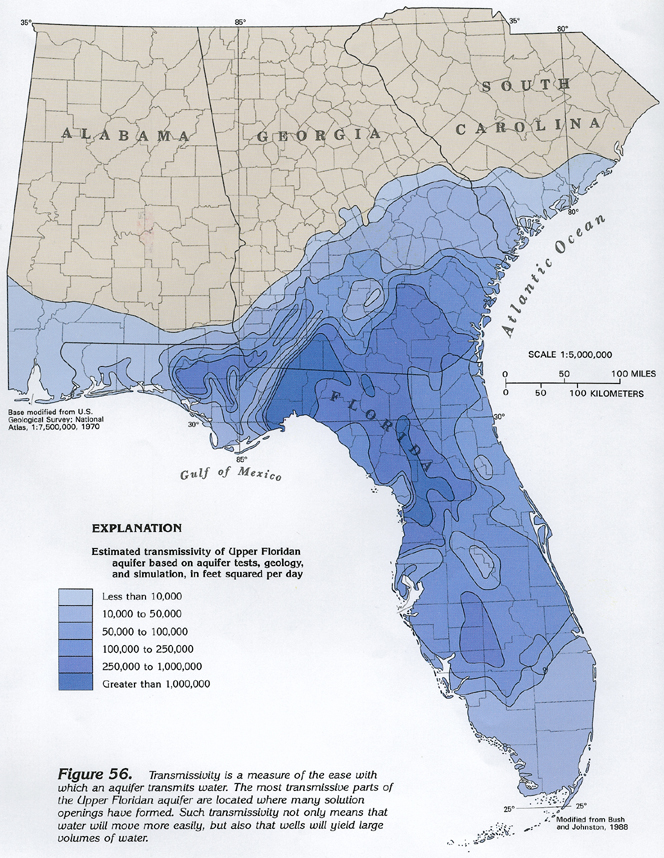
More locally, the Floridan aquifer, as many of you know, lies underneath all of Florida and southern parts of Georgia, South Carolina, and Alabama. Not all of Florida draws on the Floridan aquifer – but a lot of the state does, including Gainesville, Daytona, Flagler Beach, Tampa, Jacksonville, Ocala, Orlando, St. Petersburg, Tallahassee, several municipalities in South Florida, and numerous rural communities. Aquifer depletion is a problem. Long, long before our usage would drain the aquifer dry, the reduced levels will draw in salt water from the ocean. So we're not talking about "when will it go dry?" We're talking about, "When will it become undrinkable" -- and that'll happen a lot sooner than going dry would.

The actual level does drop some, in some places, which increases the risk of sinkholes swallowing our homes.

Global clean water issues will take a concerted attention by the world’s governments. US water shortages, however – especially in the Eastern half of the United States – are not that hard to come to grips with. It mostly takes paying attention – which we haven’t much tended to do.

We have people who are very concerned about global warming and CO2 and the harms of oil drilling, and they’re willing to pay $30,000 for a Prius – a hybrid car to get really great gas mileage and cut down on those environmental impacts. And then they’re washing it once a week in the driveway next to their very green and well-watered lawn.

If we pay attention, it’s not so hard to conserve water. In fact, nationally,
“average per capita water use in 2000 was lower than it had been since the 1950s. And total freshwater withdrawals in 2000 were less than in 1975 despite population growth” (Barnett 33)
We can do this. We can learn to pay attention to being blue the same way we have learned to pay attention being green. Many of us, evidently, have already begun.

* * *
This is part 3 of 5 of "All Dried Up"
Next: Part 4: "We Can Do This"
Previous: Part 2: "Don Quixote's Path of Least Resistance"
Beginning: Part 1: "Flow Like Water"

2012-09-21

Don Quixote's Path of Least Resistance

Water images and metaphor are especially emphasized in the Chinese tradition called Daoism (or "Taoism"). Alan Watts’ last book before he died was: Tao: The Watercourse Way. Daoism teaches that
“the great Dao flows everywhere, to the left and to the right. It loves and nourishes all things, but does not lord it over them.” (Dao De Jing, ch. 34)
You have, no doubt, heard that water always follows the path of least resistance. The teaching here isn’t so much that you should follow the path of least resistance -- that you should change yourself so to avoid as much resistance as you can. Rather, the teaching is: we always do follow the path of least resistance – as inevitably and unavoidably as water does. If you think you’re taking a path of greater resistance by heading right over that boulder instead of under and around it, it’s only because there are bigger boulders, or the banks of a ravine that are directing you that way. So ask yourself: what are those resistances, internal or external, that are directing your path?

Even Don Quixote – the fictional character of Cervantes’ novels -- is taking the path of least resistance if we take into account all the resistances at work.

Don Quixote has been a dear friend of mine for many years, and I have slowly learned that, well, he’s crazy. When I was in eighth-grade, my favorite teacher, Mr. Benson, a young man I looked up to as a role model, taught English and drama. That year I was in eighth-grade, Mr. Benson played Don Quixote in a local production of “Man of La Mancha.” I loved it. I went to see him in it twice, I bought the soundtrack album and memorized all the songs. I loved Don Quixote. "Dream the impossible dream." Yes! "Fight the unbeatable foe; right the unrightable wrong; reach the unreachable star." That’s what I wanted to do. “Love pure and chaste from afar.” How noble! (Of course, when you’re a thirteen-year-old pimply-nerdy-awkward kid, that’s pretty much your only option.)

The good Don is still with me – a companion voice I carry around – though I am not as smitten with him as I was. Quixote believes he is nobly taking on the path of most resistance -- fighting against “the system,” the establishment, City Hall, dreaming that impossible dream, refusing the quiescent, easy, submissive path. Quixote is able to believe that because he isn’t very self-aware. He has fixated on certain conceptions of nobility and principle, and he’s very attached to those conceptions, and rejects every part of himself that doesn’t fit his predetermined picture. He’s at war with himself, and in the name of his conceptions he’s ready to fight, vanquish, slay. He has erected huge inflexible banks of a story about what nobility and principle are, and he’s prepared to kill in compliance with their dictates. He’s not avoiding a path of least resistance; rather, he’s following the path of least resistance, given those huge resistances at work in him. He’s not mindfully attending to what’s there, but pouring all his energy into sustaining his delusion. "His brain," writes Cervantes, "dried up."

The lesson of water is not: change yourself so as to take the path of least resistance. The lesson is: you already do so, so notice what the resistances are that are directing you on the path you’re on. Look at them with openness and curiosity: what’s at work here? Where did that come from?

When we gain a greater self-awareness of our resistances, some of them soften up a bit. New paths start to open for us because we aren’t so fixated on our prior conceptions. It starts to feel freer, more able to be fluidly creative in the moment – life begins to feel less like white water through a narrow gorge and more like a smoothly flowing river.

On the social and ecological level, we confront the same need – the need for awareness of the flow. We turn on the faucet and out gushes water, for less than a penny a gallon. Where is it coming from, guided by the resistance of various pipes to flow from our spigot?

* * *
This is part 2 of 5 of "All Dried Up."
Next: Part 3: "Mind the Flow"
Previous: Part 1: "Flow Like Water"

2012-09-20

Flow Like Water

About a year and a half ago, I preached a sermon titled “Render Unto.” Some Lake Chalice readers may remember it. I was invoking the saying of Jesus,
“Render unto Ceasar the things that are Ceasar’s, and unto God the things that are God’s.”
Our sign out front each week gives the service title, followed by the speaker, so what the sign said all that week was: “Render Unto Rev Garmon.” Which, of course, was not what we meant.

This week the sign out front said, “All dried up, Rev. Garmon.” I actually did get one call of concern.

"Are you saying you’re all dried up, Meredith?" the caller asked.

I said, no, I’m just going to be talking about the water supply situation. As for me, well, I’m no more dried up than I ever have been. It’s not about me. What it’s about is the flow. When it comes to flow, physically and spiritually, water is our paradigm.

Water is the source from which all life springs. We require the constant flow of water into us, through us, and out. It’s not the stuff itself that is the issue so much as the flow of it. Water is not like, for instance, oil – the using of which breaks apart the chemical compound so the stuff doesn’t exist anymore. Water, pretty much, is neither created or destroyed, it just circulates. When we speak of running out of it, or the threat or possibility of running out of it, we are speaking loosely because there’s always as much water as there ever has been – it just circulates into different places for a while. And that can certainly be a problem for us when the parts of the earth that we're used to having a lot of water stop having so much and become all dried. When that happens, the water hasn't ceased to exist. It's moved somewhere else.

It isn’t quantity that is the issue, but motion and flow. In this regard water is a metaphor for our life. In so many ways we are prone to think in terms of “having” and “not having” – gaining, acquiring, possessing, holding. What have I got? What have you got? What am I trying to get? Having it, how do I hold on to it? Water doesn’t work that way. There is no holding it. It has to flow. Our bodies need to lose water every bit as much as they need to take it in. What we need is a couple liters a day or so, under normal conditions, flowing through us.

The first spiritual lesson is air, which also must flow through and cannot stay. The very word “spirit” comes from the word “breath” – hence “re-spir-ation.” Cut off that flow, and most of us pass out within a couple minutes. It’s a very immediate, constant teacher that life isn’t about having, but about passing through.

Water repeats that lesson for us at a different rhythm. Cut off the water flow, and we’re in trouble in a couple days or so rather than a couple minutes or so.

One of the six sources upon which Unitarian Universalism explicitly draws is:
“Spiritual teachings of earth-centered traditions which celebrate the sacred circle of life and instruct us to live in harmony with the rhythms of nature”
I invite you to notice the two most basic rhythms of nature: the air flow and the water flow.

There’s a subtle shift in orientation when I’m attuned to the flow through, rather than the grasping and holding. When I'm attuned to the flow, life feels moist, juicy, and flourishing. When I'm attuned to grasping and holding onto what I've got, life feels dried up, brittle, and unfertile even in the midst of bounteous flow of everything I need.

* * *
This is part 1 of 5 of "All Dried Up"
Next: Part 2: "Don Quixote's Path of Least Resistance"