Showing posts with label Theodicy: Addressing Evil. Show all posts

2012-07-19

The Wound that Cuts Through Every Human Heart

Primary sociopaths. Secondary sociopaths. What about you and me (assuming neither of us is sociopathic)?

Aleksandr Solzhenitsyn said:
"If only there were evil people somewhere insidiously committing evil deeds, and it were necessary only to separate them from the rest of us and destroy them. But the line dividing good and evil cuts through the heart of every human being. And who is willing to destroy a piece of his own heart?"
Again with the evil-and-must-be-destroyed idea! Still, there's an important point here. If we drop the concept "evil" and replace it with "sociopath," the implication (an implication which yesterday's Lake Chalice fostered and which today we shall seek to correct) is that we need only make appropriate arrangements for dealing with sociopaths. Yet there is something -- something that Solzhenitsyn calls "evil" -- which "cuts through the heart of every human being." If we seek a liberal theology of theodicy, then an understanding of sociopathy, however accurate and compelling, is incomplete. We must also name the tendency to unmindfulness to which all flesh (and spirit) is heir.

Scott Peck's book on evil -- People of the Lie: The Hope for Healing Human Evil -- speaks of the opposite of "evil" as mental health. His notion of mental health seems to me to encompass spiritual health as well. He defines mental health as:
“an ongoing process of dedication to reality at all costs.”
Peck
We are ever called to an ongoing process of dedication to reality at all costs. The reality to which we are called to dedicate ourselves is that we are interconnected, all made up of the same stuff. Dedication to that reality means practicing to keep that truth ever before us. The people for whom Peck uses the word "evil" are people who obscure from themselves, in one way or another, a clear view of reality. And that tendency to obscure reality from ourselves does, as Solzhenitsyn put it, cut through the heart of every one of us.

As I read the case studies that Scott Peck presented, I noticed that the people he called "evil" were deficient in two connected and overlapping areas in their way of relating to other people. They lacked sincere gratitude, and lacked any clear sense of personal responsibility. When things go well, the patients Peck describes seem to believe they did it all themselves. And when things go awry, it’s always someone else’s fault. These patients, as I see them, are suffering from a sense of division. They feel separated from the world, they have a definite divide between an always-virtuous “me,” and an often-thwarting “out there.”

I believe that the very act of calling them evil perpetuates exactly the same false divide. Buddhists say “drop those attachments that are distorting your perception – and see things exactly as they are.” This isn’t easy. It is, just as Peck says, an ongoing process of dedication to reality at all costs. With that dedication to wholeness comes gratitude and humility -- the salve (thence, salv-ation) for healing that wound cutting through every human heart.
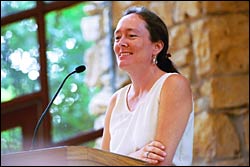
Morn, in Nashville
If we drop the concept evil, it doesn’t mean that harmful actions disappear. We have to respond to actions that harm, whether those actions result from intent or from negligence. Our response must include:
“mindfulness concerning the ways we ourselves and those around us dehumanize others, perpetuate evil by categorizing others as less than human.” (Rev. Mary Katherine Morn, who was once my minister, back in Nashville, TN)
We cannot stand for spiritual wholeness while demonizing those who lack realization of that wholeness. We must celebrate and be aware. Celebrate the whole of creation. Be aware of the constantly surrounding beauty and love, and cultivate gratitude and humility.

We must do this. Whatever else we may do to respond to that which would negate celebration and awareness, we must also do this: celebrate the whole of creation, and be aware of the constantly surrounding beauty and awe.

Amen.

* * *
This part 6 of 6 of "Theodicy: Addressing Evil"
Previous: Part 5: "Answer Evil with Justice and Community"
Beginning: Part 1: "The Evil Thought-Stopper"

2012-07-18

Answer Evil with Justice and Community

Assuming we can avoid the "evil-and-must-be-destroyed" mindset, what is the best response to sociopaths?

For primary sociopaths, as part of the genetic package that equips them to occupy the niche in our world that they do, along with an inability to have the “social emotions that normally contribute to behavioral motivation and inhibition,” they also are “high on novelty-seeking, low on harm-avoidance, and low on reward-dependence.” They’re thrill-seekers – looking for high levels of physiological arousal – perhaps because that’s the only way to feel alive in a reality where they can’t pick up on anybody’s feelings but their own. You put all that together, and you can see where the Charles Mansons and the Jeffrey Dahmers come from.

Primary sociopaths can’t empathize, but they can reason. They can calculate their own self-interest. Suggests sociologist Linda Mealey:
"The appropriate social response is to modify the criminal justice system in ways that increase the costs of antisocial behavior, while simultaneously creating alternatives to crime which could satisfy the psychopysiological arousal needs.” (Mealey, L. [1995]. The sociobiology of sociopathy: An integrated evolutionary model. Behavioral and Brain Sciences 18 [3]: 523-599. See here.)
When we say increase the costs of antisocial behavior, remember that research indicates that increasing the probability of being caught is the primary deterrent. Increasing the severity of the punishment itself does almost nothing. When we speak of alternatives that could satisfy the psychophysiological arousal needs, we’re talking about finding these people appropriate jobs. They don’t empathize, but they often get quite good at pretending to, so they can make good novelists, screenplay writers, talk-show hosts, and disk jockeys.

randomly chosen talk-show host
Sociopaths also seek high levels of excitement, so they can make good stunt men, explorers, race-car drivers, and sky-diving exhibitionists.

Let’s find a way to use the gifts they have, instead of labeling them evil. Find a productive use for them, and they won’t have to use destructive outlets.

The secondary sociopaths call for a different strategy. Here we can aim to reduce the carrying capacity of the “cheater” niche. For secondary sociopaths:
“The appropriate social response is to implement programs which reduce social stratification, anonymity, and competition, intervene in high-risk settings with specialized parent education and support; and increase the availability of rewarding, prosocial opportunities for at-risk youth.” (Mealey)
In other words, we need justice, we need community, we need cooperation-fostering frameworks, we need education, and fair opportunity.

We don’t need the word or the concept, “evil.”

There’s also a spiritual reason for dropping the concept. When I invoke the concept “evil,” I draw a line, and put myself on one side – because no one ever thinks they themselves are evil – and some other part of creation on the other side. It divides the whole, and what our spirits long for is connection with the whole: all of creation, the earth, the stars, and the grasses, and the rivers – including the water bugs that dissolve frog innards, and people who vote differently from us, and even sociopaths, and Charles Manson and Jeffrey Dahmer. Our spirits long to be made whole.

Ultimately, as an early Taoist text says, “life and death are one, right and wrong are the same.” The same. Seeing this frees one from handicaps and fetters. With spiritual healing we perceive the vast whole as deeply good, and every part of creation is an integral and necessary part.

* * *
This is part 5 of 6 of "Theodicy: Addressing Evil"
Next: Part 6: "The Wound that Cuts Through Every Human Heart"
Previous: Part 4: "Primary Sociopaths and Secondary Sociopaths"
Beginning: Part 1: "The Evil Thought-Stopper"

2012-07-17

Primary Sociopaths and Secondary Sociopaths

The social evolution of humankind has been a gradual process of working out social arrangements to allow us to escape from the prisoner's dilemma created when each of us is on our own to pursue our own self-interest -- social arrangements, that is, that allow for greater and greater levels of cooperation. Setting up a police force and a legal system, for example, is one step toward working out the conundrum. Establishing outside enforcement allows us to make contracts with some reassurance that we aren’t being suckered: there’s a system to enforce compliance.

In human evolutionary history, it turns out that about 2 percent of us will find noncooperation a viable strategy. There’s a social contract, and these are the people who cheat on the social contract. Around 2 percent. This is what research indicates is the equilibrium point. About two percent is usually the carrying capacity of the “cheater” niche in our social ecology. If the number of cheaters falls to much less than 2 percent, then the rest of us get very trusting and naïve, and we become a population ripe for con men and various ne’er-do-wells to have a field day with us, running roughshod over our trusting ways. In such a context, being a noncooperator has a high pay-off, which breeds more noncooperators. As the number of noncooperators goes up, the rest of us become increasingly aware of the threat. We put up our guard; we put energy into protecting ourselves from scams, and catching and prosecuting criminals. Then the benefit-to-risk balance doesn't favor noncooperation so much, and the number drops again. It settles into an equilibrium.

I’m not so much talking about modern society, but across the millions of years of human evolution, there tends toward an equilibrium at around 2 percent of the population noncooperating – that is, being sociopaths. And if sociopathy is your strategy, then it helps you carry out that strategy if you are genetically unable to empathize.

The reason we have sociopaths is that for millions of years that niche has been there for a small percent of the human population – a niche where anti-social behavior is a successful strategy for staying alive and having offspring. As a result, the human genome produces a small percentage of folks genetically equipped to occupy that niche. These are the “primary sociopaths” -- born genetically unable to empathize. They can feel the basic emotions – such as anger, fear, sadness, disgust, surprise, joy, acceptance, and anticipation – but cannot feel what are called the social emotions. They don’t experience love, or guilt, or shame, or remorse.

Linda Mealey,
1955 - 2002
The genetic tendency to sociopathy is normally distributed – it’s not a simple on-off switch, all-or-nothing. Next to the primary sociopaths on the bell curve are people who might or might not fall into the sociopath strategy, depending on whether the environment teaches them that’s their best bet. These are the “secondary sociopaths.”
“Secondary sociopaths are not as gentically predisposed to their behavior; rather, they are more responsive to environmental cues and risk factors, becoming sociopathic ‘phenocopies’ or ‘mimics’ when the carrying capacity of the ‘cheater’ niche grows.” (Sociologist Linda Mealey. See here.)
We could call these people evil – implying that there’s an imperative to destroy them. But once we understand sociopathy, we can begin seeing other alternatives.

* * * * *
This is part 4 of 6 of "Theodicy: Addressing Evil"
Next: Part 5: "Answer Evil with Justice and Community"
Previous: Part 3: "From Evil to Sociopathy"
Beginning: Part 1: "The Evil Thought-Stopper"

2012-07-15

From Evil to Sociopathy

If we just dropped the concept, "evil," what would replace it?

"Biotheology" explores ways that biology and evolution and science can shed light on the traditional issues and questions of theology. A biotheology of theodicy looks to biology and medicine to shed light on human proclivities for doing harm. Of the conceptual space occupied by "evil," the largest area could be replaced with “anti-social behavior.”

According to the Diagnostic and Statistical Manual of Mental Disorders (DSM IV), the standard reference work in the mental health field, sociopathy is a pervasive pattern of disregard for and violation of the rights of others as indicated by any three or more of the following seven:
  • failure to conform to social norms with respect to lawful behaviors as indicated by repeatedly performing acts that are grounds for arrest;
  • deceitfulness, as indicated by repeated lying, use of aliases, or conning others for personal profit or pleasure;
  • impulsivity or failure to plan ahead;
  • irritability and aggressiveness, as indicated by repeated physical fights or assaults;
  • reckless disregard for safety of self or others;
  • consistent irresponsibility, as indicated by repeated failure to sustain steady work or honor financial obligations;
  • lack of remorse, as indicated by being indifferent to or rationalizing having hurt, mistreated, or stolen from another.
I think we do wrong if we fail to try to understand. This is not a matter of justifying harmful behaviors. It’s a matter of seeing what’s really going on so that we can make some response more effective than a blind urge to destroy.

Why are there sociopaths? There are sociopaths because sociopathy is and has been a successful strategy for a certain percent of the population -- i.e., there's a niche for the sociopath in the ecology of human society. It takes a lot of empathetic skill for the cooperation and coordination it takes to develop, design, build, and fuel a truck. But once it's built, there's space for a "free rider" to hop on. That's the sociopath's niche.

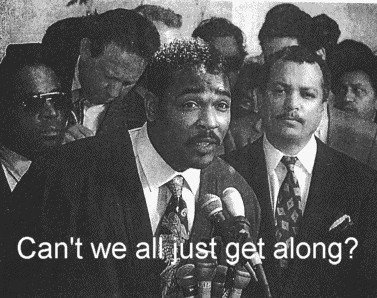
To unpack this a bit, let us put to ourselves the question Rodney King asked: "Can’t we all just get along?"

The answer, Rodney, is that we don’t want to get taken advantage of. Throughout our dealings with one another, we constantly face what are called prisoner’s dilemma situations. The classic prisoner’s dilemma gets its name from a scenario in which two prisoners, captured after being in cahoots with each other on some crime, are in separate rooms, each faced with deciding whether to keep mum or turn state’s evidence and rat on their partner. Betraying their partner is in their self-interest, but if they each betray the other, they’ll both be convicted. The overall benefit to the two prisoners combined is highest when they both keep mum – but if one goes out on a limb (keeps mum) for the other, and the other turns state's evidence, then the one who kept mum gets the maximum sentence while the fink gets off scot-free. The strategy of each pursuing their self-interest leads them to an outcome which is not in their self interest.

The social world presents us with analogous situations: we’ll all be better off if we cooperate with each other, but often we’re rightfully hesitant to cooperate because we can be taken advantage of, suckered, conned, exploited.

Why can’t we all just get along? Because we’re trapped in this prisoners’ dilemma.

Cooperation is inherently difficult and risky. Yet proto-humans and humans have been slowly developing ways to provide us with the protections we need in order to cooperate. As our cooperation has grown more extensive and elaborate, we inevitably created space for the free riders and "cheaters on the social contract."

* * *
This is part 3 of 6 of "Theodicy: Addressing Evil"
Next: Part 4: "Primary Sociopaths and Secondary Sociopaths"
Previous: Part 2: "Evil and Must Be Destroyed"
Beginning: Part 1: "The Evil Thought-Stopper"

2012-07-13

Evil and Must Be Destroyed

Sometimes people cause harm to other people. Sometimes we do so in truly horrible ways. Why do we do it? Do we do it because some – or maybe all – of us are evil?

That answer stops further inquiry. So I'm going to say I think we could get along better without the concept "evil." The concept does more harm than good. That’s not the same thing as saying I think there’s no such thing as evil. Both affirming a concept’s instantiation, and denying it, are ways of holding on to the concept. I’m saying this particular concept – evil – can just be dropped.

If we call some one "evil," we have dismissed that person. We’ve given ourselves something that feels like an explanation. It actually explains nothing at all, but because we have the illusion of explanation, it can serve to stop us from digging further into the matter. In fact, any further exploration of the matter can be met with outright hostility: "you’re not justifying what they do are you? They’re evil, end of story, nothing further to understand!"

"Evil" has become a word we use when we have become afraid of understanding. When we hate something so much that we become afraid that if we understood it, we wouldn’t be able to hate it anymore, then we call it "evil." Calling it evil is a strategy designed to prevent understanding, so that the hatred we covet will not be threatened.

If something is evil, it is not to be understood -- it is only to be destroyed. In fact, the word “evil,” and the phrase “must be destroyed” go together. “It is evil and must be destroyed,” was once the stuff of Saturday morning cartoon dialog.

In the 1989 film, Steel Magnolias, Ouiser (Shirley Maclaine) rebukes her friend Clairee (Olympia Dukakis), and tells her, “you are evil and must be destroyed.” It was a funny line. Since then a lot of things have been designated as “evil and must be destroyed.”

Interested in the popular culture’s tendency to link the concept evil with an imperative to destroy, I turned to my trusty internet search engine, and typed in the phrase “evil and must be destroyed.” I read the claim that 40% of the population believes that liberals are evil and must be destroyed. On a Star Wars blog, I read that the Sith are evil and must be destroyed. On historyexplained.org, we read that the United States has historically, in effect, insisted that dictators are evil and must be destroyed. On a web site devoted to a recently popular TV show about a vampire slayer, I read: “Buffy’s new roommate irons her jeans. Clearly she is evil and must be destroyed.”

Evil and must be destroyed?
Cincinnati, the font Papyrus, bacon-wrapped jalapeno thingies, sweet popcorn, the University of Wisconsin at Milwaukee, the handvac, the mainstream media, Newt Gingrich, Lady Gaga, dogs, cats, wasps, inheritance, derivatives, emulators, cartels, college football’s Bowl Champion Series, and everyone who isn’t part of Glenn Beck’s army of God have all been publically declared, by someone, “evil and must be destroyed.”

“Evil” and “must be destroyed” seem to be pretty tightly connected in the popular mind.

Destroying might be the best response to an invasive plant species like buckthorn in Minnesota or ardisia here in Florida, but it is rarely the best response to any of the human behaviors that get called evil.

If we just drop the concept of evil, what will replace it?

* * *
This is part 2 of 6 of "Theodicy: Addressing Evil"
Next: Part 3: "From Evil to Sociopathy"
Previous: Part 1: "The Evil Thought-Stopper"

2012-07-12

The Evil Thought-Stopper

What is evil? What are we saying when we call something "evil"?

LoraKim and I lived in Minnesota for one year, 2000-2001. There is an invasive species of plant there called “buckthorn.” There was a member of the Rochester, Minnesota congregation who had made it his mission to combat the prolific encroachment of this bush. I heard from him how buckthorn was pushing out native plants, displacing habitats for native animals, upsetting the prairie ecology of the region, and how great lengths have to be taken to kill it or it will spring right back. “Buckthorn is evil,” he said. He looked like he meant it.

Or consider this. There is a certain sort of water bug that swims up under small frogs and injects a virulent poison that dissolves the living frog from the inside, allowing the bug to suck out the nutrients, leaving only an empty skin floating in the water. Do you kinda want to call that evil?

Evil has been a regularly invoked concept in US foreign policy. Ronald Reagan called the Soviet Union the Evil Empire. In 2002, President Bush named Iran, Iraq, and North Korea an “Axis of Evil.” Remember that? Andrew Marlatt was prompted to write a satirical news piece:
“Bitter after being snubbed for membership in the ‘Axis of Evil,’ Libya, China, and Syria today announced they had formed the 'Axis of Just as Evil,' which they said would be way eviler than that stupid Iran-Iraq-North Korea axis. . . . Elsewhere, peer-conscious nations rushed to gain triumvirate status in what became a game of geopolitical chairs. Cuba, Sudan, and Serbia said they had formed the Axis of Somewhat Evil, forcing Somalia to join with Uganda and Myanmar in the Axis of Occasionally Evil, while Bulgaria, Indonesia and Russia established the Axis of Not So Much Evil Really As Just Generally Disagreeable. Canada, Mexico, and Australia formed the Axis of Nations That Are Actually Quite Nice But Secretly Have Nasty Thoughts About" the US. (Full column: see here.)
In traditional theology, the problem of evil is one of the thorniest issues. If God made everything, didn’t God make evil, too – and if so, why? She gave us free will – but she’s omniscient, so she knows how we’ll use our free will. Why did she make us that way? (There are a lot of different ways to be good. We'd still have free will if we used it only to choose among various ways of being good. We can all have free will without anybody being evil.) "Theodicy" is the field of theology that aims to address the problem of evil and reconcile God's omnibenevolence, omniscience, and omnipotence with the occurrence of evil in the world.

Just because we are religiously liberal doesn’t mean that we, too, don’t wrestle with what evil is, and why. We may not frame the issue in the traditional way, but theodicy -- the challenge to offer some accounting of evil -- is an issue for everyone.

So what is evil? Let's first notice the way the concept is invoked.

I was working as a hospital chaplain in North Carolina in 2001 when terrorists flew hijacked 747s into New York’s Twin Towers. At the next morning's gathering of the hospital’s five chaplains and our supervisor, I said I wished I understood better what might lead someone to fly an airplane into a building. One of my colleagues asked, “You do believe in evil don’t you?”

I stammered, “sure,” but the truth is I don’t know whether I do or not. I have a hard time with “believe in” questions. I can tell you what I believe -- well, sometimes -- but I have harder time with what I believe in. Do I believe in God? Do I believe in evil? Do I believe in peanut butter? Basically, I don’t believe in believing in.

I do notice that the word, the concept, “evil” is often a thought-stopper. I see it used to stop thought. We say something’s evil, and we’re off the hook to look into the matter any more deeply. "It’s evil – what more do you need to know? End of story." End of thinking.

* * *
This is part 1 of 6 of "Theodicy: Addressing Evil"
Next: Part 2: "Evil and Must Be Destroyed"