Showing posts with label The Amish Challenge. Show all posts

2012-11-05

"Their lesson could not be more important."

Almost immediately, after Martin Luther initiated the Protestant Reformation in 1517, the debates about Luther’s ideas inspired some thinkers to go further than Luther. The radical reformers rejected church authority almost entirely.

The radical reformation included the Anabaptists – literally “baptize again.” They held that baptism entailed a serious commitment, which only adults could make. Some of the Anabaptist groups, including the Italian anabaptist movement of the 1540s also rejected trinitarianism. Faustus Socinus came out of that Italian movement, moved to Poland, where he attended and influenced Polish Brethren churches that would come to be called Unitarian. Thus, we Unitarians emerged out of the Anabaptist Radical Reformation.

Meanwhile, among the Anabaptist Swiss Brethren in the late 1600s, one Jacob Ammann, born 1656, argued for stronger church discipline, and a stricter application of shunnings – a system of social exclusion of excommunicated members. Those who followed Jacob Ammann came to be known as Amish.

In the 1900s, the Amish began migrating to Pennsylvania in reaction to religious wars, poverty, and religious persecution in Europe. Those who remained in Europe slowly merged with the Mennonites. By 1937, the Amish were no longer a distinct group in Europe. In the US the Amish are thriving and growing. In 1960, there were 28,000 of them. By 2010, there were almost 10 times that number: about 250,000.

Today, the Unitarians and the Amish are very different. We both came out of the radical reformation, however. The autonomy of the local congregation is something we share with the Amish as a result of our shared roots in the Radical Reformation.

Our distant cousins have developed a simple, sustainable way of living, with real community ties that ensure everyone is taken care of. We Unitarians have developed a liberal approach to religion that values gender equality and advanced educations. Is it possible to have the advantages of both? It would be difficult.

If the strong, healthy young people are sitting in classrooms getting advanced educations, we can't sustain the labor-intensive farms that are integral to the strong community ties the Amish have. Moreover, higher education tends to foster an independence of thought that might threaten the social cohesion their system requires.

Amish religious values are reinforced and sustained through biblical narratives, hymns, sermons. Similarly, the mainstream American dream of individual success and material consumption is reinforced and sustained through our teachers, leaders, speakers, media and entertainment. It seems unlikely that either the Amish or the mainstream way of life could be sustained without its respective myths, constantly re-affirmed.

Still, bless the Amish for what they bring to us. As their numbers grow, and more and more of us have Amish neighbors, the silent challenge that their presence presents is that, however clear we might be that we don’t want to wear wide-brimmed hats, don’t want our artistic expression largely limited to quilt-making (but those quilts are beautiful, aren’t they?) and don’t want to have seven children, we also, just maybe, don’t have to be stuck in the American dream-nightmare of stress, consumption, and distraction.
Anna Peterson
“Without utopian images and hopes, it may become difficult to conceive of even moderate changes to the status quo.” (Peterson 137)
If the Amish can envision the good life as communal, can replace individualism with solidarity and cooperation, can replace harried complexity with centered simplicity, can replace profligate consumption with sustainability and ecological responsibility, then maybe we can envision a future different from this present. Perhaps we can form a vision of justice, equality, and ecological sustainability -- a way of life wherein the reality of love and a genuine reverence for our interconnection, cultivated in disciplined spiritual practice, guides our every hour.

The shape of that spiritual discipline need not be constrained to Anabaptist theology. The details of the pattern of daily life, of work and worship, could unfold as we experimented and learned. Maybe the Amish, all things considered, aren’t a more desirable ideal than mainstream American life. But they point us toward what would be.
“They straddle the boundaries between the real and the utopian, embodying the productive tension between the already and the not yet of the reign of God. Although the longed-for utopia will always be not yet on earth, it is already among us in these small and vulnerable communities, seeds and promissory notes for the future. These communities do not lack problems and strains, but neither are they castles in the air. They represent the hope of learning, first, that it is possible, not only to conceive of a different world but also to create one, to live and make a living by different rules. Second, these small communities help us see how they are possible: what they might require of us, what they might promise. Their very existence holds out hope even while this hope staggers under the combined weight of the empire to which the communities refuse allegiance and of their own human frailties. They are far from perfect, their survival is far from assured, and their visions may never be realized beyond their own borders. Still, their lesson could not be more important: human beings can live better; injustice, destruction, and cruelty are not inevitable. Another world is possible.” (Peterson 144-45)
Amen.

* * *
This is part 4 of 4 of "The Amish Challenge"
Previous: Part 3: "What Putting Community First Looks Like"
Beginning: Part 1: "But apart from that..."

2012-11-02

What Putting Community First Looks Like

For the Amish, success is defined as
“the ability to work at home, spend time with their family, cooperate with neighbors and relatives, produce much of their own food, and have time for religious and community events.” (Peterson 35)
For them success means community connection through which everyone is taken care of.

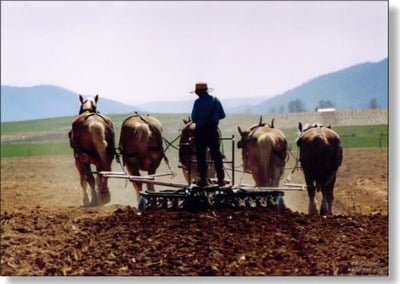
In terms of energy consumption, Amish farms are very efficient. In terms of labor hours, Amish farms are inefficient. That’s the way the Amish want it. Many people working many hours side-by-side builds community. The reason they stay away from most new technology is not that they have theological objections to human inventiveness after 1700 -- rather, they reject that technology which careful review indicates would fragment community.
“The dominant culture in the United States, including those practicing conventional agriculture, assumes without question that increasing efficiency, in terms of per person production, is always good. Amish people begin with different assumptions. They like the fact,...that they need every available family member, and often neighbors as well, to harvest their crops.” (Peterson 39)
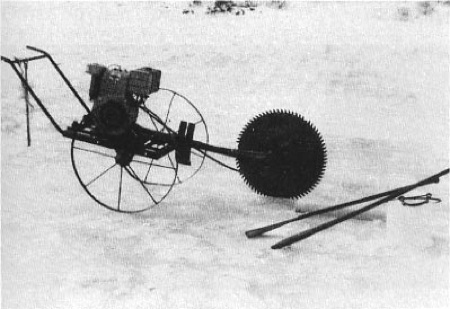
Homebuilt gas-powered ice cutter to make ice
for non-electric icebox
Thus, they resist a lot of new technology, but not all of it. On an Amish farm you’re likely to see a motorized hay baler being pulled by horses. There might even be a cell phone -- kept in the barn where it won't disrupt family life. They don’t want technology to save them too much labor, because the shared labor pulls them together as a family and a community. As Steven Stoll put it:
“Anything that undermines their ability to cohere as a community of neighbors and linked families, anything that isolates them in their work or places production for profit ahead of the collective process, is prohibited.”
In this way, they are able to be
“far ahead of mainstream U.S....[society] in their attention to the needs and wants of their most vulnerable members.” (Peterson 112)
John Hostetler’s textbook, Amish Society, notes:
“The Amish view personal property, expressed in farms and family dwellings, as a form of stewardship, but they carefully avoid any ostentatious display of wealth. The fruits of their labor are used to perpetuate community life through sharing, hospitality, stewardship, and underwriting the cost of an expanding population.” (74)
If utopian means so idealistic as to be out of touch with reality, then, asks my friend, University of Florida professor Anna Peterson:
“Which model is more utopian: the Amish Gemeinde or the American dream of affluence, freedom from want, and endless consumption, which so few people actually achieve. When it is attained, this material success not only fails to buy happiness but also demands excessive consumption of natural resources and habitats and frequently relies on the exploitation of poorly paid and treated workers in the United States or overseas who produce and sell what is consumed. Mainstream observers often dismiss the Amish as naïve idealists, unable to face the real world. However, their expectations are more realistic in their context that those of most North American, and their social institutions are more able to help them realize their dreams.” (40)
Of course, there’s still the matter of the theology – many of their beliefs correspond to fundamentalist, evangelical Christianity. There’s still the bit about the patriarchy, and the no post-middle-school education.

Could we have the simple, sustainable way of living, with real community ties that ensure everyone is taken care of, and still have a more liberal approach to religion, a more egalitarian approach to gender roles, and advanced educations? I don’t know. Not very easily.

* * *
This is part 3 of 4 of "The Amish Challenge"
Next: Part 4: "'Their lesson could not be more important.'"
Previous: Part 2: "Original Position"
Beginning: Part 1: "But apart from that..."
Sources
Peterson, Anna L. Seeds of the Kingdom. 2005.
Stoll, Steven. “Postmodern Farming, Quietly Flourishing,” Chronicle of Higher Education, 9, 2002 Jun 21.
Hostetler, John A. Amish Society, 4th Ed. 1993.

2012-11-01

Original Position


We’re all kind of set in our ways.

You know how to be the person you are. You've spent years developing the skills for navigating the kind of life you now have. You’ve had a lot of practice at it. Changing it would be difficult.

But suppose you could do it over. Suppose you were a small child again, young enough to easily learn whatever lifestyle you were surrounded by. Suppose you were being given up for adoption, and there are two possibilities:

Option 1: You are adopted by an Amish family and grow up Amish.

Option 2: You are adopted by a middle-class American family into a lifestyle of dizzying and insatiable consumption, social alienation and isolation, stress, depression, constantly rushed, rarely fulfilled, disconnected from family, barely knowing your own neighbors, blinded by myriad structural distractions from ever noticing the suffering of those oppressed by the systems that support your lifestyle, and burning through resources like there’s no tomorrow, which, at average US rates of pollution and resource depletion, there might not be.

Put that way, now which would you choose?

Do you value environmental protections and sustainability? Amish agriculture is extremely energy efficient. They use organic fertilizers that come from their own horses and cows. In dairy production,
“even the most efficient modern farms require 65% more energy per kilogram of milk”
than an Amish dairy farm (Peterson 31).

Modern tilling disrupts the topsoil, and leads to more run-off, depleting the soil and polluting the water. No-till methods are spreading, but
“Amish hose plowing, it turns out, is better for the soil than [even] new no-till methods.”
Because their farms are small compared to the vast monoculture farms of contemporary agribusiness, with crop rotation they can keep soil nutrients replenished and keep down pests. The Amish rarely use soil insecticides. Studies show that, yes, some Amish farms are ecologically questionable. But by and large
“there are real reasons to view Amish farming as a model for sustainable agriculture.”
Their farms are comparatively small. They use little fossil fuel. The Amish do not accept government subsidies, so they don’t have to follow policies that encourage monocropping. They reject many of the newer farm technologies that help put other farmers into debt. The result is that Amish
“profits are higher per acre and per animal than conventional farms, and their debts and expenses are much lower.” (Peterson 30)
The severe farm crisis of the 1980s never hit Amish farmers. While farm foreclosures were wiping out thousands of farmers, the Amish were doing just fine.

Rhonda Yoder’s 1990 study of Amish agriculture in Iowa concludes:
“In the midst of enormous economic instability, growing environmental dilemmas, and social upheaval (thousands of Iowa residents moving out of the state, countless farmers being forced out of farming and rural communities faced with decay), the Old Order Amish farmers and their communities were thriving. This type of success -- keeping farm families on the farm, building the fertility of the soil for the benefit of future generations and earning a living on small holdings – was a reality often dismissed as irrelevant in an era when agricultural leaders believed a farmer must ‘get big or get out.’ The Amish example defied this popular belief and demonstrated a viable alternative.” (Yoder 1)
Put that way, now which would you choose?

Do you value social justice? Do you support ways to meet the needs of everyone and to care for the least well-off? In Amish communities,
“families take care of older and disabled members at home, never in institutions.... Amish [rules] prohibit both public insurance such as social security and private insurance policies because these would reduce members’ mutual dependence. For members, the community is its own insurance, and in times of need no one falls through the cracks.” (Peterson 37)
There are some Amish who are wealthier than others, though overall the inequality is much less that in US society generally: the gap between the wealthiest and the poorest is much, much smaller. Indeed,
“the community has an informal claim on a wealthy Amishman’s resources. He is also protected from an all-out competition with other well-to-do families in purchasing and displaying the usual array of material status symbols. Prestige is also culturally tied in to the welfare of the community so that personal reputation can only reach fulfillment in the service of the kin and church community. The religious support for both cultural practices is strong teaching against high mindedness or pride and a conscious cultivation of the virtue of humility.” (Stoltzfus 312)
They’re off the grid. They’re farming sustainably. They’re taking care of everyone.

Are they happy? It’s harder to measure that. What we can say is that they are succeeding, by their own standards of success.

* * *
This is part 2 of 4 of "The Amish Challenge"
Next: Part 3: "What Putting Community First Looks Like"
Previous: Part 1: "But apart from that..."

Sources
Peterson, Anna. Seeds of the Kingdom. 2005.
Stoltzfus, Victor. "Reward and Sanction: The Adaptive Continuity of Amish Life," Mennonite Quarterly Review 51, no. 4, October 1977.
Yoder, Rhonda Lou. "Amish Agriculture in Iowa: Indigenous Knowledge for Sustainable Small Farm Systems," Studies in Technology and Social Change, no. 15, Iowa State University, 1990.

2012-10-31

But apart from that...

Do you remember this schtick from Monty Python's Life of Brian? The "Judean People's Front" is having a meeting to plan their rebellion against Roman rule:
Reg: They've bled us white, the bastards. They've taken everything we had,... And what have the Romans ever given us in return?
Xerxes: The aqueduct.
Reg: Oh yeah, yeah, they gave us that. Yeah. That's true.
Masked Activist: And the sanitation!
Stan: Oh yes, the sanitation, Reg, you remember what the city used to be like.
Reg: All right, I'll grant you that the aqueduct and the sanitation are two things that the Romans have done.
Matthias: And the roads.
Reg: (sharply) Well, yes, obviously the roads. The roads go without saying, don't they? But apart from the aqueduct, the sanitation and the roads?
Another Masked Activist: Irrigation.
Other Masked Voices: Medicine. Education.
Reg: Yes, all right. Fair enough.
Activist Near Front: And the wine.
Omnes: Oh yes! True!
Francis: Yeah. That's something we'd really miss if the Romans left, Reg.
Masked Activist at Back: Public baths!
Stan: And it's safe to walk in the streets at night now, Reg.
Francis: Yes, they certainly know how to keep order. (General nodding). Let's face it, they're the only ones who could in a place like this. (More general murmurs of agreement).
Reg: All right, all right. But apart from the sanitation, the medicine, education, wine, public order, irrigation, roads, the freshwater system, and public health, what have the Romans ever done for us?
Xerxes: Brought peace.
Reg: Oh, peace. Shut up!


Funny! To use another Monty Python line: "Now for something completely different."

I am susceptible to occasional yearnings for a utopian community where property is held in common. Problem is, communes generally don’t last. They tend to fall apart after a couple years, if they last that long. Richard Stosis studied communities that hold property in common. They dissolve because the level of trust and cooperation required is just so difficult to maintain. Stosis found, however, that:
“communes that base their existence on religious ideals tend to last roughly four times as long on average as do those that base their existence on a secular ideology.” (“Religion and Intra-group Cooperation: Preliminary Results of a Comparative Analysis of Utopian Communities,” Cross-Cultural Research 34 (2000): 71-88)
Groups with shared rituals and sacred stories cohere better. Indeed, religion itself just is an adaptive strategy for fostering group cohesion. Shared myths, ritual, and music help our brains be ready to trust at the levels required for communal life. Some secular communes, such as Twin Oaks in Louisa, Virginia, have managed to last – but they’re only 100 people, and they have high turn-over. They survive because they’ve made themselves well-known so that there’s a constant flow of new folks ready give communal life a try.

Tegher Monastery in Armenia
In contrast, some monasteries, with the members holding property in common, have lasted a thousand years, and the turn-over rate is pretty slow. They share sacred stories and rituals: they stay together.

Problem is, monastics have this vow of celibacy. Even while we know they aren’t all keeping that vow, the removal, or at least the marginalizing of family life and sexual competition probably plays a role in monasteries surviving and keeping their levels of discord below the point of dissolving the community.

Would it be possible for a shared-property community to have shared spiritual principles and practices – like a monastery – but also have marriage, children, and family life? What would that look like? I suppose it would look rather like an Amish community.

There's a lot to admire about the Amish. They have strong and stable communities, which can sometimes look pretty attractive to those of us with the fragmented, hustle-bustle, disconnected, alienated lives typical of our times. So the question arises: If they would have us, why not join the Amish?

At this point, my internal dialog enters a sequence reminiscent of Life of Brian.
Me: Why not be Amish?
Also Me: Cars, computers, televisions, telephones.
Me: Sure, we'd have to give those up. But that might be rather liberating.
Also Me: I've heard that some Amish operate cruel puppy mills.
Me: Well, those aren't the kind of Amish we're talking about.
Also Me: Very plain clothes.
Me: That would be OK.
Also Me: The career options are basically farming and... farming.
Me: Well, yes, there is that.
Also Me: When they aren't farming -- and often when they are -- they're parenting. They place great value on having large families, averaging 6.8 children per family.
Me: I enjoyed parenting two children. I don't know about seven.
Also Me: They have a very literal interpretation of the Bible, and adhere to it strictly.
Me: OK, but other than that...
Also Me: They're very patriarchal. Women aren’t allowed to be ministers or bishops, are largely consigned to traditional female roles, and, if mistreated, have little recourse.
Me: Um. Yeah, I do have a problem with that.
Also Me: No education beyond the eighth grade.
Me: All right, all right. But apart from the theology, the patriarchy, large families, the lives of farming, no education beyond middle school, limited clothing options, and maybe an occasional issue over humane treatment of puppies, why not be Amish?
OK, so, we're not going to be running off and joining an Amish community -- even if they would have us. Even so, we can learn a thing or two from the Amish.

* * *
This is part 1 of 4 of "The Amish Challenge"
Next: Part 2: "Original Position"