Showing posts with label Holy Dialog. Show all posts

2012-08-28

"To Arrive Where We Started"

Dialog participants try to build on other individuals' ideas in the conversation. In this way, misunderstanding each other is actually central to the enterprise. In the misunderstanding of what another person meant, we might bring forth a new meaning.

Interestingly, this again echoes that Gospel of John, I notice. David Bohm never talked at all about any of the Gospels. In fact, I am surely misunderstanding him by explaining his point as being in line with that Gospel – which illustrates the point: a new yet related thought emerges from misunderstanding.

You see, in the Gospel of John, People often misunderstand what Jesus says. Instead of speaking in parables and short sayings about the kingdom of God, as he does in the other Gospels, Jesus speaks in long, difficult monologs that are misunderstood. But they are misunderstood in a way that opens up new levels of meaning.

If there can be said to be a goal of the various incarnations of "Bohm Dialogue" it turns out it is the same goal the spiritual path has: to understand ourselves. For dialog groups, what it’s all about is the whole group getting a better understanding of itself. Bohm Dialogue is used to inform all of the participants about the current state of the group they are in. Where are we right now?

Irony. My dream of a future for Unitarian Universalism, for this Fellowship, is a dream of bringing our attention back from futures and into the precise present. Right now we are a long way from right now. In three years, in ten years, in thirty years, I see us -- Unitarian Universalism nationally and globally and locally here in this Fellowship – moving along that long day’s journey into…Day.

When it comes to suspending assumptions, judgment, not repressing them, just looking at them, I have to admit that I am lousy at that. That’s exactly what my spiritual practice has been all about for the last 11 years, and like that student who asked for wisdom, what I got seems pretty disappointing. Yet the journey not only is more important than the destination, the journey IS the destination. I see Unitarian Universalism growing more and more serious about living into that paradox, cultivating genuine spiritual practice.

I see us becoming less and less interested in being a social club of the like-minded, and more and more hungry for work – for engaging the difficult, boring work of transformation into exactly what we are. I see more and more Unitarian Universalists making their congregations into places not that politely reinforce while not examining the assumptions people came in with, but places that facilitate the suspension of assumptions and the holding of them in our attention. I see Unitarian Universalists increasingly devoted to spiritual journaling, study of scriptures and wisdom writings, meditation, mindfulness, and meeting in small groups to do the work of deepening together.

That is where our faith’s growing edge is, and it is on that edge that my ministry is called to serve. The impulse to deepen, to get down to right now, to not cease from the labor of exploration, and, as T.S. Eliot said, “the end of all our exploring will be to arrive where we started and know the place for the first time” – that is the impulse to spiritual work that I am here to serve, to nurture and guide with every understanding and misunderstanding I have. It is who I am. I can do no other.

We have a long way to go to arrive at where we are. It’s a journey that starts everywhere at once: in our hearts unfolding like flowers; in the joy of this day; in field and forest, mountain and meadow, calling us ever to that space of joy. There is a triumph song of life, and there is nothing we need do but hear it. And learn to sing it.

Amen.
* * *
This is Part 4 of 4 of "Holy Dialog"

Previous: Part 3: "Attention, Everyone"
Beginning: Part 1: "Dialog"

2012-08-27

Attention, Everyone

A dialog group is like the back porch scenario in not having a purpose defined in advance, but it needs to be a larger group of people. It needs to be, according to David Bohm, more than twenty. Why? Because smaller group don’t have enough conflict. In a smaller group we can all adjust to each other.
“If five or six people get together, they can usually adjust to each other so that they don’t say the things that upset each other – they get a ‘cozy adjustment.’
People can easily be very polite to each other and avoid the issues that may cause trouble....In a larger group...the politeness falls away pretty soon.” (Bohm, On Dialogue)
In that very conflict comes the unsettling – for, as Emerson said, it is only when we are unsettled that there is any hope for us.

Irony. In the conflict lies the possibility of wholeness that we can never have on our own.

Dialogue is not discussion. An individual’s thought is inherently fragmentary, and in discussion it stays fragmentary.
“Discussion is like “a ping-pong game where people are batting the ideas back and forth and the object of the game is to win or to get points.” (Bohm, On Dialogue)
“In the dialogue, a very considerable degree of attention is required to keep track of the subtle implications of one’s own assumptive/reactive tendencies, while also sensing similar patterns in the group as a whole. Bohm emphasized that such attention, or awareness, is not a matter of accumulated knowledge or technique, nor does it have the goal of ‘correcting’ what may emerge in the dialogue. Rather, it is more of the nature of relaxed, nonjudgmental curiosity, its primary activity being to see things as freshly and clearly as possible. The nurturing of such attention, often bypassed in more utilitarian versions of dialogue, is a central element in Bohm’s approach to the process.” (from "Foreword" by Lee Nichol to David Bohm, On Dialogue
In Dialogue, each individual agrees to suspend judgment in the conversation. “Suspend” doesn’t mean you don’t have the judgment. It just means you don’t live there.
"...people in any group will bring to it assumptions, and as the group continues meeting, those assumptions will come up. What is called for is to suspend those assumptions, so that you neither carry them out nor suppress them. You don't believe them, nor do you disbelieve them.”
“For example, if you feel that someone is an idiot, to suspend you would (a) refrain from saying so outwardly and (b) refrain from telling yourself you should not think such things.”
You don’t suppress the thought, nor do you indulge it. You “suspend” it – as if it were hanging in the air in front of you, and you just look at it, watch it. And you watch what the effects of the thought are. The thought “you are an idiot,” is going to be attended by feelings: agitation, anger, resentment. Don’t suppress those either. And don’t indulge them either. Watch the feelings as they run their course. See them without identifying with them. Suspending an assumption or reaction means neither pushing it out of your mind nor following through on it, but fully attending to it. Dialogue, ultimately, is about attention.

It is fascinating to me that a theoretical quantum physicist – just by watching his own thought process as he tackled the problems of physics by himself and in groups – came up with just what the great spiritual traditions teach. You may have heard the Japanese story of the student who came to visit a renowned spiritual teacher, and found the master absorbed in calligraphy:

Japanese Kanji for "Chuumoku" (Attention)
The student asked, “Please, master, write for me something of great wisdom."
The master pulled over a clean sheet and his brush quickly wrote the word: "Attention."
The student said, "Is that all?"
The master wrote, "Attention. Attention."
The student became irritable.
"That doesn't seem profound or subtle to me."
So the master wrote, "Attention. Attention. Attention."
In frustration, the student demanded, "What does this word 'attention' mean?"
The master looked up, and for the first time spoke: "Attention means attention."

You might, like the student in the story, find this disappointing: dry and uninteresting. We would like the prospect of spiritual development to be exciting. Attention is pretty boring.

If you’re feeling boredom, that’s OK. Pay attention to the boredom, too.

* * *
This is Part 3 of 4 of "Holy Dialog"

Next: Part 4: "'To Arrive Where We Started'"
Previous: Part 2: "Remember That We Are Insane"
Beginning: Part 1: "Dialog"

2012-08-26

Remember That We Are Insane

There’s a little parable that has stayed with me ever since I was 17 and first read it on the sleeve of a comedy album by George Carlin -- his 1972 "Class Clown" album:
“In ancient times there was a country whose harvest came in, and it was poisoned. Those who ate of it became insane. 'There is but one thing to do,' said the King. 'We must eat the grain to survive, but there must be those among us who will remember that we are insane.'"
A wonderful parable for a comedian, isn’t it? Carlin’s life was dedicated to remembering that we are insane.

In the same way that we have to eat, we have to think. We can’t avoid it – and it wouldn’t be a good idea if we could. But can we remember, as we think, that we’re getting it wrong with every thought?

British-American physicist David Bohm emphasized that true dialog can’t have a purpose. If we're getting something wrong with every thought, it might be helpful to just talk without a purpose that we'd only be mucking up. Dialog may end up accomplishing a lot of things, but we can’t start out with an idea of: “Here’s our problem, and how are we going to fix it.” If we do this, we’re locked into thoughts about what the problem is, and what a solution would look like -- thoughts that are always awry.

In dialog, we bring our thoughts, but try not to be locked into any of them. Everything is up for grabs in the free flow of ideas. A dialog group is not like a problem-solving group, a strategy group, a planning group. It’s more like people sitting on the back porch sipping lemonade and gabbing about nothing in particular. In that context, anything can come up, and a thought at any level can be called into question without making people impatient to get on to the point. Indeed, whatever is being offered is the point.
“As soon as we try to accomplish a useful purpose or goal, we will have an assumption behind it as to what is useful, and that assumption is going to limit us. . . . In the dialogue group we are not going to decide what to do about anything. This is crucial. Otherwise we are not free.”
It’s rather like watching the Olympics. Did you watch any of the recent London Olympics? The athletes certainly have a very clear purpose, but those of us watching, we don’t do so to solve any particular problem we have. We just want to see something new about human possibility. The gymnastics, the synchronized swimming – the speed of the runners and the muscle of the weight-lifters – it’s just amazing. We want to see amazing possibilities.

I was watching a little bit of Olympics this week with LoraKim, and I said, “Did I tell you my idea for an Olympic event they should add?”

She said, “You did. You first told me in the summer of 2000, the summer after we had just gotten married, and then you told me again in 2004, and again in 2008. Every time the Olympics come on, you tell me.”

What a memory, that woman! OK, so she’s heard it. But I’m pretty sure, gentle reader, that you haven’t.

My idea for an Olympic event is: The Team Pentathlon: a Pentathlon of team sports. The same five people have to play together as a team in five very different team sports. They have to play basketball, and five-on-five versions of volleyball, water polo, team handball, and beach soccer. The same five people have to work together in all those sports. I love imagining what that would do to a group of people – the kind of connections and sense of each other they would have to develop in order to function effectively in five such different sports. Obviously, the players would be very focused on a purpose – winning – but what appeals to me is the thought that something without purpose would emerge: a knowing of each others’ movement so well that a flow of connection and oneness transcended their individuality as they merged into one thing. They would develop, I imagine, a oneness so palpable that even the British announcers would be compelled to say, “the team is” instead of “the team are.”

Ah, but five is much too few for David Bohm’s notion of a dialogue group. If you are remembering your experiences of gabbing aimlessly on back porches, perhaps you are thinking that those might have been relaxing and pleasant times but they didn’t exactly seem transformative to you. David Bohm noticed that, too.

* * *
This is Part 2 of 4 of "Holy Dialog"

Next: Part 3: "Attention, Everyone"
Previous: Part 1: "Dialog"

2012-08-25

Dialog

Irony.

Irony is: wearing a Che Guevara t-shirt manufactured by a huge multinational corporation.

Irony is: the name for the fear of long words is
Hippopotomonstrosesquipedaliophobia.
Irony is: the sign that announces:
“Psychic Fair canceled due to unforeseen circumstances.”
And irony is this monolog on the subject of dialog.

Dialog comes the two Greek parts: “dia” and “logos.” Logos is the words or thoughts.
Logos is the root of “logic.” We also see logos as “study of” in words like biology, geology, anthropology – and scientology. Interestingly, logos is the term that the Gospel of John, in its original Greek is using in those famous opening lines.
“In the beginning was the Word, and the Word was with God, and the word was God.”
What is translated as “Word” is this term logos. John is saying:
“In the beginning was the logos, the logos was with God, and the logos was God.”
John was clearly deeply influenced by Greek philosophy which developed a concept of logos as the divine principle of reason that gives order to the universe and links the human mind to the mind of God. Words, logic, study, thought: the divine principle of reason. The basic order of the universe parallels, or models, or is the manifestation of, or just IS reason, thought. And this logos, you know, says John, isn’t just WITH God. The logos IS God.

There’s a lot about the world that maybe doesn’t seem so rationally ordered. But let’s get down to the real basics here – as the Comedian Lily Tomlin does when she quips:
“Time is just nature’s way of making sure everything doesn’t happen at once.”
I’d have to say that’s a good idea. "Good job, logos -- making sure everything doesn’t happen at once."

Dia – log, then, is dia – logos. “Dia” does not mean two. It means between or among. Dialog is the mystic logos that comes into being between us, among us: the shared logos.
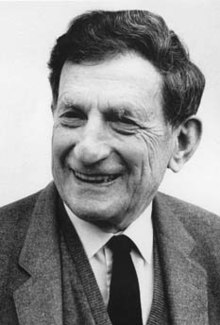
David Bohm, 1917-1992 

What Lake Chalice would like to do in this series on dialog is note some ideas about dialog developed by David Bohm. David Bohm was a very interesting man: an American-British quantum physicist who died in 1992 at age 74. One of the most significant theoretical physicists of the 20th-century, he thought a lot about very difficult things to think about – like theoretical physics, and also the nature of thought itself. In trying to get thinking to square with the ultimate nature of reality, as explored in physics, Bohm noticed that thinking itself is an inherently limited medium. Maybe our minds somehow reflect a divine logos, but they do so in a very distorting, limited way.

We are always getting it wrong. If I think somebody did something wrong – I’m wrong. If I think somebody did something right – I’m wrong. This physicist, David Bohm, echoes what the Korean spiritual teacher Seung Sahn often said:
“Open your mouth and you’re wrong.”
The truth is before thinking. So spiritual teachers, like me, will typically instruct: plunge into silence. Train ourselves to be present to the silence that underlies and surrounds the noise of thinking.

David Bohm’s approach is – at least on the surface – a bit different. Bohm says the cure for the inherent error of any thought is encounter with someone else’s thought.
In other words, dialog. Of course, other people’s thought is just as wrong as mine is. The point isn’t to arrive at some better opinion to settle into, but simply to unsettle our opinions. He’s not saying get rid of your opinions. Just: unsettle them.

As our own Ralph Waldo Emerson said,
“People wish to be settled. Only insofar as they are unsettled is there any hope for them.”
The great value of dialog isn’t that we get better or broader opinions, but that we come unsettled from any opinion, unsettled from any definite thought.

* * *
This is part 1 of 4 of "Holy Dialog"

Next: Part 2: "Remember That We Are Insane"