The “miracle” – on 34th street and on your street – is that love is good business. In fact, for a faith community, love is our business. If it isn’t, then we don’t need to be in business. If it isn’t, then we might as well close our doors right now.
Some folks who pride themselves on being hard-headed business realists seem to have missed certain chapters of the basic textbook of business reality. The business reality is that there are ways that benefitting our rival benefits us, too, because it makes the business that we and our rival share go better for both of us.
When radio first began broadcasting baseball games, owners worried that radio listening would compete with stadium attendance. “Who’ll buy our tickets to watch the game if they can stay home and listen to it on the radio for free?” they reasoned. The first baseball game broadcast on radio was in 1921. By the 1930s, many owners were still wary, and radio coverage was a “sometimes” thing. The Chicago Cubs, in 1935, were the first team to have all their games on radio. The last holdouts were the New York teams (Giants, Dodgers, Yankees), but by 1939, all the teams had contracts allowing broadcast of all their games.
The money that radio stations paid to the teams slowly overcame the resistance of team owners, who figured that radio income would compensate for lost ticket sales. What they discovered was that ticket sales actually went up as a result of radio broadcasting. People who heard about Babe Ruth, Lou Gehrig, and Walter Johnson on the radio were more likely to want to see them in person. Attendance at the games in 1940 was nearly eight percent higher than it had been in 1920 – a remarkable statistic given the drastic effect of the Great Depression on discretionary income.
When TV coverage came along, the same pattern repeated: initial resistance – why come to the games if they’re free on TV? – followed by realization that the medium was a help.
Radio broadcast and stadium ticket sales were both in the business of promoting baseball. Faith communities are all in “the business” of promoting what we might call “spiritual values” – a way of life that attends to grace, abundance, and fundamental, irrevocable goodness that envelops even the greatest tragedies. Any church, fellowship or other faith community that does that is cooperating with us in the overall project of human growing, deepening, developing. The better they are at that mission, the better it is for us, in the long run: the more people there are who are oriented to any path of awakening from mindless consumerism, awakening to greater presence to the beauty and mystery of life, then the more people will ultimately find their way to the liberal version of that path.
(It’s also true – though this may not seem very comforting to Unitarian Universalists – the other way around. The better UU congregations are at carrying out our mission of deepening and growth, the better that is for the more conservative churches, too. We should recognize that some folks who learn from us the value of a serious religious path will find that path leading them over to the Baptists. God bless them. Their path is not mine, but if they end up helping to build an effective Baptist congregation, some of the folks from that congregation will eventually find that their spiritual path leads them to us. Like Macy’s and Gimbel’s in “Miracle on 34th Street.”)
A scarcity mentality – small, protective, guarded, grasping, ungenerous – hinders the mutual boon that occurs when rivals cooperate simply by recognizing that they always were in the same "business." Love is our business. We are here to make the word flesh. We are here to take the pure and perfect ideas of caring and relationship and put them into the messy flesh of lived human relationship. All the many Christmas stories, as varied and bright as the lights on a tree, are stories of incarnation: love embodied, in flesh. The stories of our winter festival remind us that the joy, the belonging, the love for which we hope, will come from the most unexpected places – an impoverished babe, a hardened miser, a glowing red nose and an island of misfit toys – or the very group we thought was our rival.
* * *
This is part 5 of 5 of "The Word Made Flesh"
Previous: Part 4: "Miracle on 34th Street"
Beginning: Part 1: "The Word Made Flesh"
Pages 'n' Links
Showing posts with label Word Made Flesh. Show all posts
2013-01-09
2013-01-07
Miracle on 34th Street
The Johannine community -- an early Christian group, probably in Asia minor, which, in the late-first- and early-second-centuries, produced several documents that became books of the New Testament, including the Gospel of John, three Epistles of John, and possibly the book of Revelations -- would have been familiar with the very different stories of incarnation in the Gospel of Matthew and the Gospel of Luke. Rather than trying to decide between them or write their own, the Johannine authors offer us a poetic way to sum them up:
Thus, at Christmas time, we tell that story. We tell it in so many different ways, but they are all stories of incarnation.
There’s the pagan story of the rebirth of the great horned hunter God, viewed as the newborn solstice sun. Life and the rhythms of nature are incarnated in Cerenunnos.
There’s the story of a red-suited elf with flying reindeer who brings us presents for no reason other than that it’s what he likes to do. Kindness and giving are incarnated in Santa Claus.
There’s the story of one of those reindeer, who believes he does not have a place, and learns that the very same nose that is his shame, that is his brokenness, that is the thing about him that is wrong -- is also his strength and his great gift, and that he does have a place. Belonging is incarnated in Rudolph.
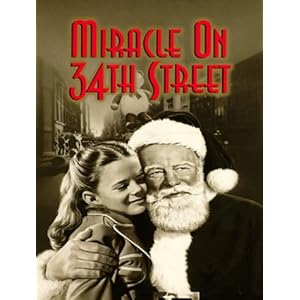
There’s the story of Ebenezer Scrooge, who has visions one night that show him what life really means, and when he is imbued with this recognition of life, he responds with generous compassion and ebullient joy. For filmgoers, since the 1940s there has been the story of George Bailey in “It’s a Wonderful Life,” who sees a of vision in which he was never born, his dear friends and family do not know him, and he grasps the precious, dear sweetness of relationship – of the love made flesh. And also the story of a department store Santa who calls himself Kris Kringle who shows two department stores, Macy’s and Gimbel’s, that they’re better off cooperating.
Let me linger on that last one for a bit, for this year is the 65th anniversary of the movie “Miracle on 34th Street” – and 2012 is the 60th anniversary of my congregation – the Unitarian Universalist Fellowship of Gainesville, founded in 1952 on the UF campus and now coincidentally on 34th street.
In the story, as you may remember, one Kris Kringle is hired as the Santa for Macy’s flagship store on 34th Street. One of the roles of a department store Santa is to steer customers to buy things at that department store. But Kris Kringle will occasionally tell parents, “you might have better luck finding just what you need” at Gimbel’s, the rival department store. The Macy's management is at first horrified, but it turns out this sort of honesty and helpfulness impresses customers. Gimbel’s doesn’t want to seem greedy, so they implement a policy of referring customers back to Macy’s if Gimbel's doesn't have the item or if the Macy's version is better. This makes Macy’s escalate further, and spread the word throughout their chain to send customers to Gimbel’s if Macy’s doesn’t have exactly the right item.
Kindness and honest helpfulness are good business. Kris Kringle broke Macy’s out of its scarcity mentality -- a mentality that said, "we’ve got to protect our turf, never help a rival, because there’s not enough to go around."
It turns out retail sales is not a zero-sum game. When the stores cooperate to steer customers to the products they want, customers feel better about shopping, and are more willing to do more total shopping. Setting aside, for the moment, our qualms that "more total shopping" is not a good thing for our souls or our earth, the point remains that all sides gain from cooperation. Life is not a zero-sum game. The miracle on 34th Street is that love is good business. That’s true on 34th Street, New York, New York, and on 34th Street, Gainesville, Florida.
* * *
This is part 4 of 5 of "The Word Made Flesh"
Next: Part 5: "Business, Baseball, and the Spiritual Path"
Previous: Part 3: "Love Becomes Incarnate Many Ways"
Beginning: Part 1: "The Word Made Flesh"
“The word became flesh.”Love became incarnate.
Thus, at Christmas time, we tell that story. We tell it in so many different ways, but they are all stories of incarnation.
There’s the pagan story of the rebirth of the great horned hunter God, viewed as the newborn solstice sun. Life and the rhythms of nature are incarnated in Cerenunnos.
There’s the story of a red-suited elf with flying reindeer who brings us presents for no reason other than that it’s what he likes to do. Kindness and giving are incarnated in Santa Claus.
There’s the story of one of those reindeer, who believes he does not have a place, and learns that the very same nose that is his shame, that is his brokenness, that is the thing about him that is wrong -- is also his strength and his great gift, and that he does have a place. Belonging is incarnated in Rudolph.
There’s the story of Ebenezer Scrooge, who has visions one night that show him what life really means, and when he is imbued with this recognition of life, he responds with generous compassion and ebullient joy. For filmgoers, since the 1940s there has been the story of George Bailey in “It’s a Wonderful Life,” who sees a of vision in which he was never born, his dear friends and family do not know him, and he grasps the precious, dear sweetness of relationship – of the love made flesh. And also the story of a department store Santa who calls himself Kris Kringle who shows two department stores, Macy’s and Gimbel’s, that they’re better off cooperating.
Let me linger on that last one for a bit, for this year is the 65th anniversary of the movie “Miracle on 34th Street” – and 2012 is the 60th anniversary of my congregation – the Unitarian Universalist Fellowship of Gainesville, founded in 1952 on the UF campus and now coincidentally on 34th street.
In the story, as you may remember, one Kris Kringle is hired as the Santa for Macy’s flagship store on 34th Street. One of the roles of a department store Santa is to steer customers to buy things at that department store. But Kris Kringle will occasionally tell parents, “you might have better luck finding just what you need” at Gimbel’s, the rival department store. The Macy's management is at first horrified, but it turns out this sort of honesty and helpfulness impresses customers. Gimbel’s doesn’t want to seem greedy, so they implement a policy of referring customers back to Macy’s if Gimbel's doesn't have the item or if the Macy's version is better. This makes Macy’s escalate further, and spread the word throughout their chain to send customers to Gimbel’s if Macy’s doesn’t have exactly the right item.
Kindness and honest helpfulness are good business. Kris Kringle broke Macy’s out of its scarcity mentality -- a mentality that said, "we’ve got to protect our turf, never help a rival, because there’s not enough to go around."
It turns out retail sales is not a zero-sum game. When the stores cooperate to steer customers to the products they want, customers feel better about shopping, and are more willing to do more total shopping. Setting aside, for the moment, our qualms that "more total shopping" is not a good thing for our souls or our earth, the point remains that all sides gain from cooperation. Life is not a zero-sum game. The miracle on 34th Street is that love is good business. That’s true on 34th Street, New York, New York, and on 34th Street, Gainesville, Florida.
* * *
This is part 4 of 5 of "The Word Made Flesh"
Next: Part 5: "Business, Baseball, and the Spiritual Path"
Previous: Part 3: "Love Becomes Incarnate Many Ways"
Beginning: Part 1: "The Word Made Flesh"
2013-01-05
Love Becomes Incarnate Many Ways
In addition to the Gospel of John, the New Testament includes three epistles of John, the first of which, at least, might have been written by the same “John” who wrote the fourth gospel. In any case, scholars think all four “John” books were produced by what they call the “Johannine community” – an early Christian cell that developed a distinctive form of Christian thought.
The first epistle of John says:
Lake Chalice is inclined to say love becomes more real when it takes its material form in our bodies and our actions of care. Plato apparently disagrees: he says love is more real as an unchangeable abstract ideal and becomes less real when dimly refracted into our fumbling, stumbling imperfect bodies. Nevertheless, Plato's perspective is valuable for reminding us that whatever we manifest, whatever incarnation we pull off, it is never the final form, never the end of the story, that there are always more possibilities.
Love becomes flesh, becomes embodied, and dwells among us. Love moves into the neighborhood. The poetry of John is more telling us than showing us. He leaves it to other gospels, Matthew and Luke, to show us what the word made flesh actually looks like.
John’s Gospel was the last one written, so its author would have known about the gospels Matthew and Luke, and would also have noticed how very different they were. Love becomes flesh in many different ways -- as John would have known just from the two examples of Matthew and Luke.
In Matthew, Joseph plans how to dump his pregnant disgraced fiancé, but an angel comes in a dream and tells him to stick it out. Wise men from the East come asking for the child born king of the Jews. They saw his star. King Herod consults his own priests and scribes, learns the child is in Bethlehem, and tells the wise men from the East to go look there, and then report back. They go, and the star reappears and leads them. They find the child and are overwhelmed with joy. Then another dream, another celestial intervention, tells the wise men not to go back and tell Herod. They left for their own country by another road.
In Luke, Emperor Augustus decrees the world should be registered. There’s an awareness of class that isn’t in Matthew. Mary and Joseph head down from Nazareth to Bethlehem because that’s where Joseph is from. While they are there, Mary gives birth, wraps the babe in swaddling clothes, and “laid him in a manger because there was no place for them in the inn.”
In Matthew, there's nothing about a stable, or a manger, or no room in the inn.
In Luke, the messiah comes from a poor, outcast family.
In Matthew, Joseph has middle-class worries about respectability and has to have an angel tell him to stay with Mary.
In Luke, they’re poor. There’s no concern about respectability, no mention of Joseph making plans to “dismiss” Mary. For Luke, for the poor, solidarity matters, not respectability. And in Luke, shepherds nearby that night see an angel who tells them, "a messiah is born – go." So they go. They find the parents and newborn. I love how Luke places the poor at the center of the story. The simple shepherds are the agents of the good news. There’s no fancy wise men in Luke, and no expensive gifts.
In any case, love becomes incarnate in a lot of different ways.
* * *
This is part 3 of 5 of "The Word Made Flesh"
Next: Part 4: "Miracle on 34th Street"
Previous: Part 2: "Logosland"
Beginning: Part 1: "The Word Made Flesh"
The first epistle of John says:
“Whoever does not love does not know God, for God is love.” (1 John 4:8)Thus, the John gospel is saying that, “The word,” -- the logos, the uniting connecting principle which we might call love – “became flesh.” Love becomes flesh, becomes embodied. If we read this as poetry, not as a claim upon belief – that is, if we read it as expanding the ways available to us for understanding experience rather than as narrowing the ways available to us – then it is neither empirical nor imperial, but an invitation to play upon a field of imagination and possibility.
Lake Chalice is inclined to say love becomes more real when it takes its material form in our bodies and our actions of care. Plato apparently disagrees: he says love is more real as an unchangeable abstract ideal and becomes less real when dimly refracted into our fumbling, stumbling imperfect bodies. Nevertheless, Plato's perspective is valuable for reminding us that whatever we manifest, whatever incarnation we pull off, it is never the final form, never the end of the story, that there are always more possibilities.
Love becomes flesh, becomes embodied, and dwells among us. Love moves into the neighborhood. The poetry of John is more telling us than showing us. He leaves it to other gospels, Matthew and Luke, to show us what the word made flesh actually looks like.
John’s Gospel was the last one written, so its author would have known about the gospels Matthew and Luke, and would also have noticed how very different they were. Love becomes flesh in many different ways -- as John would have known just from the two examples of Matthew and Luke.
In Matthew, Joseph plans how to dump his pregnant disgraced fiancé, but an angel comes in a dream and tells him to stick it out. Wise men from the East come asking for the child born king of the Jews. They saw his star. King Herod consults his own priests and scribes, learns the child is in Bethlehem, and tells the wise men from the East to go look there, and then report back. They go, and the star reappears and leads them. They find the child and are overwhelmed with joy. Then another dream, another celestial intervention, tells the wise men not to go back and tell Herod. They left for their own country by another road.
In Luke, Emperor Augustus decrees the world should be registered. There’s an awareness of class that isn’t in Matthew. Mary and Joseph head down from Nazareth to Bethlehem because that’s where Joseph is from. While they are there, Mary gives birth, wraps the babe in swaddling clothes, and “laid him in a manger because there was no place for them in the inn.”
In Matthew, there's nothing about a stable, or a manger, or no room in the inn.
In Luke, the messiah comes from a poor, outcast family.
In Matthew, Joseph has middle-class worries about respectability and has to have an angel tell him to stay with Mary.
In Luke, they’re poor. There’s no concern about respectability, no mention of Joseph making plans to “dismiss” Mary. For Luke, for the poor, solidarity matters, not respectability. And in Luke, shepherds nearby that night see an angel who tells them, "a messiah is born – go." So they go. They find the parents and newborn. I love how Luke places the poor at the center of the story. The simple shepherds are the agents of the good news. There’s no fancy wise men in Luke, and no expensive gifts.
In any case, love becomes incarnate in a lot of different ways.
* * *
This is part 3 of 5 of "The Word Made Flesh"
Next: Part 4: "Miracle on 34th Street"
Previous: Part 2: "Logosland"
Beginning: Part 1: "The Word Made Flesh"
2013-01-01
Logosland
![]() |
| Raphael's Plato |
For Heraclitus, 500 years before the Common Era, logos was a principle of order and knowledge.
For the Greek sophists, logos meant discourse.
For Aristotle, logos meant reasoned discourse.
The Stoic school conceived of logos as the divine principle, the active reason, pervading and animating the universe, the operative principle of all activity.
Philo, a Hellenized Jew about 15 years older than Jesus, merged Greek and Jewish philosophy. Philo followed Plato’s distinction between the perfect realm of ideas and the corrupted world of matter. For Philo, logos was the intermediary force that bridged the gap between God and the material world. The logos was God’s instrument in creating the world. Said Philo:
“The logos of the living God is the bond of everything, holding all things together and binding all the parts, and prevents them from being dissolved and separated.”
![]() |
| The Logos Made Flesh? |
“In the beginning was the Logos, and the Logos was with God, and the Logos was God. He was in the beginning with God. All things came into being through him, and without him not one thing came into being. What has come into being in him was life, and the life was the light of all people. The light shines in the darkness, and the darkness did not overcome it. There was a man sent from God, whose name was John. He came as a witness to testify to the light, so that all might believe through him. He himself was not the light, but he came to testify to the light. The true light, which enlightens everyone, was coming into the world. He was in the world, and the world came into being through him; yet the world did not know him. He came to what was his own, and his own people did not accept him. But to all who received him, who believed in his name, he gave power to become children of God, who were born, not of blood or of the will of the flesh or of the will of man, but of God. And the Logos became flesh and dwelt among us, and we have seen his glory, the glory as of a father’s only son, full of grace and truth.” (John 1: 1-14)
![]() |
| The Legos Made Flesh? |
“The Word became flesh and blood, and moved into the neighborhood. We saw the glory with our own eyes, the one-of-a-kind glory, like Father, like Son, like Mother, like Daughter: Generous inside and out, true from start to finish.”This word, this logos, that was embodied, that was manifested in flesh and blood, that moved into the house next door, that is your neighbor and mine, that is kind and steadfast as a devoted family member, what is it?
It's love. What else?
* * *
This is part 2 of 5 of "The Word Made Flesh"
Next: Part 3: "Love Becomes Incarnate Many Ways"
Previous: Part 1: "The Word Made Flesh"
2012-12-31
The Word Made Flesh
"The word made flesh."
It's a nice phrase. Poetic. Evocative of Plato's Republic, which he described as a "city of words." But it's a phrase that has, through the centuries, acquired so much theological baggage that its primary signification in the West today is as a talisman of tribal identity. It's hard to sweep that baggage away and come to the phrase fresh.
"The word made flesh."
For some of us those can be some scary words. Perhaps you have felt rather colonized by an empire whose banners flew phrases including “the word made flesh” – and your allegiance is with the rebel alliance.
"The word made flesh."
I have been accused of being Christian, and, depending on the court I was tried in, I suppose it’s possible I might be convicted -- though, my guess would be, not likely. I don’t choose that label for myself. I self-identify as represented by four of the nine symbols on the wall of the UU Fellowship of Gainesville: I’m humanist, naturalist, Buddhist, and Unitarian Universalist. Maybe in some sense, I am all nine. Maybe in some sense, we all are. Still, I don’t call myself Christian, Jew, Muslim, Hindu, or Daoist.
I got together this week with a friend of mine who is a Christian, or at least a Methodist who, I think he would say, tries to be a Christian. He said, “I drove by your Fellowship.”
“Yeah?” I said, realizing that he saw the sign out front announcing the sermon topic: "The word made flesh."
“So educate me,” he said. “How do you preach on 'the word made flesh'?” Maybe that’s your question, too.
"The word made flesh."
Does that text make you nervous? Have you staked out your identity and your honor in opposition to what you believe that text stands for? Lake Chalice just wants to ask you to consider that maybe what that text stands for in some people’s minds doesn’t have to be what it means for you.
The text in question is from the Gospel according to John, chapter 1, verse 1 through 14. In "Rededicating the Temple" last week, Lake Chalice described how the Empires of Alexander the Great and its successor, the Seleucid empire, brought Hellenic culture to the Hebrew people: Greek art, architecture, sports, philosophy, drama, and geometry. The Gospel of John was originally written in Greek because at the end of the first century of the Common Era, when that Gospel was written, Greek had been, for some time, the language in which literate Palestinians wrote.
Further, Greek philosophy deeply influenced John’s Gospel. John used the Greek word “logos,” which in the context of this Gospel is usually translated as “the word.” John was saying: the logos was made flesh and dwelt among us. This "logos" is the root of our word logic, and the "logy" in biology, geology, etc. What did logos mean for John?
Stay tuned . . .
* * *
The is part 1 of 5 of "The Word Made Flesh"
Next: Part 2: "Logosland"
It's a nice phrase. Poetic. Evocative of Plato's Republic, which he described as a "city of words." But it's a phrase that has, through the centuries, acquired so much theological baggage that its primary signification in the West today is as a talisman of tribal identity. It's hard to sweep that baggage away and come to the phrase fresh.
"The word made flesh."
For some of us those can be some scary words. Perhaps you have felt rather colonized by an empire whose banners flew phrases including “the word made flesh” – and your allegiance is with the rebel alliance.
"The word made flesh."
I have been accused of being Christian, and, depending on the court I was tried in, I suppose it’s possible I might be convicted -- though, my guess would be, not likely. I don’t choose that label for myself. I self-identify as represented by four of the nine symbols on the wall of the UU Fellowship of Gainesville: I’m humanist, naturalist, Buddhist, and Unitarian Universalist. Maybe in some sense, I am all nine. Maybe in some sense, we all are. Still, I don’t call myself Christian, Jew, Muslim, Hindu, or Daoist.
![]() |
| The flaming chalice in the center is the symbol of UU. Clockwise from top: Islam, Hinduism, Daoism, Christianity, Humanism, Naturalism, Judaism, and Buddhism |
“Yeah?” I said, realizing that he saw the sign out front announcing the sermon topic: "The word made flesh."
“So educate me,” he said. “How do you preach on 'the word made flesh'?” Maybe that’s your question, too.
"The word made flesh."
Does that text make you nervous? Have you staked out your identity and your honor in opposition to what you believe that text stands for? Lake Chalice just wants to ask you to consider that maybe what that text stands for in some people’s minds doesn’t have to be what it means for you.
The text in question is from the Gospel according to John, chapter 1, verse 1 through 14. In "Rededicating the Temple" last week, Lake Chalice described how the Empires of Alexander the Great and its successor, the Seleucid empire, brought Hellenic culture to the Hebrew people: Greek art, architecture, sports, philosophy, drama, and geometry. The Gospel of John was originally written in Greek because at the end of the first century of the Common Era, when that Gospel was written, Greek had been, for some time, the language in which literate Palestinians wrote.
Further, Greek philosophy deeply influenced John’s Gospel. John used the Greek word “logos,” which in the context of this Gospel is usually translated as “the word.” John was saying: the logos was made flesh and dwelt among us. This "logos" is the root of our word logic, and the "logy" in biology, geology, etc. What did logos mean for John?
Stay tuned . . .
* * *
The is part 1 of 5 of "The Word Made Flesh"
Next: Part 2: "Logosland"
Subscribe to:
Posts (Atom)