2010-04-27

The Ecospiritual Imperative

See also: "The Ecospiritual Challenge"

Happy Earth Day! We’re celebrating Earth Day Week today. Alachua County has designated the week of April 17 – 25 as Creation Care Week. Earth Day itself was Thursday, April 22. Did you celebrate? Did you exchange gifts with friends and family? Well, at least you sent your Mother Earth some nice flowers, right? No? You figure she’s got enough flowers? Well, then, you gave her a phone call, right? Hmm. If you’re like me, maybe you called collect.

On this auspicious occasion, let me begin with a vocabulary word: “soteriology.” Soteriology is the branch of theology that deals with salvation. What saves us? Salvation, it is well to remember, comes from the same root as the word “salve.” What is it that heals us? What makes us whole? What sources are available to us for meaning and hope, inner peace? For mystery, awe, and wonder before the fullness of reality? For equanimity, awareness of the beauty of each moment, and the one-ness of all things? For loving-kindness, compassion, and a trust of our own intuitive wisdom? So I’m asking today: what is your soteriology? What is your account of what saves us, salves our woundedness, makes us whole?

Salvation lies, I believe, in our connection with this world of ours. The salve for our woundedness, our fragmentation, lies in nature, in an ecological spirituality.

And, oh, we are feeling the wound. A sense of doom permeates the zeitgeist of our age. On the right-wing this manifests in the Left Behind series of books and increasing talk about a rapture. On the left-wing it manifests as urgent warnings from environmentalists who describe impending catastrophe: climate change, melting icecaps, species extinctions from loss of habitat, impending shortages leading to resource wars.

Maybe those environmentalists are right. I don’t know. Or, more precisely, what I don’t pretend to know or to even have any good guesses to share with you about how much time we’ve got, what factors the models have overlooked might buy us a few more years – and what behavior changes we will make that will make a difference.

Forty years ago at the first Earth Day in 1970, many of the environmentalists giving speeches on that day didn’t expect our planet would last 40 years without ecological collapse. The good work of the environmental movement of the 1970s helped buy us some time. How much, we don’t know. What I do believe the evidence is clear about is that we will eventually need to change our ways. Hard times are coming – we don’t know when, or how hard. We as a species are going to have to develop and adopt sustainable ways of living if we are to survive – and our present ways, particularly in the US, are not sustainable. Nowhere close.

Let me speak personally and confessionally: I don’t live sustainably. I took a quiz online – you can try this:
http://www.footprintnetwork.org/en/index.php/GFN/page/calculators/

The first question: How often do you eat meat or diary? All right. We’re off to a great start and I’m feeling all virtuous because I’m a vegetarian. “No meat, occasional dairy.”

How much of the food you eat is processed, packaged, and not locally grown (more than 200 miles away)? Oh. Suddenly, I’m not so virtuous. I said about half, though really, it’s probably more than half.

How much clothing, footwear, sporting goods purchases do you make in a year? I answered, “A little.”

Household furnishings? Again, I said, “A little.”

How often do you buy new appliances? I said, “Infrequently.”

How often do you buy home entertainment, personal computer equipment and electronic gadgets for your household? We do get more than our share of computer stuff. I said, “Occasionally.”

How often do you buy new books, magazines and newspapers for your household? Uh-oh. I’m in trouble on this one! I had to say, “Often.”

How much paper waste do you recycle? I said, “Most.”

How much of your plastic waste to you recycle? I said, “Most.”

Which housing type best describes your home? I clicked the answer, “Free-standing house with running water, not green-designed.”

Do you have electricity in your home? Well, yes, in fact, I do.

How many people live in your household? Three.

Size of your home? I’m in the 1050 – 1600 square feet range.

How far do you travel by car each week, as a driver or passenger? Well, we’re still racking up about 1,000 miles per month on our one car. I said: about 200 miles a week.

How far by motorcycle? Zero.

Gas mileage of the car you travel in most often? Ours is a small car. We get 30-40 mpg.

How often do you drive in a car with someone else? Occasionally.

How far do you travel by bus each week? By train each week? Zero.

Last question: How many hours do you fly each year? Oh, I do go a fair number of plane trips each year. I estimated 10-25 hours.

My results? I’m doing better than the average US resident. Just barely. If everyone lived like me, we’d need 4.8 planet earths to provide enough resources. The average US resident lives in a way which, if everyone lived that way, would take 5 earths. If everyone lived like the average Canadian, we’d need 4.3 earths, eh? Canadians do a little bit better than we do. Fortunately, a lot of countries do a lot better than we do and many are living within the planet’s resource means, which pulls the world average down. As it is right now, we need 1.4 earths – that is, the earth’s population of humans are utilizing resources faster than the earth can regenerate them. Every year we’re using 40% more resources than the earth created that year. Eventually, at this rate, we will use it all up.

That’s a problem.

It’s an economic problem, and I’m not an economist.

It’s a political problem, and I’m not a politician. I do have, as you do, political opinions, but I don’t have the kind of political connections to begin bringing world governments to the kinds of agreements we need.

It's a technological problem because modern technology burns huge quantities of resources. At the same time, some technological advances help other technological advances use less. It’s a technological problem, and I’m not an engineer.

It’s a spiritual problem. Ah. Now we can talk. Can we talk? A spiritual problem? Oh, yes, indeed.

Steven Rockefeller says:

“Our environmental problems will not be fully addressed until we come to terms with the moral and spiritual dimensions of these problems, and we will not find ourselves religiously until we fully address our environmental problems.”

Connecting to the sacredness of the earth is what saves us – and it’s also what will save the Earth, if it will be saved.

As Jeanne Mackey puts it,

eco-spirituality “means that our experience of the divine comes through the natural world.”

Writes Thomas Berry:

“The universe is the primary revelation of the divine, the primary scripture, the primary locus of divine-human communion.”

As a recent campaign from the Sierra Club put it: “This is not about getting back to nature. It’s about understanding that we never left.”

I am a Unitarian Universalist. I am in a sacred covenant with every other Unitarian Universalist in this world, to, among other things, affirm and promote respect for the interdependent web of existence of which we are all a part. That is a spiritual statement and a spiritual act. Environmental action is spiritual practice, and environmental protection is a spiritual mandate. Our relationship to our planet is as much a religious issue as our relationship to our soul is; as much a religious issue as our relationship to God is. Indeed, for many of us, our relationship to our planet is both our relationship to our soul and our relationship to God.

Every religious tradition on the planet includes a deep belief-tradition of respect and honor for our planet. Indeed, “deeply embedded in our human consciousness is a primal awe and gratitude for the air, water, solid ground, sunlight, and nourishing life forms that sustain” us. Our ancestors have “stood in awe of these at our most sacred ceremonies” for maybe a million years.

Our awareness of being bound in a relationship of responsibility with our planet is religious awareness. Acting responsibly within that relationship is religious practice. To ignore what is happening to our home – out of hubris or out of despair – is to break our connection to the holy whole, to break faith with the ground of our being.

Environmental protection a religious issue? If it isn’t, then there are no religious issues.

Amidst the many trends – the resource depletion, the pollution, the greenhouse gases, there is this hopeful tend: religion is greening. There’s green religion and then there’s what University of Florida professor Bron Taylor calls dark green religion. Green religion “posits that environmentally friendly behavior is a religious obligation.” A number of Christian, Jewish, or Muslim groups have in recent years shifted away from the idea that humans have been granted dominion over the earth and toward the idea that God calls us to stewardship, and that this stewardship is measured by health ecosystems and sustainable, responsible consumption. That’s an important shift.

There are also an increasing number of people who are going beyond green religion to dark green religion. For dark green religion, it’s not merely that we have a religious obligation to protect ecosystems, reduce consumption, and in general be responsible stewards of our environment. Rather, in dark green religion nature itself is sacred, has intrinsic value, and is due reverent care – not simply because it is God’s creation and God tells us to, but because nature tells us to, and nature has that authority based on being sacred in itself.
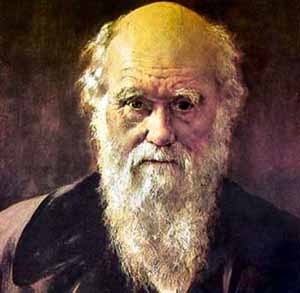
Charles Darwin
Dark green religion is popping up in a lot of places that aren’t in churches. Here is a religion that is spiritually satisfying and scientifically respectable. Scientists themselves have expressed it. When Charles Darwin’s Origin of Species first appeared 150 years ago, he concluded it, saying:
“There is grandeur in this view of life . . . Whilst this planet has gone cycling on according to the fixed law of gravity, from so simple a beginning endless forms most beautiful and most wonderful have been, and are being, evolved.”
Carl Sagn would later add:
“A religion, old or new, that stressed that magnificence of the Universe as revealed by modern science might be able to draw forth reserves of reverence and awe hardly tapped by the conventional faiths. Sooner or later, such a religion will emerge.”
Even the New Atheists – folks who have made a name for themselves being cranky about religion – have religion of the dark green sort. One of them, Richard Dawkins, acknowledges that “a quasi-mystical response to nature and the universe is common among scientists and rationalists.”

Another of the New Atheist crew is Christopher Hitchens, who, for my money is the crankiest of the cranky, a man who seems either to be, or to have carefully cultivated an image of being, joyless and permanently annoyed.

Even Christopher Hitchens, it turns out, has religion. It took a Unitarian Universalist minister to coax it out of him, but he’s got it. My colleague Rev. Marilyn Sewell interviewed Christopher Hitchens, and in the course of their conversation Hitchens declared:
“It's innate in us to be overawed by certain moments, say, at evening on a mountaintop or sunset on the boundaries of the ocean. Or, in my case, looking through the Hubble telescope at those extraordinary pictures. We have a sense of awe and wonder at something beyond ourselves, and so we should, because our own lives are very transient and insignificant. That's the numinous, and there's enough wonder in the natural world without any resort to the supernatural being required. . . . I know it's not enough for us to eat and so forth. We know how to think. We know how to laugh. We know we're going to die, which gives us a lot to think about, and we have a need for, what I would call, ‘the transcendent’ or ‘the numinous’ or even ‘the ecstatic’ that comes out in love and music, poetry, and landscape.”
Christopher Hitchens said that! Who knew he had it in him?

At least one politician, Al Gore, seems to have dark green religion. His 1992 book, Earth in the Balance, came out before he was elected Vice-President. In it, he says:
“We must make the rescue of the environment the central organizing principle of civilization. . . . As a politician, I know full well the special hazards of using ‘spiritual’ to describe a problem like this one . . . . But what other word describes the collection of values and assumptions that determine our basic understanding of how we fit into the universe?”
Disney cartoon movies from the mid-1990s express dark green religion. The Lion King sung to us of the Circle of Life that had to be respected and balanced, and in Pocahontas, Grandmother Willow teaches of belonging to nature and of the sacred interconnections within the web of life. Pocahontas sings, “You think you own whatever land you land on; the earth is just a dead thing you can claim. But I know every rock and tree and creature has a life, has a spirit, has a name.”

There may be more religion, more spirituality, in movies these days than there is in some churches. Last year’s film, Avatar stands out. James Cameron, the writer and director, said, “Avatar asks us to see that everything is connected, all human beings to each other, and us to the Earth.”

If you are a subscriber to Surfing magazine – as I’m sure most of you are -- then you will recall the July 2008 issue which proclaims in large letters on the cover, “Surfing is a religion,” and in letters twice as big above that, it says, “Nature = God.”

The article inside -- by Bron Taylor – analyzes surfing as aquatic nature religion and quotes from a number of surfers who understand their practice as spiritual. As one surfer put it: “The ocean has a powerful energy and it connects you to the earth.” Dude!

The New Atheists have got dark green religion. It’s possible to be a politician and have it. Disney and Hollywood have got dark green religion, in some of their products. Surfers have dark green religion, some of them. It’s popping up all over the place these days.

Dark green religion has no single sacred text. It has no institutions. I asked Bron Taylor about institutions: do we need there to be places – buildings and memberships – where people gather for ceremonies to express and affirm the sacredness of nature? He said, it’s infusing a variety of institutions, various church denominations are beginning to embrace it, environmental organizations are increasingly speaking a spiritual kind of language about the earth they seek to protect, and dark green religion is expressed in all manner of ways in books and movies and theme parks where people are jazzed up, or awed by the majesty and sacredness of our blue-boat home, and sent out into the world without ever taking the step of being a member of an organization. That’s rather encouraging, really – this trend all around us toward dark green religion. But we will need institutions if we are going to make it through the hard times that are coming.

We will need people organizing, committing to each other to be members together of a place that will be there for them week after week to support them in remembering what is divine, and in practicing it, and in worshipping (worth-shaping, giving shape to what is of worth) this blue-green home on which we live and breath and have our being. We will need:

- a place that will call them, over and over, because Gaia knows we are prone to forget and to lapse, to practice what we preach;

- a place that doesn’t just give you an experience like a book or a movie or a speech or a theme park;

- a place that provides community support for a way of life;

- an institution: an ongoing pattern of being together through which there is, (a) awakening of the spirit, and (b) encouragement to action in line with our spiritual values; and these two, the (a) and the (b), the spiritual and the action, are mutually reinforcing.

Unitarian Universalism has always been about living our religion, and religioning our lives. Awaken to the sacred depths of nature. Express your worship also through acts of care for our mother, for Earth, for Gaia. Re-commit today to this faith of awe and wonder and openness to whatever this universe may bring us. Re-commit today to actions of care, of compassion for our planet home.

That’s what the paper leaf inside your Order of Service is for. Write on it. Write down your commitment. Write down what you’re going to do as an act of love and an act of worship that will reduce your footprint. During our closing hymn, and then on into after-the-service, come on up and attach your leaf to the large bare-branched tree banner at here at the front of the sanctuary. That’s our altar, and this is our altar call to every one of us. Take some action, rise to whatever for you is the next challenge in living more wholesomely, not because you actually expect it to do any good. Do it because it might. Do it because it’s sure to do this good: you will be more whole, more spiritually alive, the more you replace mindless consumption with mindful consumption.

As the Bhagavad-Gita says, “Those who perform actions without attachment, resigning the actions to God, are untainted by their effects as the lotus leaf by water.”

And begin, as Joanna Macy says, with gratitude.
“We have received an inestimable gift. To be alive in this beautiful self-organizing universe – to participate in the dance of life with senses to perceive it, lungs that breathe it, organs that draw nourishment from it – is a wonder beyond words. And it is, moreover, an extraordinary privilege to be accorded a human life, to possess this self-reflexive consciousness, which brings awareness of our own actions and the ability to make choices. It lets us choose to take part in the healing of our world.” [Macy, Joanna. Coming Back to Life: Practices to Reconnect Our Lives, Our World (New Society Publishers, 1998)]
That’s a soteriology for our time.

* * *

A earlier version of this was preached at the Unitarian Universalist Fellowship of Gainesville, Florida, 2010 April 25.

2010-04-01

The Song of the Nonsinger

Keren and my Uncle Toby married in 1959
I had no idea . . .

My Mom, the first born, has a brother a couple years her junior, my Uncle Toby. A few years after my Mom and Dad married, Toby married Keren Coxe. From Toby and Keren came my cousins Charles (about a year and a half younger than me) and Mary Sue, younger still. For a while there, when I was wee, Mom and Uncle Toby were both graduate students at the University of Virginia, and our two families shared a big house in Charlottesville.

During that year or so, Aunt Keren was a daily part of life. I remembered her most for a disability that she claimed: she said she couldn’t sing. One day, in my four-year-old way, I wanted us all to sing, “Old MacDonald Had a Farm.” Keren said she couldn’t sing. This was frustrating for me, difficult to understand (which, I suppose, is why it has stuck in my memory all these years). What could she mean? How could anybody not be able to sing? There are certain kinds of sounds that come out of people’s mouths that are just talking and there are other sounds that are singing (at age 4, I had no concept of off-key, or missing the note), and surely everyone can produce both sorts. Everyone at my nursery school piped right up when it was time to sing “Old MacDonald,” or “Twinkle, Twinkle, Little Star.” C’mon Aunt Keren. Sing with us. But she wouldn’t. Said she couldn’t. Couldn’t! How bizarre!

A couple years ago I read Oliver Sacks’ Musicophilia. Sacks describes a number of things that can go wrong with the brain, one of which makes an otherwise normal-functioning person unable to reproduce a melody. We’re not talking “off-key” – we’re talking “no identifiable key or melody at all.” Maybe that’s what my Aunt Keren had. Or maybe she just didn't like to sing.
From left: Mom, me, Aunt Keren,
and Cousin Charles

Graduate school is fleeting, and our two families soon had finished their programs and headed off to jobs in other cities. A few years afterwards, word reached us that Toby and Keren were divorcing. This was the mid-sixties, and my first significant exposure to the concept of divorce. It all seemed very mysterious: sad and inexplicable.


And I never saw or heard from Keren again. Uncle Toby remarried, and I had a new aunt – with an additional couple of cousins. I’d be taken for visits with the new family – or they’d visit us, or we’d both visit at my grandparents’ – once or twice a year for most of the years of my childhood and adolescence. Since Toby had complete custody of Charles and Mary Sue, Keren was out of the picture entirely. Very rarely ever mentioned, at least in my hearing. She existed only in one or two of the older snapshots in the family album, wearing the cat’s-eye glasses and a dress in that early 60s style.

I got the news today that Keren Coxe died last week, on March 26, at age 71. Cardiac arrest. In reading the obit in the Washington Post, and in googling around, I learned what a fascinating woman my missing Aunt Keren actually was.

In 1960, she became the first female physics major to graduate from Virginia Tech. I hadn’t known that. It fits that my Uncle Toby, an engineer, would have liked a scientific-minded woman. Indeed, the big sister he’d always looked up to (my Mom) was herself working on a PhD in physical chemistry during the year we lived together in that big house in Charlottesville. My grandparents, born in 1908 and 1909, somehow got it into their heads, apparently, to teach their children to value the pursuit of truth and the power of science to progressively reveal truth – and that the progress of truth was more important than traditional gender roles. So Mom grew up unafraid to be a pioneering female scientist, and her brother grew up unafraid to marry one.

After the divorce, as I learned just today, Keren worked as a statistician for Jones & Laughlin Steel in Pittsburgh. In 1970, she completed a master's degree in health statistics from the University of Pittsburgh. The next year, she moved to Washington, DC, where she lived the rest of her life. In 1981, she got a master's degree in theoretical statistics from George Washington University in DC.

Then there was a car accident. She was run down by a drunk driver. Yes, I had heard something about that. What I hadn’t quite picked up was that the brain trauma incurred in the accident made her unable to do statistics, but awakened a passion for art. She started working in stained glass and moved on to work in watercolor, other water media, design and collage.

Here's one of her works:


She also began posing nude for art students at the Corcoran College of Art. Of modeling, one newspaper quoted her as saying: “I found I liked it almost as much as I liked being a statistician.”

She lived with Alex Belinfante, an econometrician, for the last 24 years of her life.

In 2004 September 17, The Washington City Paper ran an article about Keren and Alex. It seems that, to some extent, they lived on the hors d’oeuvres at art receptions.

www.washingtoncitypaper.com/articles/29307/the-hunger-artists

According to the article: “Since they met in 1981, Coxe, 60, and Belinfante, 65, have dined almost exclusively at gallery openings and other cultural events. ‘The number of art openings we go to in one day varies a lot; anywhere from zero to over a dozen,’ says Belinfante.”

The article continues:
You can’t ingest that much raw celery and dip without getting a name for yourself, and the Chevy Chase couple has several: “the Eaters,” “the Munchers,” “the Moochers,” “the Art Bums,” “the Cheese Critics.” Whatever they’re called, their voracity is legendary.
“Some people get some food at an art opening [that] they kind of eat because it’s there,” says B. Stanley, artistic director of the District of Columbia Arts Center. “It’s not like they really care about eating this food. It’s obviously not very good food.”
Coxe and Belinfante are different. “These guys,” Stanley says, windmilling both hands in front of his mouth, “it’s like they’re having dinner or something. It looks like somebody’s who’s watching the news while they’re eating dinner.” And they sometimes opt for takeout, he adds. “If it’s cookies or something you can put in your pocket, those guys are up for it.”
They also eat with singular focus. Painter Dana Ellyn Kaufman, who was at a 2002 opening of erotic art at Arlington’s old Khoja Gallery, remembers a votive candle on the food table setting Coxe’s sleeve afire while she loaded up with crackers and Hershey’s Kisses. “She was very cool about it,” says Kaufman. “Just put it out and went along with her business. I think I’d have been...screaming like a little girl if it happened to me.”
I’ve sometimes, myself, been known at various events to be paying a little more attention to the refreshment table than was quite seemly. Guess I’ve got a little of my Aunt Keren in me.

 Google images located this 2006 photo:

Keren and Alexander 06 by yospyn.
Keren Coxe and Alex Belinfante

Keren’s memberships included the National Capital Art Glass Guild, Senior Artists Alliance and Metropolitan Washington MENSA.

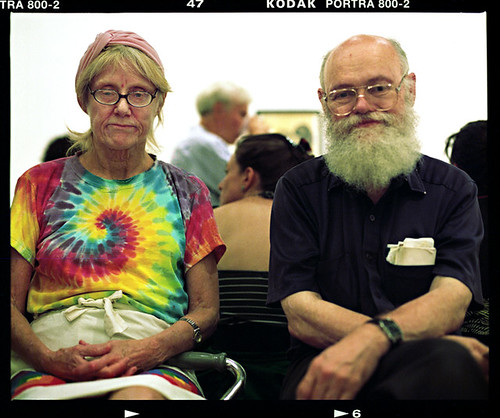
Smart woman. Creative. Weird. I wish I’d known her past my pre-school years. I myself am not such great shakes as a singer: I go off-key, miss notes. I can, however, hum "Mary Had a Little Lamb" in a way that you'll recognize the tune. In some ways, Keren couldn't pick up and sing along with the melodies of the social world. In some ways, I can't either, though I do, as it were, recognizably hum the simple tunes. We are not genetically related, Aunt Keren and I, but some kind of vague resembling vibe connected her with my family to be the mother of my cousins, and I do see some of her in me, though the differences are certainly great (I'm not and have never been a physicist, statistician, artist, nude model, or art collector). I, too, may some day find myself wearing my wristwatch almost at the elbow. I'm already a fan of bright tie-dyed t-shirts. Not to mention cheese cubes.

Keren sang with her life -- with her brain and with her body -- and she sang of numbers, of colors and shapes, forms and figures. She sang a song that teaches us, if we give it a sympathetic listen, to expand our conception of how it's possible for humans to be, and to thrive, in this world.

Rest in peace, Aunt Keren.

- - - - - - - - -

POSTSCRIPT

Since posting the above, have heard from Alex Belinfante. He says that Keren was a passionate lover of opera and excellent music. She had a perfectionist's ear, and chose not to sing because it didn't match what she felt was worth hearing.

Regarding the 2004 article in the Washington City Paper, Alex wrote to the paper:
In spite of John Metcalfe’s attempts to check facts prior to publishing “The Hunger Artists” (9/17), it nevertheless contained factual errors. For starters, he got our ages mixed up. Keren is 65 and I am 60. He failed to mention that while “pacing around the room” at the Korean Cultural Service we were admiring the art. Stanley of DCAC has selective memory. They have only once served any food worth mentioning in the few times that we have been there. (We rarely go there because it is hard to park in Adams Morgan.) That was the occasion in 1995 he mentioned, where the food, contrary to his characterization of it, was very good, and donated by a restaurant. Anyone who sees my pockets knows there is no room for food in there, and Keren usually doesn’t have any pockets. The person that used to stuff his pockets with food at openings was a now-deceased lawyer friend of ours. Keren’s daughter rarely goes to art openings. Clark of MOCA doesn’t need to use “reverse psychology” to keep us from eating much. The only times they serve decent food is when it is provided by someone else. He knows that we will buy art if it is to our liking and reasonably priced, regardless of the cuisine. Gallery owners that are more concerned about how much we eat than they are about selling their art have their priorities mixed up. If they can’t afford to provide food, they shouldn’t do so. (Most galleries just provide drinks and maybe a little junk food.) We have often seen gallery owners’ attitudes toward us change 180 degrees when we buy art from them. My taste in art is not the result of a “medical condition.” My difficulty in distinguishing reddish brown from greenish brown may explain my distaste for brownish art, but it has little to do with my taste in art otherwise. Metcalfe’s uninformed snide remarks about our art collection show that he has little appreciation for colorful abstract art. This is exemplified by his characterization of paperweights as “glass blobs” and our house as a “monster.” Maybe he should have paid more attention to the retired Georgetown professor at the Korean Cultural Service than he did watching us.

In his letter (9/24) Campello of Fraser is wrong about our never feigning interest in the artwork at his galleries. While most of his shows are not to our taste, we particularly enjoyed the Dali-inspired show a while back at his Georgetown Gallery. Most of the time when we do go there it is simply because it is part of the art walks in Canal Square and Bethesda, and we don’t stay very long. The gallery he mentioned in Leesburg has not gone out business; it has simply changed its name and later moved. The birthday party he referred to was for Keren’s son (not daughter) who lives in Leesburg, and who does not normally attend art openings. The only thing in the back room refrigerator was beer (not food), which he helped himself to after he observed other people (not associated with us) drinking it.

2010-03-24

The Diversity Thing

Diversity isn’t as simple as it sounds. Increasingly the business world is paying attention to multiculturalism and cultural diversity issues. They're training their people to recognize those differences between workers that are grounded in the worker's culture-worthy-of-respect. Doesn't sound complicated.

At my congregation, and in my denomination (Unitarian Universalists), we have a lot of certain kinds of diversity. Like many UU congregations, the membership of mine includes pagans, and Christians, and Buddhists, and humanists – all sitting side by side, walking hand-in-hand, sharing in the faith that life is good, that justice is attainable, that caring redeems us, and that joy is one another’s company. Some UUs journal, some take quiet walks in the woods, some (like me) meditate, some of us turn to scriptures of Eastern or of Western religious traditions – yet we are unified by our covenant to stand by each other, stand for our seven principles, and stand on the side of love. How much more diverse would we -- or any group -- want to be? What are reasonable and fair aspirations when it comes to diversity? That's where it starts getting complicated.

There is something that we might call a Unitarian Universalist culture. We UUs are predominantly white, upper middle class with an average of 17.2 years of schooling, which puts us at a Master’s degree in our educational level, and that’s significantly higher than the general population. Rosemary Bray McNatt in the recent issue of our magazine, UU World, characterized UU culture this way:

“Many of us are the people who brag about not owning televisions because there is nothing worth watching, unless it is PBS. Many of us are the people who refuse to listen to popular music because it is misogynistic and violent, and more than a few of us regard rap music as nothing more than noise and confusion. Many of us change the channel, and listen to NPR and love Garrison Keillor and Prairie Home Companion, and laugh when Keillor makes fun of us. Many of us are unapologetic nature lovers, and the only thing we might love more than hiking in the woods is building our congregations in the woods, complete with tiny elegant signs that blend in well with the natural environment but cannot possibly be seen by a seeker on the highway. Many of us eat locally, we shop at farmer’s markets, and we would never be caught in Wal-Mart, unless it was a dire emergency. Many of us do look ahead in our hymnal to see whether we agree with the words, and forget that the person sitting next to us may need exactly the words we are refusing to sing."

We have a kind of culture. And even though UU congregations include a lot of members of whom McNatt’s description isn’t at all true, we have managed to be the sort of place where people who do more-or-less fit McNatt’s description feel at home. This in itself doesn’t mean we aren’t diverse. We may have a higher proportion of Public Radio fans than the general population, but we also have a number of members who don’t listen to Public Radio at all.

My colleague, Rev. Mark Morrison-Reed, an African American Unitarian Universalist minister, insists that Unitarian Universalism is an ethnic faith. He spoke of his multi-ethnic neighborhood in Toronto where there are a large number of houses of worship which are predominantly of one culture or ethnicity: a Korean church, a Thai Buddhist Temple, a Mosque, a Greek Orthodox church, all within walking distance.

Morrison-Reed says the Unitarian Universalist Congregation is every bit as much an ethnic faith as those others. The Armenian Orthodox church in town is a center of Armenian culture; the Cambodian temple a center of Cambodian culture. These institutions don’t try to be culturally diverse – it’s a large part of their function to maintain their own one culture. Maybe we Unitarian Universalists should lighten up on ourselves – stop flagellating ourselves for not attracting more people from more widely varying cultures – settle for the wide and impressive theological diversity that we already have, and accept that we are an ethnic church, a culture center for Prius-driving, fair-trade-coffee-drinking, PBS-watching, vegetarian, world religion dilettantes.

Well, no. That’s a caricature of Unitarian Universalists, of course. Most UUs aren’t that way. So what are we? To describe the Unitarian Universalist culture a little more fairly and accurately: We’re people who have a style of worship that is basically Protestant – in its structure and its form, though not its content. We light a chalice, which, for us, symbolizes the flame of divinity held in the container of community. And we sing from, and read readings out of, a particular hymnal: Singing the Living Tradition. If you had to point to one thing that is characteristic of just about all UUs and no non-UUs, this hymnal would probably be your best bet.

Unitarian Universalists do constitute and comprise a distinct culture. That doesn't mean, however, that the average UU knows her own culture very well. It's important to respect and honor diversity. At the same time, our congregations would do well to keep in mind that they are never going to attract significant numbers of people who want something different from what Unitarian Universalism is. By knowing who we are, and being authentic to who we are, we will be able to attract more people who are like us even if their cultural background is nonwhite.

It's also worth reminding ourselves that change will come whether we want it or not. Unitarian Universalists have (or are) a culture, but it's a different one every year -- every day -- and like the rivers of which Heraclitus spoke, the same one cannot be stepped in twice. If you want us to change, have no fear. It is inevitable. Society around us is changing, and we change with it. As more African Americans, Asians, Latinos and Latinas infiltrate all strata of society, more of them will come to want the sort of approach to religion that Unitarian Universalism especially emphasizes -- an approach that:

- does not tell them the one way they must believe;
- urges people to think hard and diligently about what to believe, but that ultimately does not define one’s religion in terms of belief;
- shares a covenant to affirm seven general principles and no theology more specific than that;
- insists that every birth is a blessing, that everybody’s actions matter, that no experience of divinity can be lightly dismissed, and that no one has to go it alone – and that anything much more specific than that is optional as long as, together, we stand on the side of love;
- sings and reads out of “Singing the Living Tradition”, that lights chalices, and politely mentions Jesus from time to time – at least on Christmas and Easter;
- carries forward a history of free and thoughtful people wrestling with religious questions and church governance, a history going back 400 years to the early years of the Reformation itself;
- stands upon the shoulders of William Ellery Channing, Ralph Waldo Emerson, Theodor Parker, Olympia Brown, Eleanor Gordon and Mary Safford, John Dietrich and Curtis Reese and peers into a still more glorious dawn that they upon whose shoulders we stand could not have imagined.

When the barrier to inclusivity has been gender, Unitarian Universalist history shows that we have moved well to surmount that barrier. It’s true that we had a number of women ministers in the late 1800s, and that a backlash against women Unitarian minister meant that there were virtually none by 1920. But it’s also true that when second-wave feminism came in the 1960s, our congregations accepted large numbers of women ministers more readily than any of the mainstream denominations.

When the barrier to inclusivity was sexual orientation, Unitarian Universalist history shows that we have moved well to surmount that barrier. We performed same-sex unions (in some congregations as far back as the 50s), and eventually began observing them as simply marriages – religious marriage rather than civil marriage. We came to accept gay and lesbian ministers – and eventually transgender folk in our pews and in our pulpits.

These moves to tear down barriers to inclusivity have been matters of being authentic to what Unitarian Universalism is. Freedom, reason, and acceptance are the very definition of liberal religion.

But when the barrier to inclusivity has been culture, we run into trouble. We are good at tearing down barriers by being true to who we are. Not surprisingly, we aren’t so good at the kind of tearing down that would require us to stop being who we are. So our level of diversity in terms of race isn’t nearly as high as our diversity in terms of theology, gender, and sexual orientation.

And race is culture. The scientists tell us that, biologically, there is no such thing as race – that genetically, the differences within the group we identify as “black” and the differences within the group we identify as “white” are larger than the differences between white and black. If race is not biology, then it can only be culture. Yet culture is not monolithic, it isn’t fixed. It is always changing, and the efforts of some to preserve their culture can succeed at some levels but are doomed to fail at others. Mostly you can preserve the artifacts of a culture: you can, sometimes with some success, deliberately motivate a group to keep wearing certain kinds of clothes, keep cooking and eating certain kinds of foods, keep making and listening to certain kinds of music, and keep speaking a “native” language, but these artifacts of culture inevitably take on new meanings as history and the wider context rolls on, and the artifacts preserved will inevitably come to feel more and more like museum pieces and less and less like un-self-conscious manifestations of a way of life.

Unitarian Universalist culture is changing – and each slight change makes this faith tradition attractive to a slightly different sort of newcomer, and each newcomer shifts our culture still further. In my lifetime as a born-and-raised Unitarian Universalist, I have seen us increasingly recognize that scientific understanding is compatible with disciplining ourselves to exercise to strengthen certain neural pathways that help us have more joy and more kindness in our life. I’ve seen us develop more taste for reading a certain kind of writing sometimes called “spiritual.” I’ve also seen, in my life time, that substantial lowering of the barriers to inclusivity of women and GLBT folk. Our Unitarian Universalist culture is changing, and the African American culture is also changing, and all the various nonwhite cultures are evolving.

It’s true that our membership roles under-represent nonwhites. In 10 years, 1998 - 2008, the proportion of the US population that were people of color (either nonwhite or Hispanic or both) climbed from 28 percent to 34 percent. In the same 10 years, the proportion of UUs that were people of color climbed only from 9 percent to 11 percent. Yet, as Morrison-Reed points out, the people of color who do become Unitarian Universalist are those happy to operate within our norms. As more people of color become comfortable with those norms, we’ll see more of them. And as we see more of them, they will shift our norms – incrementally, in small steps. One sign of our moving culture was the appearance a few years ago of our hymnal supplement, Singing the Journey, with more current and popular styles of music represented.

While cultural evolution has an organic component to it – it happens willy-nilly (will-ye-or-nil-ye), and in ways we cannot predict – there can also be a thoughtful, intentional component. Unitarian Universalist culture represents the combined efforts of centuries of free and thoughtful women and men looking for a way to nurture our spirits and help heal our world. We mean to be respectful of other religions, we mean to learn from them, we mean to honor and accept and celebrate what they show us of human creativity in response to the conditions of life. Their example teaches us profound lessons about human capacity – we learn what we too would have been had we merely been raised that way.

For all our respect and open-ness to learn from other religions and other cultures, we have our own. And our own is necessarily our best guess about how we can nurture our spirits and help heal our world – this we, in turn, offer back to the world insofar as it is willing to respect and learn from us. To put it bluntly: we do think we’re right. Right, that is, about the modest claim that this Unitarian Universalist path is the best way for people more-or-less like us to nurture our spirits and help heal our world. That’s our claim. If we didn’t think this was the best way for us, we wouldn’t be doing what we do. If we thought that something else was better, we’d have adopted it.

The trouble with diversity comes if our respect and open-ness to learn leads us to view all cultures as needing to be preserved. Some diversity, our planet is better off without. The African American culture that grew up under Jim Crow, was a testament to human resilience under difficult conditions. It was a paragon of community solidarity, and ingenuity and courage and leadership under oppressive circumstances. There is much to admire and much to learn from. Some in the African American community have sometimes seemed nostalgic about those days because of the solidarity people showed. Even so, the culture that arose as a response to Jim Crow is a culture that we can be glad, all things considered, doesn't exist anymore.

A culture is a set of interlocking coping strategies. So when we remove horrific things that have had to be coped with, a culture is lost. As we move forward, we can remember the flowers that bloomed amidst the pain of what we left behind – yet let us, indeed, not fail to leave it behind.

It’s possible, for example, that we might one day be able to eliminate deafness. Widespread access to cochlear implant and gene therapy might someday make every human on the planet able to hear. This might be many years away – conceivably, it might not be so many. Would this be a good thing? I think so, yes – although there would be a loss. There are deaf activists who regard the cochlear implant as cultural genocide. Deaf people have a culture and a language – ASL, American Sign Language – and part of the richness of the world of diversity is inventive coping strategies these humans have come up with. That’s a culture to respect, to cherish, to honor, to learn from, to be inspired by. It’s also, I believe, a culture to be eliminated if we can do so by eliminating deafness.

Take, for another instance, poverty and the culture of poverty. There are growing disparities of wealth in the US – and not just between the very rich and the very poor, but between the “kinda rich,” say the 80th percentile of income, and the “kinda poor,” say the 20th percentile of income. In constant inflation-adjusted 2004 dollars, the gap between an income at the 80th percentile and an income at the 20th percentile has more than tripled – from under $24,000 in 1947 to over $75,000 in 2005. (Remember: those are inflation-adjusted 2004 dollars!)

The culture that emerges as a group of people together copes with its economic oppression is something we can learn from – and we can admire lives of dignity and integrity in the midst of deprivation. But all things considered, we would be better off without that culture and the poverty that produces it. Since the days of Lyndon Johnson’s Great Society programs, concern with poverty and flat-out economic injustice has all but dropped completely out of the national discourse. When was the last time you heard a politician advocate redistribution of wealth? There’s a real need to reawaken attention to poverty, to economic inequality – to the elmination of poverty if we have the will and the means to do it, even though that would also mean the passing of a certain culture.

On the troubling question of cultural diversity, it comes to this:

- Your own culture: know it well. Go deep into it.
- Other cultures: respect them and learn from them.
- Cultures that arise as responses to oppression, injustice, or disability: respect and learn from them, too -- while also working to remove the harmful conditions that make them necessary and possible.

2010-03-08

Atheists & Agnostics & Unitarian Universalism

Atheists

One criticism of professing atheism is that it’s presumptuous to claim to know – and that the atheist and theist alike claim to know what is fundamentally unknowable. This criticism is silly. Atheism and theism are not, except peripherally at most, about knowledge. They are about deciding how one is going to live. Are you going to live as if there were a God, or as if there were not one? That’s the question.

It is true that a certain arrogance can sometimes affect a person of either persuasion. Some atheists and some theists will regard you as benighted – ignorant (perhaps malignantly) or stupid (perhaps malignantly) – if you do not agree with them. But let us set aside this issue of hubristic certainty, for theism and atheism come in both arrogant and humble variants, and neither arrogance nor humility is a characteristic of either atheism as such or theism as such.
My complaint to the atheist is not that she presumes an unattainable certainty (after all, who am I to be so certain that her certainty really is unattainable?). My complaint is that “atheism” is not an answer to any question I’m interested in asking. If I am interested in your faith, in your spiritual life, in your religious practices or beliefs, and you tell me you are an atheist, you have only told me what you don’t believe. But what I would be wanting to know is what you do believe. Or, better yet, what you practice. What do you do cultivate in yourself the qualities that you most want to have, to be the person you most want to be? What do you practice to help you develop the spiritual virtues? (I use "spiritual virtues" to refer to: inner peace, equanimity, compassion, loving-kindness, joy, intuitive wisdom.) What groups do you join with, or would you consider joining with, in spiritual community to foster together those spiritual virtues? What rituals does that group perform to strengthen the communal connection of its members? What other ethics and values do you adhere to as supportive of your path toward the cultivation of those spiritual virtues? What experiences of transcendence, or one-ness, or interconnection, or wholeness have you had that have had lingering effects on your interest in the spiritual virtues? All of this, I would be interested in hearing about from you. And saying, “I’m an atheist” doesn’t answer any of these questions – or any question that I would care to be asking. “Atheist” leaves all of my questions unanswered, still on the table, awaiting your response. (Saying, “I’m a theist,” if that's what you are, is a little more helpful, but only a little.)

Agnostics

Consequently, “agnostic” is no improvement over “atheist” as a way to identify yourself religiously. Now you’ve told me what you’re not sure about. But I’m not asking what you are or aren’t sure of. I’m only asking what you are willing “to do with your one wild and precious life” (as Mary Oliver puts it) vis-à-vis those spiritual virtues, communities, experiences. Let us grant that we do not have certainty. Now what? What ethic and values shall we live by? What community shall we join and build? What intentional practices shall we undertake to sharpen our perception of the luminous quality of existence? These are questions to which living cannot help but offer up an answer, one way or another, by default or by deliberate purpose.

Unitarian Universalism

Both the self-identified agnostic and the “true believer” have in common that they take as central the question, “What can I know for sure?” “Nothing,” insists the agnostic. Fine. But for Unitarian Universalism that is not the central question. For us, the question is more like: "What shall I be in the world? How shall I practice awareness and bring to the world compassion and wisdom?” Our answer to these questions identifies our religion – and “agnostic” is not an answer to these questions. Saying you're agnostic – just as saying you’re atheist -- answers a question that we're not asking.

To approach the matter another way, once we acknowledge uncertainty – that there's always more to learn, and nothing is permanently exempt from revision – then either we have to say there is no such thing as knowledge, or else we must conceive of knowledge as allowing for change and growth. The latter course seems the better. Our Unitarian Universalist tradition inclines toward a view of knowledge as doing – specifically, as effective doing (while ignorance is ineffective doing). If this is what “knowledge” is, then we UUs are not a people who “don’t know.” We act, and our action's effectiveness is the embodiment of what we know. So, no, Unitarian Universalists are not agnostic, for we do not profess ignorance. Indeed, our knowledge is displayed in all our doing; and our religious knowledge is manifest as our way of living in community, with care, and for justice.

2010-03-02

Meditation as a selfish thing?

Minnesota native Jim Reynolds became a Theravada Buddhist monk in the Thai tradition. Now known as Ajahn Chandako, he is the abbot of a monastery near Aukland, New Zealand. Recently he was visiting his home state giving a series of talks. About his physical and spiritual journeys, he said:
“I could have gone off to the Amazon and become an ecoterrorist, blowing up bulldozers that were ruining the rainforest. But I knew that would potentially harm other people, and it wouldn’t come from a peaceful mind. If one is practicing meditation correctly, it naturally leads to a reduction in anger and selfishness and greed. It very directly affects the people around us, our family and friends, the people we know best. Ripples start to go out in unseen ways. Immediately, the idea of meditation as a selfish thing doesn’t make sense. It has immediate effects.”
Friends, this struck a chord, because, frankly, those un-blown-up bulldozers really are wreaking an atrocious toll on the rainforest, and, yeah, I’ve got some anger about that. I can see the appeal of taking direct action to equalize the ratio of blown-up bulldozers to not-yet-blown-up bulldozers. Ah, but the good Ajahn is right. Such playing with incendiary devices is not the product of a peaceful mind. Not to mention that it would harm other people.

Compassion and understanding toward the downtrodden – the people and ecologies bulldozed by injustice and greed and fear and consumerism and ignorance – is easy. The trick is to bring compassion and understanding to the bulldozers, too. In the end, only this can effect real and permanent good.

Does spiritual practice help you feel better?
Sure.
It also cultivates the peace and compassion that our world so desperately needs.

2010-03-01

Who Are These People?

(This is a revised version of a sermon I delivered yesterday at The First Unitarian Universalist Congregation of the Palm Beaches in North Palm Beach, Florida)

I grew up Unitarian Universalist. I grew up in the Southeast: in Virginia, North Carolina, Alabama, and Georgia. In adulthood, I lived in Atlanta, Georgia; Waco, Texas; Charlottesville, Virginia; Nashville, Tennessee; Rochester, Minnesota. That was all before I became a minister. However strange a new town might feel, however adrift in unfamiliar streets and customs I might be, I would look up the local Unitarian Universalist congregation in the Yellow Pages. (You remember Yellow Pages? It’s what us old timers used to use before there was the internet.) I would show up on Sunday morning and there I would be among my people. I would be home.

Yet even I, born and raised Unitarian Universalist, would occasionally have a certain experience. It must be even more common among the many people who do not come to Unitarian Universalism until adulthood. I’m talking about those times of looking around the room – around the sanctuary on a Sunday morning, or at a committee meeting, or a potluck dinner – and thinking: Who are these people? They’re not really like the (fill-in-the-blank) other people.

Unitarian Universalists today are the inheritors of a long and a deep and a rich tradition of free and thoughtful people making together religious community.

Heaven, hell, and sin are big concepts. Many of those who do find themselves landing at a Unitarian Universalist congregation in adulthood after growing up in some other tradition have journeyed through significant evolution of their concepts of what heaven and hell and sin are. The individual journey that many Unitarian Universalists have taken recapitulates the journey of Unitarianism and Universalism. The liberal religious movement in this country went through stages, just as some current Unitarian Universalists individually did. Before we could come to a place of affirming both heaven and hell as experiences in this life, we started by saying there was no hell of eternal afterlife punishment.

To illustrate this evolution, let’s look at the life of an early Universalist: Hosea Ballou,  born in 1771. His father, Maturin Ballou, was a preacher in Rhode Island before American independence. Then he headed out for that harsh New Hampshire wilderness for a new life. It was a tough life. With the tools they had, and the stony ground, and the short growing season, only the scantiest of living could be wrung from the land. And on Sundays, Maturin “preached without pay in the plain little meetinghouse where the members of his own household provided a large portion of the congregation” (Scott 58). Hosea was Maturin and Lydia Ballou’s eleventh child – so that congregation wasn’t quite so small as might have been supposed. When Hosea was two, his mother Lydia died, worn out and without medical care.

It was a life of arduous toil. Hosea was 19 years old before he first went to school. And the only reading matter in the house was one Bible, one old almanac, one battered dictionary, and one pamphlet about the Tower of Babel.

Maturin was a strict Calvinist Baptist. He preached that God willed eternal damnation for most of the human race. As Hosea was growing up, gradually the hamlet near the Ballou farm, Richmond, New Hampshire, grew. There were more people in the church.

And Maturin stepped down from the pulpit before Hosea was baptized at age 17. By full immersion. Out of doors. In a New Hampshire river. In November.

About that time, Hosea began to think about “the reasons for the faith he had accepted. There was no use asking his father questions; he already knew what the answers would be. So he went to the Bible” (Scott 59-60). He went to see for himself what it really said. What he saw was disturbing. What he saw were a lot of passages that seemed to contradict what he’d been taught all his life. What he saw didn’t say anything about most of humanity being condemned to hell forever.

Then, as if on cue, as if to compound Hosea’s uncertainties, word started to drift over from Warwick, New Hampshire, about six miles away, that there was a minister there named Caleb Rich who was preaching a strange doctrine called Universalism. And occasionally some cohorts of Caleb Rich came and visited Hosea’s church just for the purpose of raising embarrassing questions. “How could a good God be responsible for endless suffering in hell of creatures of his own making?” And what about this passage here, Romans chapter 5, verse 18: “Therefore as through one man’s offense [Adam’s], judgment came to all men, resulting in condemnation, even so through one man’s righteous act [Jesus’s] the free gift came to all men resulting in justification of life.” All men, it says – all people, to use a better translation. What’s up with that?

These universalists were starting to get a following in Richmond, New Hampshire. The Calvinists resisted strongly, but some substantial Baptists were won over. A whole family of Ballous – cousins of Hosea – were won over. This universalist threat had to be countered. Hosea went to the Bible to find the refutations that would confound these wrong-headed universalists once and for all. But instead, he found himself forced to yield more and more ground.

Hosea really struggled. “Could it be that his father missed important passages in the Bible? Is the doctrine of ‘election’ really true? Is the great majority of humanity doomed to endless suffering?” (Scott 60). Hosea felt like: “Hey, if it were up to me, I’d let everybody into heaven. “It’s not like it’s going to get too crowded – it’s infinite. Could God be less kindly than I feel?”

Finally, Hosea Ballou came to resolution of that struggle. He let go a part of his inheritance. Yes, there were still parts of the Bible that did raise questions that he could not answer, but a basic clarity came to him. Certain clouds rolled away, and he said, “That’s it. I am a Universalist.”

Many Unitarian Universalists today can relate to what that moment must have been like. While I was born to this denomination, most of those who are Unitarian Universalist now reached a time in their adult life when they said, “That’s it. There are things I am still struggling with; my quest, my spiritual journey, does continue, but I am a Unitarian Universalist. It’s what I am. My lot is cast with these people.” (For many of them, the very next thought was: “Oh, my, how do I tell my parents?”)

Here’s a story: “One Sunday afternoon as young Hosea sat in the corner of the kitchen, Maturin his father asked, ‘What is that book you are reading?’ and Hosea answered, ‘A Universalist book,’

‘I cannot allow a Universalist book in my house,’ declared the father.

So Hosea walked out to the woodshed,” and, knowing his father would be watching him, in plain sight hid the book “in the woodpile. After Hosea had gone to bed Maturin went to the woodpile, and discovered that the forbidden book was the Bible” (Scott 61).

Hosea scrimped and saved his pennies and, at age 19, bought himself one term at Chesterfield Academy. “He got his money’s worth, absorbing so much from his studies that at the end of the term he was granted a certificate that declared that he was prepared to teach school” (Scott 61). In September 1791, at age 20, he attended the General Convention of Universalists in Oxford, Massachusetts. Universalism had gained a foothold in communities on the Atlantic coast, and Hosea had the chance to hear those preachers speak.

Hosea heard the call, took to preaching. In his day there were many preachers who earned most of their living doing something else. Hosea would teach all week and preach on Sunday. His fame spread. He got ordained.

At age 25 some colleagues began to be a little concerned. He showed no signs of getting married. As far as anyone could tell, he had never had a love affair. His colleague universalist minister Caleb Rich explained to Hosea the hazards of an unmarried minister, and even produced a woman for Hosea: Ruth Washburn – amazingly both intelligent and willing. The marriage was long and happy and produced eleven children. (Perhaps eleven was the quota in those days?)

Through his preaching and his writing, Ballou reshaped Universalist doctrine. Ballou’s 1805 book, A Treatise on Atonement, is a major landmark in the development of our thought. His editorship of the Universalist magazine – creatively titled The Universalist Magazine – gave us our identity for more than a generation.

Unitarian Universalists today are both Unitarians and Universalists. We are Universalists, walking in Hosea Ballou’s footsteps, not to try to be like him, but to be who we are – to let each of our unique little lights shine. We are Universalists not because we believe what Hosea Ballou, or any other predecessor, believed. We are Universalists because we are the latest participants in the conversation that is Universalism – the conversation that Hosea Ballou reshaped with his powerful ideas. It is as participants in that unbroken dialog, that continuous conversation which in this country extends back 240 years, that we are who we are, not by adherence to any article of belief advanced in that conversation. We are Universalists because we today speak with each other continuing the ongoing conversation in which Ballou in his time so eloquently spoke. And we understand ourselves by understanding how we got here, how this conversation came to constitute us. We learn to see for ourselves, more independently and more confidently, by hearkening to the echoes of voices from our past.

In his Treatise on the Atonement Ballou addressed Christ’s act of atoning for our sins by dying on the cross. The Calvinist doctrine proclaimed limited atonement. Christ’s act atoned for only a few – the great majority of humankind was doomed to hell. This included, the Calvinists felt sure, all the nonCalvinists and even probably most of the Calvinists. Ballou’s point, like the other Universalist preachers, was that Christ’s atonement atoned for us all.

And I can agree with that.

Insofar as Jesus knew what he was risking, and did it anyway, insofar as Jesus saw for himself and dared to speak of what he saw despite the danger, then his brave compassion, which earned him crucifixion, redeems us, all of us. Insofar as Socrates’ saw for himself and refused to shut up about what he saw, insofar as he continued to urge others to also come take a look, then his civil disobedience for the cause of a free and responsible search for truth and meaning, which earned him a bowl of hemlock, redeems us, all of us. Insofar as Katherine Vogel in the sixteenth century saw for herself and spoke out saying God was one and not three, insofar as she would not recant, knowing the penalty, then her theology, which earned her fiery death at the stake, redeems us, all of us. For every act of imagination and vision and courage redeems the species that is capable of producing it. By such acts we are lifted out of our petty, small-minded, mean tendencies and we are shown of what we, too, are capable. Such acts speak to us, if we will listen, and they say, “Hey you, human being, look what your humanity has in it to do.”

There’s Jeff Foxworthy joke, and he can tell it because he identifies himself as a redneck. He says the last words of most rednecks is “Hey, y’all. Watch this.” Yet it is essentially those words that are spoken to us by those who whose vision and courage wholly guides them: Socrates, Jesus, Joan of Arc, Francis of Assisi, Michael Servetus, Katherine Vogel, Harriet Tubman, Mohandas Gandhi, Martin Luther King, Che Guevera, Rigoberta Menchu, Aun Sang Su Chi, Mother Teresa, Steven Biko. Hey y’all. Watch this.

And watching, we are awakened to a depth and possibility of human life. And we are redeemed from a life constrained into more narrow concerns, and all our many failures to be all that we wish we were, are atoned for by the knowledge of what we can be. “Lives of Great [ones] all remind us, we can make our lives sublime,” wrote Henry Wadsworth Longfellow.

So, yes, I believe in Universal atonement. The doctrine as I accept it has certainly evolved as the conversation rolled from Ballou's time to ours, but I see an essence there that is the same doctrine. It’s like poetry. The poetry of the early 21st century is different from the poetry of the early 19th century, or of the 17th or 15th centuries, or of the ancient Greeks. Yet we can see the poetic truth in earlier forms and styles. Theology isn’t science. It’s more like poetry. Theology can certainly be informed by science – just as poetry can -- as when our sense of transcendence, of wholeness, and interconnection is triggered by reflections on scientific findings in their very broadest context of meaning. We can see the poetic truth in earlier forms and styles of theology too – if we are willing to lay aside dogmatic axes to grind, stop being literal and superficial, and see through to the deeper truth behind, say, a 19th century account of atonement.

So I read Ballou at two levels, both for the significance he had to his own time and for the meaning he still offers to ours. And the former paves the way for the latter, for Ballou altered the course of Universalism forever. He did so in two ways.

First, he was a unitarian – unitarian with a small u, since Unitarians had not yet formed a separate denomination. Saying Ballou was a unitarian means that, in addition to believing in universal salvation, another one of his doctrines just happened to be that the trinity idea was insupportable. Prior to Ballou, Universalists were trinitarian universalists, but Ballou agreed with Unitarians that God was one, not three. Before the 1961 merger of the American Unitarian Association and the Universalist Church in America could happen both sides had to be ready. And the Universalists had been made doctrinally ready a century and a half before by Hosea Ballou.

Ballou’s other major contribution to Universalist thinking was about hell. For prior Universalists, everyone goes to heaven – but not right away. There was a hell, though it was temporary. We endured a period of punishment of duration proportionate to wickedness -- before passing Go, collecting $200, and advancing to the pearly gates. For a few years Ballou waffled on that question, but he finally came to the view that heaven was immediate for everyone.

This was a big controversy. People within and outside the Universalist church said: if there were no punishment at all, we’d have complete licentiousness. If there is no price to be paid for sin, you will have total moral anarchy. Without fear of retribution, people will sin freely, wild sex, drunken orgies, social decay, “cats and dogs living together” (that’s a line from the movie Ghostbusters).

The story is told that Ballou “was riding the circuit of the New Hampshire hills with a Baptist minister one afternoon. They argued theology as they traveled.”

The Baptist minister said, “If I were a Universalist and feared not the fires of hell, I could hit you over the head, steal your horse and saddle, and ride away, and I’d still go to heaven.”

Ballou replied, “If you were a Universalist, the idea would never occur to you” (Richard Gilbert, Building Your Own Theology: Introduction. 2000. 64)

What Ballou was saying – what we still say – what I learned as a child at the Unitarian Universalist Congregation of Atlanta – is not that we don’t pay the price for our sins. We do. We pay the price for small-souledness. We pay the price for every thoughtless deed that diminishes the light from the spark of divinity within us. We pay the price for not loving ourselves, and our neighbor as our selves. We pay the price for not recognizing kinship, and we pay the price for not accepting difference. We pay the price. But that price is paid here. It is paid in this life. Hell is an earthly phenomenon, and it is those who cannot see beyond themselves and their own narrow self-interests who are imprisoned in the hell of their own making.

This is the teaching that comes to us from father Ballou. He saw for himself. And he helped our other forebears see for themselves, and they helped intellectual descendants see for themselves, so that we here now can help each other in the ways that we do to see for ourselves. “Our own lives expanding, our gratitude commanding, his deeds have made immortal his days and his years.”

Who are these people? We are the inheritors of a long and a deep and a rich tradition of free and thoughtful people making together religious community.

2010-02-26

The Right Place

I am not a fully evolved being, spiritually. My equanimity in the face of life’s vicissitudes remains perturbable. Of course, equanimity doesn’t mean that disappointments aren’t disappointing, or that affirmation doesn’t feel nice – any more than it means that good food and bad food taste the same. Equanimity just means that capacity to be at peace with the badness of the bad stuff and the goodness of the good stuff – to keep your balance while standing in the middle of it all. Inner calm doesn’t dull the relish of what is pleasant or the rue of grief – indeed, equanimity allows us to experience our ups and downs more directly and fully because it disentangles them from the ego’s story and desires. That’s equanimity. And I don’t always have it.

I have a ways to go yet. I still can get rather attached to outcomes sometimes. I have to admit to a certain attachment to the outcome of the January 31 vote of the membership of the Unitarian Universalist Fellowship of Gainesville. Hoorah!

My spouse, Rev. LoraKim Joyner, and I were called as half-time-each co-ministers of the UUFG in 2006 April. On 2009 December 1, we announced we would be resigning that co-ministry. At that time I asked the congregation to undertake to discern whether to call me as sole minister. That discernment process culminated in the January 31 vote. Follow LoraKim's new activities and adventures at these exciting blog locations:

www.liberatingwings.typepad.com
www.yearsrisingmaryoliver.blogspot.com
www.beyondwrongdoing.blogspot.com

Attachment or not, I’m so grateful for this calling. It’s important work, and it’s the work that every day makes clear to me again that my soul/God/the world is calling me to do.

Frederick Buechner writes, in a wonderful passage that bears frequent repeating:
There are all different kinds of voices calling you to all different kinds of work, and the problem is to find out which is the voice of God rather than of Society, say, or the Superego, or Self-Interest. By and large a good rule for finding out is this. The kind of work God usually calls you to is the kind of work (a) that you need most to do and (b) that the world most needs to have done. If you really get a kick out of your work, you've presumably met requirement (a), but if your work is writing TV deodorant commercials, the chances are you've missed requirement (b). On the other hand, if your work is being a doctor in a leper colony, you have probably met requirement (b), but if most of the time you're bored and depressed by it, the chances are you have not only bypassed (a), but probably aren't helping your patients much either. Neither the hair shirt nor the soft berth will do. The place God calls you to is the place where your deep gladness and the world's deep hunger meet.
Where does your deep gladness and the world's deep hunger meet? My gladness meets the world's hunger in ministry to liberal religious community: building the beloved community that our souls long for and showing the world that a community of faith can exist, a community of friends, of mutual support, of laughter and love, warmth and acceptance, sharing the faith that life is good, that justice is attainable, that caring redeems us, and that joy is one another’s company. You don’t have to turn over the authority of your individual conscience to the priest at the door, you don’t have to turn off your brain when the service starts, you don’t have to suppress the impulse to ask discomfiting questions, you don’t have to shut up and believe what you’re told. You don’t have to go it alone. You can have your cake of freedom, and reason, and tolerance, and also eat of the cake of faith community, and worship, and the serious work of spiritual growth.

I begin work as sole and full-time minister in late July. In the meantime, LoraKim and I will continue following the preaching schedule we worked out last fall. I'll be in the pulpit on Sunday morning twice in March, and one of those will be at Camp Montgomery at the Congregational Retreat March 26-28. I'm scheduled to preach just once each in April, May, and June (plus some shared services in there). Not until after the July vacation does the full-time preaching schedule go into effect: I’m slated for four Sundays between July 24 and August 30, for instance.

Meanwhile LoraKim will be preaching five more times, the last one being June 20. LoraKim also remains available for pastoral care upon request, will continue to facilitate the Nature Spirituality and Engaged Spirituality Circles until April, and will be involved in a number of ways with the Congregational Retreat March 26-28. Aside from these, with the blessing of the UUFG's Governing Board and Program Council, essentially all of the rest of our co-ministry has already shifted to me: office hours, handling emails to the minister, staff supervision, pastoral care, and the meetings of board, program council, staff, and some committees, writing the Millhopper column, hosting the “Dinner with the Minister” and facilitating the “UU 101” classes, etc.

I’m not a fully evolved being, spiritually. I am, however, in the right place.