2012-09-21

Don Quixote's Path of Least Resistance

Water images and metaphor are especially emphasized in the Chinese tradition called Daoism (or "Taoism"). Alan Watts’ last book before he died was: Tao: The Watercourse Way. Daoism teaches that
“the great Dao flows everywhere, to the left and to the right. It loves and nourishes all things, but does not lord it over them.” (Dao De Jing, ch. 34)
You have, no doubt, heard that water always follows the path of least resistance. The teaching here isn’t so much that you should follow the path of least resistance -- that you should change yourself so to avoid as much resistance as you can. Rather, the teaching is: we always do follow the path of least resistance – as inevitably and unavoidably as water does. If you think you’re taking a path of greater resistance by heading right over that boulder instead of under and around it, it’s only because there are bigger boulders, or the banks of a ravine that are directing you that way. So ask yourself: what are those resistances, internal or external, that are directing your path?

Even Don Quixote – the fictional character of Cervantes’ novels -- is taking the path of least resistance if we take into account all the resistances at work.

Don Quixote has been a dear friend of mine for many years, and I have slowly learned that, well, he’s crazy. When I was in eighth-grade, my favorite teacher, Mr. Benson, a young man I looked up to as a role model, taught English and drama. That year I was in eighth-grade, Mr. Benson played Don Quixote in a local production of “Man of La Mancha.” I loved it. I went to see him in it twice, I bought the soundtrack album and memorized all the songs. I loved Don Quixote. "Dream the impossible dream." Yes! "Fight the unbeatable foe; right the unrightable wrong; reach the unreachable star." That’s what I wanted to do. “Love pure and chaste from afar.” How noble! (Of course, when you’re a thirteen-year-old pimply-nerdy-awkward kid, that’s pretty much your only option.)

The good Don is still with me – a companion voice I carry around – though I am not as smitten with him as I was. Quixote believes he is nobly taking on the path of most resistance -- fighting against “the system,” the establishment, City Hall, dreaming that impossible dream, refusing the quiescent, easy, submissive path. Quixote is able to believe that because he isn’t very self-aware. He has fixated on certain conceptions of nobility and principle, and he’s very attached to those conceptions, and rejects every part of himself that doesn’t fit his predetermined picture. He’s at war with himself, and in the name of his conceptions he’s ready to fight, vanquish, slay. He has erected huge inflexible banks of a story about what nobility and principle are, and he’s prepared to kill in compliance with their dictates. He’s not avoiding a path of least resistance; rather, he’s following the path of least resistance, given those huge resistances at work in him. He’s not mindfully attending to what’s there, but pouring all his energy into sustaining his delusion. "His brain," writes Cervantes, "dried up."

The lesson of water is not: change yourself so as to take the path of least resistance. The lesson is: you already do so, so notice what the resistances are that are directing you on the path you’re on. Look at them with openness and curiosity: what’s at work here? Where did that come from?

When we gain a greater self-awareness of our resistances, some of them soften up a bit. New paths start to open for us because we aren’t so fixated on our prior conceptions. It starts to feel freer, more able to be fluidly creative in the moment – life begins to feel less like white water through a narrow gorge and more like a smoothly flowing river.

On the social and ecological level, we confront the same need – the need for awareness of the flow. We turn on the faucet and out gushes water, for less than a penny a gallon. Where is it coming from, guided by the resistance of various pipes to flow from our spigot?

* * *
This is part 2 of 5 of "All Dried Up."
Next: Part 3: "Mind the Flow"
Previous: Part 1: "Flow Like Water"

2012-09-20

Flow Like Water

About a year and a half ago, I preached a sermon titled “Render Unto.” Some Lake Chalice readers may remember it. I was invoking the saying of Jesus,
“Render unto Ceasar the things that are Ceasar’s, and unto God the things that are God’s.”
Our sign out front each week gives the service title, followed by the speaker, so what the sign said all that week was: “Render Unto Rev Garmon.” Which, of course, was not what we meant.

This week the sign out front said, “All dried up, Rev. Garmon.” I actually did get one call of concern.

"Are you saying you’re all dried up, Meredith?" the caller asked.

I said, no, I’m just going to be talking about the water supply situation. As for me, well, I’m no more dried up than I ever have been. It’s not about me. What it’s about is the flow. When it comes to flow, physically and spiritually, water is our paradigm.

Water is the source from which all life springs. We require the constant flow of water into us, through us, and out. It’s not the stuff itself that is the issue so much as the flow of it. Water is not like, for instance, oil – the using of which breaks apart the chemical compound so the stuff doesn’t exist anymore. Water, pretty much, is neither created or destroyed, it just circulates. When we speak of running out of it, or the threat or possibility of running out of it, we are speaking loosely because there’s always as much water as there ever has been – it just circulates into different places for a while. And that can certainly be a problem for us when the parts of the earth that we're used to having a lot of water stop having so much and become all dried. When that happens, the water hasn't ceased to exist. It's moved somewhere else.

It isn’t quantity that is the issue, but motion and flow. In this regard water is a metaphor for our life. In so many ways we are prone to think in terms of “having” and “not having” – gaining, acquiring, possessing, holding. What have I got? What have you got? What am I trying to get? Having it, how do I hold on to it? Water doesn’t work that way. There is no holding it. It has to flow. Our bodies need to lose water every bit as much as they need to take it in. What we need is a couple liters a day or so, under normal conditions, flowing through us.

The first spiritual lesson is air, which also must flow through and cannot stay. The very word “spirit” comes from the word “breath” – hence “re-spir-ation.” Cut off that flow, and most of us pass out within a couple minutes. It’s a very immediate, constant teacher that life isn’t about having, but about passing through.

Water repeats that lesson for us at a different rhythm. Cut off the water flow, and we’re in trouble in a couple days or so rather than a couple minutes or so.

One of the six sources upon which Unitarian Universalism explicitly draws is:
“Spiritual teachings of earth-centered traditions which celebrate the sacred circle of life and instruct us to live in harmony with the rhythms of nature”
I invite you to notice the two most basic rhythms of nature: the air flow and the water flow.

There’s a subtle shift in orientation when I’m attuned to the flow through, rather than the grasping and holding. When I'm attuned to the flow, life feels moist, juicy, and flourishing. When I'm attuned to grasping and holding onto what I've got, life feels dried up, brittle, and unfertile even in the midst of bounteous flow of everything I need.

* * *
This is part 1 of 5 of "All Dried Up"
Next: Part 2: "Don Quixote's Path of Least Resistance"

2012-09-19

The Path of Salvation

If there is an instinctive bond between humans and other living systems -- if deep affiliation with nature is rooted in human biology -- then salvation, for humans and for life itself, lies in the cultivating the connections that we subconsciously seek with the rest of life.
  • We are drawn to baby faces of any mammal -- we find them universally cute and adorable. Our positive emotional response toward baby mammals across species helps increase the survival rates of all mammals.
  • We keep plants and flowers in and around our homes. Our natural love for life leads us to sustain life. (Since most fruits begin as flowers, it was crucial for our ancestors to detect and remember plants that would later provide food.)
  • Researchers are finding that a nurturing relationship with animals is important in early and middle childhood development. (Myers and Saunders in Children and Nature: Psychological, Sociocultural, and Evolutionary Investigations, 2002.)
  • Richard Louv finds that modern urban living is producing children with “nature-deficit disorder.” Attention disorders, obesity, depression, and dampened creativity, he argues, result from children spending more hours indoors and fewer hours in unstructured, solitary contact with the natural world. (Last Child in the Woods: Saving Our Children from Nature-Deficit Disorder, 2005.)
What if we took seriously a commitment to do the work of cultivating the fuller flourishing of our spirits through contact with more of the diversity of nature?

David Cockrell asks us to:
“Imagine for a moment a church community that had a fundamental, bottom-line commitment to living in harmony with the earth. The program of such a church would be continuously infused with environmental ideas, actions, and spiritual ceremonies. There would be at least one children's religious education curriculum taught each year on the environment. The adults in this church, all of them, would gather in small groups to help each work out and implement lives that minimize their footprints on the planet. There would be field trips to sites of environmental concern and to places of great natural beauty. Community meals would emphasize locally-grown sustainable foods, free of biocides, with nothing wasted. Worship would normally invoke elements of the earth and our human connectedness to it.”
The building and grounds would utilize renewable energy, and native plants requiring no chemicals and no watering.
“The administration would be mindful of conservation in all its policies. Church investments would emphasize socially and environmentally responsible funds.”
Recognizing that ecospirituality calls for ecojustice, we would
“recognize that poor people and people of color are the first victims of environmental poisons and natural disasters, that the problems of the ecosystem cannot be solved without facing the problems of inequality.”
Its members would organize to confront irresponsible action by industry or government, protect habitats, and reduce consumption. (David Cockrell, "Greening Liberal Religious Communities," UUWorld, 2005).

Many Unitarian Universalist congregations have begun to approximate that kind of church community. Yet we have farther to go.

It’s our built-in need as humans, but that doesn’t mean humans will do it. We don’t know yet how to live in real joy, in harmony with this earth – this planet to which we are given every bit as much as it is given to us. We have hard work to do to understand and follow the biophilia path.

Biotheology (an approach to the issues of theology grounded in biological and evolutionary understanding) includes a soteriology (teachings about salvation). Our salvation emerges from our connection with great diversity of life. The joy of biophilia might lead you to bicycle more, set the thermostat lower in winter and higher in summer, eat strictly local and vegan, rely exclusively on second-hand thrift-shops for clothing, or look into the possibility of tofu shoes -- or it might not. What is your path toward the salvation of reconnection to life?

Our Universalist heritage began over 200 years ago with a radical soteriology: salvation is for everyone, and there is no hell of eternal damnation. The Universalists were not saying that we don’t pay the price for our sins. We do pay the price for small-souledness; for thoughtless deeds that diminish the light from the spark of divinity within us; for not loving ourselves and our neighbor as our selves; for not recognizing kinship and not accepting difference; for not connecting with diverse life. But that price is paid here, in this life and on this earth.

Salvation is universal, but that doesn't mean we're off the hook for doing the spiritual work we are called to do. Grace is free, but it ain't cheap. On the other hand, the work is not a grim, joyless duty to sacrifice. Indeed, visitations of joy in the heart are our clearest indicator that we're on the right path.
"Meanwhile the wild geese, high in the clean blue air,
are heading home again.
Whoever you are, no matter how lonely,
the world offers itself to your imagination,
calls to you like the wild geese, harsh and exciting --
over and over announcing your place
in the family of things." (Mary Oliver)
Life is repeatedly, incessantly, announcing our place in the family of things. But we’re just babies, and we don’t understand. We are as toddlers, with built-in impulses in the right direction, but just beginning to learn our potty-training.

Amen.
* * *
This is part 6 of 6 of "Soteriology: Biophilia"
Previous: Part 5: "Small Islands"
Beginning: Part 1: "Drawing the Line"

2012-09-18

Small Islands

E.O. Wilson’s Biophilia argues that humans subconsciously seek connections with the rest of life. Consider the elements of a savannah habitat: open spaces with clear views, scattered clumps of trees, and a smattering of lakes and rivers.
“Put these three elements together: it seems that whenever people are given a free choice, they move to open tree-studded land on prominences overlooking water. Psychologists have noticed that people entering unfamiliar places tend to move toward towers and other large objects breaking the skyline. Given lesiure time, they stroll along shores and river banks…. When people are confined to crowded cities or featureless land, they go to considerable lengths to recreate an intermediate terrain, something that can tentatively be called the savanna gestalt” (110-11)
In addition to scattered trees or shrubs, and the occasional pool or fountain, the savanna had one other feature that we have come to be genetically encoded to be attracted toward: abundant and diverse life.

Cyril Smith compared the most attractive patterns of the physical world and technology to artistic representations of plants and animals.
"People react more quickly and fully to organisms than to machines. They will walk into nature, to explore, hunt, and garden, if given the chance. They prefer entities that are complicated, growing, and sufficiently unpredictable to be interesting. They are inclined to treat their most formidable contraptions as living things.” (116)
We have an "urge to affiliate with other forms of life," and we need lots of diversity of life around us. This means, it turns out, that the idea that we could do quite well living in space stations is problematic. Wilson explains in some technical detail why smaller islands in the ocean necessarily have less diversity than larger islands. It takes a lot of space to allow for the initial species to interact enough in ways that create further niches for new species.

In other words: imagine a space station. It's not hard to imagine that, more-or-less with our present technological capability, we could create a space station with artificial gravity (from the the centrifugal force of spinning), eternally cycling water, microorganisms, and plants. We could create a stable ecosystem in space that could sustain a small human population indefinitely. We could survive. We could not, however, Wilson argues, be fully realized as human beings in such a setting -- not unless it were a very, very large space station.
“People can grow up with the outward appearance of normality in an environment largely stripped of plants and animals....Yet something vitally important would be missing, not merely the knowledge and pleasure that can be imagined and might have been, but a wide array of experiences that the human brain is peculiarly equipped to receive.” (118)
If we don’t occasionally glimpse a swallow-tailed kite, or a fox – or at least an alligator, robin, and squirrel -- if we aren't exposed to a wide variety of life forms -- we can still live, but not flourish. Small, isolated islands cannot develop or maintain much diversity. Our psyches, our spirits, crave to be around more complexity, more different forms of life than any space station smaller than, say, Vermont could sustain.

Within the evolutionary story, then, there is a moral. It is a story about what kind of being we are, and in what our flourishing, healing, wholeness, reconnection -- that is, our salvation -- consists. It is also a story that calls for a conservation ethic arising from our inborn spiritual need for nature’s diversity. Without more intentional conservation, we are losing species diversity: even our largest land masses are becoming as small islands. Wilson writes:
“...if no country pulls the trigger [and begins a nuclear war] the worst thing that will probably happen – in fact is already well underway – is not energy depletion, economic collapse, conventional war, or even the expansion of totalitarian governments. As tragic as these catastrophes would be for us, they can be repaired within a few generations. The one process now going on that will take millions of years to correct is the loss of genetic and species diversity by the destruction of natural habitats. This is the folly our descendants are least likely to forgive us.” (121)
 * * *
This is part 5 of 6 of "Soteriology: Biophilia"
Next: Part 6: "The Path of Salvation"
Previous: Part 4: "Soteriology and Biophilia"
Beginning: Part 1: "Drawing the Line"

2012-09-17

Soteriology and Biophilia

The Lake Chalice “Biotheology” project has sought to address the traditional questions and issues of theology in a way informed by the biological sciences. Our eschatology series (study of the end times), looked at the question of whether species evolution has a direction – an “end” it is aimed toward. Our ecclesiology series (study of the structure and function of the church), looked at evolutionary origins of the human need for faith community. Our theodicy series (traditionally, “justifying God’s ways to man” – i.e. explaining the presence of evil), looked at recent research on sociopathy: why our genome predisposes about 2 percent of humans to be sociopaths, and what would be the best way to respond.

Soteriology (from the Greek, “soteria,” meaning salvation) is the branch of theology that deals with salvation. What does it mean to be saved? By what is salvation brought about? From the root of the word “salvation,” we also have the word, “salve.” Salvation is what heals our wounds and brings us to wholeness. Indeed, when the Greek “soteria” appears in the New Testament, it more frequently means to save from suffering than to save from sin. Suffering and sin are connected, of course. Our soteriological task is to indicate what will heal our pain and reconnect us with the sacred. We are asking, that is, about spiritual health and cultivating our connection with the widest possible reality.

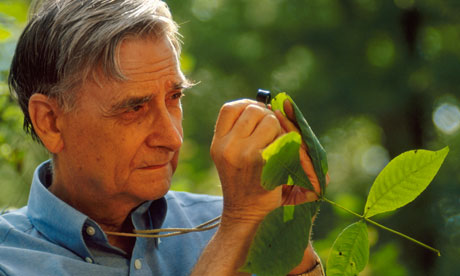
The religious impulse is to love and revere life – often represented as loving God, understood as the creator of life. Harvard biologist Edward O. Wilson offers a single word that sums up the impulse to love life and the healing and reconnection toward which that impulse leads: biophilia (love for life).

E. O. Wilson
The science of the 20th and 21st century includes a detailed description of the intricacy the interconnection of all things. And more than that: this science also gives us new material for describing our own yearning to be in connection. Wilson argues that evolution has built into us an affinity for life, biophilia:
“To explore and affiliate with life is a deep and complicated process in mental development. To an extent still undervalued in philosophy and religion, our existence depends on this propensity, our spirit is woven from it, hope rises on its currents.” (Wilson 1)
We are drawn toward life; we want it to be around us:
“Life of any kind is infinitely more interesting than almost any conceivable variety of inanimate matter.” (84)
This attraction toward living things is innate, wired into to us by millions of years of natural selection. It’s who we are, and we cannot build fulfilling and meaningful lives for ourselves – we cannot flourish – without a lot of life around: goldfish and houseplants at the least.
“We are in the fullest sense a biological species and will find little ultimate meaning apart from the remainder of life.” (Wilson 81)
Consider the way that humans, whatever their religious background, select habitat for themselves.
“For most of two million years human beings lived on the savannas of Africa, and subsequently those of Europe and Asia, vast, parklike grasslands dotted by groves and scattered trees.” (Wilson 109)
The right sort of habitat -- the habitat we were "made for" -- tells us about what is needed for human healing and reconnection. The savanna may not be the only spiritually wholesome habitat for humans, but it does contain these key features: wide open spaces affording a clear view for detecting animals and rival bands at long distance; a few cliffs, hillocks, and ridges which allowed still more distant surveillance and which provided overhangs and caves for shelter at night; scattered clumps of trees; lakes and rivers offering fish, mollusks, and new kinds of edible plants.

* * *
This is part 4 of 6 of "Soteriology: Biophilia"
Next: Part 5: "Small Islands"
Previous: Part 3: "Out from Under Over and Above"
Beginning: Part 1: "Drawing the Line"

2012-09-16

Out from Under Over and Above

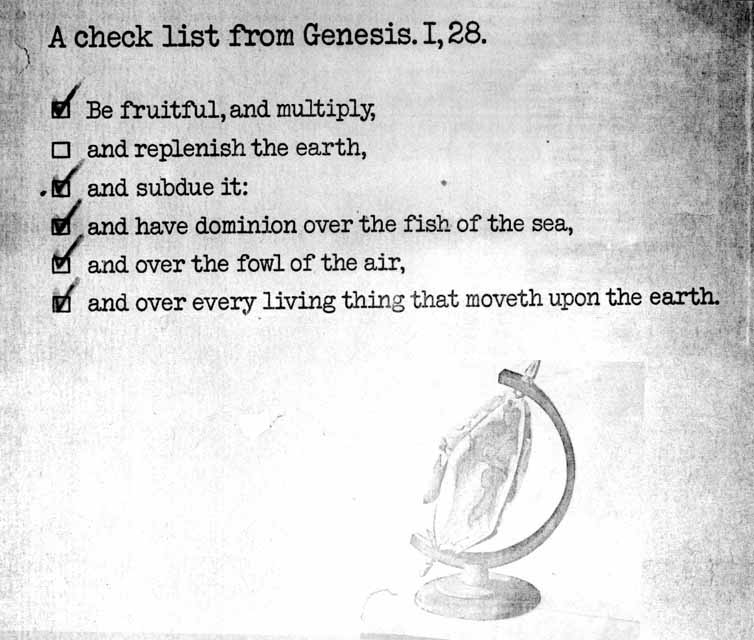
The part of our brain wired for what can be called “spiritual experience,” gives us a sense of our place in the web of life and the web of existence. Some religio-cultural traditions – like the historical Western religions – interpreted that feeling of place, of belonging, as meaning that we humans were on top: that we have dominion, are top dog, and all of nature is a bounty just for us. Genesis, chapter 1, tells us:
"God said, let us make man in our image, after our likeness, let them have dominion over the fish of the sea, and over the fowl of the air, and over the cattle, and over all the earth, and over every creeping thing that creepeth upon the earth. So God created man in his own image, in the image of God created he him; male and female created he them. And God blessed them, and God said unto them, Be fruitful, and multiply, and replenish the earth, and subdue it: and have dominion over the fish of the sea, and over the fowl of the air, and over every living thing that moveth upon the earth." (Gen. 1:26-28)
Darwin alone does not dislodge this habit of thinking of the human species as properly dominating all other species. Early Darwinists – and some people to this day who have no doubt about evolution as a force of nature – see evolution as aiming all along at producing humans.

(While evolution does tend toward complexity, it does not tend toward the human form of it. Moreover, it’s not clear how to measure complexity. For instance, while humans have the biggest brain-volume-to-body-mass ratio, dolphin brains have about as many total neurons and 40 percent more cerebral cortex than humans, part of which allows them to process sounds, as well as make sounds, much faster and in more detail than we can, so they can send and receive three-dimensional audio “images.” So are dolphins "more complex"? Hard to say. But whether humans count as the most complex kid on the block today, nothing’s to say that we – and the dolphins -- won’t, in the end, be surpassed by an even more complex species emerging from, say, descendents of the African gray parrot.)

On the one hand, we didn’t used to know that our lives are totally dependent upon bacteria – comparatively simple organisms. On the other hand, spiritual experience has always included a sense of humility. Given our ancient capacities and our recent knowledge, we can now say it is a good spiritual practice to remind ourselves that we are totally dependent upon bacteria for our very lives and sustenance. Knowledge gleaned from modern science is available to take on spiritual significance, if we let it.

Other religio-cultural traditions – like many Native American ones – interpreted our sense of place and belonging in nonhierarchical terms to begin with. For us westerners, modern science is at last correcting one particular mistake that certain nonwestern peoples never made. For westerners, it takes science, it seems, to help us understand that we are enmeshed in the web of life, and this web created us and sustains us. We have our role to play – just as every species does – in maintaining that web. In the web of interconnection, there truly is no "top," and no relation of "dominion."

Yet these teachings of science have not yet been very well or widely learned. In our culture, an inaccurate account of the self continues. We continue to find emphasis on a picture of
“the personal self in competition with and in opposition to nature. But if we destroy our environment, we are destroying what is in fact our larger self.” (Freya Matthews)
For modern westerners, the emergence of ecospirituality today is bringing together (a) our ancient and universal human capacity for spiritual response to the natural world around us, and (b) the descriptions of that nature only recently available to us through our science. This emergence, however, remains nascent for us. We are only beginning to come out from under the shadow of long cultural assumptions that the relationship between humans and the rest of nature is one of opposition and dominion or the attempt to dominate.

* * *
This is part 3 of 6 of "Soteriology: Biophilia"
Next: Part 4: "Soteriology and Biophilia"
Previous: Part 2: "Sacrifice"
Beginning: Part 1: "Drawing the Line"

2012-09-15

Sacrifice

Material things don’t make us happy. Within six months, at the longest, after even the most exciting material acquisition, a person's overall happiness is back to its baseline level. While we know that material things don't make us happy, it's also true that forcing ourselves to give them up before it feels right to do so won’t make us happy either. Mohandas Gandhi reminds us:
"No sacrifice is worth the name unless it is a joy. Sacrifice and a long face go ill together."
Many religious traditions recognize sacrifice as a spiritual practice. Our early ancestors noticed thousands of years ago that, while there is a certain satisfaction in acquiring things, it also, sometimes, feels good to give some of them up. Other times, the prospect of sacrificing doesn't feel so good -- in which case, as Gandhi cautions us, sacrifice isn't much good as a spiritual practice:
"Service which is rendered without joy helps neither the servant nor the served. As long as you derive inner help and comfort from anything, you should keep it. If you were to give it up in a mood of self-sacrifice or out of a stern sense of duty, you would continue to want it back, and that unsatisfied want would make trouble for you. Only give up a thing when you want some other condition so much that the thing no longer has any attraction for you."
Environmentalism runs into the question of sacrifice: what to give up, and how. This is a practical question (What will it take for human life on Earth to be sustainable?) as well as a spiritual one. Approaching it as spiritual may help us find and live with the practical answers.

Ecospirituality

Ecospirituality is the deliberate attention to those connections between the well-being of Morther Earth and our spiritual joy. It attunes us to hear the call to joy in our own path, however small our steps, toward better protecting this planet home of ours. It
“means that our experience of the divine comes through the natural world” (Jeanne Mackey).
Those who have been exploring this religion of nature, and have been developing a growing literature articulating it, are finding that the religion of nature is indeed the religion that is natural to us.
“The universe is the primary revelation of the divine, the primary scripture, the primary locus of divine-human communion” (Thomas Berry).
We can now discern a common basic wiring: a capacity for a certain kind of experience that we recognize as spiritual experience regardless of whatever cultural form it appears in, and for that experience to involve connection with nature. We’re also finding that a sense of contact with nature, with diversity of life forms, is an essential part of our health, whatever our religion.

Ecospirituality has pre-scientific and the post-scientific forms. At one level, ecospirituality doesn’t need science. It’s a transcultural imperative for any human and any time – before or after the scientific revolution. At another level, certain contents of our ecospirituality are available to us only recently, incorporating what modern science tells us about ecology, and the universe.

Humans have always looked to the natural universe. Only now do we have science’s sort of understanding of why we do so – and what it is we’re seeing when we look.

* * *
This is part 2 of 6 of "Soteriology: Biophilia"
Next: Part 3: "Out from Under Over and Above"
Previous: Part 1: "Drawing the Line"

2012-09-14

Drawing the Line

One hundred-thousand years, humans have been around as the species homo sapiens -- which makes us, as a species, very young. Still practically brand new. Our neighbors here in Florida, the alligators, have been around at least 100 times that long. This is a point made in a "Rustle the Leaf" comic strip.

Rustle the leaf and his acorn side-kick are talking as they look over a trash-despoiled wetland.

Acorn: “Stupid humans. “It’s like they have an obsession for trashing every corner of the planet.”

Rustle the Leaf: “Don’t be too hard on the human species. In geologic time, they’re just babies.”

Acorn ponders this, looks at the trash, and says: “How much longer ‘til they’re potty-trained?”

It would be nice to "grow up" -- or at least reach the stage of being potty-trained. But what exactly does that entail? How far do you and I need to go to be mature, responsible stewards of our planet home? The difficulty of the question was illustrated in another comic strip. A couple years ago my mother had a point to make about my environmental concerns and the actions I take out of that concern. She clipped out and mailed to me a Sunday comic strip of “Zits.”

Jeremy asks his friend, Pierce, “Why aren’t you wearing your boots today, Pierce?”

Pierce: “Can’t. I’m boycotting leather in support of animal rights.”

Jeremy: “Then couldn’t you just wear your sneakers?”

Pierce: “Nope. The rubber soles are made with petroleum-based plasticizers, and I’m against arctic drilling.”

Jeremy: “What about your wooden sandals?”

Pierce: “And support deforestation? Not likely. I’m an activist, Jeremy. I have to set an example to show others that there is a better way to live.”

In the last panel, we finally see Pierce’s footwear, as Jeremy says: “Hence, the tofu shoes.”

Pierce: “Teriyaki flavor. Want some?”

Sometimes the quest to do the right thing with our purchasing decisions can just seem silly.

I wrote back to Mom:
"It’s worse than that. Tofu is made from soybeans, and if the soybeans aren’t organic, there’s the harm of nitrogen-based fertilizers, and there’s pesticides. Even if it’s all organic, there may have been monoculture growing, without proper crop rotation and variation. Finally, even if you fix all that, there’s almost certainly some oppressed labor somewhere along the way. So, Mom, where do you draw the line? Do you so thoroughly trust your government as to figure that anything they haven’t outlawed has got to be morally and environmentally OK to participate in?”
She never answered. When I saw her some months later at Christmas, I asked her about it. "I assumed the question was rhetorical," she said.

I can imagine my children writing to me with that question: “Well, OK, Dad, where do you draw the line?” I don’t know if I’d answer either.

I am a vegetarian. Also, for the last dozen years all my clothes – all outerwear except socks – has come from second-hand thrift stores, and the occasional gift. I bicycle to work -- sometimes. So I draw the line somewhere north of supporting the environmental degradation of the meat industry and the labor oppression of the textile trade, at least directly. But I draw it somewhere south of driving a car, at least sometimes; flying in airplanes; using heating in the winter, air conditioning in the summer, and electric lights all year around; eating eggs and dairy (though I've cut way down); buying foods that are processed, packaged, and imported; and wearing shoes that aren’t even tofu.

I try to draw the line where it seems joyous to do so, where the gladness of simplicity calls. I urge you to use the same method for discerning where to draw the line -- though I expect your results from employing that method will differ from mine. Though the method of following where the spirit’s joy calls yields different results for different people, it is not an altogether easy method. "Follow your bliss" (as Joseph Campbell put it) is a rigorous path and a lot harder than, "Just do any old thing you happen to feel like."

* * *
This is part 1 of 6 of "Soteriology: Biophilia"
Next: Part 2: "Sacrifice"

2012-09-13

The Cruelty of Ideals and the Labor of Homecoming

Industrialist George Pullman was born, lived, and died a Universalist. Something of the Universalist outlook may be detected in his life and actions. He believed his workers deserved decent accommodations. He saw that education was a win-win: it made workers lives better, and made them more useful workers for businessmen like him. "I have faith," Pullman told the press, "in the educational and refining influences of beauty, and beautiful and harmonious surroundings."

Pullman had a kind of Universalist hope that different denominations could come together and worship together in one church. There is a certain idealist, utopian strain of thought in the planning of his town.

Shortly after Pullman's death in 1897, courts ordered
the homes sold to individual homeowners.
Liberal religion is characterized by an optimism about human possibility. From our beginnings 450 years ago, Unitarians and Universalists have been peoples who rejected Calvinistic conceptions of humankind’s total depravity. That optimism about human capacity is displayed in Pullman’s vision of a company town where every one was happy and productive.

So what went wrong?

It's not hard to see that what went wrong was that Pride and Control took over. Yes, people can get better – can learn, can grow: but they have to do so in their own way. Growth, learning, and development cannot be all planned out with precise outcomes determined in advance. Pullman believed in human improvability, but didn't believe in people enough to let them work out their own growth, awakening, salvation, in their own way -- even if they used their freedom to go backwards for a few years -- or a few generations -- and even if, left to their own devices, they drank, or listened to speeches from agitators, read independent newspapers, gathered and discussed unsavory ideas. Pullman wouldn't listen to his workers' needs. We can’t ever be so arrogant that we won’t meet and talk and consider where other people are coming from.

For Labor Day, remember George Pullman, the industrialist whose meanness sparked the events that led to the creation of the holiday.

Remember George Pullman, the Universalist who got the optimism but didn’t get the humility – because we Unitarian Universalists today follow in his footsteps in more ways than it's comfortable to admit. When has your voice of “let’s make it better,” come out as "fix it my way or I will treat you as evil obstructionist"? When have your own ideals made you cruel?

I think we do that every time we think someone else is wrong.

Then let this be our Labor Day prayer: to find the courage to talk to the people we think are wrong, and stay at it until we get over ourselves.

I've had a few long conversations in the last month – three-hour lunches or four-hour evenings that started with two hours in my office and continued at a bar. Earnest and exhausting conversations. It takes a long time to get over myself, to feel a way back to reconnection. I’m ready to keep having those conversations – as many as you’ll have with me. If you’re ready, I’m ready – because I think we’ve seen enough of iconic heroic loner figures talking to empty chairs. (If you missed it, I'm referring to Clint Eastwood’s convention speech addressing an empty chair, pretending it was occupied by the opposition candidate.)

It’s not the loner heroics, but boring community building that’s called for. It’s not the empty chairs, or the people we already agree with and understand, that we need to meet with and talk to.

“God rejoiced at our disobedience,” said Rabbi Kushner, “and then wept with joy that we could feel our estrangement and want to return home.” We feel the estrangement. For Labor Day, commit to the labor it takes to return home. That labor, we cannot send to China. To go into the labor of giving birth to ourselves -- to go into the labor of giving birth to community -- we can’t get surrogates in India. It’s up to us.

May we make it so.

Amen.

* * *
This is part 4 of 4 of "Going Into Labor"

Previous: Part 3: "The Origin of Labor Day"
Beginning: Part 1: "Labor"

2012-09-12

The Origin of Labor Day

The stock market crash of 1893 brought a depression in which 150 railroads closed and unemployment was massive. George Pullman cut his workers' wages by 25 percent, but did not reduce rents in the town of Pullman at all.

The next year, 1894, 4,000 Pullman employees went on a wildcat strike: "wildcat" because it wasn’t authorized by the workers’ trade union officials, and that was because they didn’t have any trade union officials because Pullman didn’t allow labor unions. Then organizers for Eugene Debs' American Railway Union came in and signed up many of the striking workers, and the Pullman strike spread. Soon 100,000 railroad workers across the country were refusing to handle trains with Pullman cars.

The strike shut down much of the nation's freight and passenger traffic west of Detroit. Various sympathy strikers prevented transportation of goods by walking off the job, obstructing railroad tracks or threatening and attacking the replacement workers the railroads sought to hire. At its peak, the strike involved 250,000 workers in 27 states.

Artist's rendering of the clash between striking Pullman workers and federal troops.
Pullman called up his friend and fellow railroad director, United States Attorney General Richard Olney. With President Grover Cleveland's backing, troops were sent to Chicago. The federal government secured a federal court injunction against the union, Debs, and the top leaders ordering them to stop interfering with trains that carried mail cars. They refused. The Army moved in to stop the strikers from obstructing the trains. Violence broke out in a number of cities: millions of dollars in damages and 30 people were killed.

The Army broke the strike. Debs went to prison for violating a court order. The railroads fired and black-listed all the employees who had supported the strike. As soon as the strike was over and the trains were running, President Cleveland and Congress moved quickly to make conciliation to organized labor.

Six days after the 1894 Pullman strike ended, legislation was pushed through Congress declaring that the first Monday of September was a Federal holiday, Labor Day. So we have Labor Day as a consolation prize after the Feds sent in troops to protect corporate interests and break up a strike. It was a bone to try to head off further conflict. And they put it in September, instead of giving official recognition to the more widely known International Workers Day on May 1, because they wanted to pull attention away from the more radical labor movements.

Every Labor Day, let us remember this story of the origin of the holiday. The story of conflict between "management" (the wealthy, the controllers of capital) and people whose labor they want to make use of (slaves, indentured servants, laborers) is the central and on-going story of our country. This is who we are as a people.

Labor Union membership peaked in the 1940s and 50s, and has been declining ever since. The number of working poor has been climbing. The percentage of all workers whose incomes fall below the poverty threshold was 4.7% in 2000, and rose to 7.2% by 2010. On the weekend for celebrating labor, let’s remember those who labor but whose pay is so low that they remain in poverty.

The story of George Pullman is of particular salience to us Unitarian Universalists. This is our story, quite specifically. You see, George Pullman was one of us in a very direct sense. George Pullman was a Universalist: born, raised, and lifelong.

George’s father, raised a Baptist, and his mother, raised Presbyterian, converted to Universalism, drawn to the “God is Love” message of the Universalist minister Thomas Eaton. George's Dad often led the services when no preacher was available.

The Pullmans were a devotedly, devoutly, Universalist family. Both of George’s two older brothers became Universalist ministers and were prominent figures in our faith. Late in his life, George Pullman had a Universalist church built in his hometown, Albion, New York, as a memorial to his parents.

* * *
This is part 3 of 4 of "Going Into Labor"

Next: Part 4: "The Cruelty of Ideals and the Labor of Homecoming"
Previous: Part 2: "Pullman, Illinois"
Beginning: Part 1: "Labor"

2012-09-11

Pullman, Illinois

A holiday becomes again a holy day when, among other things, we honor the occasion with retellings of particular sacred stories -- stories made sacred by the meaning we give them. What are the stories that consecrate Labor Day?

George Pullman, 1831-1897
I'm not sure Labor Day has any widely recognized sacred stories, so let me offer a story as a candidate for adopting and making sacred through the widespread retelling of it every Labor Day. This is the cautionary tale of industrialist George Pullman, born 1831. He founded the Pullman Palace Car Company that manufactured railroad cars, particularly the Pullman sleeping car.

In 1880, he bought 4,000 acres 14 miles south of Chicago, and got an architect to design not only his new plant for making railroad cars, but a whole town: houses for 10,000 workers, shopping areas, a church, theatres, parks, a hotel, and a library – all owned by one man. He built and owned the power plant that powered his factory and his town. The town was named after him: “Pullman, Illinois.” Pullman’s workers worked for him, lived in houses owned by him, paid their rent and their utilities to him, and shopped in stores owned by him, strolled in his parks.

His aim was to solve the issue of labor unrest and poverty. For years Pullman had been a philanthropic supporter of fine schools – with the aim of providing business with a better quality of laborer. He wanted a happy, loyal workforce, so his town provided for all his workers’ needs. They got a state-of-the art home: indoor plumbing, gas lights, sewers – well above the average dwelling of the time. They got fine country air and beautiful neighborhoods. The mortality statistics, indeed, established that Pullman, Illinois was one of the most healthful places in the world to live. The town created a national sensation. The press praised Pullman’s benevolence and vision.

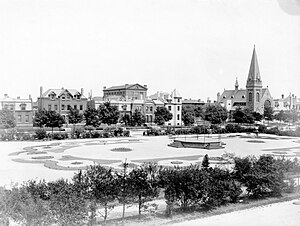
Pullman, Illinois
To ensure there would be no unhappiness, Pullman prohibited outside agitators, allowed no saloons, or vice district. The hotel on the edge of town had the town’s only bar, and it was open only to visitors, not the residents. He prohibited independent newspapers, public speeches, town meetings or open discussion. He wanted his workers to have clean homes, so his inspectors regularly entered homes to inspect for cleanliness and could terminate leases on ten days notice. Private charitable organizations were prohibited.

He built only one church building in his town: the Greenstone Church. Pullman’s plan was that all religious denominations would band together and share the one building. But the various denominations would not unite, and no single denomination could afford the rent, so the church stood empty for the town’s first seven years until Pullman finally slashed the rent by two-thirds, and Presbyterians rented it.

Then in 1893 the stock market crashed. The railroad "bubble" (overbuilding railroads, and relying on shaky financing to do it) burst. The "Panic of 1893" was, at the time, the worst economic depression the United States had ever experienced. 150 railroads closed. There was massive unemployment. Pullman cut his workers' wages by 25 percent or more. He did not, however, reduce the rents he charged his workers for living in Pullman, Illinois.

* * *
This is part 2 of 4 of "Going Into Labor"

Next: Part 3: "The Origin of Labor Day"
Previous: Part 1: "Labor"

2012-09-10

Labor

The three-day Labor Day weekend celebrates the economic and social contributions of workers. Many of us had the day off from work or classes and were glad to have a chance to gather with friends, have a cook-out. It’s a chance to have a good time.

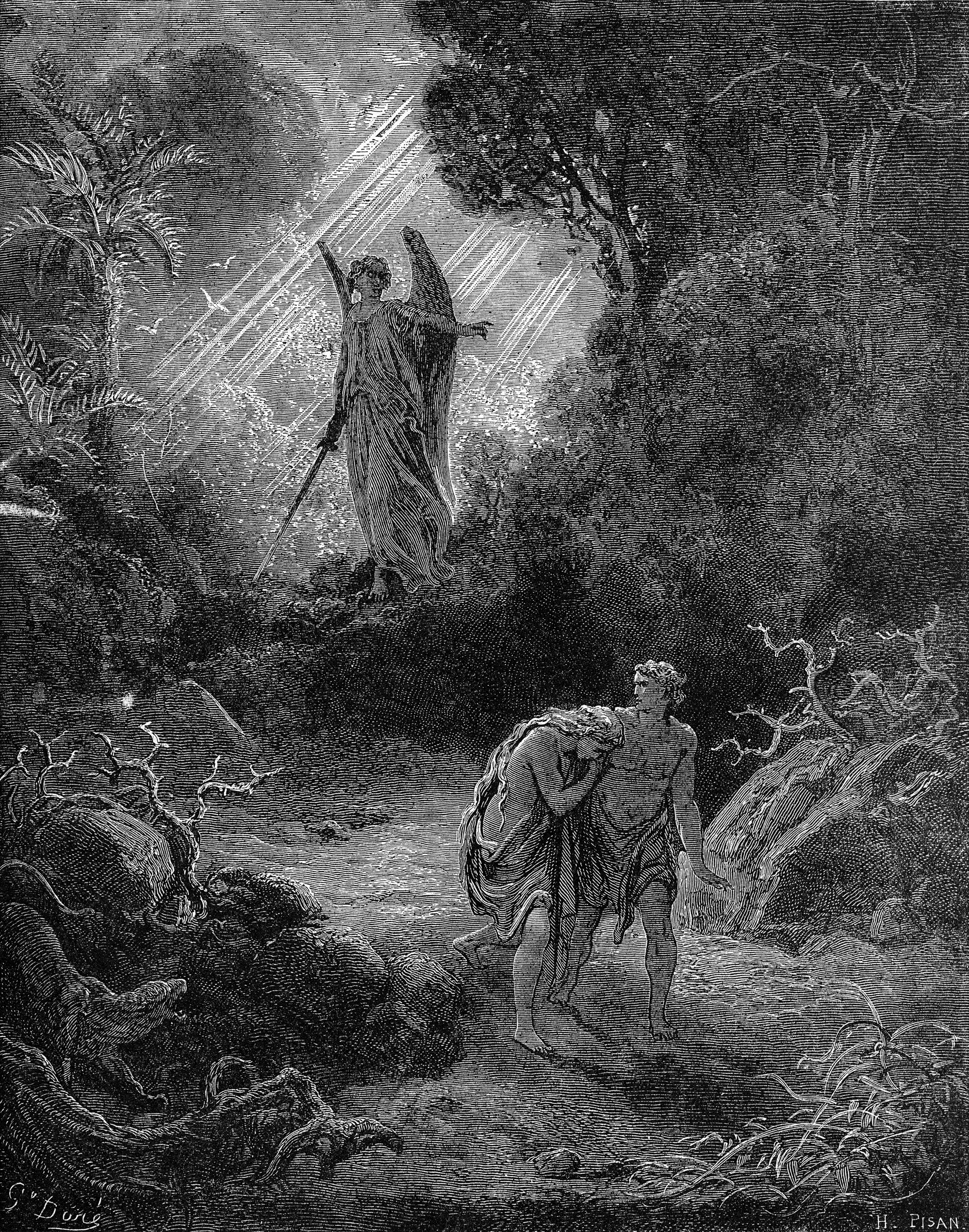
For Labor Day, we honor and celebrate: Labor. At the same time, Western civilization happens to inherit a tradition in which labor is punishment. In the Genesis story, the original humans ate “of the tree of the knowledge of good and evil,” and Yahweh kicked them out of paradise, and gave them labor: gender-specific labor. The woman’s labor is childbearing:
“I will greatly increase your pangs in childbearing; in pain you shall bring forth children” (Gen. 3:16)
The man’s labor is working the fields.
“Cursed is the ground because of you. In toil you shall eat of it all the days of your life. Thorns and thistles it shall bring forth for you, and you shall eat the plants of the field. By the sweat of your face you shall eat bread. (Gen. 3:17-19)”
So labor is what we have to endure because we ate of a tree and got called out. We go out of Eden and go into: labor. Tough break.

The interpretation of that Genesis story that makes more sense to me is one offered by Rabbi Lawrence Kushner in Eyes Remade for Wonder. Kushner suggests that the whole thing was a setup. Like any good parent, God knew that to grow up we would have to leave home and so put that tree there to create a pretext for kicking us out.
“We have read it all wrong. God was not angry. God rejoiced at our disobedience and then wept with joy that we could feel our estrangement and want to return home.”
The return home, however, is not easy. It is, in fact, labor. For the most part, though, we think of labor less as the work of "returning home" and more as punishment. When we can, we avoid it -- outsource it to Asia.

We outsource factory labor and telephoning labor. We even outsource the childbirth labor. Someone creates an embryo in a lab, ships it abroad for gestation in a stranger's body, then takes possession again after birth. Overseas labor – of both kinds – is cheaper. Farmed-out childbirth is an industry in India, turning the rural poor into wombs for hire.

The trend to outsource our labor was satirized in “The Borowitz Report,” which ran this fake-news piece:
“Labor Day Officially Moved to China. First US Holiday to be Outsourced. Labor Day, one of America's most beloved and longest-celebrated holidays, has been officially moved to China, U.S. officials confirmed today. The Labor Day celebrations are expected to kick off Monday afternoon in Beijing with a barbeque attended by over seven million people and presided over by former NBA star Yao Ming. The transfer of Labor Day to China represents the first time in American history that an entire holiday has been outsourced, experts said....Meanwhile, U.S. officials said it was looking 'more and more likely' that Thanksgiving would be relocated this year to India. 'At the very least, Americans will still be able to celebrate Thanksgiving by phone,' one official said. 'But they should listen closely because some menu options have changed.'"
Well, that’s silly. Whatever work we may have sent overseas, we will always have the work of living here, and with it, our celebrations.

Labor day is a holiday – which originally meant holy day. Let us, then, remember the holiness of work – whether we work for pay or not. Whether or not labor seems to us to be a pain or a drudgery to endure just to pay the pills, there is before us also the prospect of labor as the path home.

* * *
This is part 1 of 4 of "Going Into Labor"

Next: Part 2: "Pullman, Illinois"

2012-09-09

To Have All You Want, Want All You Have

Noticing our desires, holding them in the gaze of attention, often softens their grip. Many times, they simply vanish.

I had a friend once who discovered one day that she thought it would be really cool to own a hummer – one of those tank-like vehicles that were unaccountably popular for a while. After a week of dragging her friends around to showrooms to gaze lovingly at these beasts, some of those friends were able, gently, to muse with her about where that desire was coming from. When she carefully examined it, it just vanished. Not all our desires will do that – and we wouldn’t want them to – but some of them will, and those are the ones for which we are better off if they do vanish.

Gaining liberation from the desires that don’t make our life better takes some time, some effort, some work. In the end, though, it will take less time, effort, and work, than pouring our lives into the desire treadmill that never satisfies.

As the philosopher William Irvine argues:
“If we like what the Zen Buddhists have to say about mastering desire, we might want to spend hours in silent meditation. If we like what the Amish say, we might want to join an Amish community (if they will have us). If we like what the Stoic philosophers say, we might want to spend time studying their writings. But having said this, I should add that the time and effort we spend trying to master desire are probably considerably less than the time and effort we will expend if we instead capitulate to our desires and spend our days, as so many people do, working incessantly to fulfill whatever desires float into our head.” (On Desire 8).
So what do you want? Your first thought might be, like the James Earl Jones character in Field of Dreams, to start listing off your frustrations. Occasionally, you are able to relax into enjoying a simple pleasure: “Oh. A dog and a beer.”

There’s another desire in there – so often buried under the constant scream of various other day-to-day desire – and that’s why, I think, we’re here, whether we quite consciously know it or not. We probably understand, cognitively, that the path to happiness, well-being, contentment is not to get what we want but to want what we have. To really do that, though -- to want all and only what one has -- is a rare thing. To perceive sacred mystery in what we have right here, to catch a whiff of the holiness of life, helps us get to that place of wanting just what we have.

Maybe you’re a single mom who had a particularly frazzled week. Your child had a sore throat this week, which made you late for work, where the boss scolded you, and you were so grumpy you started an argument with a secretary. Now it's the evening or weekend and you've found a few moments taking a look at Lake Chalice, maybe hoping for some tips or strategies for holding together the competing demands on your life. Or maybe you seek some spiritual entertainment to distract you from the insanity of your week.

What Lake Chalice would like to offer you, at the end of this five-part ramble through the terrain of human desire, is that life is shot through with sacred mystery. You might not be accustomed to hearing that your frazzled days of rush and frustration are holy, just as they are.

The best thing about desire is that it energizes us to engage with this wonderful, wonderful world. The worst thing about desire is that its constant screaming obscures from us the wonder of what we have.

Standing in the place of wonder, of love for just what is, a new and peaceful strength comes to us. Desires arise, then, and do not so instantly seize control, but await our assessment: Is that really going to make my life better? If so, OK. If not, let’s put that one on hold. To open to the presence of holiness all around us is our quietest, greatest, most important yet most easily ignored, desire.

Amen.

* * *
This is part 5 of 5 of "Desire!"

Previous: Part 4: "Your Inner Whining Child"
Beginning: Part 1: "Fields of Dreams, Streetcars of Desire"

2012-09-08

Your Inner Whining Child

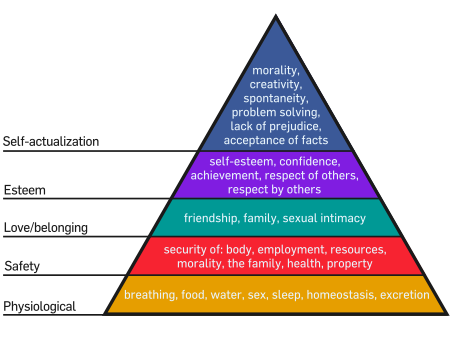
The psychologist Abraham Maslow developed a pyramid of human needs. At the base are physiological desires: breathing, food, water, sleep, sex, homeostasis. Next up are safety desires: security of body, resources, family, health, property. Third level are desires for love and belonging: friendship, family, intimacy. Fourth are desires for esteem: for confidence, achievement, the respect of others. And the top level is desire for self-actualization: the desire to be creative, accepting, nonprejudicial, serene.

Maslow’s idea was that we work on the lower-level desires first, and when those are met, we move up to pursue the next higher level of desire. But that can’t be quite right. Sleep, for example, is a first-level, basic physiological desire. Yet lots of us are sleep deprived – and we gave up sleep to put in longer hours at work to better meet those higher-level esteem needs. Some of us even give up sleep, food, comforts, security in order to pursue self-actualization desires to be creative, compassionate, and at peace. Experience seems to show that those desires at the top of Maslow’s pyramid do not, in fact, depend on the lower desires first being met.

You might say that the story of Siddhartha, who became the Buddha, fits the basic picture. He was a prince, grew up in luxury and high status, and, with those lower needs not occupying his worry, moved on to seek self-actualization. On the other hand, the story of Jesus, who became the Christ, is story of a person in poverty and very low status who turned to self-actualization without ever really nailing down those security desires. We also know that most people who are plenty wealthy enough to have the first four levels of need met do not move on to the kind of self-actualization that Jesus and Siddhartha did. So meeting the supposedly lower-level desires turns out to be neither necessary nor sufficient for pursuing the very highest-level desires.

Most of us do sacrifice a lot for status – for the admiration, respect, and even, if possible, the envy of other people. We work hard to project that image calculated to induce other people to think well of us. To finance all this image-projection, we might spend our adult life in a job we hate – pretending to love it, because, after all, it’s not very admirable to be stuck in a job you hate.

Arthur Schopenhauer, a 19th-century German philosopher, wrote that
“almost all our sufferings spring from having to do with other people.”
He adds that
“The [Greek philosophers known as the] Cynics renounced all private property in order to attain the bliss of having nothing to trouble them; and to renounce society with the same object is the wisest thing [one] can do.”
Our desires are like an ultra-headstrong five-year-old inside our psyche: a child who “never tires of whining, whose whining can’t be avoided” (Irvine). We are like the parents who give-in, who find that the only way life will be tolerable is to give the child what it wants most of the time. Good parenting, though, we know, while it does mean saying ‘yes,’ a lot, it also means standing fast on ‘no,’ sometimes – for the sake of the child’s and the family’s long-term good. And, often, it involves skillful negotiated substitution.
“No, you can’t have that candy bar now. You’ve already had one today. I want to respect that you are hungry. I hear that, and I share your concern about that. We do have fruit available. And, you may have another candy bar tomorrow.”
Or we bargain:
“Tell you what, if you’ll clean up your room and empty all the trashcans in the house, you can have the candy bar.”
Learning to wisely live with our desires is a lot like learning to wisely live with a demanding five-year-old. To get good at it means getting good at recognizing when indulging is unwise, and, in those cases, getting good at using substitution and bargaining.

For many adults, that whining inner child is whining for more success – which means recognition by others of accomplishment.
“Success is very much like a drug: it makes you feel good; you don’t know what your are missing until you experience it; once you experience it, you want more; and in your attempts to recapture that first high, you will have to resort to ever bigger ‘doses.’ And if success is like a drug, some drugs are like success: a cocaine high, [as I understand], very much resembles the rush of success.” (Irvine)
We are built to crave that drug of success: we are born to be addicted to it. Yet, it is a never-ending treadmill – and it never allows us to be satisfied, content with our life. We are hijacked by desires many of which will not improve our lives. Denying and repressing them just makes them stronger. Noticing and looking at them, though, weakens them. Many times, in the light of conscious attention, they simply vanish.

* * *
This is part 4 of 5 of "Desire!"

Next: Part 5: "To Have All You Want, Want All You Have"
Previous: Part 3: "Two Thought Experiments"
Beginning: Part 1: "Fields of Dreams, Streetcars of Desire"

2012-09-07

Two Thought Experiments

In moving toward simply bringing more consciousness and awareness to our own desires, notice just how much our social position is a huge part of what we want. To illustrate the power of our concern over social position, let me ask you to imagine this scenario:

You work in an office, and one day you
“receive an anonymous letter listing the salaries of the people in the office in which you work. Your salary listing is correct, but you notice that you are way down on the pay scale. In fact, people who have been there a shorter time and have less experience than you nevertheless draw a bigger salary. You are angry and depressed. You consider quitting. Then you notice that your co-workers are massed around a memo your boss has posted on the office bulletin board. According to the memo, someone, in order to stir up resentment at the workplace, has been sending people false salary listings. The person in question has apparently obtained the actual list of salaries to work from, since he always correctly gives the salary of the letter’s recipient, thereby adding an element of authenticity to his letter. To restore office harmony, the boss adds, he is posting this one time only a listing of everyone’s salaries. Your eyes turn to the listing in question. You find your own salary. And when you look at the salaries of your co-workers, you realize that compared to them, you are very highly paid. Your self-esteem soars. In fact, you take on a mildly condescending attitude toward your co-workers.” (William Irvine, On Desire)
It’s the same salary either way – but that same salary that was first made unsatisfying was then made very satisfying.

When we shine the light of consciousness on this desire for social rank, only then can we, maybe, begin to see through it. We have to notice how much we cared about it in order to begin moving toward not caring about it so much.

By doing that little thought experiment, you might find yourself saying, hey, it’s silly for me to care as much about my relative position in the office as I have. I will still care about it some, but not as much. I think I’ll pay more attention to just being glad I have enough.

For a second thought experiment, try this. Suppose you awoke tomorrow morning to find yourself the only human on Earth. Space aliens had spirited everyone else away, leaving only you. There are enough canned goods in the stores to ensure you a lifetime of plenty of food -- and the orchards will continue to bear fruit in season, and let’s say that electricity and plumbing somehow continue to work without people maintaining them. At the gas pump, you can swipe your credit card to dispense gasoline, but of course you never get the bill. You now, essentially, own everything. You can take any car, live in any house. You can stroll into the most expensive fashion boutiques and pick out any clothes. You can drive up to Washington, DC if you want to, get the Hope diamond out of the Smithsonian, and wear it around.

This could be you.
At first, perhaps, you might do some of these things: live in a palace, wear the most expensive clothing, a Rolex watch, sip the most expensive wines, drive around in an Italian sportscar or a Rolls Royce picking up the greatest art works from museums to hang in your palace. I think you’d fairly quickly tire of all this, though, don’t you? Before long you’d be back in a smaller house: cozier, easier to keep clean. You’d wear any old comfortable thing, or stroll around in pajamas all day. If that.

What this shows us, again, is how much impact other people have on our desires. We dress, choose a house, a car, a wristwatch with other people in mind. We spend large percentages of whatever we have to project an image calculated to gain the admiration of other people – or, better yet, their envy.

* * *
This is part 3 of 5 of "Desire!"

Next: Part 4: "Your Inner Whining Child"
Previous: Part 2: "First, Notice"
Beginning: Part 1: "Fields of Dreams, Streetcars of Desire"

2012-09-06

First, Notice

Desires that enhance reproductive success spread and grew -- and those are the desires we inherit, built into us. Thus we desire, for instance, status – because status gives access to healthier mates, more food, more protection, more assurance of healthy children to carry on our genes.

Here's our problem: restless, unsatisfied anxiety to always get more, to never be satisfied, facilitates reproduction better than being happy, content, and satisfied does. What a predicament! Where’s the hope for us?

Notice, however, that desires are always competing with each other. Does the organism go looking for food, or seek safety from some danger, or seek a mate? Once there are multiple options, then there are desires. Something has to determine whether the organism will seek food, safety, or a mate, and we name that something “desire.”

Desires are there to compete with each other to determine what will do. So if the food desire is shouting louder than the safety desire – because it’s been a while since the animal ate, and there are no signs of danger – then the animal will usually go about trying to rustle up some grub.

Your desire for another piece of pie competes with your desire to be trim and svelte. Your desire for job success – and the things that go with that – competes with your desire to sleep in on Monday morning. Because there are always competing desires, there’s hope for us for a kind of liberation. The desire that happens to be yelling the loudest doesn’t have to win. We can, if we work on it, bring thoughtful intentionality to our desires, and thereby reduce the attraction of the desire that happens to be loudest at a particular moment, and increase the influence of quieter desires.

Let's say a desire intrudes itself on me. "Pizza!" I can ask myself, "Where did that come from?" Or, somewhat more expensively, suppose I discover this desire: “I think I’d like to own an original Van Gogh.” I can turn the light of attention on the desire. I can explore where it might have come from.

The young Thomas Merton was, in his college years, a hard drinker who ran with a fast crowd and fathered a child out of wedlock. He was, in his own words,
“an extremely unpleasant sort of person – vain, self-centered, dissolute, weak, irresolute, undisciplined, sensual, obscene, and proud. I was a mess.”
Then, out of the blue, he felt a desire to convert to Catholicism. He took instruction, got baptized, and became a Catholic. Shortly thereafter, he got another spontaneous desire: to become a priest. He tried the Franciscans for a while. And then a third desire: to be a Trappist.

He didn’t know where the desire came from, but there it was: powerful, irresistible, clear. As William Irvine suggests, there is something very disturbing about Thomas Merton’s story.
“It raises the possibility that we are all just three spontaneous desires away from life in a Trappist Monastery.”
This could be you.
When it comes to making our peace with ourselves, making our peace with being creatures filled with desires imposed upon us and out of our control, the first step is noticing. Just step back and say: "Ah, there’s that desire." And bring a curiosity to it: "Where did you come from, desire? You are legitimate, I will not deny your presence or try to repress you. But maybe you need not be indulged, either."

In moving toward simply bringing more consciousness and awareness to our own desires, notice just how much our social position is a huge part of what we want.

* * *
This is part 2 of 5 of "Desire"

Next: Part 3: "Two Thought Experiments"
Previous: Part 1: "Fields of Dreams, Streetcars of Desire"

2012-09-05

Fields of Dreams, Streetcars of Desire

What is the role of DESIRE in your life? Or perhaps the question to ask is: Is there a role for anything else? Choose a set of desires and everything in life is determined from there. The thing is, we don't choose our desires. Desires just appear on their own.

What desires are grabbing hold of you these days? What do you want?

In the 1989 film, “Field of Dreams,” Kevin Costner goes to see the reclusive writer played by James Earl Jones. Jones tries to chase him away, but Costner prevails upon him to go to a baseball game. They’re at the game, standing in front of the concession stand.

Costner: “So what do you want?”
Jones: “I want them to stop looking to me for answers, begging me to speak again, write again, be a leader. I want them to start thinking for themselves. I want my privacy.”
Costner (pointing to the concession stand menu): “No, I mean, what do you WANT?”
Jones: “Oh. Dog and a beer.”

It’s wonderful to see Jones’ character relax into the present. There he was getting into his familiar wind-up about people, with the unreasonable things they do and want – these people this and those people that. What a relief it always is to set that aside -- to come back to: what’s right here. Why, it’s a baseball game, with concessions in the offing. There is nothing to want more complicated than, “dog and a beer.”

Desire seems to take us down the tracks that it wants, without our choosing. Can we ever get off of the streetcar named "desire" -- or do we only switch from one to another, without choosing the switch either?

The screen adaptation of Tennessee Williams' play, "A Streetcar Named Desire,” is best remembered for Marlon Brando's anguished cry of desire for connection and acceptance, calling out for his wife, "STELLAAAaaa!" Brando's character, Stanley Kowalski, had hit Stella, and Stella sought refuge in the neighbor’s upstairs apartment. Later, in remorse and desire, he cries after her.

We spend much (all?) of our lives riding on that streetcar named desire. There actually, incidently, was a streetcar line called the Desire Line in New Orleans. It ran from 1920 to 1948, when streetcars were at their height in that town. The route ran down Bourbon, through the Quarter, to Desire Street and back up to Canal. When Stella’s sister, Blanche Dubois, comes to visit the Kowalskis, she describes her route:
"They told me to take a streetcar named Desire, transfer to one called Cemeteries and ride six blocks and get off at — Elysian Fields!"
That particular route is fictitious, and will, as we learn more about Blanche, represent how Blanche’s ride on desire has led to her spiritual death – for desire leads to Cemeteries and Elysian Fields, the land of the dead in Greek mythology.

Desires pop into our heads, seemingly out of nowhere. We don’t choose our desires, we discover them. They just show up at the door, like Blanche Dubois with a big suitcase, ready to move in and start asking us to do their bidding.

And we do need them. We need desire. Desire, after all, is another word for caring about something. Desirelessness would be deep, paralyzing depression – not able to move because not able to want what moving could get. Evolution built us to want to find food, avoid predators, find a mate. Evolution made sugary foods feel good because it was better for us to eat fruit that was ripe. Fatty foods feel good because out on the Savannah 10 million years ago, we needed all the fat we could get. Making love feels good, and nurturing feels good, especially for young adult females, and chasing down game feels good, especially for young adult males, because evolution needed us to do those things – or, we might say more precisely and simply: the ones that did those things made more copies of themselves.

* * *
This is part 1 of 5 of "Desire."

Next: Part 2: "First, Notice"

2012-09-04

How Do You Want to Grow?

For the last year, I’ve been asking the members of the Unitarian Universalist Fellowship of Gainesville: "In what ways do you want to grow? What does growing look like for you?"

A couple months ago the Fellowship was invited to take a survey. It asked:
How would you complete this sentence: “I would like my connection with UUFG to help guide, provoke, and facilitate my transformation toward being a person who . . . .”
In other words, what is growing for you? Growing toward what? The survey listed 37 answers that had been submitted by UUFG members over the previous year.

The answer that got the most resonance was:

“...is a better person.”

There is a widespread agreement among us that we want to grow toward being a better person. And what does being a better person look like for us? Other top answers help give a clue.

“...really is as tolerant, open-minded, and accepting as I sometimes assume I am.”

“...is kinder and more compassionate.”

“...has deeper spiritual connections; has learned better ways to deal with my feelings around conflicts; shows and helps others show more love and trust.”

“...embodies compassionate wisdom and equanimity; constantly and continuously at every moment serves justice, peace, and the needs of sentient beings.”

These were some of the top responses of who we said we wanted to be. It’s not who we said we thought we were. It’s what we said we’re here to help each other grow toward.

In the months ahead, we’ll be using these results to suggest a number of options for a mission statement that best expresses our collective sense of the growing we’re here for. We’ll be inviting everyone into more conversation and more suggestions around those possibilities. The process of articulating together how we want to help each other grow is itself what growing looks like.

And if you are having a moment when growing just doesn’t seem possible, give Starr Austin, our new Director of Religious Education, a call. Tell her you’d like to be involved in our Children’s and Youth ministry. Our kids, reliably, will show you how growing is done.

Count on it.

Amen.

* * *
This is part 6 of 6 of "What Growing Looks Like"

Previous: Part 5: "Hiding Behind the Veil of Reason"
Beginning: Part 1: "Growth Amidst Perfection"

2012-09-02

Hiding Behind the Veil of Reason

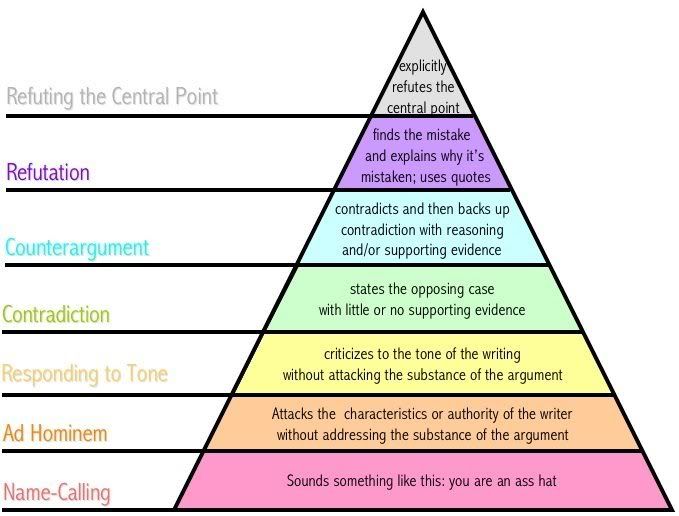
It's really not that hard to get to the top of this pyramid.
It is, in fact, a fair bit easier than genuine self-understanding
My personal favorite form of resistance to growing is rational argument.

When I’m having a hard time growing with some new development – and every day brings some new development, if we’re paying attention – I will lay out exactly why the world and other people are wrong about that. I’m pretty good at this. I will weave such an adamantine web of logic that all opposition will be as mental midgets in comparison to the brilliance of my critique.

And it’s not just me that thinks so. I can always find some others who will agree. “Right on,” they will say as I explain what’s totally unreasonable about what some other person or group has done.

Some friends, though, just nod and say, “uh-huh,” and then ask where all this energy of resistance is coming from.

This annoys me. “The argument!” I want to say. “Can we keep our eye on the ball, here? Look! Clear and rational reasons why the world is wrong, wrong! Right?”

These friends will say, “I hear you. I’m just not sure that’s the best ball to be watching right now”

These are the friends who serve me better, who help me see past the argument to the fear that drives it.

Argument-making is the easy part. I can make arguments for just about any side of any question. As a high school debater, I’d defend the affirmative side one round, and a few minutes later the negative side in the next round, as easily as putting now the left foot forward and now the right foot.

In college I studied philosophy. My favorite teacher and philosopher once defined a philosopher as someone who can make the best possible argument for any position no matter how wrong-headed.

David Hume, 1711-1776
Seen here at the beginning of
abortive career in haberdashery
I think argument is fairly easy for most of us even if we don’t have formal credentials in it.

The harder part is the inner work, the self-understanding. “Reason is and ought only to be the slave of the passions,” said David Hume. And one of the things that my reason does in its diligent service to my emotions, is distract me from investigating those emotions -- since actually looking at my stuff will weaken the hold those emotions have on me.

Looking at my stuff -- is what growing looks like.

Other people help me do that. We come together in faith community to be people who help each other grow. Look around you at church (or synagogue or temple or fellowship . . .) on Sunday morning (or Friday evening, or . . .) That's what growing looks like.

* * *
This is part 5 of 6 of "What Growing Looks Like"

Next: Part 6: "How Do You Want to Grow?"
Previous: Part 4: "Only Way Out is Through"
Beginning: Part 1: "Growth Amidst Perfection"

2012-09-01

Only Way Out Is Through

When we’re frozen, paralyzed with fear – or paralyzed with comfort – hovering over the big hole, we could spend the rest of our lives stuck there. Or we could get into it. That would be what growing looks like.
“If you can’t get out of it, get into it.”
I had not heard of the Outward Bound motto when I formulated my own version of that wisdom. The year I worked as a hospital chaplain, I started to think, and sometimes to say:
“The only way out is through.”
At least, I thought at the time it was my own. Turns out a lot of people use the expression -- including Alanis Morissette in a song of hers:
“Every time I'm confused
I think there must be easier ways
Every time our horns are locked I'm towel throwing
Every time we're at a loss, we've bolted from difficulty
Anytime we're in stalemate of final bowing
My tendency to want to hide away feels easier and
The immediacy is picturing another place comforting to go
We could just walk away and hide our heads in the sand
We could just call it quits, only to start all over again with somebody else
The only way out is through
The faster we're in the better
The only way out is through.”


"The only way out is through." I said this to myself, mostly, as I worked through my "stuff." I'm not sure if I ever said it out loud to a patient -- though I had it in mind as they told me about their "stuff."

Whatever your difficulty, your problem, whatever fear or sadness besets you, turn toward it rather than away – embrace your demons rather than push them away – plunge into whatever it is that you don’t like about your situation or your self, rather than repress it. The only way out is through.

Avoiding what makes us anxious, gives the anxiety more power. It has long been a part of folk wisdom to get back on the horse that threw you, back on the bicycle you fell off of. The way to get over fear of elevators is to keep getting into them. The way to get over fear of spiders is to handle them. (Maybe it’s not worth it to get over that fear!) The only way out is through.

Doctor Kenneth Porter also uses that expression when writing about depression. He recommends awareness
“Let yourself feel the actual physical and emotional sensations of the depression.” 
Understand it. It’s coming from a legitimate place and doesn’t mean anything’s wrong with you. Accept it, and yourself. Don’t run away from it.

The only way out is through. You can’t get out of it, so get into it. That’s what growing looks like.

* * *
This is part 4 of 6 of "What Growing Looks Like"

Next: Part 5: "Hiding Behind the Veil of Reason"
Previous: Part 3: "If You Can't Get Out, Get In"
Beginning: Part 1: "Growth Amidst Perfection"