2013-06-14

Yay for Our Team

We Unitarian Universalists have a reputation for being logically minded. There was a Unitarian Universalist who was on death row. On the eve before his execution, the Warden asked, “It’s customary for the condemned to have time with a priest or chaplain. Would you like me to get you a priest? A chaplain?"

The man said, “I’m a Unitarian Universalist.”

The Warden said, “In that case, would you like to talk to a math professor?”

I’ve got this part of me that says, “Now that’s not fair!” Then I’ve got this other part of me that says, actually, I think, before I die, I would like some help making my peace with transfinite cardinal numbers. (Neither infinite nor finite? What kind of Zen math is that?)

We of liberal religion do have a reputation for being logically minded. We’re also quick thinkers. There was a Unitarian Universalist youth, working her first job in grocery store. A man comes up and asks for half a head of lettuce. She says, “Hold on.” She goes back to talk to the manager. She’s telling the manager, “There's a jerk out there who wants to buy half a head of lettuce.” Just then she notices that the man has followed her and is standing behind her, so she says,“and this fine gentleman wants to buy the other half." Quick thinking!

For all that, we have learned that it isn’t thinking that saves us. It’s each other. Thinking can be glorious, but it can also be dreary when we’re by ourselves. I heard about a highway sign along a desert stretch of highway: "Your Own Tedious Thoughts, next 200 miles." Together with others we are lifted out of the constant tedium of our own thoughts.

It’s said that Jews don’t recognize Jesus as the Messiah, that Muslims don’t recognize Jews as God’s chosen people, that Protestants don’t recognize the Pope as the leader of the Christian world, that some Episcopalians don’t recognize their own bishop (if said bishop happens to be gay), that Baptists don’t recognize each other in the liquor store, and that UUs don’t recognize each other in Wal-Mart. We do, however, love to recognize the famous people in our history. Three of the first six presidents were Unitarian: John Adams, Thomas Jefferson, and John Quincy Adams. The 13th president, Millard Fillmore, and the 27th president, William Howard Taft, were also Unitarian, as was the Democratic Party's nominee in 1952 and 1956, Adlai Stevenson. Back in the 16th century, there was a Unitarian King: King John Sigismund of Transylvania, reigned 1560-1570.

Other political figures include:
Benjamin Franklin (1706-1790), scientist, writer, statesman, printer.
Paul Revere (1735–1818).
Abigail Adams (1744–1818) women's rights advocate and first Second Lady and the second First Lady of the United States
John Marshall (1755-1835), Chief Justice of the United States Supreme Court.
John C. Calhoun (1782–1850) U.S Senator, Co-founder, All Souls Church, Unitarian (Washington, D.C.)
Daniel Webster (1782-1852), orator, U.S. Senator, Secretary of State, presidential candidate.
Oliver Wendell Holmes, Jr. (1841-1935), lawyer and member of the U.S. Supreme Court, 1902-32.
Harold Hitz Burton (1888–1964) U.S. Supreme Court Justice 1945-1958
Elliot Richardson, former Secretary of Health, Education and Welfare, and Attorney General (1973).

Unitarians or Universalists in the arts and entertainment include:
Nathaniel Hawthorne (1804-1864), 19th century American novelist, author of "The Scarlet Letter."
Margaret Fuller (1810–1850) Journalist.
P. T. Barnum (1810–1891) American showman and Circus Owner.
Charles Dickens (1812–1870) English novelist.
Herman Melville (1819-1891), writer, author of Moby Dick.
Julia Ward Howe (1819–1910) author of "The Battle Hymn of the Republic".
Louisa May Alcott (1832–1888)Author of Little Women.
Beatrix Potter (1866-1943), author of Peter Rabbit and other children's stories.
Carl Sandberg (1878-1967), American poet, won Pulitzer Prize for his biography of Abraham Lincoln.
Béla Bartók (1881–1945) Composer.
e. e. cummings (1894–1962) Poet and painter
May Sarton (1912-1995) Poet.
Ray Bradbury (1920–2012) Author.
Kurt Vonnegut (1922–2007), writer.
Rod Serling (1924–1975) Writer; Creator of "The Twilight Zone" television series.
Paul Newman (1925–2008) Actor, film director.
Christopher Reeve (1952–2004) Actor.

Our activists, organizers, and humanitarians include:
Horace Mann (1796-1859), leader in the public school movement, founder of the first public school in America, U.S. Congressman.
Dorothea Dix (1802-1887), crusader for the reform of institutions for the mentally ill.
William Lloyd Garrison (1805-1879), abolitionist, editor of The Liberator.
Horace Greeley (1811-1872), journalist, politician, editor and owner of the New York Tribune, champion of labor unions and cooperatives.
Susan B. Anthony (1820–1906).
Florence Nightingale (1820-1910), British nurse and hospital reformer.
Clara Barton (1821–1912) organizer of American Red Cross, Universalist.
Albert Schweitzer (1875–1965) Nobel Peace Laureate 1953.
Whitney M. Young (1921–1971) Social work administrator, head of the Urban League.
Morris Dees (b. 1936) Attorney, cofounder, chief legal counsel of Southern Poverty Law Center.

Inventors, innovators, and scientists who were Unitarian or Universalist or Unitarian Universalist:
Joseph Priestley (1733–1804) discoverer of oxygen and Unitarian minister.
Charles Darwin (1809-1882), scientist and evolutionist, author of Origin of the Species.
Alexander Graham Bell (1847-1922), inventor of the telephone; founder of Bell Telephone Company.
Buckminster Fuller (1895–1983) inventor, engineer.
Linus Pauling (1901–1994) Nobel Laureate for Peace and for Chemistry.
Tim Berners-Lee (1955-) inventor of the World Wide Web.

Best known Unitarian or Universalist clergy include:
Ferenc Dávid (often rendered Francis David) (1510–1579) Hungarian-Transylvanian priest, minister and bishop, first to use the word "Unitarian" to describe his faith.
Hosea Ballou (1771–1852) American Universalist leader. (Universalist minister and a unitarian in theology)
William Ellery Channing (1780–1842), Unitarian minister whose "Unitarian Christianity" was the manifesto of the new Unitarian denomination.
Adin Ballou (1803–1890) Abolitionist and former Baptist who became a Universalist minister, then a Unitarian minister.
Ralph Waldo Emerson (1803–1882) Transcendentalist, essayist.
Theodore Parker (1810–1860) Transcendentalist and abolitionist.
Edmund Hamilton Sears (1810-1876) Author of the first social gospel Christmas Carol, "It Came Upon a Midnight Clear."
Olympia Brown (1835–1926) suffragist, Universalist minister.
John H. Dietrich (1878–1957), primary intellectual force in the development of religious humanism.
James Haynes Holmes (1879-1964), co-founder of the American Civil Liberties Union, anti-war activist.
Robert Fulghum (1937-) Essayist.

As much as we love and honor our past, our eyes are ever cast to the future. We work to build a world of peace and of justice – a heaven right here on this earth. Many of us share this prayer with Diane Ackerman:

School Prayer

In the name of the daybreak
and the eyelids of morning
and the wayfaring moon
and the night when it departs,

I swear I will not dishonor
my soul with hatred,
but offer myself humbly
as a guardian of nature,
as a healer of misery,
as a messenger of wonder,
as an architect of peace.

In the name of the sun and its mirrors
and the day that embraces it
and the cloud veils drawn over it
and the uttermost night
and the male and the female
and the plants bursting with seed
and the crowning seasons
of the firefly and the apple,

I will honor all life
—wherever and in whatever form
it may dwell—on Earth my home,
and in the mansions of the stars.
* * *
This is part 3 of 3 of "Yay For Our Team"
Previous: Part 2: "UU By The Chuckle"
Beginning: Part 1: "When the Spirit Says UU"

2013-06-13

UU by the Chuckle

By following where our heart leads us, following the dictates of our conscience rather than the dictates of someone else, we do often end up with unique and interesting viewpoints. Like the little girl in one of our Religious Education classes. She was drawing a picture. The teacher asked what she was drawing a picture of.

“It’s a picture of God,” she said.

The teacher said, “But no one knows what God looks like.”

The little girl answered, "They will when I've finished."

Sometimes we take things pretty literally – and yet in a way that might open up a new perspective. Like this other little girl that was sad because her cat had died. She was crying, and her neighbor said, “Don’t cry. Your kittie is with Jesus.”

And she did stop crying because she was turning this over in her mind. Then she said, “What would Jesus want with a dead cat?”

Whatever you may believe about where kitties go, or where humans go, what matters for us is the peace, joy, and love we find here, together.

Ours is a tradition that has Jewish and Christian roots. There were Unitarians and Universalists over 200 years ago in this ago country, and they were all Christians then. But we were Christians with critical thinking, and, though we followed Jesus, we weren’t sure we believed everything in the Bible. I’ve heard there was a Unitarian Bible study class, and the newsletter notice said, “Bring your Bible and a pair of scissors.”

The Unitarian Thomas Jefferson did just that. He clipped out only those parts of the new testament that he especially wanted to have available to study and he created “The Jefferson Bible.”

So it’s not that we aren’t interested in Bible scholarship. In fact, some of us, like Thomas Jefferson, bring scissors, but others get into the theology. For intance, there was the UU who, legend has it, was present at one of Jesus' public addresses.

“Who do you say that I am?” asked Jesus.

The UU piped up and answered: “You are the kerygma behind all myths. You are the incarnate logos. You are of one substance and coeternal with the Father, or the Mother, as the case may be. You are the eruption of eternity into the space-time continuum."

And Jesus looked at the UU and said, “What the heck is that?”

When Eastern religious writings began to be available for the first time in English – in the mid-19th century, both the Unitarians and the Universalists were very interested, and they studied those, too. Yes we do have a friend in Jesus, but not just in Jesus. We don’t stop there. We find wisdom that guides our life also in Socrates, Buddha and Confucius, Moses and Esther.

What a friend we have in Jesus, what a friend in Socrates.
What a friend we have in Buddha, to the kingdom we have keys.
We believe in many saviors, we believe in many seers.
Souls whose universal gospel, speaks to us across the years.

What a friend we have in Moses, what a friend in Esther, too.
We have Lao-zi and Confucius, and a prophet lives in you.
When you're weak and heavy laden, cumbered with a load of care,
Think of friends thruout the ages, ev'ry when and ev'rywhere.

Have we trials and temptations? Is there trouble anywhere?
We should never be discouraged. U U saints are ev'rywhere.
Souls like President John Adams, souls like Olympia Brown.
Oh, what friends we have to guide us. Oh, what sages we have found.

What a friend in Charles Darwin, what a friend in Susan B.
What a friend in Clara Barton, they all helped to make us free.
What a friend in P .T. Barnum, what a friend in Jefferson.
We've four hundred years of friendship, and you bet there's more to come.
- Lyrics by Tony Larsen
* * *
This is part 2 of 3 of "Yay For Our Team"
Next: Part 3: "Yay For Our Team"
Beginning: Part 1: "When the Spirit Says UU"

2013-06-12

When the Spirit Says UU

Yay for our team! Let's celebrate ourselves. It’s a good idea to do that every once in a while. Yay, us! Give our own selves a pat on the back.

It’s great to be a Unitarian Universalist! Yeah!

We don’t mean any slight to any other world religion when we say this. We are not at war with other tribes. We’re just proud of our own (or, if we have transcended pride, say rather that we are especially grateful for our own). If your heart and conscience lead you to follow a Muslim, or Christian, or Jewish path, more power to you. That's just not our path.

Actually: Don't Believe ANYTHING You Think
Sometimes people in those other faiths think they’re right. But let’s be honest. Sometimes we think we’re right. I appreciate what I saw on a bumper sticker once: “Don’t believe anything you think.”

The reality is, pretty much all of us are suckers for our thoughts. We all believe our thoughts. There's a saying:
"The world is divided into those who think they're right."
That's the whole saying, because everyone thinks she's right. So let’s also keep that in mind as we celebrate Unitarian Universalism.

In many ways, we don’t choose our faith beliefs, they choose us. It’s up to us to be true to them, to do the work of cultivating them to their fullest flower. Whichever seed got planted in you: do the work of cultivating it to its fullest flower. The flower of liberal religion is rooted in the understanding that revelation is continuous, there are always new things to learn, that our community is based on freely entered covenant, that we work for fairness in the whole world, that conflict is a good thing, and doesn’t mean any side is evil or wrong, and that a better world and a richer life is possible for all of us. That is the root grounding from which liberal religion grows.

It doesn’t mean you can believe anything you want to. Let me tell you a story about that. What you want to believe might be what is easy – a theology that is superficially attractive, doesn’t require much thought or creative work. You might want some belief that you can hold and gaze upon like a pretty crystal: beautiful and static. But hearing and heeding what your heart, mind, and conscience dictate requires effort. Thirty years ago, I was 24 years old. Neecie Vanston and I were members of the Unitarian Universalist Fellowship of Waco, Texas. Neecie was 70-years-old, which, you know, doesn’t seem as old to me now as it did when I was 24. She came up to about the middle of my chest. Neecie was a long-time and dedicated member of that fellowship. She had been part of the small group that founded the Waco UU Fellowship back in the 50s. I was newly returned to the fold after having been unchurched since high school. I didn’t understand that distinction between the easy and lazy believe-anything-you-want-to and the disciplined quest to discern your own heart and mind’s dictates. One Sunday in Waco, during our holiest sacrament -- the coffee communion after the service -- I made the mistake of blithely blurting, “We’re Unitarian Universalists. We can believe whatever we want to.”

Neecie overheard that remark. And she turned around. I will never forget it. It was a religious moment.
“You think I believe in what I do because I want to?” she said. “I believe this because I have to. You think here in Waco, Texas my life wouldn’t be a lot easier if I could be a Baptist? But I can’t. My conscience won’t let me. If this were about what I wanted to believe,” Neecie continued, “about what I found it convenient and easy to believe, you wouldn’t see my face here on Sunday morning.”

Unitarian Universalism: It’s not about believing anything you want to. It’s about being free to believe what you find you have to – because your conscience won’t let you believe otherwise. You got to do when the spirit says do. You got to UU when the spirit says UU.

* * *
This is part 1 of 3 of "Yay for Our Team"
Next: Part 2: "UU By the Chuckle"

2013-06-11

The Real Work

Seneca
As protective strategies go, anger is not that great. It’s an impulse that comes out of pain or fear of pain, and seeks to inflict pain back. Aristotle defined anger as “a burning desire to pay back pain.” In the process, it does more harm to us. Holding on to anger, the saying goes, “is like drinking poison and expecting the other person to die.”

When anger arrives, it comes with a certain energy. Breathe into it. That energy is usually not immediately useful outside of situations in which fleeing and fighting actually are the only two viable alternatives.

There are times when a protective use of force may be called for, yet it’s best not to use that first wave of anger energy to carry out whatever protection is needed. Protection is better served without being carried primarily on anger’s energy because that energy is so narrow, so tunnel-visioned, all it can see is the hurt or the fear and how to hurt back.

Anger makes it harder to get things right. Think of the old Kung Fu TV show from the 1970s. Caine, played by David Carradine, was indeed formidable at protecting himself. He’s able to do that all the more skillfully because he maintains inner calmness while fighting. The point was noticed many centuries before by Seneca, the first-century Roman philosopher and statesman:
“The energy of anger is not steady and reliable. It attacks violently at first, but quickly wearies and cannot sustain the fight....Nor is anything great which is not at the same time calm.”
It’s not having anger that is the sin, it’s indulging it – resigning ourselves to the fire of anger and letting it burn us up. Cultivating understanding, insight, patience, and forgiveness, allows the fire to settle into an energy for creative and healing engagement.

In the end, we are not separate. Most of the stuff I am made of, everyone is made of. And everything that I am made of exists in a lot of other people, too. Not born, not destroyed, just constantly shifting around. When that is not forgotten, the anger energy can transform into healing.

What then about Amos’ anger? Amos relays God’s view that:
“I loathe, I spurn your festivals, I am not appeased by your solemn assemblies. If you offer Me burnt offering – or your meal offerings – I will not accept them”
Is Amos, or Yahweh, indulging wrath, or is he using the energy to be a calm voice for healing? It seems more like indulging wrath – but we can’t say for sure.

I’m reminded of an old Zen story. The semi-legendary founder of Zen, Bodhidharma, migrated from India to China. In China, his reputation as a spiritual teacher spread to the emperor who, himself a Buddhist, asked to see this foreign teacher. The emperor said, “Since I came to the throne, I have built many temples, published numerous scriptures and supported countless monks and nuns. How great is the merit in all these?"

Bodhidharma answered, “No merit.”

The Emperor then asked, “What then, is the essence of the holy teaching?”

Bodhidharma said, “Vast emptiness. No essence, no holiness.”

The stunned Emperor said, “Who are you?”

Bodhidharma said, “I don’t know.”

Amos was saying, “Your shallow rituals count for nothing.” Bodhidharma was saying, “Your outward displays count for nothing.”

Is the practice of your faith doing the real work of connection? Or do your faith practices merely protect you, bolstering ego in its delusions of separateness and specialness? Probably, at least sometimes the one, and at least sometimes the other. The energy of anger, the fire whose first impulse is aggressive protection, provides a key practice ground for re-directing energy to that real work of connection.

May that path be found, and the courage to take it, step by step.

* * *
This is part 17 of "The Seven Deadlies" (Part 4 of 4 on Wrath)
Next: Part 18: "Wanting the Cow Dead"
Previous: Part 16: "Powerful and True Bad Examples"
Beginning: Part 1: "Seven and Sin"

2013-06-04

Mr. Trigg Takes Mr. Singer to Wall St

"To challenge my students to think about the ethics of what we owe to people in need, I ask them to imagine that their route to the university takes them past a shallow pond. One morning, I say to them, you notice a child has fallen in and appears to be drowning. To wade in and pull the child out would be easy but it will mean that you get your clothes wet and muddy, and by the time you go home and change you will have missed your first class. I then ask the students: do you have any obligation to rescue the child? Unanimously, the students say they do. The importance of saving a child so far outweighs the cost of getting one’s clothes muddy and missing a class, that they refuse to consider it any kind of excuse for not saving the child. Does it make a difference, I ask, that there are other people walking past the pond who would equally be able to rescue the child but are not doing so? No, the students reply, the fact that others are not doing what they ought to do is no reason why I should not do what I ought to do. Once we are all clear about our obligations to rescue the drowning child in front of us, I ask: would it make any difference if the child were far away, in another country perhaps, but similarly in danger of death, and equally within your means to save, at no great cost – and absolutely no danger – to yourself? Virtually all agree that distance and nationality make no moral difference to the situation. I then point out that we are all in that situation of the person passing the shallow pond: we can all save lives of people, both children and adults, who would otherwise die, and we can do so at a very small cost to us: the cost of a new CD, a shirt or a night out at a restaurant or concert, can mean the difference between life and death to more than one person somewhere in the world – and overseas aid agencies like Oxfam overcome the problem of acting at a distance. At this point the students raise various practical difficulties. Can we be sure that our donation will really get to the people who need it? Doesn’t most aid get swallowed up in administrative costs, or waste, or downright corruption? Isn’t the real problem the growing world population, and is there any point in saving lives until the problem has been solved? These questions can all be answered: but I also point out that even if a substantial proportion of our donations were wasted, the cost to us of making the donation is so small, compared to the benefits that it provides when it, or some of it, does get through to those who need our help, that we would still be saving lives at a small cost to ourselves – even if aid organizations were much less efficient than they actually are. I am always struck by how few students challenge the underlying ethics of the idea that we ought to save the lives of strangers when we can do so at relatively little cost to ourselves."
- Peter Singer, New Internationalist, 1997 Apr
In 1975, the year young Meredith Garmon -- who then went by "Steve" -- turned 16, the national high school debate topic was, "Resolved: That an international organization should control the development and allocation of scarce world resources."  Some affirmative teams chose to focus on food. There's enough food in the world for everyone, they argued, so let's set up an international organization to distribute it so that starvation would be eliminated.

Some time in the fall of that year his debate coach set Steve up to participate in a "public debate" for the edification and possibly amusement if not amazement of the local Rotary or Lions or some such civic club. This would be different from the usual debate competitions to which Steve was accustomed. For one thing, it was a one-on-one affair as opposed to the two-on-two debates of tournament competitions. Steve would be squaring off against Paul, the classmate who was Steve's partner at said tournament competitions. For a second thing, this audience, unfamiliar with the technical jargon and fast talking of competitive debate would require Paul and Steve to adopt a style that was considerably slower and that spent more words (as well as time) explaining each argument.

Steve was assigned the affirmative, and, drawing on evidence researched in preparation for the national debate topic that year, he argued that starvation was significant and that, in terms of the quantity of food on Earth, ending it was possible. Therefore, we ought to, indeed, distribute food so as to end starvation. Paul shrewdly countered that this would mean food producers (which included some of the stalwart citizens in the room) would either get less than the market value they were now getting, or that we would have to all be taxed to pay the food producers the market value for their crops. And either way we'll all be taxed to pay for the distribution.

Steve thought, and argued, that surely the compelling need of 10,000 premature deaths a day from starvation outweighed these concerns. It was clear to him that we would not begrudge the costs to save our neighbors. The fact that the great mass of the most hungry are overseas doesn't matter, he said. We have obligations to help others when we can. A human life is a human life, and our obligation is not limited only to fellow citizens of the same country as us. A life doesn't stop mattering just because it's on the other side of a national boundary.

At the end of the debate, the audience applauded appreciatively. They were not polled as to who they thought won the debate, but somehow Steve had the impression that, had they been polled, he'd have lost. The audience was implicitly patriotic and would have included a number of WWII veterans. Steve suspected that he had not persuaded very many that people far away counted just as much as fellow Americans.

Lake Chalice believes that, like the students in Peter Singer's classes, we know that saving a life is saving a life whether it's someone a few yards away or on the side of the globe. Lake Chalice believes that we know that saving a life is the right thing to do even if it causes us some inconvenience and sacrifice. It's just that when the dying person in need is far away and out of sight, it's easy to push out of our minds. Steve Garmon, age 16, clearly understood that lives should be saved wherever on the globe they may be. But, as with most people, time passed and he allowed other matters to command his attention. Lake Chalice is grateful that Peter Singer has been relentless in not letting us push from mind a truth that we know but prefer to live as if we didn't: that neither distance nor nationality are morally relevant.

Other philosophy professors have picked up Singer's thought experiment, and pose to their own classes the hypothetical drowning-toddler scenario. The discussion sometimes hits students as a revelation. The revelation is not that all lives are equal, entitled to equal concern and respect. Students have all been told as much since grade school. And most teens are able to follow this out to at least a fleeting thought that overseas deaths are every bit as tragic as those close at home (which is why Singer is able to so readily elicit classroom consensus that distance and nationality make no moral difference). But the typical young person then looks around, notices that neither their peers nor the grown ups they know show any concern for this point. All around them is the general Jeffersonian agreement that "all are created equal," combined with near-total negligence when it comes to living that truth. As these teens are almost always still dependent on their parents by the time their minds mature enough to draw logical moral inferences, they confront, consciously or unconsciously, a cognitive dissonance between the equality principle and the benefit they derive from the fact that their own parents ignore that principle (i.e., their parents regard the care of their own children as much more important than caring for the youth of urban slums throughout the Third World). The revelation, then, is not the idea of equality. The revelation is that there actually are grown ups who take it seriously. Some at-least-moderately clear-thinking adult has stood in front of them and stated out loud a moral inference which, in their experience up to that point, is as universally avoided as it is undeniable. That's the revelation. It's suddenly clear that their own dim and buried realization of that moral truth is not, after all, crazy.

Jason Trigg
Occasionally, such a student will re-orient her or his life because of such a 15-minute discussion in a philosophy class. One such student was Jason Trigg. Jason was the subject of a wonderful piece in the Washington Post a few days ago. Impressed by the inescapable inference which most of us know but in forgetfulness of which live -- and of which Singer so boldly confronts us -- Trigg set out to save as many lives as he can. The way to do that, he calculated, is to make a lot of money and give it away.
"Jason Trigg went into finance because he is after money — as much as he can earn.
The 25-year-old certainly had other career options. An MIT computer science graduate, he could be writing software for the next tech giant. Or he might have gone into academia in computing or applied math or even biology. He could literally be working to cure cancer.
Instead, he goes to work each morning for a high-frequency trading firm. It’s a hedge fund on steroids. He writes software that turns a lot of money into even more money. For his labors, he reaps an uptown salary — and over time his earning potential is unbounded. It’s all part of the plan.
Why this compulsion? It’s not for fast cars or fancy houses. Trigg makes money just to give it away. His logic is simple: The more he makes, the more good he can do.
He’s figured out just how to take measure of his contribution. His outlet of choice is the Against Malaria Foundation, considered one of the world’s most effective charities. It estimates that a $2,500 donation can save one life. A quantitative analyst at Trigg’s hedge fund can earn well more than $100,000 a year. By giving away half of a high finance salary, Trigg says, he can save many more lives than he could on an academic’s salary.
In another generation, giving something back might have more commonly led to a missionary stint digging wells in Kenya. This generation, perhaps more comfortable with data than labor, is leveraging its wealth for a better end. Instead of digging wells, it’s paying so that more wells are dug." (Dylan Matthews, "Join Wall Street, Save the World." Washington Post, 2013 May 31. Click here.)
David Brooks, writing in the New York Times, suggests the missionary approach would be preferable. Better to go dig the wells yourself than to pay others to do so. Why? Apparently because the Wall Street life is liable to corrupt you.
"Every time you do an activity, or have a thought, you are changing a piece of yourself into something slightly different than it was before. Every hour you spend with others, you become more like the people around you. Gradually, you become a different person. If there is a large gap between your daily conduct and your core commitment, you will become more like your daily activities and less attached to your original commitment. You will become more hedge fund, less malaria." (David Brooks, "The Way to Produce a Person." New York Times, 2013 Jun 3. Click here.)
Brooks is certainly right that we become what we do. It's not clear, however, that financier-who-gives-away-half-his-wealth is not a sustainable identity. Is that not indeed the identity that Trigg is reinforcing with every week at the office and every consequent fat check he puts in the mail? There is no "gap between [Trigg's] daily conduct and [his] core commitment" if, from the beginning, his daily conduct is in the service of -- is the manifestation of -- his core commitment (as, in Trigg's case, it appears to be).

On what else would Trigg spend his money? A large house? A fleet of Italian sports cars? Why should we think that what he spends it on must somehow compete with how he earns it? If Trigg's wealth went into a large house, we wouldn't worry that over time he would become more hedge fund, less mansion. If  his wealth went into sports cars, we wouldn't worry that over time he would become more hedge fund, less Ferrari. Such worries would be silly. Isn't it equally silly to worry that Trigg will become "more hedge fund, less malaria"?

Perhaps it's not the work itself that is corrupting but the company Trigg keeps. He'll "become more  like the people around" him. But Lake Chalice is not sure that applies to what he does with the money. Trigg's coworkers' attitudes will surely reinforce the core value that making bucketloads of cash is a wonderful thing. But his coworkers will have different projects for the spending of it. Some will want a yacht. Some will want the earliest possible retirement. Some will want trophy lovers. Some, perhaps, will want to reinvest all earnings until they have a enough to conquer the world. Lake Chalice's guess is that Wall Street culture is pretty flexible about leaving plans for the spending up to individual taste while holding adamant to the proposition that nothing could possibly be better than acquiring. We could be wrong about that, but the honored place of wealthy philanthropists among the monied class suggests that giving it away is acceptable within Wall Street culture.

Brooks offers:
"Second, I would be wary of inverting the natural order of affections. If you see the world on a strictly intellectual level, then a child in Pakistan or Zambia is just as valuable as your own child. But not many people actually think this way. Not many people value abstract life perceived as a statistic as much as the actual child being fed, hugged, nurtured and played with."
True enough. Not many. But a few -- and Trigg, it seems, may be one. To say that not many actually think this way is only to say that not many people are able to do what Singer shows us morality requires. It is not to claim, let alone argue, that morality does not require it. OK, most don't. But should we all?
Brooks continues:
"If you choose a profession that doesn’t arouse your everyday passion for the sake of serving instead some abstract faraway good, you might end up as a person who values the far over the near. You might become one of those people who loves humanity in general but not the particular humans immediately around. You might end up enlarging the faculties we use to perceive the far — rationality — and eclipsing the faculties we use to interact with those closest around — affection, the capacity for vulnerability and dependence. Instead of seeing yourself as one person deeply embedded in a particular community, you may end up coolly looking across humanity as a detached god."
Brooks then invokes the Buechner quote that we have ourselves so often invoked:
"When most people pick a vocation, they don’t only want one that will be externally useful. They want one that they will enjoy, and that will make them a better person. They want to find that place, as the novelist Frederick Buechner put it, 'where your deep gladness and the world’s deep hunger meet.'"
It's a fair enough point that one might end up valuing the far over the near, etc. Might. That's true for any of us. Also, might not. But, yes, it's worth keeping an eye on. Lake Chalice hopes that young Mr. Trigg's passions are, in fact, aroused by the challenges of the job and the prospect of making money to fight malaria. We hope that he finds his work fun and enjoyable. If it's possible for someone to enjoy being a hedge fund manager for the sake of buying vast tracts of real estate, then it would seem possible to enjoy being a hedge fund manager for the sake of buying vast flasks of malaria medicine. It is, of course, always a good idea to check in with oneself and ask whether one is sufficiently loving to the particular humans immediately around as well as to those far away. Trigg would appear to be in no greater danger of emotional detachment from friends and family than anyone else. It's a good question for all of us.

From the briefest of glimpses afforded into Jason Trigg's life by Dylan Matthews' article in the Washington Post, we have no basis for supposing that the job he's in isn't the place where his "deep gladness and the world's deep hunger meet." As an MIT computer science graduate, it may well be that he enjoys solving the sorts of puzzles involved in writing "software that turns a lot of money into even more money."

That said, at the end of the day, we actually have considerable sympathy for Brooks' point. Our souls do require work that is intrinsically rewarding rather than merely extrinsically.
"Taking a job just to make money is probably going to be corrosive, even if you use the money for charity rather than sports cars."
Yes, it probably is. We notice, however, that this objection applies to anyone working on Wall Street. To work in the financial sector is precisely to work "just" to make money -- that's why they call it "the financial sector." Money is the only product of that industry, and if we encourage people to choose work that is valuable for its own sake, then we must always discourage them from Wall Street jobs, since money is the one thing that, by its nature, cannot be valuable for its own sake. Its value necessarily lies only in what can be done with it. If Jason Trigg shouldn't be on Wall Street, no one should. And if the making of money the Wall Street way can ennoble any soul -- because said soul holds a sincere and undeluded belief in the good that money can do -- then Jason Trigg's soul is eligible.

2013-06-03

Powerful and True Bad Examples

Scripture and other ancient legends and myths are not to be approached the way you would approach testimony in a criminal court trial. They are texts to be approached the way you approach poetry.

The tetragrammaton, YHWH, often pronounced Yahweh, many scholars believe is a verb derived from the Hebrew root for “to be.” In Exodus 3:
“Moses said to God, ‘When I come to the Israelites and say to them “The God of your fathers has sent me to you” and they ask me “What is His name?” what shall I say to them?’ And God said to Moses, ‘Ehyeh-Asher-Ehyeh’.”
Ehyeh Asher Ehyeh is variously translated as “I am that I am,” “I am who I am,” “I will be what I will be,” “I am who am” “I am what is,” “I am.” We are invited to conceive of reality poetically as a living being, to relate to reality in the dynamic, free-flowing way we relate to people. We are invited into a relationship with our world in which our purpose is not to control and predict but to befriend. This is challenging. Reality -- a.k.a. "that which is," "I am who am," Yahweh -- is sometimes capricious. The world sometimes treats us as if it is punishing us, as if it is angry.

This is, indeed, life. Life is not all love and sunshine.

We need stories that help us express, and thereby come to terms with, the fact that sometimes life beats us up. Even in the midst of times when the whole world seems angry at us, there is yet an ongoing, abiding relationship with the universe that feels like love. As those within the Jewish and Christian traditions tend to put it: “God’s anger is not the opposite of God’s love. Rather, God’s judgment is an expression of God’s love.” It’s a mythic way in to cultivate a capacity to affirm what is, even the hard parts – while at the same time finding in that affirmation a wellspring for kindness toward others.
“But let justice well up like water, righteousness like an unfailing stream.” (Amos)
Potent and powerful are these stories that tell the truth about the fact that the world is sometimes pretty stern with us, but that a relationship called love prevails, and that kindness and fairness toward others is the needful response. That’s a truth that does not fail.

At the same time let us also frankly acknowledge that Yahweh’s punitive judgments as depicted in a number of the stories of the Tanakh are bad examples of how to handle anger. There are more skillful ways of handling it.

Anger or wrath is, after all, one of the seven deadly sins. Along with gluttony, sloth, greed, vanity, lust, and envy, the seven deadlies are tendencies we are all prone to. We don’t all commit murder, theft, adultery, or perjury, but we are all presented with these seven challenges which, if not handled well, can lead to lying, cheating, stealing, or even murdering. The seven are all teachers to study and learn from. They are all the ego’s addictions – and as with drug or alcohol addiction, as the 12-steppers say, we may be recovering but are never recovered.

The ego’s central conceit is to believe in itself. The ego is a virtual machine programmed to convince you that it is the machine itself. A virtual machine is a software-implemented abstraction of the underlying hardware, which is presented to the application layer of the system.

The ego is just one app. It’s the ultimate “killer app” because it fools itself into thinking it’s the computer itself, or the essence of the computer, or that the only reason the computer exists is to be a vehicle for this one app. Specifically, the ego is a kind of anti-virus app. There’s a vast interconnected world wide web, and this app's job is to pick out just one thru-way point on the great web of flowing energy and information – pick out one node on the web, a node called “a personal computer” (personal!) and protect that one tiny node from the sort of energy and information that could harm it. In order to do that, the anti-virus app has to delimit what it is protecting, draw boundaries, cordon off a chunk of the vast web and call that chunk "self."

Anger is one such protective strategy. It’s not that great a strategy. It’s an impulse that comes out of pain or fear of pain, and seeks to inflict pain back. The more civilized we become, the less often is such a strategy effective.

* * *
This is part 16 of "The Seven Deadlies" (Part 3 on Wrath)
Next: Part 17: "The Real Work"
Previous: Part 15: "Amos 'n' Angry"
Beginning: Part 1: "Seven and Sins"

2013-05-31

Amos 'n' Angry

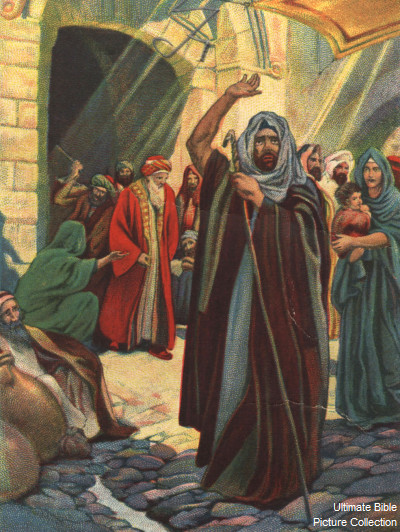
What you might have noticed if you’ve read much from the books of the prophets is that they seem pretty angry. Consider the prophet Amos who did his prophetic work around 750 years before the common era and is the earliest of the prophets of whom we have record. Speaking for Yahweh, Amos declares:
“I loathe, I spurn your festivals, I am not appeased by your solemn assemblies. If you offer Me burnt offering – or your meal offerings – I will not accept them; I will pay no heed to your gifts of fatlings. Spare Me the sound of your hymns and let Me not hear the music of your lutes. But let justice well up like water, righteousness like an unfailing stream.” (Amos 5: 21-24. JPS.)
Sounds pretty angry – wrathful.

Over and over Amos proclaims that Israel’s God is about to intervene to punish the people, an individual, or a group for their sins. Because of the religious arrogance of Israel’s leaders, and because of Israel’s economic and judicial oppression of the poor, says Amos repeatedly, God will soon bring disaster in the form of military defeat and exile upon Israel. Amos cries:
“Listen to this, you who devour the needy, annihilating the poor of the land.” (Amos 8:4)
Amos describes in detail the suffering of the economically and legally exploited masses, and the luxury of the wealthy and comfortable few. Meanwhile, declares Amos, the religion of the people of Israel had become “a comfortable ritual divorced from God’s demands for justice.” The practice of their faith was not doing the real work of connection. (Is yours?) Amos was an afflicter of the comfortable. He was an angry prophet speaking for an angry, wrathful God -- or so it seems.

A number of us aren’t very comfortable with the Yahweh of the Tanakh – the 39 books that Christians call the Old Testament. We aren’t comfortable with the idea of that wrathful, angry deity. It’s easier to prefer the New Testament Jesus who is mostly love and light and kindness.

Some of us like to take the wrath bits only within the context of comedy, as in the movie "Ghostbusters," when the title characters are trying to convince the mayor of the dangers about to be unleashed on the city.
Venkman: This city is headed for a disaster of biblical proportions.
Mayor: What do you mean, "biblical"?
Ray: What he means is Old Testament, Mr. Mayor, real wrath of God type stuff.
Venkman: Exactly.
Ray: Fire and brimstone coming down from the skies! Rivers and seas boiling!
Egon: Forty years of darkness! Earthquakes, volcanoes...
Winston: The dead rising from the grave!
Venkman: Human sacrifice, dogs and cats living together... mass hysteria!

The characters are mixing together the kind of social decay that, as the stories go, causes God’s wrath with the expressions of that wrath itself. And the overall message is that none of that is the kind of thing to take any more seriously than one takes the ghosts and ghostbusters of the movie.

As a Unitarian Universalist, a person of liberal faith, a faith that recognizes that love and understanding go together, and that all people warrant understanding, I have to recognize that I have my myths and other people have theirs, and there is no noncircular way of establishing the superiority of either.

I also recognize that any story that becomes and stays rooted in a culture over millennia does so because it satisfies some need – some universal need – which means it is a need I, and we, also have and in some form inevitably always will have.

I believe that the books of the Tanakh, as well such texts as Gilgamesh, the Bhagavad Gita, or Beowulf, tell us a lot about the cultures in which those texts emerged AND ALSO reveal a lot about me and us – for we, too, like them, are, as Auden says, "composed of eros and of dust, beleaguered by the same negation and despair," seeking some way to "show an affirming flame."

These texts (any ancient scripture/legend/myth) are not to be approached the way you would approach testimony in a criminal court trial. They are texts to be approached the way you approach poetry.

* * *
This is part 15 of "The Seven Deadlies" (Part 2 on Wrath)
Next: Part 16: "Powerful and True Bad Examples"
Previous: Part 14: "Pastors and Prophets"
Beginning: Part 1: "Seven and Sins"

2013-05-28

Pastors and Prophets


Is the practice of your faith doing the real work of connection?

Or do your faith practices merely protect you, bolstering ego in its delusions of separateness and specialness?

Probably, at least sometimes the one, and at least sometimes the other.

The energy of anger, the fire whose first impulse is aggressive protection, provides a key practice ground for re-directing energy to that real work of connection.

Let’s begin with a story.

A man walks into a store and asks the clerk for some kielbasa.
The clerk says,"Are you Polish?" The man takes some offense at this. He is in fact, angry.
"If I’d asked for crepes would you ask me if I were French?"
"No," says the clerk.
"If I’d asked for wienerschnitzel would you ask me if I were German?"
"No," says the clerk.
"If I’d asked for fettucine alfredo, would you be wanting to know if I were Italian?"
"No," says the clerk.
"So how come when I ask for kielbasa, you ask me if I’m Polish?"
"Because," says the clerk, "this is a hardware store."

The clerk gets in his zinger. Maybe he’s mad at somebody who is Polish, and he’s taking it out on all Polish people. And the would-be customer is laboring with anger issues of his own. Anger often gives us tunnel-vision: all we can see is something that hurts. He can’t expand his view to notice what’s really going on in the clerk’s question – or what sort of store he’s in.

Today, I am giving special attention to our second Unitarian Universalist source. As Unitarian Universalists, ours is a living tradition. The living tradition we share draws from many sources – and we officially designate six of them. The second one is:
“words and deeds of prophetic women and men which challenge us to confront powers and structures of evil with justice, compassion, and the transforming power of love.”
Our conception of prophets is based on the examples of the before-common-era prophets of the Tanakh – the three major prophets – Isiaiah, Jeremiah, Ezekial – and the twelve minor prophets: Hosea, Joel, Amos, Obadiah, Jonah, Micah, Nahum, Habakkuk, Zephaniah, Haggai, Zechariah, and Malachi. (There will be a quiz!)

The prophets of the Tanakh spoke out against the injustices of the powerful. Thus “prophet” refers to anyone who speaks out against injustice. Emerging, as the Unitarians and the Universalists did, from the Jewish and Christian traditions, we share with many Catholic and Protestant churches the sense that a congregation has two essential functions: the pastoral function and the prophetic function. The pastoral function is the function of caretaking, caregiving. The prophetic function is to speak out against oppression, unfairness, and follow through with the organizing work of creating justice – to call the people to task for complacency, and point them the way toward healing the fabric of the social covenant rent by abuse of power and the complacency that allows it.

The pastoral and the prophetic functions are summed up when we say the church’s job is to comfort the afflicted and afflict the comfortable. Which are you? Comfortable? Or afflicted? Do you need some comforting or some prodding today? The thing is, we are, all of us, both afflicted AND comfortable. We are in some ways beset by troubles, and in other ways overly complacent. All of us.

When we talk about those “words and deeds of prophetic women and men which challenge us to confront powers and structures of oppression with justice, compassion, and the transforming power of love,” we’re talking about afflicting the comfortable.

What you might have noticed if you’ve read much from the books of the prophets is that they seem pretty angry. Is the prophetic voice always an angry voice?

* * *
This is part 14 of "The Seven Deadlies" (Part 1 on Wrath)
Next: Part 15: "Amos 'n' Angry"
Previous: Part 13: "Community AND Faith"
Beginning: Part 1: "Seven and Sins"

2013-04-29

Community AND Faith

Even in the secular, market sphere, greed, unconstrained, backfires. Gordon Gekko, in the sequel to “Wall St.” has come to recognize the problems of extreme greed:
“It’s greed that makes my bartender buy three houses he can’t afford with no money down. And it’s greed that makes your parents refinance their $200,000 house for $250,000. Then they take that extra $50,000 and they go down to the mall. They buy a plasma TV, cell phones, computers, an SUV, and, hey, why not a second home, while we’re at it, because, gee whiz, we all know the prices of houses in America always go up, right? And it’s greed that makes the government of this country cut the interest rates to one percent after 9-11 so we can all go shopping again. They’ve got all these fancy names for trillions of dollars of credit: CMOs, CDOs, SIVs, ABSs. I honestly think there’s only 75 people in the world who know what they are. I’ll tell you what they are: WMDs: Weapons of Mass Destruction.” ("Money Never Sleeps" [2010])
Beyond the economic arguments, there’s the intimate spiritual understanding that some things come to us only by not wanting them. Joy comes to us when we en-joy what we were not anticipating, did not expect, or earn, or deserve.

Imagine standing in your backyard and looking up and seeing a swallow-tailed kite fly over. There’s a joy and a grace in that – maybe small, maybe it makes your day. The fact that you didn’t make it happen is a crucial component of that experience. Had you paid someone to capture a swallow-tailed kite and release it from a tree behind you at just that moment, then seeing that kite would be a very different experience. It would be one more experience of control and reward – rather than of simple open-ness and grace.

So I ask: do you show up at your congregation in order to learn how to grow in faith, to open to life’s gifts, to live in grace? Grace is unpredictable and uncontrolled – and it is also invisible if we aren’t open to it, if we’re so caught up in what we can control that we don’t notice anything we haven’t intentionally manipulated. Grace just takes paying attention. You can’t earn grace, but you can work on your attentional skills. Your congregation can help with that, if you’re ready to be helped.

I’ve been around congregations most of my life – in an ordained capacity for nearly nine years years now (since 2004). I have to admit I don’t know whether most congregants are simply there for the community – which is wonderful, and is a blessing – or there to engage in becoming more open to, more appreciative of, more grateful for, more aware of, life’s abundant, free, unearned and unearnable gifts.

Are you at your congregation to be transformed into a being of ever greater love and joy, open to the greatest gifts, those you’d never have thought to desire?

Or are you there to meet the needs you already had, to get something you knew in advance that you wanted?

I know there’s a paradox here. I seem to be inviting you to want something (grace) without wanting it (because wanting makes you try to control its occurrence). I can only say that I feel a spaciousness in the acceptance and openness to what comes – and that contrasts with the constricted narrowness in which I do spend much of my life working out how to control things so I’ll get what I had previously determined to want.

If you were to decide that you did want faith deepening, you can’t buy it, can’t control it, can’t make it happen – which is to say, it is not one more object of greed. But you can, with unpredictable and irregular results, nurture faith. There are things you can do to nurture it on purpose, if you wanted to. You could do those things privately, by yourself. Maybe you do. It’s more fun, and more likely to happen, if we do them together.

Moreover, we do need to be aware that the spiritual path is a tricky one. The very practices to open us to uncontrolled grace can so easily turn into technologies of attempted control. At that point, “spiritual practice” is just one more ego delusion. That can happen.

See how spiritual practice itself so easily gets co-opted by ego?
The path toward liberation can turn into yet another snare. 

Having each other along the path, a community of accountability, helps us stay on the path without the path becoming delusive. Left to ourselves to practice, our egos will tend to wind the spiritual path into one more on-ramp to the ego highway -- all the more insidious because disguised as "spirituality." Gordon Gekko's original paean to greed was certainly an ego trip, but at least it did not suffer from the particular delusion of imagining itself to be "spiritual."

So, you see, while I’m not so interested in community without faith, I’m also not so interested in faith without community. Community without faith is giving up on the possibility of any life other than delusion. Faith without community is a naïve failure to address just how wiley our delusions are. We need the help of others in identifying them. (This is the crucial point that the SBNRs -- "Spiritual But Not Religious" folks -- often overlook.)

If you were to decide that you did want faith deepening, then look for at your congregation – or, if necessary, ask your congregation to develop -- programs and structures through which that deepening can be practiced with others.

With both -- with community of faith and faith of community -- we have a chance to transcend greed and move into grace.

We have a shot at freedom.

* * *
This is part 13 of "The Seven Deadlies" (Part 4 of 4 on Greed)
Next: Part 14: "Pastors and Prophets"
Previous: Part 12: "Counterweight to the Market"
Beginning: Part 1: "Seven and Sins"

2013-04-26

Counterweight to the Market

Faith does stand over and against the secular.

The goal of the secular world is to meet material needs. A fair secular structure will ensure that everyone has a chance to have their most basic needs met. That's important. Still, it’s about people wanting things – basic things, food, clothing, clean air, housing – and not so basic things, cars, TVs, books, "nice" clothes, corner offices. In distributing the things that people want (whether basic or not so) in a way that is fair, we have, over the centuries, come a long way. And we still have a very long way to go. Still, the whole system is about wanting stuff, and about coordinating the activities that we engage in to get the stuff we want. That’s why Gordon Gekko says greed is good. If we don’t have people wanting stuff, then we don’t have them doing the things to get it, which allows the system to try to set things up so that the things people will do to get stuff will also help provide some stuff to the rest of us.

A system is just, as John Rawls famously argued in his 1971 A Theory of Justice if the things that the rich do to get richer also help the poorest get richer. The poorest don’t have to get as much richer as the rich get, but if they are benefited even a little bit from the activity that gives the billionaire another billion – then the system is just. It is unjust if the poor are made poorer -- or not benefitted at all -- by those activities which enrich the rich.

We might want to go a little further than Rawls. We might want to argue that even if the income at the bottom is going up, if the income at the bottom goes up only $1 for every million dollars that income goes up at the top, then the widening income disparity is itself harmful and unjust even though the poor are getting the one extra dollar.

However we might answer that important issue, the point to note is that the secular realm is based on wanting stuff – greed. The activities driven by wanting stuff may be regulated in a way that is more or less just or more or less unjust, but without the wanting stuff, we wouldn’t have a system at all. That’s what the secular is all about.

Faith stands as a counterweight to the secular, the market. Faith is the openness to whatever comes – not the desire-driven activity to make certain things come. Faith knows that the best things in life are free, that you can’t take it with you, that money is the root of evil, that we do not live by bread alone.

Of course, we also can’t live without bread. We can’t live without stuff – the stuff that the market provides, that we get by working for money so that we can buy.

But a lot of 21st century denizens of the modern world, it seems, do live without faith.

Do you?

Is your congregation a faith community, or just a community?

Recognizing that greed – wanting stuff and exerting as much control as you can to get it -- dictates a large part of your life (as it does of mine), do you gather at your Church, Fellowship, Temple, etc., to deepen into a way of life that ultimately trusts in things outside your control?

Or do you gather to get more of what you want: social connections, entertainment, interesting things to think about?

Is your congregation a place that’s about control, about strategies for getting what you want?

Or is it a place that’s about learning how to accept that in the most important ways there is no control?

Is it about what you can make and earn for yourself, about what you deserve, about what you have every right to expect?

Or is it about grace, about the gifts that are freely given, but which you will miss if you focus on how to meet your own needs – whether for material stuff, or entertainment or intellectual stimulation or a congenial setting for a get-together?

Is it about getting what you want, or about learning how to love what you have?

It could be about both. Both is OK. Just as long as the second part is in there too. Sometimes it's not.

* * *
This is part 12 of "The Seven Deadlies" (Part 3 of 4 on Greed)
Next: Part 13: "Community AND Faith"
Previous: Part 11: "Gekko, Boesky, and the Mahabharata"
Beginning: Part 1: "Seven and Sins"

2013-04-24

Gekko, Boesky, and the Mahabharata

Greed, more than any others (gluttony, sloth, envy, lust, vanity, wrath) of the seven sins, has numerous and powerful champions. Oliver Stone’s 1987 film, “Wall Street,” was initially titled “Greed.” The ruthless corporate raider, Gordon Gekko, proclaims that greed is good. Specifically, in a speech to the stockholders of Teldar Paper, Gekko says:
“I am not a destroyer of companies. I am a liberator of them! The point is, ladies and gentleman, that greed, for lack of a better word, is good. Greed is right. Greed works. Greed clarifies, cuts through, and captures the essence of the evolutionary spirit. Greed, in all of its forms -- greed for life, for money, for love, knowledge -- has marked the upward surge of mankind -- and greed, you mark my words, will not only save Teldar Paper, but that other malfunctioning corporation called the USA.”


The speech by the fictional Gekko was inspired by a similar speech given by the actual Ivan Boesky, the Wall Street arbitrageur who was charged by the SEC with insider trading and who paid a $100 million penalty to settle those charges. Speaking at the University of California's commencement ceremony in 1986, Boesky said:
"Greed is all right, by the way. I want you to know that. I think greed is healthy. You can be greedy and still feel good about yourself."
The gospel of Greed has many followers. Indeed, even though the fictional story of Gordon Gekko was,
"Intended as a cautionary tale on the pitfalls of unchecked ambition and greed, Stone's 1987 original instead had the effect of turning [Michael] Douglas' hugely charismatic (and Oscar-winning) villain into a household name and boardroom icon -- an inspiration to the very power players and Wall Street wannabes for whom he set such a terrible example.” (Justin Chang, Variety, 2010)
The film's stars and director have commented that over the years “people still approach them and say that they became stockbrokers because” they admired the characters in that film. People widely and freely participate in gluttony, sloth, lust, envy, anger, vanity, but you don’t hear them publically declare how proud of the fact they are. Greed stands alone as the vice most enthusiastically promoted as a virtue.

Yet greed is also universally seen as a problem by the world’s faith traditions. Take Hinduism. In the Mahabharata, we read:
“Yudhisthira said: I desire, O bull of Bharata’s race, to hear in deatail the source from which sin proceeds and the foundation on which it rests. Bhisma said: Hear, O King, what the foundation is of sin. Covetousness alone is a great destroyer of merit and good ness. From covetousness proceeds sin. It is from this source that sin and irreligiousness flow, together with great misery. This covetousness is the spring also of all the cunning and hypocrisy in the world.... It is from covetousness that loss of judgment, deception, pride, arrogance, and malice, as also vindictiveness, loss of prosperity, loss of virtue, anxiety, and infamy spring.... Pitilessness for all creatures, malevolence towards all, mistrust in respect of all, insincerity towards all, appropriation of other people’s wealth... all these proceed from covetousness.”
Take Buddhism. This is a tradition that puts at the center the observation that desire is the cause of suffering. The Visuddhimagga says:
“Greed is the real dirt, not dust... The wise have shaken off this dirt and live.”
Take Daoism. The Dao de Jing says:
“There is no greater calamity than indulging in greed.”
In Sikh scripture we read:
“Where there is greed, what love can there be?”
It goes by many names: covetousness, acquisitiveness, avidity, cupidity, avarice, miserliness, simony. Many find greed the root of all the other sins.

* * *
This is part 11 of "The Seven Deadlies" (Part 2 on Greed)
Next: Part 12: "Counterweight to the Market"
Previous: Part 10: "Faith and Fellowship, Greed and Grace"
Beginning: Part 1: "Seven and Sins"

2013-04-22

Faith and Fellowship, Greed and Grace

Do our congregations constitute a faith, or a chain of social clubs?

I don’t mean to disparage social clubs. In fact, I think we’d have to say that our congregations are social clubs. That’s clear, and it’s a good thing. We need friends, fellowship, sociability along the path. But what path? Are we, in addition to our clubbishness, also a faith?

Faith, let us remember, is not a matter of – or, at least, need not be a matter of – adhering to beliefs without objective evidence. Faith is openness to the unknown – “the act of opening our hearts to the unknown.” Faith is a certain willingness to let go of the need for control and certainty.
Faith is an inner quality that unfolds as we learn to trust our deepest experience, and trust our world. Faith is about opening to life’s gifts. There is indeed a “leap” in throwing ourselves into the unknown of each moment, going forward to take in new evidence and new experience, ever-willing to be transformed.

Our conceptions of how things are “supposed” to go can close us to realities that present themselves. Faith is the liberating capacity to step out of our illusion, and, without pretending already to know, be open to surprise and mystery. Faith means engaged and open-minded and open-hearted participation in all that life brings, even the hard parts. Faith's opposite is not doubt, but despair; not doubt, but anger; not doubt, but greed; not doubt, but anything that retreats from joyful presence.

Thus faith is intricately tied to grace, for grace is the qualities of life that are available to us beyond our control: that we do not earn and do not deserve and have no rational ground to expect.

To deepen our faith, we do need friends along the path, we need social bonds. We need to have our social club. And all social clubs enforce values. They don’t all enforce a path of faith deepening. Does ours?

The answer to that question has a lot to do with our approach to greed, for greed is the opposite of opening to life’s gifts.

Today we take up the third in our series on the seven deadly sins: gluttony, sloth, greed, anger, vanity, envy, and lust.

The list of seven deadly sins emerged in the middle of the first millennium. They are not in the Bible, nor are they the most serious offenses. A little envy, or a touch of pride is not as serious as lying, cheating, stealing, and murdering. Rather, what makes these seven sins deadly is that they are the origins, the root causes, of the more serious sins. Envy, vanity, anger, sloth, lust, gluttony, or greed can lead you to lie, steal, or kill. The church leaders who created the list of seven deadly sins 1500 years ago were developing a kind of theological psychology. If a person could purge themselves of these seven, none of those other sins would tempt. Indeed, precisely because these seven so often occur in mild form, and are universal, or nearly so, the seven deadly sins constitute an agenda for spiritual work for everyone. The project of coming to terms with these root bedevilments of the human condition is necessary for our healing and wholeness.

Coming to terms with them, however, does not mean expunging them. While these seven impulses can induce us to do real harm, they also name qualities that we need. I suppose that’s what makes them so deadly. There is virtue mixed in with the vice. For instance, in discussing gluttony, we noted that zest for life and for the food and drink that sustains it is good to have. When it comes to sloth: peace from incessant work and worry is a blessing. Peace is a virtue.

Notes theologian Phyllis Tickle:
“These [seven] taunting companions of ours can prod us into well-being as well as destruction. Indeed, without them we will die just as because of them we are condemned to die.”
When it comes to greed, though, I don’t need to make the point that it has some value. Greed, more than any of the other seven sins, has numerous and powerful champions.

* * *
This is part 10 of "The Seven Deadlies" (Part 1 on Greed)
Next: Part 11: "Gekko, Boesky, and the Mahabharata"
Previous: Part 9: "Beware the Ubersloth"
Beginning: Part 1: "Seven and Sins"

2013-04-19

Zombies vs. Jesus

No, this is NOT what I'm saying. (Funny though.)
The Easter story tells about one kind of reanimation of the dead. Let me mention a very different sort of story about the reanimation of the dead. I am not comparing the Easter story of Jesus’ resurrection to this very different story. I am contrasting. The contrasting story, which, like the Easter story, comes in many different versions, originated in Africa and was further developed in the voodoo culture in Haiti in the 19th century and probably going back further. I'm talking about zombies. In the mainstream Haitian tradition, before Hollywood began making its modifications of the story, zombies are “undead” – animated, yet entirely under the control of the bokor, a sorcerer.

We can understand this zombie narrative as an expression of the fears of an enslaved and oppressed people. Zombies represent a loss of cognition, of independent thought, of free will. As slavery and oppression led people to feel the loss of their minds, their freedom, their humanity, they told stories of zombies that represented what they felt like. It was a way for the enslaved and oppressed to depict what they feared they were becoming, and also a way to remind them that they weren’t quite zombies yet. Though their conditions deprived them, they could hold on to self-respect and dignity and refuse to be like zombies in the story.

When zombie stories spread and began to be told and modified by the middle and upper classes, zombies represented a different sort of horror. These stories featured zombies terrorizing the oppressors -- which is to say, normal middle-class Westerners like you and me. Given Earth's current technological development, and its population of more than seven billion humans, middle- and upper-class people in the developed world maintain a lifestyle that is possible only through considerable oppression and essentially enslavement of large parts of the world who labor to feed our voracious, insatiable appetite for stuff. We push this uncomfortable fact out of our minds as much as we can, yet we who are the oppressor fear what we have oppressed and enslaved. We fear that those to whom we have denied autonomy and free will may yet come after us. We have forced others for our material gain into a state of unthinkingness, yet we recognize that that very unthinkingness puts them out of relationship with us, gives them a certain power to threaten us unconstrained by the mores our class takes for granted, the mores we call "rationality." We who are the oppressor express our fear through zombie stories.

Our own consuming appetite, we project upon the zombies. In our fearful imaginings, they come to consume us -- just as providing for our material comforts and conveniences has consumed so many of them. They want to eat our brains, for independent thought is exactly what we have sought to strip them of. Can it be coincidence that the contemporary boom in tales of zombie apocalypse coincides with alarming income inequalities that have been worsening since 1980? (See Lake Chalice's seven-part series, "Our Spirits Long to be Made Whole" -- for the beginning, click here.) We know our world is out of balance. We’re afraid of what that imbalance will lead to, and our zombie movies and tales express that fear.

The story of reanimation of the dead from 2000 years ago is very different. Jesus was no zombie. (You heard it here first!) His resurrection represented the opposite: a liberation of mind and spirit. He comes into his full power as a spirit-being who can appear and disappear in our material world at will. Freed of the need to calculate – to solve problems, to advance and defend ideas any more – the resurrected Jesus is freer than ever to just be and to love. There are no more sermons on the mount or the plain, no more parables and teachings to try to persuade, no more exasperation about "ye of little faith." The resurrected Jesus mostly simply appears to people. He shows his wounds to Thomas; he has a meal with the disciples; he tells Peter to “tend my sheep.” Mostly it’s just appearing: just being there, and shining a light of love. That’s not the activity of reason and rationality. It represents instead the liberation from the insatiable need to figure out this, and then figure out that, develop a strategy for accomplishing some purpose – all the things that reason is good for. He simply sees, and is seen, and his being itself blesses.

Jesus' death represents a loss of reason in a very different way from zombies' loss of reason. Jesus transcends the half-way house of reason into complete liberation. His death/resurrection represents the death of the rational ego, which marshals concepts, advances claims, and works so hard to preserve its self-identity. Zombies, by contrast, are pulled out of the half-way house of reason into complete enslavement. Their death/reanimation represents the loss of the autonomy that comes with reasoning ability.

Living in the rational mind is a half-way house, for reason does liberate us from many of the chains of the mind. The zombie stories told by oppressed and by oppressor illustrate the ways that without autonomy, without being able to think for ourselves, to reason for ourselves about what to do, and the freedom to act on our rational decision-making, we are undead, alive yet not alive, the living dead. And forces of oppression that deprive others of that freedom risk triggering unreasoning, brain-eating reprisal.

Yet life in the rational mind is only a half-way house, which, though it be not as constraining as prison, isn’t fully free either. Rationality cannot get us the rest of the way to freedom. We use rational concepts to cut through certain chains, but then we become attached to those concepts, and end up bound and limited by them. Only love gets us the rest of the way to liberation: unreasoning, uncalculating love.

Without reason, we are undead.

Without love – the love that knows no reason and has no purpose – we are also undead, alive yet not alive, the living dead.

That is my Easter message. May we indeed be risen.

* * *
This is part 3 of 3 of "Jesus, Zombies, and the Half-way House of Reason"
Previous: Part 2: "The Dead Live"
Beginning: Part 1: "Waking Up on Easter Morning"

For a more orthodox approach to "Zombies vs. Jesus" see here.

2013-04-17

The Dead Live

If we’re going to connect with those whose religious opinions we do not share – as opposed to settling into splendid isolation among ourselves, speaking only within our echo chamber (where our own opinions are sure to be re-echoed back to us) – then we will need to be Biblically literate, familiar with the Christian stories and able to use them to illustrate what we want to say.

(Yes, I know that Biblical literacy in the US at large is pretty low. As a column in Christianity Today, put it: “Americans love their Bibles. So much so that they keep them in pristine, unopened condition.” Apparently only half of US adults can name even one of the four gospels. Fewer than half can correctly identify the first book of the Bible as Genesis. Maybe the reason that some folks are pushing to have the 10 commandments posted in public places is that they don’t know what the Ten Commandments are, nor are they able to locate them in a Bible, so if we don’t post them in public places, how can these folks find out what they are? Maybe they’re not trying to push their morality on the rest of us, they’re just curious! Nevertheless, even in a culture that might like to think of itself as Christian but doesn’t know its own scripture very well, the stories of Jesus can function as an entré, a way of establishing the impression of a common ground, the beginnings of respect and connection.)

So, let Unitarian Universalists not be shy about knowing and referencing gospel stories. Like Easter. There are four Easter stories – a different one in each of the four gospels (Matthew, Mark, Luke, and John – just in case, like most Americans, you don’t know the names of the gospels). Jesus, a charismatic teacher and healer was executed by crucifixion on a Friday. By the time his body was brought down from the cross it was late in the afternoon – with Sabbath beginning at sundown. Since there’s no burying allowed on Sabbath, his body was placed in a temporary tomb, a cave, until it could be buried on Sunday. Mary Magdalene, either alone or with other women, went to the tomb carrying spices to prepare the body for burial. At that point the four stories become quite different. (Lake Chalice explored those differences last year: see here.)

If we are interested in historically what actually happened, we don’t have much to go on. In one of the gospels, there’s a tantalizing clue. Matthew says that some of Jerusalem's rulers caught wind of the news that Jesus' body had gone missing, and these leaders then concocted a story that some of Jesus’ followers came in the middle of the night and took the body away. The leaders, says Matthew, bribed the guards to affirm, “His disciples came by night and stole him away while we were asleep” (28:13). So maybe some disciples really did come by night and steal away the body. Maybe Matthew was trying to discredit the guards’ inconvenient testimony by saying the guards had been bribed to lie.

But historical accuracy is not the point. It doesn’t matter. The point is that each of the four different stories – whether they are history or fiction -- have something to tell us about loss and death. The dead are with us. Those who are gone continue to live in memory, where they are not merely stored but also grow and change, for every time the brain recalls a memory, the memory is changed through association with the situation in which it is recalled. Those who are gone from us are not merely entombed in memory, they are actually growing and changing there – living, we can say.

* * *
This is part 2 of 3 of "Jesus, Zombies, and the Half-way House of Reason"
Next: Part 3: "Zombies vs. Jesus"
Beginning: Part 1: "Waking Up on Easter Morning"

2013-04-15

Waking Up on Easter Morning

He is risen! She is risen! They are risen! We are risen! OK, everybody up? Excellent. Now what?

The little joke that I sometimes tell when I’m talking to someone who regularly attends a Catholic or Protestant church is that as a Unitarian Universalist minister, I get to talk about Jesus twice a year, at Christmas and Easter. If, however, you are keeping count (and I wouldn't be surprised to learn that some of you are), then you know that I quote from and make reference to the prophet from Galilee here and there throughout the year – whenever a parable or some passage from one of the gospels seems appropriate.

Collaboration: UUA President Peter Morales with Eugene F. Rivers,
Pastor of the Azusa Christian Community,
at a press conference announcing opposition to three strikes bill
I know that this makes some folks uncomfortable. They are concerned that any strategy that neither ignores Christianity nor frontally assaults it will give aid and comfort to bad religion. After all, in the name of this Jesus, there was a Spanish Inquisition; in the name of this Jesus, witches were burned; in the name of Christianity, people were demonstrating at the Supreme Court during Easter week this year, hoping to maintain as much restriction on same-sex marriage as possible.

It’s true that religion, even if we can’t outright say it causes, sure seems connected to a lot of harm. People plant bombs – on themselves, in cars, in buildings – and fly jet airliners into buildings – and are led to do so in a way that is enmeshed with their religious understanding and is facilitated by their religious institutions. People want to take away women’s reproductive freedom, and punitively stigmatize gay, lesbian, bisexual, and transgender people, and their thinking makes heavy and frequent reference to their religion, and their activism on these points is facilitated by their religious institutions. Our children are liable to be told by their classmates that they are going to hell. A few people make it their life's mission to devise elaborate refutations of evolution, and more than a few people work to change the public school science curricula to present their religious views as science. For many of us, most of the religious institutions we have experienced have seemed authoritarian: not allowing questioning, not allowing critical thinking, demanding uncritical acceptance of authority. The word “faith” often seems to mean “believe what the authority figure tells you to believe and pray what the authority figure tells you to pray.” Studies sometimes find that countries that measure higher on religiosity also measure higher on violence, drug and alcohol addictions, teen pregnancies, imprisonment rates, and high school drop-out rates.

So I understand the urge to resist any story, any reference to any character in any story that is claimed and cited by “those people” – the ones with the magical thinking, the superstition, and the backwards political opinions. I understand the impulse to say, “Let’s just get rid of religion. Let’s let rationality and reason be our guide. Let us never speak of God or Jesus because then 'those people' might think we are on their side, might draw some aid and comfort from what they could construe as our support, might think that we agree with them, which, of course, we don’t, because religion, after all, is divisive.” So, repulsed by that divisiveness, we ourselves become divisive.

I understand that. I’ve done it myself. But I can no longer believe that it makes sense to try to overcome division by being divisive, by putting on my armor like Don Quixote and tilting at the windmill of religion. The attempt to conquer and vanquish the parts of ourselves that we don’t like, or the parts of our society that we don’t like, is an enterprise doomed to failure.

Living in the rational mind is a half-way house. I call it a half-way house because reason does liberate us from many of the chains of the mind -- but not all of them. Rationality cannot get us the rest of the way to liberation. Only love gets us the rest of the way: unreasoning, uncalculating love.

That is my Easter message.

I know there is harm that is perpetrated in the name of religion, but I believe that love and acceptance is a better strategy than invective -- and better, even, than benign neglect. Love has subversive power, and I prefer subversion to open battle. I prefer, and recommend, for the sake of our own emotional and spiritual well-being, looking for ways to make connection rather than ways to denounce and vilify. Moreover, on many issues there are many Christians with whom Unitarian Universalists, whether themselves Christian or not, can make common cause. There is good work to be done together to advance values that we share. If, however, we refuse to speak the other person's language, then we're hampered in that collaborative possibility.

When it comes to my inner demons, the better strategy is to embrace, befriend, and then re-direct that energy. Likewise, when it comes to outer demons -- who are not demons at all, but people whose cognitive rational functioning is typically as high as mine is -- the better strategy is embracing and befriending. Granted, "those religious people" sometimes choose not to be wholly governed by the rational part of the mind. So do I. I choose to allow myself to enjoy music, to delight in beauty, to enjoy good food, to write a poem instead of more prose, to fall in love. These are not rational things to choose. In making these choices, I choose to participate in the nonrational. The result is a life that is more, not less, than rational.

If those of us who do not identify as Christians can connect better with those who do, then we we’re part of the conversation. We can introduce various alternative directions that those stories point. But we have no chance of subverting the dangerous ways of interpreting the gospels if we refuse to talk about the gospels at all. Such refusal is dumb -- and an irrational prejudice. Too often, we have been neither loving nor rational.

* * *
This is part 1 of 3 of "Jesus, Zombies, and the Half-Way House of Reason"
Next: Part 2: "The Dead Live"