Showing posts with label wonder. Show all posts

2011-04-27

Which Is To Be Master?

Our story so far . . .
“God” must, at least, include “reality as a whole.” What else is “God”? Which of the qualities that have at one time or another been said to be qualities of God are qualities that are instantiated in reality?

Candidates for qualities that have sometimes been said to be qualities of God include: “supernatural,” and “personal” (that is, person-like; knowing and wanting). I discussed and rejected “supernatural” in part 1. In part 2, I recognized an important poetic place of play for conceptions of nature/reality as “person-like" before turning to consider possibilities for "God" neither supernatural nor person-like.

In Part 3, I looked at such qualities as the final source of beauty and mystery; a power inspiring gratitude, humility, wonder, and awe; an ultimate context and basis for meaning and value; the widest (or highest or largest) reality to which our loyalty is owed, and, hence, the basis of the ethics that flow from that loyalty.

As Carl Sagan describes it, the cosmos has all of these qualities. Many people today, even though they may lack the detail of sophisticated understanding that professional scientists have, share Sagan’s sense of the natural world – the ecological, biological, and geological processes of planet Earth and the physical processes of electrons and atoms and stars and galaxies – as possessing attributes traditionally belonging to God. Let us call these people “Religious Naturalists.” They are naturalists by virtue of holding that “the supernatural” either doesn’t exist or is conceptually incoherent, and by virtue of holding that such attributes of personhood as knowing and wanting do not apply to nonliving nature or reality-as-a-whole. Naturalists may be nonreligious or religious, depending on whether they experience nature and the cosmos as beautiful, mysterious; inspiring gratitude, humility, awe; commanding loyalty, and grounding ethics.

Can we say that the cosmos, then, is God – even though the cosmos is neither supernatural nor person-like? May reality thus described reasonably be called God? May we call “God” a cosmos that has “most” of the qualities traditionally associated with God – or must we insist that supernatural and person-like necessarily must be a part of the definition? How shall such a question be answered?
'When I use a word,' Humpty Dumpty said, in rather a scornful tone, 'it means just what I choose it to mean — neither more nor less.'
'The question is,' said Alice, 'whether you can make words mean so many different things.'
'The question is,' said Humpty Dumpty, 'which is to be master — that's all.' (Through the Looking Glass, Lewis Carroll)
My mother was a physics and chemistry professor. My father was an English professor. Once, at dinner, Mom posed a question to my sister Alizon and me, as she was sometimes wont to do.

“If you throw a rock into the air, straight up – perfectly vertical – it will reach its topmost point, and then start to come straight down. At that instant at the top, is the rock accelerating?”

“No,” my father interjected. “For just an instant, it’s not moving at all.”

“At that instant it is stopped,” agreed Mom. “But it’s still accelerating. Acceleration means that its velocity is changing, and the rock’s velocity is changing throughout its trajectory – on the way up and on the way down.”

“No,” said my father, “that is not what 'acceleration' means.”

Since Dad’s specialization was 18th-century British literature, perhaps Dad had in mind Dr. Samuel Johnson’s dictionary of 1755.

Dr. Johnson defines accelerate as:
To make quick, to hasten, to quicken motion; to give a continual impulse to motion, so as perpetually to increase.
“You scientists,” fumed Dad, “don’t get to change the English language.”

Actually, scientists do get to change the meanings of words. Sorry, Dad. Sometimes scientists even do so through an explicit and formal process, as when the International Astronomical Union, on 2006 August 24, adopted a new definition of “planet” for our solar system. Their definition excluded Pluto, which had been within the definition of planet since its discovery in 1930. More often, the shift in meaning disseminates slowly and informally.

Words change their meaning as we learn more about the things they point to. As we learned more about motion, we saw that all regular changes in velocity were mathematically describable, and we needed the word “accelerate” to refer to all such changes, not just to speeding up.

Similarly, as we learned more about a planet, the word’s meaning changed. “Planet” originally meant “wandering star.” By Galileo’s lifetime, educated Europeans had pretty much universally dropped the “star” part from their understanding of the meaning of “planet.” By 1930, the definition took in nine objects in our solar system, then, in 2006, in the light of discoveries about the Kuiper belt, the definition was refined to include only eight objects in our solar system.

Other examples:

- As we learned more about what water was, we incorporated “H2O” into its definition.

- As we learned more about “atoms,” the word’s meaning changed. “Atom” originally meant “not divisible.” When we developed the ability to split atoms, we had to change the definition of “atom” so that it no longer meant “indivisible.”

- A thousand years ago, "animal" was almost universally understood to mean nonhuman -- and "human" to mean nonanimal (Aristotle's definition of humans as the "rational animal" notwithstanding). As we learned more about animals and humans, we changed the definitions to reflect our new understanding of what humans and animals are.

Words change their meaning as we learn more about the things they point to. Our definitions of words reflect our understandings of things.

The word “God” points to a source of beauty and mystery; a power inspiring gratitude, humility, wonder, and awe; an ultimate context and basis for meaning and value; the widest reality to which our loyalty is owed; a basis of ethics. As our understanding of the reality to which the word points has evolved – so that, for many of us, that reality is no longer regarded as supernatural or person-like – then dropping “supernatural” and “personal” from the definition would seem a simple matter. Since so much of the meaning of “God” is retained, then the dropped part would seem more easily releasable than, say, dropping “star” from “planet” or “indivisible” from “atom”. After all, “star” and “indivisible” were once much bigger parts of the definitions of “planet” and “atom” respectively than “supernatural and person-like” have been for “God.”

Case closed? Not so fast. We must also consider the "does not exist" option. As our understanding of things evolves, sometimes we do indeed change the meanings of words. Other times, however, instead of redefining the word, we conclude that the word fails to refer -- i.e., that the purported object pointed to does not exist.

The authors of the Biblical Book of Job evidently wrote for a populace that took leviathans to be real entities. Now we say they don’t exist.

From the late 17th-century until the late 18th-century, the phlogiston theory of combustion postulated that a fire-like element called phlogiston was contained within combustible bodies and was released during combustion. Eventually, the phlogiston theory of combustion was replaced by the oxygen theory of combustion that we have today. Scientists did not re-define “phlogiston.” Instead, they expressed their new understanding by saying, “phlogiston does not exist,” and “there is no such thing as phlogiston.”

Which route should religious naturalists take? Should we say that God is the cosmos? Or, instead, should we say that there is no God?

In the history of the evolution of human knowledge, re-definition is the norm, and the “doesn’t exist” route is the rarely necessary resort. Had there been any actual beasts that were at all close to leviathans, even if significant features of the mythical understanding were missing, we would have retained “leviathan.” Phlogiston was unusually awkward: it turned out that combustion involves the taking in of something (oxygen), rather than the giving off of something. The process itself was entirely opposite to what phlogiston theory had said. So redefining “phlogiston” as “oxygen” would have required unusual conceptual gymnastics. Moreover, the “phlogiston” concept itself was new, never broke out of scientific circles to become well-anchored in cultural understandings, and lacked a long history of accumulated associations that might have given it meanings we wouldn’t want to throw away. Phlogiston was a rare case of an easily disposable concept.

The word “God,” however, has a very long history of referring to a source of mystery and meaning, an origin, a basis for values and commitment, an ultimate the contemplation of which cultivates well-being, humility, peace, and an ethical vision, as such contemplation does for religious naturalists such as Sagan. The list of the functions of the word “God” that are retained by religious naturalism is much longer than the functions dropped.

The great advantage of the word “God” is clarity of communication. That word, better than any other, clearly and directly specifies that what we’re talking about is indeed an ultimate ground of both concrete values and commitments and at the same time incomprehensible, mysterious, full of powers we can but dimly apprehend (e.g., dark matter; 128 dimensions; the Heisenberg Uncertainty Principle; reproduction; immunological response; consciousness) – a reason for living, and a beauty beyond reason.

What humans have been pointing to with that word, “God,” turns out, for religious naturalists, not to have beliefs and desires. We can now drop that nonessential meaning and speak even more clearly of the holy within which we live and breathe and have our being.

Words change their meaning as we learn more about the things they point to.

CODA

Religion brings us together, binds us, makes community of us. A religion offers a basis for an ethics. We might say that whatever is your basis for ethics is your religion. Religion is a context for cultivation of virtues. It is a field in which wisdom slowly grows. Through all this is an account that responds to the question: Who am I? Who are we? What sort of world is this? What is reality?

A shared account of what reality is supports religious community-forming power. It supports the ethical grounding and the virtue aspirations because what we hope to be and can be is framed by what is. Today our best account of reality – a dynamic and constantly shifting account – emerges from the researches of scientists. To know it as best we can gives us shared reality to ground community and hopes. And it opens for us a world of wonder, even as it affirms connectedness.

In the Book of Job, the Hebrew and eventually the Western Mind addressed suffering. “Why do I suffer?” cries Job. Job’s friends, Eliphaz, Bildad, and Zophar, come to visit him in his misery. They offer the trite moral simplifications: “You must have done something wrong to bring this on yourself; you must have sinned to incite God’s punishment.” For these friends, the universe is mechanically moral: Goodness in, reward out; badness or evil in, punishment out.

Finally, God himself/herself appears to answer the charge that Job’s suffering is unfair and without basis. It’s not clear, however, that what God proceeds to say can be accurately called an “answer.” God unleashes four chapters of rhetorical questions that invoke the wonders and grandeur of creation. A sampling:
Where were you when I laid the foundation of the earth?... Or who shut in the sea,... made the clouds its garment... Have you commanded the morning since your days began, and caused the dawn to know its place... Have you comprehended the expanse of the earth?... Has the rain a father, or who has begotten the drops of dew?... Can you bind the chains of the Pleiades or loose the cords of Orion?... Do you know when the mountain goats give birth?...Do you give the horse its might?... Is it by your wisdom that the hawk soars, and spreads its wings toward the south? Is it at your command that the eagle mounts up and makes its nest on high? (Job 38: 4, 8, 9, 12, 18, 28, 31. Job 39: 1, 19, 26-27. NRSV.)
God goes on also to invoke leviathans and behemoths (and unicorns, too, according to the King James Version, though later translations say "wild ox" instead). God’s speech is not an explanatory “answer” to the question Job had so plaintively raised to the heavens, "Why do I suffer?" Yet confronted with the vast awe of creation, Job’s complaint is stilled. Humbled and speechless, Job abandons his plea, for he grasps that the mystery of the cosmos is so much deeper than principles of justice.

What about you and me? Amidst our daily and variable discomforts, distractions, and all the slings and arrows of outrageous fortune, where shall we look today for the “speeches of God” that will fill us afresh with such profound wonder that our sufferings fade into insignificance, replaced by an awe unto joy? We look to nature, just as God directed Job to look. Such "speeches" today are read through the Hubble and other telescopes, inscribed by particle accelerators, displayed with electron microscopes. Those of us without the training to decode those cryptic signals can nevertheless find abundance of beauty and mystery in more popular science writing. We find it in looking, naked-eyed or with simple binoculars, at the night sky or a distant flock of cranes. We find it in walking amidst uncultivated undisturbed flora of the land of our belonging.

Near the end of his life, Carl Sagan wrote in Pale Blue Dot:
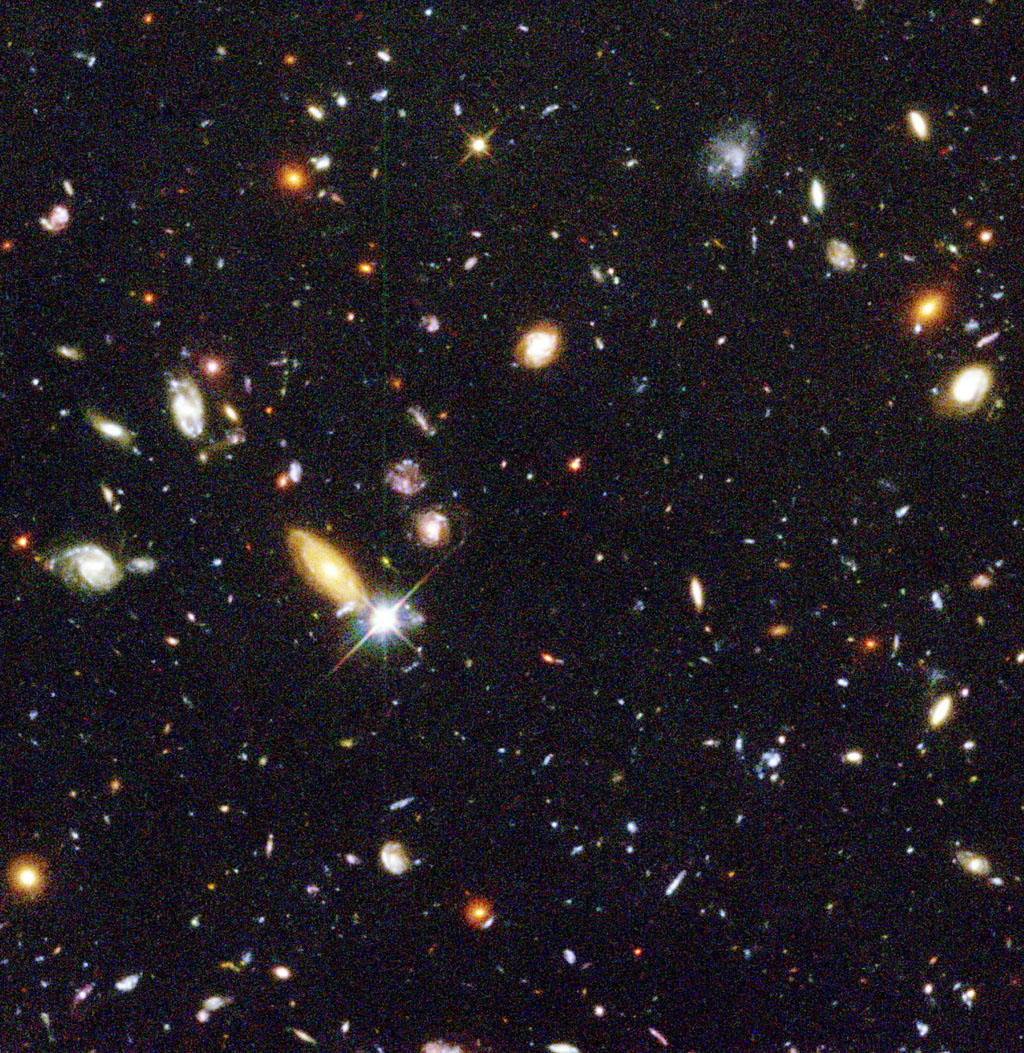
In some respects, science has far surpassed religion in delivering awe. How is it that hardly any major religion has looked at science and concluded, 'This is better than we thought! The Universe is much bigger than our prophets said, grander, more subtle, more elegant?' Instead they say, 'No, no, no! My god is a little god, and I want him to stay that way.' A religion old or new, that stressed the magnificence of the universe as revealed by modern science, might be able to draw forth reserves of reverence and awe hardly tapped by the conventional faiths. Sooner or later, such a religion will emerge.
Dear Carl: It’s here.

Thank God.

* * *
This is part 4 of 4 of "Science, God, and the Universe."
Previous: Part 3: "Saganic Verses"
Beginning: Part 1: "Not Supernatural"

2011-03-09

Saganic Verses

In this series, I am asking two questions.
(1) Which of the qualities that have at one time or another been identified as qualities of God are qualities of reality as a whole?
(2) May reality thus described reasonably be called "God"?

So far, I have looked only at the first question. In "Part 4: Which Is To Be Master?" I shall turn to the second question.

One of the qualities that is sometimes mentioned as a quality of God is “supernatural.” In part 1, I said that won’t work. The reason it won’t work is not that God/reality isn’t supernatural, but that we cannot make sense of either the proposition,
“Reality is supernatural”
or the proposition,
“Reality is not supernatural.”
Each of those propositions require us to be able to be able to draw a line between supernatural and natural – and we have no way to do that.

Another candidate for a quality of God is: person-like; having knowledge and desires. In part 2, I said that being able sometimes to respond to reality as if it had such person-like attributes is a part of a healthy playful or poetic capacity. It does our hearts good and fosters creative interrelationship with our world to play make-believe from time to time – even if we are self-aware that we’re playing as we do it.

Today I want to consider what would be left – or what would have room to emerge into greater significance -- if we set aside the supernatural and the person-like. What does science tell us about reality – and what descriptors of God apply to a description of reality consistent with science?

Let's begin with some parallels between science, particularly physics, and religion.

They both address the question: What is reality? That is, what’s out there? What’s right here? What’s in here? These are old questions. What we now call science – a particular method of hypothesis, and observation and replicability – emerged only in the 17th century.

What we call religion today – religion as the kind of thing that we could have a first amendment protecting the free exercise of – is also fairly recent. For most of human history, religion and culture were essentially the same thing. If you were an ancient Egyptian, then you did what Egyptians did – including participate in certain rituals, make certain sacrifices, and tell stories about beings called gods. They didn’t divide the practices and teachings of their lives into the religious ones and the nonreligious ones. It wasn’t until the 16th century that serious thought about tolerating religious differences began to emerge in the West, and, along with it, the implication that it was possible to separate certain practices from the rest of a given people’s way of being together. Now we live in a world where we have distinct areas called “science” (recently emerged as a distinct area of culture), and “religion” (recently separated into a distinct area of culture), each addressing that ancient question: What is reality?

For millennia, priests in dark robes have said:
"There is a world beyond what you can see or hear. It is a realm of deep mystery. The normal principles of nature as we experience it do not apply there. And: Trust us. We have plumbed some of this mystery, so believe what we tell you. Do not critically evaluate it for yourself."
Now scientists in white labcoats say:
"There is a world beyond what you can see or hear. Black holes, worm holes, antimatter, dark matter, quantum probability waves, superstrings, parallel universes. It is a realm of deep mystery. The normal principles of nature as we experience it do not apply there. Trust us. We have plumbed some of this mystery, so believe what we tell you.”
Actually, science teachers would love for us all to have a much better grasp on the data and the reasoning that leads to the conclusions of contemporary physics and astrophysics. But since most of us aren’t able to be physics majors on top of the rest of our life, we can’t critically evaluate cutting edge physics research. I, for instance, feel I’m doing really well if I grasp just some of the conclusions reached a century ago in Einstein’s special theory of relativity. Like this:

If you’re standing still, and I zip past you at half the speed of light, and I’m shining a flashlight ahead of me as I go, the speed of the flashlight-beam as you see it emanating from the flashlight is not the combination of our two forward velocities – it’s not 1.5 times the speed of light, as you might think. The beam leaves the flashlight at exactly the speed of light, and receives no boost from the fact that the flashlight itself is going half the speed of light. On the other hand, it might seem that if the flashlight-beam is going forward at the speed of light, and I’m going forward at half the speed of light, then the flashlight-beam is going faster than me by only half the speed of light. But no! I will see the beam receding on ahead of me at the full speed of light. How could that be? Well, it’s because time slows down for me when I’m going that fast.

At that point, most of us have to say, “If you say so.” Most of us can’t get the training to assess these mysteries ourselves, so we end up in a position analogous to our early ancestors’ position in relation to their shamans and priests: we have to take their word for it. Certainly there are significant differences. I trust my astronomy prof a lot more than I trust the TV and radio preachers of conservative Christianity. This is because the scientific community is self-critical and always looking for better answers while priestly communities are self-reinforcing and looking to maintain the same answers.

Nevertheless, scientists deal in things that are, to the rest of us, mysterious and arcane. Quantum mechanics is even more arcane than Einsteinian relativity. I turn to "Dr. Quantum" for a 5-minute sampling of one aspect of this baffling strangeness:

With Newton, and for a couple centuries after, physics was gradually making the world more and more clear and explicable. Or seemed to be. Since Einstein's publication of 1905, physics has been making our reality more and more mysterious and inexplicable. Or seems to be. As the purveyors of the arcane, physicists now occupy a spot analogous to the priests of old.

Having sketched some parallels between the cultural space occupied historically by the community of priests and occupied now by the community of physicists, we may turn now to some parallels between the universe, as described by physics, and God, as described by traditional theology. Both are:
  • profound mystery; 
  • origin; 
  • source of wonder, awe, and beauty; 
  • ultimate context inspiring humility and gratitude; 
  • grounding for ethical commitments. 
These are qualities associated with God, yet do not require being either supernatural or person-like. This is the reality that Carl Sagan called "Cosmos."  More than 30 years ago, Sagan’s PBS series, Cosmos first aired. Its 13 one-hour episodes captivated the minds and hearts and imaginations of a nation. It was the most widely watched series in the history of American public television and has since been broadcast in more than 60 countries and seen by over 600 million people. Carl Sagan (1934-1996) had an obvious passion for discovery, a poetry of wonder – and contacts among engineers who created for him special effects dazzling for the time. In 1980, the cold war was going strong. In a time of a nuclear arms race threatening planetary annihilation, Carl Sagan showed us a vision of another path. In this vision, deep engagement in the investigation of reality manifests and engenders a way of life thrilling and beautiful and also peaceful and just. As the first episode opens, Sagan is standing by the shore of an ocean. The camera pans, moves in, and Sagan begins:
"The cosmos is all that is, or ever was, or ever will be. Our contemplations of the cosmos stir us – there is a tingling in the spine, a catch in the voice, a faint sensation, as if a distant memory, of falling from a great height. We know we are approaching the grandest of mysteries. The size and age of the cosmos are beyond ordinary human understanding. Lost somewhere between immensity and eternity is our tiny planetary home, the Earth. For the first time we have the power to decide the fate of our planet and ourselves. This is a time of great danger. But our species is young, and curious, and brave. It shows much promise. In the last few millennia we have made the most astonishing and unexpected discoveries about the cosmos and our place within it. I believe our future depends powerfully on how well we understand this Cosmos in which we float like a mote of dust in the morning sky.
We’re about to begin a journey through the Cosmos. We’ll encounter galaxies and suns and planets; life and consciousness: coming into being, evolving, and perishing. Worlds of ice, and stars of diamond; atoms as massive as suns, and universes smaller than atoms. But it is also a story of our own planet and the plants and animals that share it with us. And, it’s a story about us: how we achieved our present understanding of Cosmos, how the Cosmos has shaped our evolution and our culture – and what our fate may be.
We wish to pursue the truth no matter where it leads. But to find the truth, we need imagination and skepticism both. We will not be afraid to speculate, but we will be careful to distinguish speculation from fact. The Cosmos is full beyond measure of elegant truths, of exquisite interrelationships, of the awesome machinery of nature. The surface of the Earth is the shore of the cosmic ocean. On this shore we have learned most of what we know. Recently, we have waded a little way out, maybe ankle deep, and the water seems inviting. Some part of our being knows, this is where we came from. We long to return. And we can. Because the Cosmos is also within us. We are made of star stuff. We are a way for the Cosmos to know itself.”
We ask, as our ancestors asked 100,000 years ago, what is reality? We want to be able to respond to it effectively, to get our needs met. Something in us would also like to reciprocate: to befriend the ultimate – space and time and all the
“gas and dust and stars – billions upon billions of stars” (Sagan).
We want to live in our world, our universe, in a way that is awake to its beauty, that evokes our gratitude, that shows us how very, very small we are so that, from such humility, we can loosen the bonds of ego defenses – yet which also gives us the significance of connection to something wider, bigger, grander. We want to know how to live in awe and wonder. For most of human history, we interpreted reality as person-like because brains built like ours are inclined to look for the traits of personhood: belief, desire, intentionality. We see others as having their own beliefs and desires, and this is crucial for interpreting their behavior and getting along with them. So it’s natural for us to look for beliefs and desires in the universe itself. And for millennia, we imagined that we found them there.

The most natural path to humility and gratitude for beings like us is to be grateful and humble toward some person-like entity. That’s the most natural path; it is not the only possible path. Four centuries ago, science was being born as one part of our culture, while religion was being separated from the rest of our culture and separated into its own part. In Cosmos, and throughout his life, Carl Sagan showed us, and embodied, a way to bring them together. Though others have pointed that direction before and after him, no one has done so as consistently and thoroughly. Sagan’s example showed us a way to be connected to a source for beauty, gratitude, humility, and wonder, a source that gives meaning to our lives and joy to our days and purpose to our work.

 We cannot all be professional scientists, but we can all be scientific in the sense of having respect for the scientific process, knowledge of the more significant findings, an interest in the general directions of current research, and an appreciation of the "big picture" unfolding through that research. Sagan showed us a way we can all be both scientific, in this sense, and also religious. Sagan's science and his religion did not conflict. Nor were they distinct areas irrelevant to each other. They were the same thing. The impulse that has led so many to embrace one dogma or another, just so we can believe we have some kind of handle on what’s out there – that same impulse can instead be directed to embrace a process. Instead of latching on to one set of beliefs, we can place our faith in a process of continually revising beliefs. Sagan said:
“We are born to delight in the world. We are taught to distinguish our preconceptions from the truth. Then new worlds are discovered as we decipher the mysteries of the Cosmos.”
Sagan recognized,
“We humans long to be connected to our origins, so we create rituals.”
He then added,
“Science is another way to express this longing – it also connects us with our origins.”
The textbooks and equations of physics are not inherently so inspiring. It takes scientist-poets like Sagan to show us that it is possible to weave the findings of astronomy and physics into a story that connects us to our origins, that, indeed, as he said,
“stirs us – there is a tingling in the spine, a catch in the voice, a faint sensation, as if a distant memory, of falling from a great height.”
Groups and communities can now take Sagan’s cue, and encourage one another in being inspired together by the vastness of space, the beauty of the galaxies, and the mind-boggling first millionth of a second after the big bang. Another function of religion is to ground and yield an ethic. To befriend our world, we need both a sense of what it is and how to be and act with it. Sagan’s Cosmos flowed seamlessly from the talk of atoms and stars to talk of right and justice:
“If we are to survive, our loyalties must be broadened further, to include the whole human community, the entire planet Earth.”
He then spoke to us as the prophets of Judea of old spoke:
“Many of those who run the nations will find this idea unpleasant. They will fear the loss of power. We will hear much about treason and disloyalty. Rich nation-states will have to share their wealth with poor ones. But the choice is clearly the universe or nothing.”
It is a function of religion to expresses and inform our loyalties and obligations beyond ourselves to something larger. Thus Sagan is speaking religiously in these concluding words of the 13th and final episode of Cosmos:
“Our loyalties are to the species and the planet. We speak for Earth. Our obligation to survive and flourish is owed not just to ourselves but also to that Cosmos, ancient and vast, from which we spring.”
Sagan avoids the word “God” – after all, he’s on PBS – yet when he says “Cosmos” he is pointing to a source, a connection to our origin, an ultimate context and basis for meaning and value, beauty and mystery. He is pointing to what humans have for millienia pointed to with the word “God” (or with non-English words that translate as the English word “God”). Is it fair to say that Sagan’s Cosmos is God, albeit neither supernatural nor personal? Or does the word “God” necessarily refer to a person-like entity? To this semantic, yet important, question I turn in the next and final part.

* * *
This is part 3 of 4 of "Science, God, and the Universe."
Next: Part 4: "Which Is To Be Master?"
Previous: Part 2: "Getting Personal"
Beginning: Part 1: "Not Supernatural"

2011-03-05

Not Supernatural

I wrestle with what to make of life and this world. One of the words that sometimes comes to mind as I grope to articulate something that will make sense and be helpful – and maybe even true – is “supernatural.” I have, from time to time, said such things as, "I don't conceive of God as supernatural." I say this to try to clarify. The word "God” seems too slippery, so I reach for "supernatural” to make my meaning clearer. This doesn't work. "Supernatural" fails to add meaning.

"Supernatural” (or "not supernatural") is also too slippery. How, exactly, are we to draw the line between natural and supernatural? My Random House Unabridged offers that “supernatural” is “unexplainable by natural law or phenomena.” Does that help? Alas, no.

Explainability is also too slippery. Have you noticed, for instance, that Newton was thin – nonexistent, really – on the explanation for his laws? Objects in motion tend to stay in motion, says Newton. And why do they stay in motion? We have no explanation. “That’s just the way things are,” says Newton. My sixth-grade science teacher said the same thing when I asked her. (Actually, Newton had a fancy Latin way of saying it: “Hypothesis non fingo” – meaning, “I make no guess about that.”) Inertia and gravity may be “natural laws”, but they are not explained by natural law. Are we then to conclude that they are supernatural forces? Perhaps we should call them “supernatural laws."

Inertia and gravity are so ordinary that it may strike you as bizarre or perverse to suggest that they are inexplicable. Very well, let us call them “explained” just by virtue of the widely shared subjective sense that no explanation feels called for. What shall we make of the weirder end of physics: wormholes and dark matter and quantum indeterminacy? We explain X by positing Y – and eventually arrive at a Y that we have no explanation for. Why, oh, Y? Not only that, but the principles of quantum indeterminacy tell us that some things not only are unexplained, but never could be. (Oddly, physicists have a good explanation for this permanent inexplicability.)

We are surrounded by and submerged in weirdness. Driven by an urge to feel we have some grasp on things, we seek explanations. And what is "an explanation"? If any story gives us a sense (illusion?) of having a grasp on something, we call it an “explanation.” We don’t have nonsubjective standards for what counts as an explanation.

Which means that we can’t tell what is “unexplainable” (by natural law or phenomena).

Which means that we can’t tell what is “supernatural” and what isn’t.

Which means that “supernatural” (and “not supernatural”) isn’t available for careful thinking about our conceptions of “God” or “reality.”

Which means . . . ?

It’s not so much that I’m back to the drawing board. It’s more like I never left it. I stand forever before this drawing board, erasing as fast as I draw on it.

And living in wonder.

* * *
This is part 1 of 4 of "Science, God, and the Universe"
Next: Part 2: "Getting Personal"
Part 3: "Saganic Verses"
Part 4: "Which Is To Be Master?"