Standing against the powerful creep of the market: the nonprofit sector, and the public sector.
If you’re active in a nonprofit organization – including churches, synagogues, temples – you are marking out a part of your life that isn’t entirely under the sway of the market. (Of course, it’s not entirely independent of markets either: your church, too, has bills to pay.) In our Unitarian Universalist congregation in Gainesville, we gather only to be “a diverse religious community committed to lifelong spiritual growth and compassionate service to each other, our community, and the earth.” We do have a staff to pay, utility bills, and a building to keep up. We don’t have any investors to pay off.
Just by showing up at a place of worship, you say: there are some things that aren’t about making profits for shareholders. So show up there. That’s my first request of you in standing against the creep of market logic into areas better taken up collectively, in a sense of communally shared responsibility.
Let me ask you to consider doing something else as well: take this up in your journals. If you don’t keep a journal, please consider starting one because journaling is vital practice for ongoing spiritual growth. Start noticing and recording in your journal where in your life you notice market creep.
These changes in the last 30 years happened slowly, without a deliberate decision that we wanted the market in all these aspects of our lives. They happened in tiny increments that we didn’t notice at the time. So let me ask you to simply start noticing. Where do you notice buying and selling of things that didn’t used to be bought and sold, of things that maybe shouldn’t be bought and sold? Where do you notice that interests of stockholders are exerting a subtle influence on what is going on. Try keeping count of how many commercials for a political candidate you see, how many direct-to-consumer ads for prescription drugs you see.
Write down how you feel about this. Maybe some instances are positive. Maybe other instances are not. (For instance, does it seem to you that prescription drug sales should be a matter of doctor recommendations rather than advertisement-generated consumer demand?) For the next week, pause every day to jot down what you have noticed about the market entering areas of your life where maybe you’d rather nonmarket values mattered more.
Make a note of what were those nonmarket values were. What enterprises do you find that it would be appropriate for us collectively to do them through our city, county, state, and national governments? What enterprises would better be carried out through nonprofit organizations? Start noticing that particular aspect of this world we live in as it has become.
From that noticing and our own best reflecting will emerge the wisdom we need for beginning to organize to better define the limits of the market sphere.
Postscript
David Brooks observation about the rise and dominance of success, as defined by the market, over other moral systems of valuation: see Brooks 2013.06.13 Religion and Inequality.
* * *
This is part 6 of "Not For Sale"
Previous: Part 5: "Two (Not Three) Cheers for Markets"
Beginning: Part 1: "Marketplace Creep"
Pages 'n' Links
Showing posts with label Not For Sale. Show all posts
2012-08-24
2012-08-23
Two (Not Three) Cheers for Markets
Let us give the market its due. As a way to distribute and exchange resources, the market is a wonderful improvement over everything that came before it and most of what has emerged since. This improvement is not merely economic; it is also moral. The market provides a basic fairness. In the market, it doesn’t matter if we agree on anything besides price. Your ethnicity, your religion, your crazy political opinions don’t matter. You pay the money, you get the groceries. Markets are nonjudgmental. They respect your individual preferences, whatever they are. Through markets, the human species learned at last how to engage cooperatively with people we would otherwise despise. We learned to set aside the differences that divided us and just “do business.”
Insofar as “market” amounts to “voluntary (on all sides) distributions through trade” then market approaches are presumed preferable to any nonmarket (and therefore at least somewhat coercive) approach. (Though markets may themselves involve economically coerced actors, a.k.a. "the poor" – and in a variety of circumstances the regulatory need outweighs the presumption in favor of markets.)
When people buy and sell from each other, they don’t have to fight each other for stuff. Indeed, if you’re providing me with goods or services, I have a vested intererest in you staying healthy so you can continue to provide me. Between nations, the rise of markets reduced the temptation to go to war. As the 19th-century French economist Frederic Bastiat supposedly said (and, at least, would have agreed):
In some areas, we need still need more market logic, not less. Market logic doesn’t care about whether a construction worker, or an agricultural worker, or any worker, happened to be born north or south of a line some generals and politicians drew in the sand across the southwest desert a little over 150 years ago. But our immigration policies skew that market logic, and it isn’t fair.
So let us, by all means, give the market its due. We may nevertheless ask whether the market has crept into areas where it is best kept out. It may be fine for private companies working to maximize shareholder profit to run our system of filling the shelves at the stores where we shop. But do we really want private, for-profit companies running our health, our education, our public safety, our national security, our criminal justice, our environmental protection, our recreation? They didn’t used to. I grew up in the 60s and 70s when all those things were public goods and were matters of public policy and nonprofit organizations.
Whatever the market is in charge of distributing goes to those who can pay for it. If there’s enough for everyone – like basic food – then that’s fine. If there’s enough supply for the price to be low enough so that everyone can afford what they need, then, fine, let the market handle it. Also, for things in short supply that people don’t need – like Lamborghini sports cars – let the market handle that, too. Only the rich will get them, but nobody needs them.
Are there are some things that we think ought to be available to everyone, not just the rich? Healthcare, education, public parks, police protection, perhaps?
Are there some duties that we think ought to fall to everyone, not just the less rich? Paying taxes, military service, the same jail cell everyone else gets who has committed the same kind of crime, perhaps?
There’s something else about markets. The market is the perfect cynic. A cynic, as Oscar Wilde said, is someone who knows the price of everything and the value of nothing. The market knows only one value: price.
When this country, after much struggle, finally ended formal slavery, we recognized that a human being is a value beyond price. Human beings cannot be bought and sold and owned. Children and spouses are, for many of us, life’s greatest value, and we would not want them bought and sold.
Where the market creeps in, it corrodes any other value. When you are paid for reading a book, it’s harder to think of reading as having any other value. The market thus corrupts what it touches.
As LoraKim’s adventure in knee replacement and recovery has dragged on through many more monthes than we’d anticipated, she and I have felt a heaviness of despair from depending upon services from a healthcare system where such huge sums of money go from our insurer to hospitals and doctors. Our insurance is reasonably good, yet it’s breathtaking and saddening to see how much our insurer pays for a few days in the hospital. Even when we aren’t personally paying much, we feel like pawns in a vast scheme of money transfer. The scheme has been set up to maximize that money flow, and our medical care is merely the means to that end. Participating in and depending on that system feels degrading – a diminishment of our intrinsic nonmarket humanity.
* * *
This is Part 5 of "Not For Sale"
Next: Part 6: "Standing Against and Noticing"
Previous: Part 4: "What Shall It For-Profit Us?"
Beginning: Part 1: "Marketplace Creep"
Insofar as “market” amounts to “voluntary (on all sides) distributions through trade” then market approaches are presumed preferable to any nonmarket (and therefore at least somewhat coercive) approach. (Though markets may themselves involve economically coerced actors, a.k.a. "the poor" – and in a variety of circumstances the regulatory need outweighs the presumption in favor of markets.)
When people buy and sell from each other, they don’t have to fight each other for stuff. Indeed, if you’re providing me with goods or services, I have a vested intererest in you staying healthy so you can continue to provide me. Between nations, the rise of markets reduced the temptation to go to war. As the 19th-century French economist Frederic Bastiat supposedly said (and, at least, would have agreed):
"When goods don’t cross borders, armies will."When the US passed fair housing legislation in the 1960s, that was a triumph of justice through an insistence that market logic prevail. If your house is for sale or rent, you may not refuse it to someone based on race. Market logic, which cares only about whether the asking price can be met, must trump racial prejudice, we said – and that was an important step toward justice.
In some areas, we need still need more market logic, not less. Market logic doesn’t care about whether a construction worker, or an agricultural worker, or any worker, happened to be born north or south of a line some generals and politicians drew in the sand across the southwest desert a little over 150 years ago. But our immigration policies skew that market logic, and it isn’t fair.
So let us, by all means, give the market its due. We may nevertheless ask whether the market has crept into areas where it is best kept out. It may be fine for private companies working to maximize shareholder profit to run our system of filling the shelves at the stores where we shop. But do we really want private, for-profit companies running our health, our education, our public safety, our national security, our criminal justice, our environmental protection, our recreation? They didn’t used to. I grew up in the 60s and 70s when all those things were public goods and were matters of public policy and nonprofit organizations.
Whatever the market is in charge of distributing goes to those who can pay for it. If there’s enough for everyone – like basic food – then that’s fine. If there’s enough supply for the price to be low enough so that everyone can afford what they need, then, fine, let the market handle it. Also, for things in short supply that people don’t need – like Lamborghini sports cars – let the market handle that, too. Only the rich will get them, but nobody needs them.
Are there are some things that we think ought to be available to everyone, not just the rich? Healthcare, education, public parks, police protection, perhaps?
Are there some duties that we think ought to fall to everyone, not just the less rich? Paying taxes, military service, the same jail cell everyone else gets who has committed the same kind of crime, perhaps?
There’s something else about markets. The market is the perfect cynic. A cynic, as Oscar Wilde said, is someone who knows the price of everything and the value of nothing. The market knows only one value: price.
When this country, after much struggle, finally ended formal slavery, we recognized that a human being is a value beyond price. Human beings cannot be bought and sold and owned. Children and spouses are, for many of us, life’s greatest value, and we would not want them bought and sold.
Where the market creeps in, it corrodes any other value. When you are paid for reading a book, it’s harder to think of reading as having any other value. The market thus corrupts what it touches.
As LoraKim’s adventure in knee replacement and recovery has dragged on through many more monthes than we’d anticipated, she and I have felt a heaviness of despair from depending upon services from a healthcare system where such huge sums of money go from our insurer to hospitals and doctors. Our insurance is reasonably good, yet it’s breathtaking and saddening to see how much our insurer pays for a few days in the hospital. Even when we aren’t personally paying much, we feel like pawns in a vast scheme of money transfer. The scheme has been set up to maximize that money flow, and our medical care is merely the means to that end. Participating in and depending on that system feels degrading – a diminishment of our intrinsic nonmarket humanity.
* * *
This is Part 5 of "Not For Sale"
Next: Part 6: "Standing Against and Noticing"
Previous: Part 4: "What Shall It For-Profit Us?"
Beginning: Part 1: "Marketplace Creep"
2012-07-25
What Shall It For-Profit Us?
Did the displacement of traditional, nonprofit hospitals by for-profit hospitals result in better or cheaper care? Apparently not.
Critics of the for-profit trend say that what’s going on is not simply a matter of MBAs coming in with a more efficient management. Rather, for-profit hospital chains specialize in profitable care services for a largely affluent and insured clientele – fields such as medical rehabilitation, elective/plastic surgery, and cardiology -- while avoiding provision of loss-making services such as emergency medicine which caters mainly to the indigent.
When business people talk about “efficiency,” our minds conjure an image of a well-run machine. We take it as analogous to when our auto-mechanic tells us he has improved our car’s efficiency. We’re thinking, "Great! More miles out for less gas in." But we probably wouldn’t have such a warm, fuzzy feeling about “efficiency” if we found out that our car had become more efficient because it was now no longer available for short trips around town, but could only be used on long highway journeys. “But that’s only part of what I need my car for!” we’d say.
According to a New England Journal of Medicine editorial:
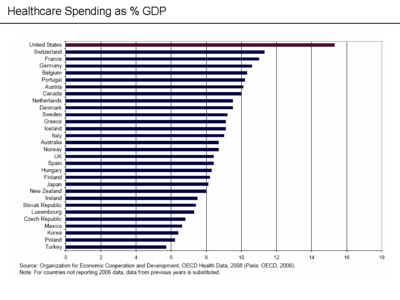
“Market medicine's dogma, that the profit motive optimizes care and minimizes costs, seems impervious to evidence that contradicts it. For decades, studies have shown that for-profit hospitals are 3 to 11 percent more expensive than not-for-profit hospitals; no peer-reviewed study has found that for-profit hospitals are less expensive.”A hospital stay averages almost $4,000 a night in the US. In Germany, it’s $632. A coronary bypass costs about $67,000, and angiogram is $800, an MRI scan over a thousand, and baby delivery almost $10,000. In Canada or Europe they are almost always less than half that cost. I’m not seeing any efficiency -- except, perhaps, at channeling money efficiently to investors.
Besides hospitals, market creep is changing our prisons. Prisons are increasingly privatized, run for profit. Which means we now have company lobbyists in our legislatures lobbying for tougher criminal penalties so that they can have more inmates and get more money. Is that any kind of way to run a prison system – where there’s a vested interest in more people in prison rather than fewer?
We are also seeing an increase in for-profit schools – which amounts to an abandonment of the notion that education is a public good. In fact, market creep is slowly eroding the idea that there is such a thing as the public good.
We are increasingly outsourcing war to private military contractors. For much of the years of US military presence in Iraq and Afghanistan, private contractors outnumbered U.S. military troops.
In the U.S. and in the U.K., public police forces are being eclipsed by private security firms. The number of private guards in both places is almost twice the number of public police officers.
* * * *
This is Part 4 of "Not for Sale"
Next: Part 5: "Two (Not Three) Cheers for Markets"
Previous: Part 3: "Still Playing Out the Reagan Revolution"
Beginning: Part 1: "Marketplace Creep"
2012-07-24
Still Playing Out the Reagan Revolution
The market – all our practices of buying and selling – is an important part of life. But it’s not the only part of life. And there’s been a real shift in the last 30 years – since about 1980. With the Reagan presidency a lot of changes began that are still playing out – subtly reinforcing or reinforced by the slow extension of the market into more and more areas that used to be outside the market sphere.
If it’s strange what you can buy these days, it’s at least as strange what you can sell. Some examples (from Michael Sandel's "What Isn't For Sale?" in Atlantic Monthly: see here):
You can get $10,000 from selling the space on your forehead. A woman in Utah was paid $10,000 by an online casino to install a permanent tattoo of the casino’s Web address on her forehead. Temporary tattoos bring less.
You can get $7,500 for serving as a human guinea pig in a drug-safety trial for a pharmaceutical company.
You can get up to $1,000 a day as a mercenary soldier, fighting in Somalia or Afghanistan for a private military contractor. Soldiers, certainly, should get paid – but should they be doing it for the pay so much so that they’ll fight for a country that isn’t their own?
You can get $15 to $20 an hour for standing in line overnight on Capitol Hill. Lobbyists pay line-standing companies, who hire homeless people and others to hold a place for a lobbyist who wants to attend a congressional hearing. It’s OK to hold a place in line for a friend, but something’s gone wrong when we’re just hiring people to stand in line for us. ("Linestanding.com" claims it "has been a leader in the Congressional line standing business since 1985," and produces "high quality line standing services for Congressional hearings or other events.")
One underachieving Dallas school is trying to encourage reading. They’re paying second-graders $2 per book read.
We can now buy things that 30 years ago weren't buy-able (see previous), and sell things that 30 years ago weren't sell-able. In these 30-some years we have seen the for-profit sector encroaching more and more into areas that used to be in either the public sector or the not-for-profit sector.
We have seen, for instance, the rise of the for-profit hospital, replacing the traditional hospital that was nonprofit. The nonprofit sector, of course, is not divorced from market realities. Apart from a few Catholic hospitals staffed mostly by Nuns who had taken a vow of poverty, the standard nonprofit hospital still paid living wages to its staff and kept up its physical plant. They had to meet payroll and maintenance costs. What they didn't pay, however, were profits to shareholders.
As market creep moved into healthcare, market logic said that everything was about the money. Market logic says that money is not just a tool for carrying out a mission, but that making more money either is the mission or is the only measure of the value of the mission. Market logic carried us from, “the hospital has to bring in money to carry out its mission,” to “therefore people can invest in the hospital's ability to bring in money, and reap dividends.”
We sold a part of our soul when we accepted the notion that a hospital’s central purpose was to make money, and caring for people was the means to that end -- rather than that the central purpose was caring for people and the money was the means to that end. Now, if the people are getting better, cheaper care, well, we got a bargain on that sale of our soul. But are people getting better care?
* * * * *
This is Part 3 of "Not For Sale"
Next: Part 4: "What Shall It For-Profit Us?"
Previous: Part 2: "Some Unusual Gift Ideas"
Beginning: Part 1: "Marketplace Creep"
If it’s strange what you can buy these days, it’s at least as strange what you can sell. Some examples (from Michael Sandel's "What Isn't For Sale?" in Atlantic Monthly: see here):
You can get $10,000 from selling the space on your forehead. A woman in Utah was paid $10,000 by an online casino to install a permanent tattoo of the casino’s Web address on her forehead. Temporary tattoos bring less.
You can get $7,500 for serving as a human guinea pig in a drug-safety trial for a pharmaceutical company.
You can get up to $1,000 a day as a mercenary soldier, fighting in Somalia or Afghanistan for a private military contractor. Soldiers, certainly, should get paid – but should they be doing it for the pay so much so that they’ll fight for a country that isn’t their own?
You can get $15 to $20 an hour for standing in line overnight on Capitol Hill. Lobbyists pay line-standing companies, who hire homeless people and others to hold a place for a lobbyist who wants to attend a congressional hearing. It’s OK to hold a place in line for a friend, but something’s gone wrong when we’re just hiring people to stand in line for us. ("Linestanding.com" claims it "has been a leader in the Congressional line standing business since 1985," and produces "high quality line standing services for Congressional hearings or other events.")
One underachieving Dallas school is trying to encourage reading. They’re paying second-graders $2 per book read.
We can now buy things that 30 years ago weren't buy-able (see previous), and sell things that 30 years ago weren't sell-able. In these 30-some years we have seen the for-profit sector encroaching more and more into areas that used to be in either the public sector or the not-for-profit sector.
We have seen, for instance, the rise of the for-profit hospital, replacing the traditional hospital that was nonprofit. The nonprofit sector, of course, is not divorced from market realities. Apart from a few Catholic hospitals staffed mostly by Nuns who had taken a vow of poverty, the standard nonprofit hospital still paid living wages to its staff and kept up its physical plant. They had to meet payroll and maintenance costs. What they didn't pay, however, were profits to shareholders.
As market creep moved into healthcare, market logic said that everything was about the money. Market logic says that money is not just a tool for carrying out a mission, but that making more money either is the mission or is the only measure of the value of the mission. Market logic carried us from, “the hospital has to bring in money to carry out its mission,” to “therefore people can invest in the hospital's ability to bring in money, and reap dividends.”
We sold a part of our soul when we accepted the notion that a hospital’s central purpose was to make money, and caring for people was the means to that end -- rather than that the central purpose was caring for people and the money was the means to that end. Now, if the people are getting better, cheaper care, well, we got a bargain on that sale of our soul. But are people getting better care?
* * * * *
This is Part 3 of "Not For Sale"
Next: Part 4: "What Shall It For-Profit Us?"
Previous: Part 2: "Some Unusual Gift Ideas"
Beginning: Part 1: "Marketplace Creep"
2012-07-21
Some Unusual Gift Ideas
It’s not just that if you have huge quantities of cash, then you can buy your way into, well, just about anything. There are some things you can now buy for relatively little that didn’t used to be the sort of thing that was for sale. These examples were cited in Michael Sandel's recent Atlantic Monthly article (see here).
$90 a night will buy you a prison-cell upgrade in Santa Ana, California and some other cities. These cities decided to offer nonviolent offenders the chance to pay for a clean, quiet jail cell separated from any non-paying customers – I mean, prisoners – who might disturb them. (See NYTimes article here). Should we be selling that? Maybe we shouldn’t have privatized prisons that are run by for-profit corporations who are looking for any way they can to make a profit from them.
A mere $8 – in Minneapolis, San Diego, Houston, Seattle, and a few other cities -- will now get you access to the carpool lane while driving solo. The rates vary according to traffic. We have toll roads, you might argue. And this is essentially a “toll lane,” so why not? Maybe because the point of HOV lanes is to encourage civic-minded conservation rather than -- just the opposite -- to further privilege wealth?
$8,000 dollars will get you the services of an Indian surrogate mother. Yes, it seems that even surrogate motherhood is something that Westerners outsource to Asia. Indian surrogate mothers go for less than one-third the going rate in the US.
For a quarter-million dollars the government of South Africa will let you buy the right to shoot an endangered black rhino. They’re not doing this just because they need the money. In fact, the money doesn’t go to the government. This is actually a plan to protect the species. By allowing ranchers to sell the rights to kill a black rhino for $250,000, they are giving the ranchers an incentive to protect the endangered species. We do protect what is valuable. But is a high pricetag the only value we recognize?
For $1,500 and up, per year, you can get your doctor’s cellphone number. Some offer cellphone access and same-day appointments for patients willing to pay annual fees ranging from $1,500 to $25,000. I respect my doctor’s right, and need, to not be at my beck and call 24/7, but I want her to be sleeping, or playing with her kids, or, heck, even getting in a round of golf. I don’t want her to be unavailable to me just so she can be available, instead, to a wealthier patient.
For $10.50, companies in Europe can buy the right to emit a metric ton of carbon dioxide into the atmosphere.
For all our fuss about immigration, for a flat $500,000 anybody can buy the legal right to immigrant to the U.S. By law, foreigners who invest $500,000 and create at least 10 full-time jobs in an area of high unemployment – and who don’t have any outstanding warrants or a criminal record – will be granted permanent residency.
If it's strange what you can buy these days, it's at least as strange what you can sell.
* * * *
This is Part 2 of "Not For Sale"
Next: Part 3: "Still Playing Out the Reagan Revolution"
Previous: Part 1: "Marketplace Creep"
* * * * *
$90 a night will buy you a prison-cell upgrade in Santa Ana, California and some other cities. These cities decided to offer nonviolent offenders the chance to pay for a clean, quiet jail cell separated from any non-paying customers – I mean, prisoners – who might disturb them. (See NYTimes article here). Should we be selling that? Maybe we shouldn’t have privatized prisons that are run by for-profit corporations who are looking for any way they can to make a profit from them.
A mere $8 – in Minneapolis, San Diego, Houston, Seattle, and a few other cities -- will now get you access to the carpool lane while driving solo. The rates vary according to traffic. We have toll roads, you might argue. And this is essentially a “toll lane,” so why not? Maybe because the point of HOV lanes is to encourage civic-minded conservation rather than -- just the opposite -- to further privilege wealth?
$8,000 dollars will get you the services of an Indian surrogate mother. Yes, it seems that even surrogate motherhood is something that Westerners outsource to Asia. Indian surrogate mothers go for less than one-third the going rate in the US.
For a quarter-million dollars the government of South Africa will let you buy the right to shoot an endangered black rhino. They’re not doing this just because they need the money. In fact, the money doesn’t go to the government. This is actually a plan to protect the species. By allowing ranchers to sell the rights to kill a black rhino for $250,000, they are giving the ranchers an incentive to protect the endangered species. We do protect what is valuable. But is a high pricetag the only value we recognize?
For $1,500 and up, per year, you can get your doctor’s cellphone number. Some offer cellphone access and same-day appointments for patients willing to pay annual fees ranging from $1,500 to $25,000. I respect my doctor’s right, and need, to not be at my beck and call 24/7, but I want her to be sleeping, or playing with her kids, or, heck, even getting in a round of golf. I don’t want her to be unavailable to me just so she can be available, instead, to a wealthier patient.
For $10.50, companies in Europe can buy the right to emit a metric ton of carbon dioxide into the atmosphere.
For all our fuss about immigration, for a flat $500,000 anybody can buy the legal right to immigrant to the U.S. By law, foreigners who invest $500,000 and create at least 10 full-time jobs in an area of high unemployment – and who don’t have any outstanding warrants or a criminal record – will be granted permanent residency.
If it's strange what you can buy these days, it's at least as strange what you can sell.
* * * *
This is Part 2 of "Not For Sale"
Next: Part 3: "Still Playing Out the Reagan Revolution"
Previous: Part 1: "Marketplace Creep"
* * * * *
2012-07-20
Marketplace Creep
Is there anything that isn’t for sale? Is there anything that is for sale but shouldn’t be?
Just to pick a random example, should, say, I don't know, a minister’s sermon topic be up for sale? Or would that violate our longstanding tradition of the free pulpit – that whoever the congregation calls to fill its pulpit is expected to speak from his conscience on the topics that he discerns, using his unfettered judgment, will be most needful and beneficial for the moral and spiritual improvement of the congregation?
The free pulpit is not for sale!
Well, except for one time a year. Once a year I offer for sale at our annual Fellowship auction a Sunday sermon on the topic of the highest bidder’s choice. That’s just once a year. One special fundraising contribution – and that’s IT. So when a member of my congregation came to me and said:
Whatever the last auction bid was, plus 10 percent.
Ironically, the topic this member was keen for me to preach about was what should and shouldn't be for sale. The member had read a recent article in Atlantic monthly: Michael Sandel, "What Isn't For Sale?" (see here), and wanted to hear my reflections and have the issue brought before the congregation.
I did cravenly name a price -- because I could use good topic suggestions, trusted that this member would have one, and figured that going up to two "sold" topics a year would not hinder my ministry. Despite evident willingness to name my price, virtue and principle did prevail. As it turned out, I ended up taking up the topic because my conscience commanded that it be addressed, not because I was bought off by the promise of a contribution to the Fellowship coffers. The deal was not closed, and, to my knowledge, no one made or promised any contribution specifically for this topic.
Now that we have established that one thing that is not for sale (after all) is the minister's sermon topics, we can ask: is there anything else you can’t buy?
What can’t you buy? It’s an election year, and we are inescapably reminded that democracy is for sale. The election doesn’t always go to the biggest spender, but (a) it usually does, and (b) it never goes to those who don’t spend a lot.
It has never been cheaper to give access to the whole world to everything you have to say. You put up a website: pictures, videos, graphics, text. Everyone in the whole world can check you out, check out your opponent’s web site for the criticisms of you, and then can check out independent websites like politifact.com to see which factual claims are true. It has never been cheaper and easier to make all the information a well-informed electorate needs readily and universally available.
And a well-informed electorate has never seemed -- to the candidates, to the press, and, indeed, to us, the electorate -- more irrelevant. We expect our candidates to spend a lot of money – we won’t take them seriously if they don’t. Never mind your integrity, your intelligence, your ability to work well with others to get things done, your compassion, your down-to-earth practicality, your values, or stands on the issues. If you aren’t spending a million dollars, you obviously aren’t a serious candidate.
It costs, on average, $1.4 million dollars to get a house seat in Congress. So candidates spend 75 percent of their time fundraising – and almost that much time after they get in office. You might be old fashioned enough to think that elective office is not the sort of thing that ought to be for sale.
What we are seeing is marketplace creep: that is, the logic of the market – where everything is about buying and selling – has been creeping into more and more corners of life.
* * * * *
This is Part 1 of "Not For Sale"
Next: Part 2: "Some Unusual Gift Ideas"
* * * * *
Just to pick a random example, should, say, I don't know, a minister’s sermon topic be up for sale? Or would that violate our longstanding tradition of the free pulpit – that whoever the congregation calls to fill its pulpit is expected to speak from his conscience on the topics that he discerns, using his unfettered judgment, will be most needful and beneficial for the moral and spiritual improvement of the congregation?
The free pulpit is not for sale!
Well, except for one time a year. Once a year I offer for sale at our annual Fellowship auction a Sunday sermon on the topic of the highest bidder’s choice. That’s just once a year. One special fundraising contribution – and that’s IT. So when a member of my congregation came to me and said:
“If I didn’t have the highest bid for choosing your sermon topic at the auction this year, then how much would I have to contribute to buy a sermon topic?”my answer was swift and unequivocal.
Whatever the last auction bid was, plus 10 percent.
Ironically, the topic this member was keen for me to preach about was what should and shouldn't be for sale. The member had read a recent article in Atlantic monthly: Michael Sandel, "What Isn't For Sale?" (see here), and wanted to hear my reflections and have the issue brought before the congregation.
I did cravenly name a price -- because I could use good topic suggestions, trusted that this member would have one, and figured that going up to two "sold" topics a year would not hinder my ministry. Despite evident willingness to name my price, virtue and principle did prevail. As it turned out, I ended up taking up the topic because my conscience commanded that it be addressed, not because I was bought off by the promise of a contribution to the Fellowship coffers. The deal was not closed, and, to my knowledge, no one made or promised any contribution specifically for this topic.
Now that we have established that one thing that is not for sale (after all) is the minister's sermon topics, we can ask: is there anything else you can’t buy?
What can’t you buy? It’s an election year, and we are inescapably reminded that democracy is for sale. The election doesn’t always go to the biggest spender, but (a) it usually does, and (b) it never goes to those who don’t spend a lot.
It has never been cheaper to give access to the whole world to everything you have to say. You put up a website: pictures, videos, graphics, text. Everyone in the whole world can check you out, check out your opponent’s web site for the criticisms of you, and then can check out independent websites like politifact.com to see which factual claims are true. It has never been cheaper and easier to make all the information a well-informed electorate needs readily and universally available.
And a well-informed electorate has never seemed -- to the candidates, to the press, and, indeed, to us, the electorate -- more irrelevant. We expect our candidates to spend a lot of money – we won’t take them seriously if they don’t. Never mind your integrity, your intelligence, your ability to work well with others to get things done, your compassion, your down-to-earth practicality, your values, or stands on the issues. If you aren’t spending a million dollars, you obviously aren’t a serious candidate.
It costs, on average, $1.4 million dollars to get a house seat in Congress. So candidates spend 75 percent of their time fundraising – and almost that much time after they get in office. You might be old fashioned enough to think that elective office is not the sort of thing that ought to be for sale.
What we are seeing is marketplace creep: that is, the logic of the market – where everything is about buying and selling – has been creeping into more and more corners of life.
* * * * *
This is Part 1 of "Not For Sale"
Next: Part 2: "Some Unusual Gift Ideas"
* * * * *
Subscribe to:
Posts (Atom)