Showing posts with label Going Into Labor. Show all posts

2012-09-13

The Cruelty of Ideals and the Labor of Homecoming

Industrialist George Pullman was born, lived, and died a Universalist. Something of the Universalist outlook may be detected in his life and actions. He believed his workers deserved decent accommodations. He saw that education was a win-win: it made workers lives better, and made them more useful workers for businessmen like him. "I have faith," Pullman told the press, "in the educational and refining influences of beauty, and beautiful and harmonious surroundings."

Pullman had a kind of Universalist hope that different denominations could come together and worship together in one church. There is a certain idealist, utopian strain of thought in the planning of his town.

Shortly after Pullman's death in 1897, courts ordered
the homes sold to individual homeowners.
Liberal religion is characterized by an optimism about human possibility. From our beginnings 450 years ago, Unitarians and Universalists have been peoples who rejected Calvinistic conceptions of humankind’s total depravity. That optimism about human capacity is displayed in Pullman’s vision of a company town where every one was happy and productive.

So what went wrong?

It's not hard to see that what went wrong was that Pride and Control took over. Yes, people can get better – can learn, can grow: but they have to do so in their own way. Growth, learning, and development cannot be all planned out with precise outcomes determined in advance. Pullman believed in human improvability, but didn't believe in people enough to let them work out their own growth, awakening, salvation, in their own way -- even if they used their freedom to go backwards for a few years -- or a few generations -- and even if, left to their own devices, they drank, or listened to speeches from agitators, read independent newspapers, gathered and discussed unsavory ideas. Pullman wouldn't listen to his workers' needs. We can’t ever be so arrogant that we won’t meet and talk and consider where other people are coming from.

For Labor Day, remember George Pullman, the industrialist whose meanness sparked the events that led to the creation of the holiday.

Remember George Pullman, the Universalist who got the optimism but didn’t get the humility – because we Unitarian Universalists today follow in his footsteps in more ways than it's comfortable to admit. When has your voice of “let’s make it better,” come out as "fix it my way or I will treat you as evil obstructionist"? When have your own ideals made you cruel?

I think we do that every time we think someone else is wrong.

Then let this be our Labor Day prayer: to find the courage to talk to the people we think are wrong, and stay at it until we get over ourselves.

I've had a few long conversations in the last month – three-hour lunches or four-hour evenings that started with two hours in my office and continued at a bar. Earnest and exhausting conversations. It takes a long time to get over myself, to feel a way back to reconnection. I’m ready to keep having those conversations – as many as you’ll have with me. If you’re ready, I’m ready – because I think we’ve seen enough of iconic heroic loner figures talking to empty chairs. (If you missed it, I'm referring to Clint Eastwood’s convention speech addressing an empty chair, pretending it was occupied by the opposition candidate.)

It’s not the loner heroics, but boring community building that’s called for. It’s not the empty chairs, or the people we already agree with and understand, that we need to meet with and talk to.

“God rejoiced at our disobedience,” said Rabbi Kushner, “and then wept with joy that we could feel our estrangement and want to return home.” We feel the estrangement. For Labor Day, commit to the labor it takes to return home. That labor, we cannot send to China. To go into the labor of giving birth to ourselves -- to go into the labor of giving birth to community -- we can’t get surrogates in India. It’s up to us.

May we make it so.

Amen.

* * *
This is part 4 of 4 of "Going Into Labor"

Previous: Part 3: "The Origin of Labor Day"
Beginning: Part 1: "Labor"

2012-09-12

The Origin of Labor Day

The stock market crash of 1893 brought a depression in which 150 railroads closed and unemployment was massive. George Pullman cut his workers' wages by 25 percent, but did not reduce rents in the town of Pullman at all.

The next year, 1894, 4,000 Pullman employees went on a wildcat strike: "wildcat" because it wasn’t authorized by the workers’ trade union officials, and that was because they didn’t have any trade union officials because Pullman didn’t allow labor unions. Then organizers for Eugene Debs' American Railway Union came in and signed up many of the striking workers, and the Pullman strike spread. Soon 100,000 railroad workers across the country were refusing to handle trains with Pullman cars.

The strike shut down much of the nation's freight and passenger traffic west of Detroit. Various sympathy strikers prevented transportation of goods by walking off the job, obstructing railroad tracks or threatening and attacking the replacement workers the railroads sought to hire. At its peak, the strike involved 250,000 workers in 27 states.

Artist's rendering of the clash between striking Pullman workers and federal troops.
Pullman called up his friend and fellow railroad director, United States Attorney General Richard Olney. With President Grover Cleveland's backing, troops were sent to Chicago. The federal government secured a federal court injunction against the union, Debs, and the top leaders ordering them to stop interfering with trains that carried mail cars. They refused. The Army moved in to stop the strikers from obstructing the trains. Violence broke out in a number of cities: millions of dollars in damages and 30 people were killed.

The Army broke the strike. Debs went to prison for violating a court order. The railroads fired and black-listed all the employees who had supported the strike. As soon as the strike was over and the trains were running, President Cleveland and Congress moved quickly to make conciliation to organized labor.

Six days after the 1894 Pullman strike ended, legislation was pushed through Congress declaring that the first Monday of September was a Federal holiday, Labor Day. So we have Labor Day as a consolation prize after the Feds sent in troops to protect corporate interests and break up a strike. It was a bone to try to head off further conflict. And they put it in September, instead of giving official recognition to the more widely known International Workers Day on May 1, because they wanted to pull attention away from the more radical labor movements.

Every Labor Day, let us remember this story of the origin of the holiday. The story of conflict between "management" (the wealthy, the controllers of capital) and people whose labor they want to make use of (slaves, indentured servants, laborers) is the central and on-going story of our country. This is who we are as a people.

Labor Union membership peaked in the 1940s and 50s, and has been declining ever since. The number of working poor has been climbing. The percentage of all workers whose incomes fall below the poverty threshold was 4.7% in 2000, and rose to 7.2% by 2010. On the weekend for celebrating labor, let’s remember those who labor but whose pay is so low that they remain in poverty.

The story of George Pullman is of particular salience to us Unitarian Universalists. This is our story, quite specifically. You see, George Pullman was one of us in a very direct sense. George Pullman was a Universalist: born, raised, and lifelong.

George’s father, raised a Baptist, and his mother, raised Presbyterian, converted to Universalism, drawn to the “God is Love” message of the Universalist minister Thomas Eaton. George's Dad often led the services when no preacher was available.

The Pullmans were a devotedly, devoutly, Universalist family. Both of George’s two older brothers became Universalist ministers and were prominent figures in our faith. Late in his life, George Pullman had a Universalist church built in his hometown, Albion, New York, as a memorial to his parents.

* * *
This is part 3 of 4 of "Going Into Labor"

Next: Part 4: "The Cruelty of Ideals and the Labor of Homecoming"
Previous: Part 2: "Pullman, Illinois"
Beginning: Part 1: "Labor"

2012-09-11

Pullman, Illinois

A holiday becomes again a holy day when, among other things, we honor the occasion with retellings of particular sacred stories -- stories made sacred by the meaning we give them. What are the stories that consecrate Labor Day?

George Pullman, 1831-1897
I'm not sure Labor Day has any widely recognized sacred stories, so let me offer a story as a candidate for adopting and making sacred through the widespread retelling of it every Labor Day. This is the cautionary tale of industrialist George Pullman, born 1831. He founded the Pullman Palace Car Company that manufactured railroad cars, particularly the Pullman sleeping car.

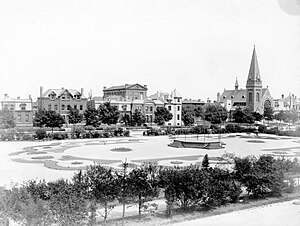
In 1880, he bought 4,000 acres 14 miles south of Chicago, and got an architect to design not only his new plant for making railroad cars, but a whole town: houses for 10,000 workers, shopping areas, a church, theatres, parks, a hotel, and a library – all owned by one man. He built and owned the power plant that powered his factory and his town. The town was named after him: “Pullman, Illinois.” Pullman’s workers worked for him, lived in houses owned by him, paid their rent and their utilities to him, and shopped in stores owned by him, strolled in his parks.

His aim was to solve the issue of labor unrest and poverty. For years Pullman had been a philanthropic supporter of fine schools – with the aim of providing business with a better quality of laborer. He wanted a happy, loyal workforce, so his town provided for all his workers’ needs. They got a state-of-the art home: indoor plumbing, gas lights, sewers – well above the average dwelling of the time. They got fine country air and beautiful neighborhoods. The mortality statistics, indeed, established that Pullman, Illinois was one of the most healthful places in the world to live. The town created a national sensation. The press praised Pullman’s benevolence and vision.

Pullman, Illinois
To ensure there would be no unhappiness, Pullman prohibited outside agitators, allowed no saloons, or vice district. The hotel on the edge of town had the town’s only bar, and it was open only to visitors, not the residents. He prohibited independent newspapers, public speeches, town meetings or open discussion. He wanted his workers to have clean homes, so his inspectors regularly entered homes to inspect for cleanliness and could terminate leases on ten days notice. Private charitable organizations were prohibited.

He built only one church building in his town: the Greenstone Church. Pullman’s plan was that all religious denominations would band together and share the one building. But the various denominations would not unite, and no single denomination could afford the rent, so the church stood empty for the town’s first seven years until Pullman finally slashed the rent by two-thirds, and Presbyterians rented it.

Then in 1893 the stock market crashed. The railroad "bubble" (overbuilding railroads, and relying on shaky financing to do it) burst. The "Panic of 1893" was, at the time, the worst economic depression the United States had ever experienced. 150 railroads closed. There was massive unemployment. Pullman cut his workers' wages by 25 percent or more. He did not, however, reduce the rents he charged his workers for living in Pullman, Illinois.

* * *
This is part 2 of 4 of "Going Into Labor"

Next: Part 3: "The Origin of Labor Day"
Previous: Part 1: "Labor"

2012-09-10

Labor

The three-day Labor Day weekend celebrates the economic and social contributions of workers. Many of us had the day off from work or classes and were glad to have a chance to gather with friends, have a cook-out. It’s a chance to have a good time.

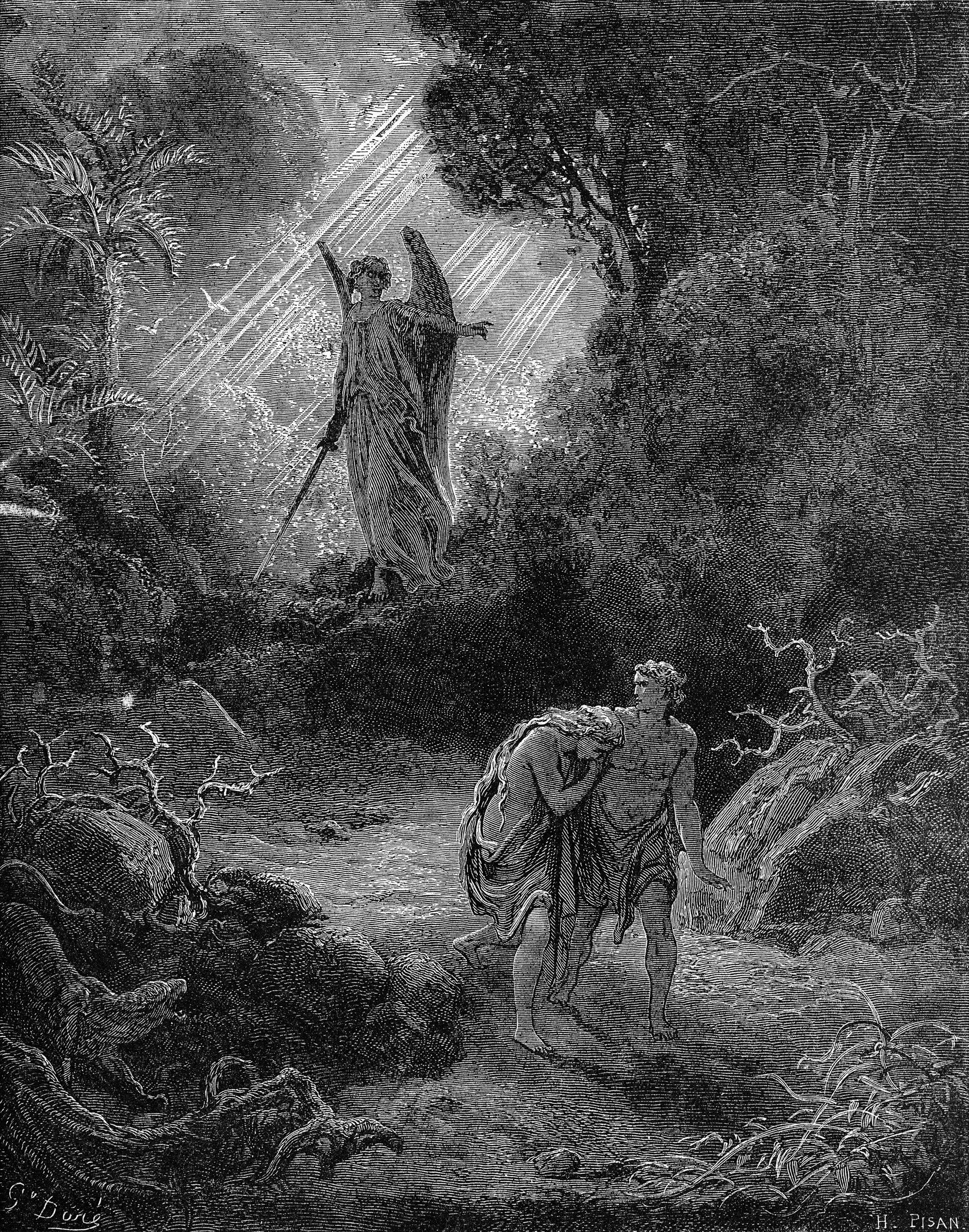
For Labor Day, we honor and celebrate: Labor. At the same time, Western civilization happens to inherit a tradition in which labor is punishment. In the Genesis story, the original humans ate “of the tree of the knowledge of good and evil,” and Yahweh kicked them out of paradise, and gave them labor: gender-specific labor. The woman’s labor is childbearing:
“I will greatly increase your pangs in childbearing; in pain you shall bring forth children” (Gen. 3:16)
The man’s labor is working the fields.
“Cursed is the ground because of you. In toil you shall eat of it all the days of your life. Thorns and thistles it shall bring forth for you, and you shall eat the plants of the field. By the sweat of your face you shall eat bread. (Gen. 3:17-19)”
So labor is what we have to endure because we ate of a tree and got called out. We go out of Eden and go into: labor. Tough break.

The interpretation of that Genesis story that makes more sense to me is one offered by Rabbi Lawrence Kushner in Eyes Remade for Wonder. Kushner suggests that the whole thing was a setup. Like any good parent, God knew that to grow up we would have to leave home and so put that tree there to create a pretext for kicking us out.
“We have read it all wrong. God was not angry. God rejoiced at our disobedience and then wept with joy that we could feel our estrangement and want to return home.”
The return home, however, is not easy. It is, in fact, labor. For the most part, though, we think of labor less as the work of "returning home" and more as punishment. When we can, we avoid it -- outsource it to Asia.

We outsource factory labor and telephoning labor. We even outsource the childbirth labor. Someone creates an embryo in a lab, ships it abroad for gestation in a stranger's body, then takes possession again after birth. Overseas labor – of both kinds – is cheaper. Farmed-out childbirth is an industry in India, turning the rural poor into wombs for hire.

The trend to outsource our labor was satirized in “The Borowitz Report,” which ran this fake-news piece:
“Labor Day Officially Moved to China. First US Holiday to be Outsourced. Labor Day, one of America's most beloved and longest-celebrated holidays, has been officially moved to China, U.S. officials confirmed today. The Labor Day celebrations are expected to kick off Monday afternoon in Beijing with a barbeque attended by over seven million people and presided over by former NBA star Yao Ming. The transfer of Labor Day to China represents the first time in American history that an entire holiday has been outsourced, experts said....Meanwhile, U.S. officials said it was looking 'more and more likely' that Thanksgiving would be relocated this year to India. 'At the very least, Americans will still be able to celebrate Thanksgiving by phone,' one official said. 'But they should listen closely because some menu options have changed.'"
Well, that’s silly. Whatever work we may have sent overseas, we will always have the work of living here, and with it, our celebrations.

Labor day is a holiday – which originally meant holy day. Let us, then, remember the holiness of work – whether we work for pay or not. Whether or not labor seems to us to be a pain or a drudgery to endure just to pay the pills, there is before us also the prospect of labor as the path home.

* * *
This is part 1 of 4 of "Going Into Labor"

Next: Part 2: "Pullman, Illinois"