Showing posts with label Yay For Our Team. Show all posts

2013-06-14

Yay for Our Team

We Unitarian Universalists have a reputation for being logically minded. There was a Unitarian Universalist who was on death row. On the eve before his execution, the Warden asked, “It’s customary for the condemned to have time with a priest or chaplain. Would you like me to get you a priest? A chaplain?"

The man said, “I’m a Unitarian Universalist.”

The Warden said, “In that case, would you like to talk to a math professor?”

I’ve got this part of me that says, “Now that’s not fair!” Then I’ve got this other part of me that says, actually, I think, before I die, I would like some help making my peace with transfinite cardinal numbers. (Neither infinite nor finite? What kind of Zen math is that?)

We of liberal religion do have a reputation for being logically minded. We’re also quick thinkers. There was a Unitarian Universalist youth, working her first job in grocery store. A man comes up and asks for half a head of lettuce. She says, “Hold on.” She goes back to talk to the manager. She’s telling the manager, “There's a jerk out there who wants to buy half a head of lettuce.” Just then she notices that the man has followed her and is standing behind her, so she says,“and this fine gentleman wants to buy the other half." Quick thinking!

For all that, we have learned that it isn’t thinking that saves us. It’s each other. Thinking can be glorious, but it can also be dreary when we’re by ourselves. I heard about a highway sign along a desert stretch of highway: "Your Own Tedious Thoughts, next 200 miles." Together with others we are lifted out of the constant tedium of our own thoughts.

It’s said that Jews don’t recognize Jesus as the Messiah, that Muslims don’t recognize Jews as God’s chosen people, that Protestants don’t recognize the Pope as the leader of the Christian world, that some Episcopalians don’t recognize their own bishop (if said bishop happens to be gay), that Baptists don’t recognize each other in the liquor store, and that UUs don’t recognize each other in Wal-Mart. We do, however, love to recognize the famous people in our history. Three of the first six presidents were Unitarian: John Adams, Thomas Jefferson, and John Quincy Adams. The 13th president, Millard Fillmore, and the 27th president, William Howard Taft, were also Unitarian, as was the Democratic Party's nominee in 1952 and 1956, Adlai Stevenson. Back in the 16th century, there was a Unitarian King: King John Sigismund of Transylvania, reigned 1560-1570.

Other political figures include:
Benjamin Franklin (1706-1790), scientist, writer, statesman, printer.
Paul Revere (1735–1818).
Abigail Adams (1744–1818) women's rights advocate and first Second Lady and the second First Lady of the United States
John Marshall (1755-1835), Chief Justice of the United States Supreme Court.
John C. Calhoun (1782–1850) U.S Senator, Co-founder, All Souls Church, Unitarian (Washington, D.C.)
Daniel Webster (1782-1852), orator, U.S. Senator, Secretary of State, presidential candidate.
Oliver Wendell Holmes, Jr. (1841-1935), lawyer and member of the U.S. Supreme Court, 1902-32.
Harold Hitz Burton (1888–1964) U.S. Supreme Court Justice 1945-1958
Elliot Richardson, former Secretary of Health, Education and Welfare, and Attorney General (1973).

Unitarians or Universalists in the arts and entertainment include:
Nathaniel Hawthorne (1804-1864), 19th century American novelist, author of "The Scarlet Letter."
Margaret Fuller (1810–1850) Journalist.
P. T. Barnum (1810–1891) American showman and Circus Owner.
Charles Dickens (1812–1870) English novelist.
Herman Melville (1819-1891), writer, author of Moby Dick.
Julia Ward Howe (1819–1910) author of "The Battle Hymn of the Republic".
Louisa May Alcott (1832–1888)Author of Little Women.
Beatrix Potter (1866-1943), author of Peter Rabbit and other children's stories.
Carl Sandberg (1878-1967), American poet, won Pulitzer Prize for his biography of Abraham Lincoln.
Béla Bartók (1881–1945) Composer.
e. e. cummings (1894–1962) Poet and painter
May Sarton (1912-1995) Poet.
Ray Bradbury (1920–2012) Author.
Kurt Vonnegut (1922–2007), writer.
Rod Serling (1924–1975) Writer; Creator of "The Twilight Zone" television series.
Paul Newman (1925–2008) Actor, film director.
Christopher Reeve (1952–2004) Actor.

Our activists, organizers, and humanitarians include:
Horace Mann (1796-1859), leader in the public school movement, founder of the first public school in America, U.S. Congressman.
Dorothea Dix (1802-1887), crusader for the reform of institutions for the mentally ill.
William Lloyd Garrison (1805-1879), abolitionist, editor of The Liberator.
Horace Greeley (1811-1872), journalist, politician, editor and owner of the New York Tribune, champion of labor unions and cooperatives.
Susan B. Anthony (1820–1906).
Florence Nightingale (1820-1910), British nurse and hospital reformer.
Clara Barton (1821–1912) organizer of American Red Cross, Universalist.
Albert Schweitzer (1875–1965) Nobel Peace Laureate 1953.
Whitney M. Young (1921–1971) Social work administrator, head of the Urban League.
Morris Dees (b. 1936) Attorney, cofounder, chief legal counsel of Southern Poverty Law Center.

Inventors, innovators, and scientists who were Unitarian or Universalist or Unitarian Universalist:
Joseph Priestley (1733–1804) discoverer of oxygen and Unitarian minister.
Charles Darwin (1809-1882), scientist and evolutionist, author of Origin of the Species.
Alexander Graham Bell (1847-1922), inventor of the telephone; founder of Bell Telephone Company.
Buckminster Fuller (1895–1983) inventor, engineer.
Linus Pauling (1901–1994) Nobel Laureate for Peace and for Chemistry.
Tim Berners-Lee (1955-) inventor of the World Wide Web.

Best known Unitarian or Universalist clergy include:
Ferenc Dávid (often rendered Francis David) (1510–1579) Hungarian-Transylvanian priest, minister and bishop, first to use the word "Unitarian" to describe his faith.
Hosea Ballou (1771–1852) American Universalist leader. (Universalist minister and a unitarian in theology)
William Ellery Channing (1780–1842), Unitarian minister whose "Unitarian Christianity" was the manifesto of the new Unitarian denomination.
Adin Ballou (1803–1890) Abolitionist and former Baptist who became a Universalist minister, then a Unitarian minister.
Ralph Waldo Emerson (1803–1882) Transcendentalist, essayist.
Theodore Parker (1810–1860) Transcendentalist and abolitionist.
Edmund Hamilton Sears (1810-1876) Author of the first social gospel Christmas Carol, "It Came Upon a Midnight Clear."
Olympia Brown (1835–1926) suffragist, Universalist minister.
John H. Dietrich (1878–1957), primary intellectual force in the development of religious humanism.
James Haynes Holmes (1879-1964), co-founder of the American Civil Liberties Union, anti-war activist.
Robert Fulghum (1937-) Essayist.

As much as we love and honor our past, our eyes are ever cast to the future. We work to build a world of peace and of justice – a heaven right here on this earth. Many of us share this prayer with Diane Ackerman:

School Prayer

In the name of the daybreak
and the eyelids of morning
and the wayfaring moon
and the night when it departs,

I swear I will not dishonor
my soul with hatred,
but offer myself humbly
as a guardian of nature,
as a healer of misery,
as a messenger of wonder,
as an architect of peace.

In the name of the sun and its mirrors
and the day that embraces it
and the cloud veils drawn over it
and the uttermost night
and the male and the female
and the plants bursting with seed
and the crowning seasons
of the firefly and the apple,

I will honor all life
—wherever and in whatever form
it may dwell—on Earth my home,
and in the mansions of the stars.
* * *
This is part 3 of 3 of "Yay For Our Team"
Previous: Part 2: "UU By The Chuckle"
Beginning: Part 1: "When the Spirit Says UU"

2013-06-13

UU by the Chuckle

By following where our heart leads us, following the dictates of our conscience rather than the dictates of someone else, we do often end up with unique and interesting viewpoints. Like the little girl in one of our Religious Education classes. She was drawing a picture. The teacher asked what she was drawing a picture of.

“It’s a picture of God,” she said.

The teacher said, “But no one knows what God looks like.”

The little girl answered, "They will when I've finished."

Sometimes we take things pretty literally – and yet in a way that might open up a new perspective. Like this other little girl that was sad because her cat had died. She was crying, and her neighbor said, “Don’t cry. Your kittie is with Jesus.”

And she did stop crying because she was turning this over in her mind. Then she said, “What would Jesus want with a dead cat?”

Whatever you may believe about where kitties go, or where humans go, what matters for us is the peace, joy, and love we find here, together.

Ours is a tradition that has Jewish and Christian roots. There were Unitarians and Universalists over 200 years ago in this ago country, and they were all Christians then. But we were Christians with critical thinking, and, though we followed Jesus, we weren’t sure we believed everything in the Bible. I’ve heard there was a Unitarian Bible study class, and the newsletter notice said, “Bring your Bible and a pair of scissors.”

The Unitarian Thomas Jefferson did just that. He clipped out only those parts of the new testament that he especially wanted to have available to study and he created “The Jefferson Bible.”

So it’s not that we aren’t interested in Bible scholarship. In fact, some of us, like Thomas Jefferson, bring scissors, but others get into the theology. For intance, there was the UU who, legend has it, was present at one of Jesus' public addresses.

“Who do you say that I am?” asked Jesus.

The UU piped up and answered: “You are the kerygma behind all myths. You are the incarnate logos. You are of one substance and coeternal with the Father, or the Mother, as the case may be. You are the eruption of eternity into the space-time continuum."

And Jesus looked at the UU and said, “What the heck is that?”

When Eastern religious writings began to be available for the first time in English – in the mid-19th century, both the Unitarians and the Universalists were very interested, and they studied those, too. Yes we do have a friend in Jesus, but not just in Jesus. We don’t stop there. We find wisdom that guides our life also in Socrates, Buddha and Confucius, Moses and Esther.

What a friend we have in Jesus, what a friend in Socrates.
What a friend we have in Buddha, to the kingdom we have keys.
We believe in many saviors, we believe in many seers.
Souls whose universal gospel, speaks to us across the years.

What a friend we have in Moses, what a friend in Esther, too.
We have Lao-zi and Confucius, and a prophet lives in you.
When you're weak and heavy laden, cumbered with a load of care,
Think of friends thruout the ages, ev'ry when and ev'rywhere.

Have we trials and temptations? Is there trouble anywhere?
We should never be discouraged. U U saints are ev'rywhere.
Souls like President John Adams, souls like Olympia Brown.
Oh, what friends we have to guide us. Oh, what sages we have found.

What a friend in Charles Darwin, what a friend in Susan B.
What a friend in Clara Barton, they all helped to make us free.
What a friend in P .T. Barnum, what a friend in Jefferson.
We've four hundred years of friendship, and you bet there's more to come.
- Lyrics by Tony Larsen
* * *
This is part 2 of 3 of "Yay For Our Team"
Next: Part 3: "Yay For Our Team"
Beginning: Part 1: "When the Spirit Says UU"
2013-06-12

When the Spirit Says UU

Yay for our team! Let's celebrate ourselves. It’s a good idea to do that every once in a while. Yay, us! Give our own selves a pat on the back.

It’s great to be a Unitarian Universalist! Yeah!

We don’t mean any slight to any other world religion when we say this. We are not at war with other tribes. We’re just proud of our own (or, if we have transcended pride, say rather that we are especially grateful for our own). If your heart and conscience lead you to follow a Muslim, or Christian, or Jewish path, more power to you. That's just not our path.

Actually: Don't Believe ANYTHING You Think
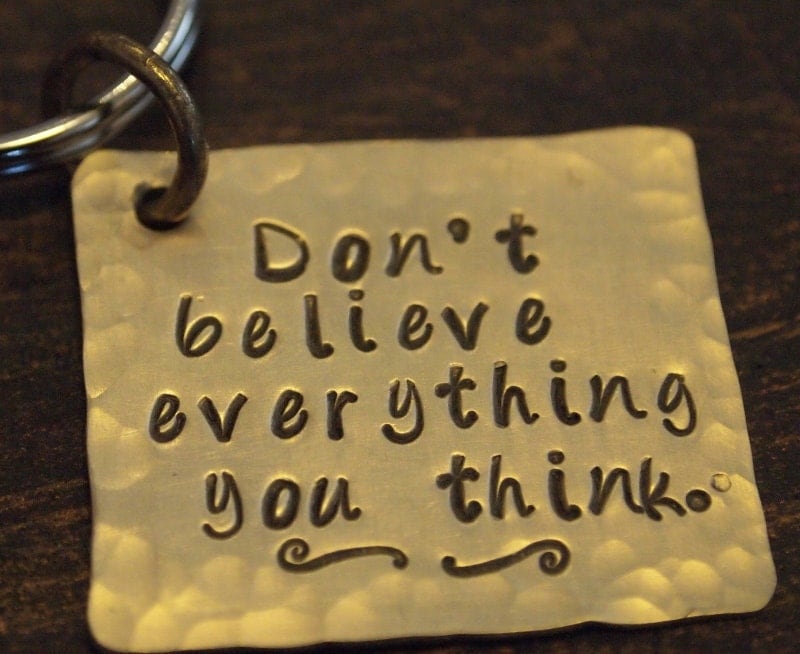
Sometimes people in those other faiths think they’re right. But let’s be honest. Sometimes we think we’re right. I appreciate what I saw on a bumper sticker once: “Don’t believe anything you think.”

The reality is, pretty much all of us are suckers for our thoughts. We all believe our thoughts. There's a saying:
"The world is divided into those who think they're right."
That's the whole saying, because everyone thinks she's right. So let’s also keep that in mind as we celebrate Unitarian Universalism.

In many ways, we don’t choose our faith beliefs, they choose us. It’s up to us to be true to them, to do the work of cultivating them to their fullest flower. Whichever seed got planted in you: do the work of cultivating it to its fullest flower. The flower of liberal religion is rooted in the understanding that revelation is continuous, there are always new things to learn, that our community is based on freely entered covenant, that we work for fairness in the whole world, that conflict is a good thing, and doesn’t mean any side is evil or wrong, and that a better world and a richer life is possible for all of us. That is the root grounding from which liberal religion grows.

It doesn’t mean you can believe anything you want to. Let me tell you a story about that. What you want to believe might be what is easy – a theology that is superficially attractive, doesn’t require much thought or creative work. You might want some belief that you can hold and gaze upon like a pretty crystal: beautiful and static. But hearing and heeding what your heart, mind, and conscience dictate requires effort. Thirty years ago, I was 24 years old. Neecie Vanston and I were members of the Unitarian Universalist Fellowship of Waco, Texas. Neecie was 70-years-old, which, you know, doesn’t seem as old to me now as it did when I was 24. She came up to about the middle of my chest. Neecie was a long-time and dedicated member of that fellowship. She had been part of the small group that founded the Waco UU Fellowship back in the 50s. I was newly returned to the fold after having been unchurched since high school. I didn’t understand that distinction between the easy and lazy believe-anything-you-want-to and the disciplined quest to discern your own heart and mind’s dictates. One Sunday in Waco, during our holiest sacrament -- the coffee communion after the service -- I made the mistake of blithely blurting, “We’re Unitarian Universalists. We can believe whatever we want to.”

Neecie overheard that remark. And she turned around. I will never forget it. It was a religious moment.
“You think I believe in what I do because I want to?” she said. “I believe this because I have to. You think here in Waco, Texas my life wouldn’t be a lot easier if I could be a Baptist? But I can’t. My conscience won’t let me. If this were about what I wanted to believe,” Neecie continued, “about what I found it convenient and easy to believe, you wouldn’t see my face here on Sunday morning.”

Unitarian Universalism: It’s not about believing anything you want to. It’s about being free to believe what you find you have to – because your conscience won’t let you believe otherwise. You got to do when the spirit says do. You got to UU when the spirit says UU.

* * *
This is part 1 of 3 of "Yay for Our Team"
Next: Part 2: "UU By the Chuckle"