The spiritual atheists recognize the importance of spirituality, and they want to liberate spirituality from the institutions they see as dangerous. "We don’t need 'God'; we don’t need the supernatural; we don’t need churches or mosques or synagogues or temples; we don’t need religion," they say.
Setting aside, for now, the points about god and the supernatural, let's look at the points about religion and religious institutions.
I appreciate the point that a lot of what goes by the name of religion has been more harmful than helpful.
We live in a world where people plant bombs – on themselves, in cars, in buildings – and fly jet airliners into buildings – and are led to do so in a way that is enmeshed with their religious understanding and is facilitated by their religious institutions.
We live in a world where, only somewhat less violently, people want to take away women’s reproductive freedom, and punitively stigmatize gay, lesbian, bisexual, and transgender people, and their thinking makes heavy and frequent reference to their religion, and their activism on these points is facilitated by their religious institutions.
We live in a world where our children are liable to be told by their classmates that they are going to hell.
We live in a world where a few people make it their life's mission to devise elaborate refutations of evolution, and where more than a few people work to change the public school science curricula to present their religious views as science.
We live in a world where our own experience of many religious institutions is that they are authoritarian: they don’t allow questioning; they don’t allow critical thinking; they demand uncritical acceptance of authority. They say that the authority is a book, but the perceptive quickly see the authority really is a community of human leaders who have settled on one interpretation of that book, when the book itself equally well – or better -- supports very different conclusions.
We live in a world where we see that “faith” so often means “believe what the authority figure tells you to believe and pray what the authority figure tells you to pray.”
We live in a world where countries that measure higher on religiosity also measure higher on violence, drug and alcohol addictions, teen pregnancies, imprisonment rates, and high school drop-out rates.
No wonder it seems important to separate spirituality from religion, from the "god" that religions seem to focus on, and from any religious institutions.
No wonder there would arise the need to claim the depths of awe and wonder, serenity and compassion, abundance and acceptance, indissoluble union with the great All, and of belonging to the universal -- while at the same time pushing away as far as possible anything that looked like a religion or a religious institution.
No wonder.
I get that.
That is so not what religion means to me – that is so the exact opposite of my experience of my religion – but I do see how someone could be led to say, “Religion prostitutes the awe and the mystery – bottles up our essence and tries to put a lid on the wonder we naturally feel.”
They haven’t seen religion as Unitarian Universalism envisions it.
And that’s a shame.
* * * * *
This is part 3 of 6 of "Atheist Spirituality"
Next: Part 4: "Reverence, Primal and Tribal"
Previous: Part 2: "freshabundantsimpleunifiedsilentserene"
Beginning: Part 1: "Back in MY Day"

Where people of different beliefs worship together as one faith.
Committed to lifelong spiritual growth and compassionate service to each other, our community, and the earth.


2012-06-14
freshabundantsimpleunifiedsilentserene
Andy Walters described his Atheist Spirituality on his blog, "The Journey":
Sigmund Freud, also a self-identified atheist and author of The Future of an Illusion (1927) about how religion is an illusion, nevertheless spoke of “the oceanic feeling:” “a sense of indissoluble union with the great All, and of belonging to the universal” – as a wave belongs to the ocean.
Andre Comte-Sponville, the French philosopher I mentioned who authored The Little Book of Atheist Spirituality, speaks of a number of features of spirituality:
A freshness of experience:
We experience unity: the gap between self and world vanishes, and you feel the oneness.
And language falls away into silence. We perceive that the world is not made of separate subjects that have various predicates. The inner monolog stops, the conceptual categories of words are set aside. All we can say is simply this, this, THIS – until even that one word, too, falls away.
With spiritual experience comes deep serenity and acceptance – not because all is well, but because all is.
* * * * *
This is part 2 of 6 of "Atheist Spirituality"
Next: Part 3: "Spirituality, Please, Hold the Religion"
Previous: Part 1: "Back in MY Day"
"As a spiritual atheist, I mean that I reject the supernatural but affirm the reality and value of what most people usually mean when they say 'the divine.'...[The divine is transcendent love, and] Transcendent love is valuing others’ interests above your own....Practicing respect, humility, compassion, and altruism, for example, is intensely gratifying....It is the divine -- the part of me that “transcends” my ego....Second, by “divine”, people also mean inner peace -- being unafraid of what is, has been, or will be....When I experience it, I am flooded with a sense of “all-right-ness” with myself and my circumstances. Although it is a sense of acceptance, it does not rid me of the desire to better myself and my circumstances....Awe is the final component of what people usually mean when they speak of the divine. Divine awe is a sense of utter astonishment and wonder at the mystery of existence...the degree of awe that can come from observing the mystery of existence....For thousands of years, humans have mapped out the divine and many have explained it in terms of the supernatural. With the advent of modernism, however, that language no longer makes sense. But that doesn’t mean that the divine isn’t real -- it only means we need a different vocabulary to describe the same reality. I call it spiritual atheism." (Walters' whole blog post: see here)Walters, too, videotaped himself offering his reflections:
 |
| Sigmund Freud |
Andre Comte-Sponville, the French philosopher I mentioned who authored The Little Book of Atheist Spirituality, speaks of a number of features of spirituality:
A freshness of experience:
“All at once, it is as if everything were new, singular and astonishing...beyond all forms of reason.”Spirituality is the feeling of plenitude, abundance:
“We spend most of our time running after things we do not possess, things we consider to be missing and wish to procure for ourselves. We are prisoners of lack….Yet there are occasional moments of grace, when we cease hoping for anything other than what is....Moments when nothing is missing.”We feel a deep simplicity of all things – the complication of judging separate things as good or bad for this or that purpose falls away, and things just are – and that’s very simple.
.jpg) |
| Andre Comte-Sponville |
And language falls away into silence. We perceive that the world is not made of separate subjects that have various predicates. The inner monolog stops, the conceptual categories of words are set aside. All we can say is simply this, this, THIS – until even that one word, too, falls away.
“This is what I call silence. It is the absence, not of noise, but of words – not of sound, but of sense. The silence of the sea. The silence of the wind. The silence of wise people, even when they speak.”The normal experience of time leaves us, and each moment has a quality of the eternal in it: the eternal now.
With spiritual experience comes deep serenity and acceptance – not because all is well, but because all is.
“It is rare and marvelous to experience, at one and the same time, mystery and self-evidence, plenitude and simplicity, unity and eternity, silence and serenity, acceptance and interdependence. Such are the summits of human existence, which can be reached only very exceptionally,...Only rarely do we inhabit eternity – or rather, only rarely are we aware that we inhabit it.” (Comte-Sponville)
* * * * *
This is part 2 of 6 of "Atheist Spirituality"
Next: Part 3: "Spirituality, Please, Hold the Religion"
Previous: Part 1: "Back in MY Day"
2012-06-13
Back in MY Day
"Atheist spirituality"? What? Huh? Atheist spirituality? Wow.
 Browsing through the bookstore at last year’s Unitarian Universalist General Assembly, I saw this book: The Little Book of Atheist Spirituality, by Andre Comte-Sponville. He’s a French philosopher. I apologize for the national stereotyping, but I admit that what popped to mind was the thought: “There's no atheist as atheist as a French atheist.” And he’s writing about atheist spirituality.
Since then I have seen this phrase, "atheist spirituality" in a number of places. "Atheist spirituality." My, my. The times they are a-changing.
Things used to be simpler. (Do I sound old? “I tell you, when I was a boy . . .”)
When I was in fourth grade, I heard the word “atheist,” asked what it meant, and shortly thereafter decided I was one. This was a scandal to my classmates in small-town Georgia. I was "the class atheist" from then on through high school.
So I can tell you, when I was a boy, things were simpler. Atheists didn’t have something they called "spirituality." We didn’t use that word for our experiences. We eschewed – and sometimes outright scorned – words such as spiritual, sacred, divine, transcendent. We weren’t so keen on awe, mystery, or wonder either. Those were the days!
Back in the day when
Spiritual atheists. Well, I have learned to accept that there are plastic glasses, tight slacks, and jumbo shrimp. Why not spiritual atheists? Times change, words change. The language itself evolves, and so, apparently, do atheists.
Here's a sample: some lines from a Youtube video called, “My Spirituality as an Atheist”
* * * * *
This is part 1 of 6 of "Atheist Spirituality"
Next: Part 2: "freshabundantsimpleunifiedsilentserene"

Since then I have seen this phrase, "atheist spirituality" in a number of places. "Atheist spirituality." My, my. The times they are a-changing.
Things used to be simpler. (Do I sound old? “I tell you, when I was a boy . . .”)
When I was in fourth grade, I heard the word “atheist,” asked what it meant, and shortly thereafter decided I was one. This was a scandal to my classmates in small-town Georgia. I was "the class atheist" from then on through high school.
So I can tell you, when I was a boy, things were simpler. Atheists didn’t have something they called "spirituality." We didn’t use that word for our experiences. We eschewed – and sometimes outright scorned – words such as spiritual, sacred, divine, transcendent. We weren’t so keen on awe, mystery, or wonder either. Those were the days!
Back in the day when
"men were real men, women were real women, and small furry creatures from alpha centauri were real small furry creatures from alpha centauri," (Douglas Adams)and atheists were real atheists, the only point that atheists were concerned to establish was that they were ethical. "It’s perfectly possible to be good without God," was the main atheist message. But these atheists today want to tell us not just that they are moral, but that they are, in fact, spiritual.
Spiritual atheists. Well, I have learned to accept that there are plastic glasses, tight slacks, and jumbo shrimp. Why not spiritual atheists? Times change, words change. The language itself evolves, and so, apparently, do atheists.
Here's a sample: some lines from a Youtube video called, “My Spirituality as an Atheist”
"…I’d have to consider myself a spiritual person. I’m not talking about some ghostly, ethereal soul…inside my body….I’m talking about the essence of human….I use the word “spirit”…rhetorically. [It means] the action or ability to see beauty, to feel wonder, and to be in awe. Religion…prostitutes the awe and the mystery….They bottle up our essence and try putting a lid on the wonder we naturally feel. They fail, of course. Religion points to the man behind the curtain in an attempt to answer the mystery – when…there is no man….The Grand Tetons….A pile of stars…still and perfect….At times I can be so overwhelmed by the sensation of being alive that I cry or I laugh or I scream or I just breathe deeply. I never once imagined that to be supernatural….Being humble is simply the feeling of recognizing the reality of one’s small significance to a universe so massive. Being grateful to be alive doesn't require a person to be grateful toward….I am one with the universe. Not metaphysically, but physically. I am as much the universe as a supernova: made of the same particles, governed by the same forces. I am genes that mutated randomly then were selected naturally based on their success in survival. And I love apple butter on a biscuit. I collapse in awe at the magnificence of this place….I breathe appreciation for it all. I have to – with all my essence, with all my spirit."
* * * * *
This is part 1 of 6 of "Atheist Spirituality"
Next: Part 2: "freshabundantsimpleunifiedsilentserene"
2012-06-12
Human Nature and Liberal Religion
I've been turning over in my mind the question of liberal religion's view of human nature.
The issue came up a few weeks ago when I was at the 2012 Festival of Homiletics in Atlanta. (See my reflections about that here.) One of the speakers I heard was Nadia Bolz-Weber, a young minister of a Lutheran "Emergent Church" in Denver. (Her blog is: "Sarcastic Lutheran: The Cranky Spirituality of a Postmodern Gal.") I have since found a profile piece about her that ran in the Denver Post last year:
In fact, Unitarian Universalists read the papers more than average. And we have a pretty clear sense of human capacity for evil. Just ask a typical UU how much she trusts the board of Monsanto to do what's best for workers, consumers, or the planet.
As I listened more to Bolz-Weber's account of her unfolding religious and spiritual development, I had the growing sense that the issue wasn't the goodness of human nature versus the darkness of the human heart. It was about religion with a closed canon (for Christians, the 66 books of the Bible -- with a special emphasis on the last 27) versus religion without a canon.
We Unitarian Universalists do not have a canon. This is not because we think we are all so intrinsically good and wise that we can get along without it. Rather, just the opposite. We UUs know that political and personal self-serving agendas and a propensity to be self-deceived are never very far from the human heart -- including the hearts of those who establish canons. We know a little bit about the intrigue and in-fighting among the early Christian bishops that went on for 300 years before one faction was able to get enough power to lock down the New Testament to its present list of 27 books, excluding at least as many other texts that had also been beloved and sacred to some early Christian communities.
It's not that Unitarian Universalists have a high opinion of human nature. Rather, we don't have a high enough opinion of human nature to trust anyone to limit our scripture to one unchangeable canon. We can't even stick with one hymnal for 20 years without needing a supplement.
This is not a question of "deferring to an authority" instead of "figuring it out for yourself." I do believe that there is just as much "figuring it out for yourself" in Bolz-Weber's present Lutheran church as there was in her erstwhile Unitarian Universalist congregation. The Christian canon may be closed, but it is infinitely flexible.
A canon – that is, a specified set of narratives to which a community agrees that its teachings, however creative and new, must appear to be tethered – does have some advantages. Canons provide an illusion of definiteness. This illusion of a definite scriptural anchor often helps new or younger members of canon-based communities keep themselves moored long enough to grow into the community’s interpretive tradition. That interpretive tradition, rather than the canonical texts themselves, provides the real anchor.
Unitarian Universalists also stand in a relation of accountability to an interpretive tradition. It’s just that, without a canon, learning our interpretive tradition is a bit different. As UUs today, we are the latest participants in a 200-year-long conversation in America (450-year-long if we go back to our European roots), and we are continually bringing new insights from physics, biology, economics, psychology, current events, other religions, fiction, and poetry into the conversation. Our interpretive tradition -- our anchor and the grounding of our identity -- is in the ways we weave together our history, the values that have emerged through that history, and these new insights.
We are well aware that it's "dark in there" (tapping chest over heart). We know that the heart is dark when it is closed. Therefore, our calling is to open our hearts to all the light of the world.
My tweet of Bolz-Weber's quip about Unitarians having "this high view of human goodness" was also posted on my Facebook, where my colleague Rev. Matthew Johnson-Doyle was prompted to reply:
 |
| Nadia Bolz-Weber |
"I left church for 14 years. I wouldn't have anything to do with it," she said. "I hated Christianity. I didn't like the anti-gay stuff. I didn't like the hubris." As a young adult, she was a hard-drinking ne'er-do-well. Clean and sober for 19 years, she said, one awakening led to another. She tried out the Unitarian Universalist Church, where they have "a high opinion of humans" that didn't fit with her experience. People are flawed, she said.In the talk I heard, Bolz-Weber recounted some of this autobiography, mentioned that her path had led her briefly to Unitarian Universalism, and quipped,
"It's dark in there," she said tapping her chest over her heart. ["Pastor turns heads by blending tradition and irreverence," Denver Post, 2011 Apr 23]
"Unitarians are so cute. They have this high, high view of human goodness. It's like they never read the paper."As I was listening, I was trying out the technique of taking notes by tweeting (posting on Twitter) every sentence that captured my attention, while also following along the tweets of other attendees (and a few off-site folks who chimed in). So I tweeted her quip. Others also tweeted the same line, and still others re-tweeted my tweet. This is as much twitter-verse buzz as I have ever been a part. (My colleague from down the road in Orlando, Rev. Kathy Schmitz, was also in the audience for Bolz-Weber's talk. Her reflections on the experience are in her sermon here.)
In fact, Unitarian Universalists read the papers more than average. And we have a pretty clear sense of human capacity for evil. Just ask a typical UU how much she trusts the board of Monsanto to do what's best for workers, consumers, or the planet.
As I listened more to Bolz-Weber's account of her unfolding religious and spiritual development, I had the growing sense that the issue wasn't the goodness of human nature versus the darkness of the human heart. It was about religion with a closed canon (for Christians, the 66 books of the Bible -- with a special emphasis on the last 27) versus religion without a canon.
We Unitarian Universalists do not have a canon. This is not because we think we are all so intrinsically good and wise that we can get along without it. Rather, just the opposite. We UUs know that political and personal self-serving agendas and a propensity to be self-deceived are never very far from the human heart -- including the hearts of those who establish canons. We know a little bit about the intrigue and in-fighting among the early Christian bishops that went on for 300 years before one faction was able to get enough power to lock down the New Testament to its present list of 27 books, excluding at least as many other texts that had also been beloved and sacred to some early Christian communities.
It's not that Unitarian Universalists have a high opinion of human nature. Rather, we don't have a high enough opinion of human nature to trust anyone to limit our scripture to one unchangeable canon. We can't even stick with one hymnal for 20 years without needing a supplement.
This is not a question of "deferring to an authority" instead of "figuring it out for yourself." I do believe that there is just as much "figuring it out for yourself" in Bolz-Weber's present Lutheran church as there was in her erstwhile Unitarian Universalist congregation. The Christian canon may be closed, but it is infinitely flexible.
A canon – that is, a specified set of narratives to which a community agrees that its teachings, however creative and new, must appear to be tethered – does have some advantages. Canons provide an illusion of definiteness. This illusion of a definite scriptural anchor often helps new or younger members of canon-based communities keep themselves moored long enough to grow into the community’s interpretive tradition. That interpretive tradition, rather than the canonical texts themselves, provides the real anchor.
Unitarian Universalists also stand in a relation of accountability to an interpretive tradition. It’s just that, without a canon, learning our interpretive tradition is a bit different. As UUs today, we are the latest participants in a 200-year-long conversation in America (450-year-long if we go back to our European roots), and we are continually bringing new insights from physics, biology, economics, psychology, current events, other religions, fiction, and poetry into the conversation. Our interpretive tradition -- our anchor and the grounding of our identity -- is in the ways we weave together our history, the values that have emerged through that history, and these new insights.
We are well aware that it's "dark in there" (tapping chest over heart). We know that the heart is dark when it is closed. Therefore, our calling is to open our hearts to all the light of the world.
My tweet of Bolz-Weber's quip about Unitarians having "this high view of human goodness" was also posted on my Facebook, where my colleague Rev. Matthew Johnson-Doyle was prompted to reply:
Here's what I have to say about that:
The Good News
by Thich Nhat Hahn:
They don't publish
the good news.
The good news is published
by us.
We have a special edition every moment,
and we need you to read it.
The good news is that you are alive,
and the linden tree is still there,
standing firm in the harsh Winter.
The good news is that you have wonderful eyes
to touch the blue sky.
The good news is that your child is there before you,
and your arms are available:
hugging is possible.
They only print what is wrong.
Look at each of our special editions.
We always offer the things that are not wrong.
We want you to benefit from them
and help protect them.
The dandelion is there by the sidewalk,
smiling its wondrous smile,
singing the song of eternity.
Listen! You have ears that can hear it.

2012-06-11
A Possible Mission
The project of articulating a mission for our congregation -- a mission that is neither trite nor incomprehensible, that is short and memorable, that captures the core of what we're all about yet provides meaningful guidance as we go forward -- requires that we think about "mission" in some ways to which we may be unaccustomed.
Let us set aside the consumer's mindset. The question isn't "what do I want the congregation to provide to me?" Though there are definite benefits of congregational life, that's not the main question in thinking about mission.
Nor are we asking for a strictly service orientation. The question isn't "what can I give to the congregation?" Though the gifts of your time, talents, and treasures are necessary for the life of the congregation, that's also not the main question in thinking about mission. Ask neither what your congregation can do for you, nor what you can do for your congregation.
Instead, think about the ways you'd like to grow, learn, deepen, and develop that congregational life might, conceivably, help with. This will involve some service to you from the congregation, and it will involve some contribution from you to the congregation, but not in a way that the receiving and the giving can be easily or neatly separated. It will also involve you doing your own work: much of it on your own, while guided by your congregational connection.
When we ask how you'd like to grow, learn, deepen, and develop, we aren't implying that you aren't good enough already. You're plenty good enough. You are, in fact, perfect -- exactly the way you are. So now what? What are you going to do next with your wonderful, perfect self? What's next for you in your ongoing growth?
Let us really listen to our own hearts and see if we can articulate what sort of direction our perfect beings are urging us to move in now. Who would you like to be more like, that your congregation might help with?
I got back a lot of answers to this question from my congregation, the Unitarian Universalist Fellowship of Gainesville. I think the tallest order of all would be the person who said their aim was to “remain just as I am now.” I resonate with this poignant yearning. There is a part of my heart that would like to stop time, make everything permanent. The heart knows that desire. But alas. There are a lot of things a faith community can help you with, but stopping time is not one of them. We could choose a mission that was focused on maintenance of physical and mental health -- we could orient our programming toward exercise and diet classes, and programs to help us keep our minds sharp. Such programs would help us remain healthier for longer -- but no matter how hard we work at it, individually and collectively, we won't remain exactly as we are.
A good mission statement will, in about three phrases, capture the yearnings that are most alive in us. Here’s one pretty good mission that one Unitarian Universalist congregation came up with:
Listen, open, serve.
If you can remember "listen, open, serve," then with just a little practice, you can remember the rest:
Listen – to our deepest selves
Open – to life’s gifts
Serve – needs greater than our own.
Then you only need to remember the lead-in: Healing spiritual disconnection by helping each other . . . listen, open, and serve.
This mission statement meets the criteria:
I don’t know what we’ll end up with at UUFG. The consensus result might turn out to be one that a few of our members just don’t feel called to. And that's OK. Even if there were folks (and I don't know that there will be) who aren't interested in the congregation's mission -- even if there were folks (and I don't know that there are) who don't want to be intentional about the changes that are coming anyway, those folks will always be welcome. We will always love them.
The world also needs – cries out for, really -- those who do choose to accept a mission of embodying a spiritually deepening liberal religion.
Amen.
* * * * *
This is part 6 of 6 of "Mission: Impossible"
Previous: Part 5: "Perfection and Intentionality"
Beginning: Part 1: "Theology and a TV Spy Show"
Let us set aside the consumer's mindset. The question isn't "what do I want the congregation to provide to me?" Though there are definite benefits of congregational life, that's not the main question in thinking about mission.
Nor are we asking for a strictly service orientation. The question isn't "what can I give to the congregation?" Though the gifts of your time, talents, and treasures are necessary for the life of the congregation, that's also not the main question in thinking about mission. Ask neither what your congregation can do for you, nor what you can do for your congregation.
Instead, think about the ways you'd like to grow, learn, deepen, and develop that congregational life might, conceivably, help with. This will involve some service to you from the congregation, and it will involve some contribution from you to the congregation, but not in a way that the receiving and the giving can be easily or neatly separated. It will also involve you doing your own work: much of it on your own, while guided by your congregational connection.
When we ask how you'd like to grow, learn, deepen, and develop, we aren't implying that you aren't good enough already. You're plenty good enough. You are, in fact, perfect -- exactly the way you are. So now what? What are you going to do next with your wonderful, perfect self? What's next for you in your ongoing growth?
Let us really listen to our own hearts and see if we can articulate what sort of direction our perfect beings are urging us to move in now. Who would you like to be more like, that your congregation might help with?
I got back a lot of answers to this question from my congregation, the Unitarian Universalist Fellowship of Gainesville. I think the tallest order of all would be the person who said their aim was to “remain just as I am now.” I resonate with this poignant yearning. There is a part of my heart that would like to stop time, make everything permanent. The heart knows that desire. But alas. There are a lot of things a faith community can help you with, but stopping time is not one of them. We could choose a mission that was focused on maintenance of physical and mental health -- we could orient our programming toward exercise and diet classes, and programs to help us keep our minds sharp. Such programs would help us remain healthier for longer -- but no matter how hard we work at it, individually and collectively, we won't remain exactly as we are.
A good mission statement will, in about three phrases, capture the yearnings that are most alive in us. Here’s one pretty good mission that one Unitarian Universalist congregation came up with:
“Healing spiritual disconnection by helping each otherThat’s short enough to remember. It has an even shorter way to remember it:
Listen to our deepest selves,
Open to life’s gifts, and
Serve needs greater than our own.”
Listen, open, serve.
If you can remember "listen, open, serve," then with just a little practice, you can remember the rest:
Listen – to our deepest selves
Open – to life’s gifts
Serve – needs greater than our own.
Then you only need to remember the lead-in: Healing spiritual disconnection by helping each other . . . listen, open, and serve.
This mission statement meets the criteria:
- It is brief and memorable;
- It identifies the work each member is there to do; it says how the members of that congregation want to be changed.
I don’t know what we’ll end up with at UUFG. The consensus result might turn out to be one that a few of our members just don’t feel called to. And that's OK. Even if there were folks (and I don't know that there will be) who aren't interested in the congregation's mission -- even if there were folks (and I don't know that there are) who don't want to be intentional about the changes that are coming anyway, those folks will always be welcome. We will always love them.
The world also needs – cries out for, really -- those who do choose to accept a mission of embodying a spiritually deepening liberal religion.
Amen.
* * * * *
This is part 6 of 6 of "Mission: Impossible"
Previous: Part 5: "Perfection and Intentionality"
Beginning: Part 1: "Theology and a TV Spy Show"
2012-06-09
Saturdao 23
 Dao De Jing, verse 14b
16 translations.
1. James Legge:
This is called the Form of the Formless, and the Semblance of the Invisible; this is called the Fleeting and Indeterminable.2. Archie Bahm:
We meet it and do not see its Front; we follow it, and do not see its Back.
When we can lay hold of the Dao of old to direct the things of the present day, and are able to know it as it was of old in the beginning, this is called (unwinding) the clue of Dao.
Nature is the formless source of all forms, and yet it remains unaffected by its forms.3. Frank MacHovec:
Thus it appears to us as if mysterious.
No matter how closely we scrutinize its coming toward us, we cannot discover a beginning.
No matter how long we pursue it, we never find its end.
One must comprehend the way in which the original Nature itself operates, if he wishes to control present conditions.
That is, he should study the ultimate source itself.
This is the way to understand how Nature behaves.
It is the form of the formless; it is existence in non-existence; it is the greatest mystery. Meet it and it has no face; follow it and it has no back.4. D.C. Lau:
Hold close to the ancient Dao and be master of your present existence. Knowing the present you mirror the past. This is the clue to Dao.
This is called the shape that has no shape,5. Gia-Fu Feng:
The image that is without substance.
This is called indistinct and shadowy.
Go up to it and you will not see its head;
Follow behind it and you will not see its rear.
Hold fast to the way of antiquity
In order to keep in control the realm of today.
The ability to know the beginning of antiquity
Is called the thread running through the way.
The form of the formless,6. Stan Rosenthal:
The image of the imageless,
It is called indefinable and beyond imagination.
Stand before it and there is no beginning.
Follow it and there is no end.
Stay with the ancient Dao,
Move with the present.
Knowing the ancient beginning is the essence of Dao.
“Experiencing the Mystery”7. Jacob Trapp:
Without form or image, without existence,
the form of the formless, is beyond defining,
cannot be described, and is beyond our understanding.
It cannot be called by any name.
Standing before it, it has no beginning;
even when followed, it has no end.
In the now, it exists; to the present apply it,
follow it well, and reach its beginning.
“The Elusive, the One”8. Stephen Mitchell:
The Form of the formless,
The Image of the imageless,
It is encountered, but not seen;
It is pursued, but not overtaken.
He who sees the timeless Dao
At work in things of time,
Sees the Unknown Original
In the continuity of things known.
Form that includes all forms,9. Victor Mair:
image without an image,
subtle, beyond all conception.
Approach it and there is no beginning;
follow it and there is no end.
You can't know it, but you can be it,
at ease in your own life.
Just realize where you come from:
this is the essence of wisdom.
This is called “the form of the formless, the image of nonentity.”10. Michael LaFargue:
This is called “the amorphous.”
Following behind it, you cannot see its back;
Approaching it from the front, you cannot see its head.
Hold to the Way of today to manage the actualities of today, thereby understanding the primeval beginning
This is called “the thread of the Way.”
This is the shape of something shapeless11. Peter Merel:
The form of a nothing
This is elusive and evasive.
Encountering It, you won’t see the front
following It, you won’t see Its back.
Keep to the Dao of the ancients
and so manage things happening today.
The ability to know the ancient sources,
this is the main thread of Dao.
"Mystery"12. Ursula LeGuin:
Its form formless,
Its image nothing,
Its name silence;
Follow it, it has no back,
Meet it, it has no face.
Attend the present to deal with the past;
Thus you grasp the continuity of the Way,
Which is its essence.
“Celebrating Mystery”13. Wang Keping:
Call it the form of the unformed,
the image of no image.
Call it unthinkable thought.
Face it: no face.
Follow it: no end.
Holding fast to the old Way
we can live in thepresent.
Mindful of the ancient beginnings,
we hold the trhead of the Dao.
This is called shape without shape,14. Ames and Hall:
Or image without image.
It is also called the Vague and Elusive.
When meeting it, you cannot see its head,
When following it, you cannot see its back.
Hold on to the Dao of old
In order to harness present things.
From this you may know the primeval beginning.
This is called the law of the Dao.
This is what is called the form of the formless15. Yasuhiko Genku Kimura:
And the image of indeterminacy.
This is what is called the vague and the indefinite.
Following behind you will not see its rear;
Encountering it you will not see its head.
Hold tightly onto way-making in the present
To manage what is happening right now
And to understand where it began in the distant past.
This is what is called the drawstring of way-making.
Therefore,16. Addiss and Lombardo:
It is called form of the formless, image of the imageless.
And it is known as the amorphous.
Confronting it, no head is seen from the front.
Following it, no rear is seen from behind.
Whereby one lives in the present in accordance with the Dao Eternal,
Thereby one comes to know the beginning of time.
This is called the Universal Law of the Dao.
Meeting it there is no front,* * * * *
Following it there is no back.
Live in the ancient Dao,
Master the existing present,
Understand the source of all things.
This is called the record of Dao.
This --
Invisible, inaudible, intangible this.
Also: visible, audible, tangible this.
Everything that we see is invisible, do you see?
Hear me: All that we hear is inaudible.
Do you grasp that what we hold is intangible?
Stay with this, ancient, move with this, present.
* * * * *
See Saturdao Index
2012-06-08
Perfection and Intentionality
I'm asking this question: What kind of person would you like to be more like -- and that an ideal congregation would be able to help you be? Here at the Unitarian Universalist Fellowship of Gainesville, we've got the seven principles of Unitarian Universalism, and we have our congregational vision and mission statement. Yet the language therein is all fairly general.
If we could say how we wanted to be changed by affirming and promoting the inherent worth and dignity of every person, how we wanted to be changed by being a part of a diverse religious community committed to lifelong spiritual growth and compassionate service – how we wanted to be changed by affirming and promoting respect for the interdependent web of all existence – how we would hope to be transformed by supporting each other in life’s passages and struggles; and if we could say what we thought it would do to us to celebrate connection to the sacredness of life and affirm and promote acceptance of one another and encouragement to spiritual growth, then we would know two really cool things.
First, we would know we were serious about those principles, about that vision, about that mission. If I expect my commitment to the goal of world community, to lifelong spiritual growth, and to respecting diversity to change me, that’s a meaningful commitment. If I don’t expect it to change me – if I don’t expect it to make a difference to who I am -- then I’m just paying lip service to those ideals. I’m just saying, “Yeah, that sounds good,” but I’m not expecting it to change my life, which means I’m not expecting it to really mean much to me.
Second, if we could say how we expected the work of upholding our principles, vision, and current mission to change us, then we would have a much better idea of how to specifically embody those rather abstract and general principles and ideals. We don’t need to spell out details. If we know what kind of people we are resolved to be on a path toward being, that will tell us what we need to know about how we’re going to affirm and promote inherent worth and dignity, how we’re going to be that diverse religious community, how we’re going to work compassionately for peace, liberty, and justice.
So, then, let us ask: To what shall each of us commit, as members, friends or visitors of our Fellowship? Who is the person you hope this Fellowship will help you become? What kind of work -- inner and outer -- are you ready to do, and that this Fellowship can help you with?
I need to be clear: this is not about what’s wrong with you that needs to be fixed. You are not broken and you don’t need fixing. You are perfect exactly the way you are.
I learned about human perfection almost 32 years ago on the day my first child was born. I held her in my arms, and she was perfect. And she grew, and she was challenging, and she became a teenager, and that was sometimes difficult. But if I stopped to ask myself the question, where along the line of her years did she stop being perfect, I would have to answer she never did. Her unfolding, her growing and changing, her challenge and difficulty, were a part of her perfection. Even when it was appropriate to identify a particular behavior as a mistake, it was a perfect mistake. It was exactly the mistake she needed to make to learn what she needed to learn in the ongoing unfolding of her perfection.
If she never stopped being perfect, then, I realized, neither did I. If I never stopped being perfect, then neither did you.
I believe in your perfection. I also believe that perfection is not static. It is a dynamic blossoming and unfolding.
We can let that unfolding happen accidentally. It is inevitable, in any case, that accident will play a large role. Or we can bring a measure of intentionality to our growth and unfolding.
To give voice to the yearnings of our own becoming: why, this is the function of prayer, is it not?
So let us pray.
The articulation we thereby bring to ourselves marshals our resources to unfold our perfection in a partly intentional -- rather than wholly accidental -- direction.
* * * * *
This is part 5 of 6 of "Mission: Impossible"
Next: Part 6: "A Possible Mission"
Previous: Part 4: "Need Clarity? Name the Change"
Beginning: Part 1: "Theology and a TV Spy Show"
If we could say how we wanted to be changed by affirming and promoting the inherent worth and dignity of every person, how we wanted to be changed by being a part of a diverse religious community committed to lifelong spiritual growth and compassionate service – how we wanted to be changed by affirming and promoting respect for the interdependent web of all existence – how we would hope to be transformed by supporting each other in life’s passages and struggles; and if we could say what we thought it would do to us to celebrate connection to the sacredness of life and affirm and promote acceptance of one another and encouragement to spiritual growth, then we would know two really cool things.
First, we would know we were serious about those principles, about that vision, about that mission. If I expect my commitment to the goal of world community, to lifelong spiritual growth, and to respecting diversity to change me, that’s a meaningful commitment. If I don’t expect it to change me – if I don’t expect it to make a difference to who I am -- then I’m just paying lip service to those ideals. I’m just saying, “Yeah, that sounds good,” but I’m not expecting it to change my life, which means I’m not expecting it to really mean much to me.
Second, if we could say how we expected the work of upholding our principles, vision, and current mission to change us, then we would have a much better idea of how to specifically embody those rather abstract and general principles and ideals. We don’t need to spell out details. If we know what kind of people we are resolved to be on a path toward being, that will tell us what we need to know about how we’re going to affirm and promote inherent worth and dignity, how we’re going to be that diverse religious community, how we’re going to work compassionately for peace, liberty, and justice.
So, then, let us ask: To what shall each of us commit, as members, friends or visitors of our Fellowship? Who is the person you hope this Fellowship will help you become? What kind of work -- inner and outer -- are you ready to do, and that this Fellowship can help you with?
I need to be clear: this is not about what’s wrong with you that needs to be fixed. You are not broken and you don’t need fixing. You are perfect exactly the way you are.
I learned about human perfection almost 32 years ago on the day my first child was born. I held her in my arms, and she was perfect. And she grew, and she was challenging, and she became a teenager, and that was sometimes difficult. But if I stopped to ask myself the question, where along the line of her years did she stop being perfect, I would have to answer she never did. Her unfolding, her growing and changing, her challenge and difficulty, were a part of her perfection. Even when it was appropriate to identify a particular behavior as a mistake, it was a perfect mistake. It was exactly the mistake she needed to make to learn what she needed to learn in the ongoing unfolding of her perfection.
If she never stopped being perfect, then, I realized, neither did I. If I never stopped being perfect, then neither did you.
I believe in your perfection. I also believe that perfection is not static. It is a dynamic blossoming and unfolding.
We can let that unfolding happen accidentally. It is inevitable, in any case, that accident will play a large role. Or we can bring a measure of intentionality to our growth and unfolding.
To give voice to the yearnings of our own becoming: why, this is the function of prayer, is it not?
So let us pray.
The articulation we thereby bring to ourselves marshals our resources to unfold our perfection in a partly intentional -- rather than wholly accidental -- direction.
* * * * *
This is part 5 of 6 of "Mission: Impossible"
Next: Part 6: "A Possible Mission"
Previous: Part 4: "Need Clarity? Name the Change"
Beginning: Part 1: "Theology and a TV Spy Show"
2012-06-07
Need Clarity? Name the Change.
Sometimes a congregation could use more clarity about why it gathers, maintains a building, pays a staff. Not that there aren't already have some good words about what the congregation is all about. It's very rare for a congregation to have to start from scratch on this. Most are off to a good start.
Unitarian Universalist congregations have the seven principles. Most also have some form of vision and mission statement. These say quite a lot about what the congregation exists for.
The seven principles – the principles for all Unitarian Universalists -- are a covenant to affirm and promote:
 The Unitarian Universalist Fellowship of Gainesville, like many congregations, also has a vision statement. Here's the UUFG vision statement:
In addition to a vision statement, UUFG has a current mission statement. It's too long, almost no one knows it, and I've never heard it referenced in decision-making. But UUFG does have one:
Here at UUFG, our Unitarian Universalist principles, our vision, and the current mission statement are all good. Affirming and promoting those principles, living by the vision and mission of this Fellowship – those are all wonderful. They tell us a great deal about what we're here for.
A great deal, but a little more clarity could help.
You may have noticed, the language is all rather general. How exactly shall we, for instance, affirm and promote the free and responsible search for truth and meaning? How exactly are we to work compassionately for peace, liberty, and justice. And how can we tell if we’re doing it?
If those are the things we’re here for, are we doing them? Are we doing what we say we’re here to do? If I had to answer that question, I'd have say, “Well, kinda.”
It’s not that UUFG needs to specify more details. I don’t think that would help. Details are subject to endless quibbling over and too easy to ignore in any case, too hard to remember. Details don’t capture the heart and fire the imagination.
What we've got is language that's general and abstract. Yet adding specific details isn't the way to go. So what would help?
Here's what I think would help. Each one of us asks herself/himself this question:
We can get some clarity on what we're here for if we can identify how the members would like to be changed. What kind of person would they like to become – that their congregation could help with? Our seven principles don't answer that. They don't say how the people living by that covenant will be, or would hope to be, transformed by adhering to the principles. The vision and the current mission statement of UUFG do not indicate how the members can expect to be affected by following that vision and mission.
The central question for each of us is this: On what path would I like to see myself? In what direction is that path headed?
* * * * *
This is part 4 of 6 of "Mission: Impossible"
Next: Part 5: "Perfection and Intentionality"
Previous: Part 3: "Scylla of Banality; Charybdis of Incomprehensibility"
Beginning: Part 1: "Theology and a TV Spy Show"
Unitarian Universalist congregations have the seven principles. Most also have some form of vision and mission statement. These say quite a lot about what the congregation exists for.
The seven principles – the principles for all Unitarian Universalists -- are a covenant to affirm and promote:
- The inherent worth and dignity of every person;
- Justice, equity, and compassion in human relations;
- Acceptance of one another and encouragement to spiritual growth;
- The free and responsible search for truth and meaning;
- The right of conscience and the use of the democratic process in our congregations and in society at large;
- The goal of world community with peace, liberty, and justice for all;
- Respect for the interdependent web of existence of which we are a part.

“We are a diverse religious community committed to lifelong spiritual growth and compassionate service to each other, our community, and the earth.”What does UUFG exist for? It exists to be that kind of committed religious community.
In addition to a vision statement, UUFG has a current mission statement. It's too long, almost no one knows it, and I've never heard it referenced in decision-making. But UUFG does have one:
“Honor the inherent worth and dignity of all people of the world in which we live.What does UUFG exist for? It exists to honor and respect worth and dignity and diversity; support each other; work for peace, liberty, and justice; celebrate and protect.
Respect and encourage the many different approaches to spiritual fulfillment.
Support each other in life's passages and struggles.
Work compassionately for peace, liberty and justice.
Celebrate our connection to the sacredness of life and protect life's sustaining systems.”
Here at UUFG, our Unitarian Universalist principles, our vision, and the current mission statement are all good. Affirming and promoting those principles, living by the vision and mission of this Fellowship – those are all wonderful. They tell us a great deal about what we're here for.
A great deal, but a little more clarity could help.
You may have noticed, the language is all rather general. How exactly shall we, for instance, affirm and promote the free and responsible search for truth and meaning? How exactly are we to work compassionately for peace, liberty, and justice. And how can we tell if we’re doing it?
If those are the things we’re here for, are we doing them? Are we doing what we say we’re here to do? If I had to answer that question, I'd have say, “Well, kinda.”
It’s not that UUFG needs to specify more details. I don’t think that would help. Details are subject to endless quibbling over and too easy to ignore in any case, too hard to remember. Details don’t capture the heart and fire the imagination.
What we've got is language that's general and abstract. Yet adding specific details isn't the way to go. So what would help?
Here's what I think would help. Each one of us asks herself/himself this question:
"How would I like to be changed?"
We can get some clarity on what we're here for if we can identify how the members would like to be changed. What kind of person would they like to become – that their congregation could help with? Our seven principles don't answer that. They don't say how the people living by that covenant will be, or would hope to be, transformed by adhering to the principles. The vision and the current mission statement of UUFG do not indicate how the members can expect to be affected by following that vision and mission.
The central question for each of us is this: On what path would I like to see myself? In what direction is that path headed?
* * * * *
This is part 4 of 6 of "Mission: Impossible"
Next: Part 5: "Perfection and Intentionality"
Previous: Part 3: "Scylla of Banality; Charybdis of Incomprehensibility"
Beginning: Part 1: "Theology and a TV Spy Show"
2012-06-06
Scylla of Banality and Charybdis of Incomprehensibility
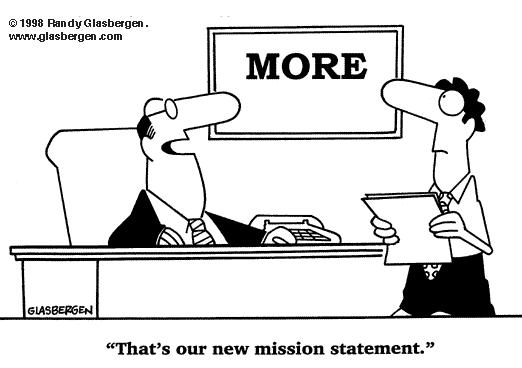
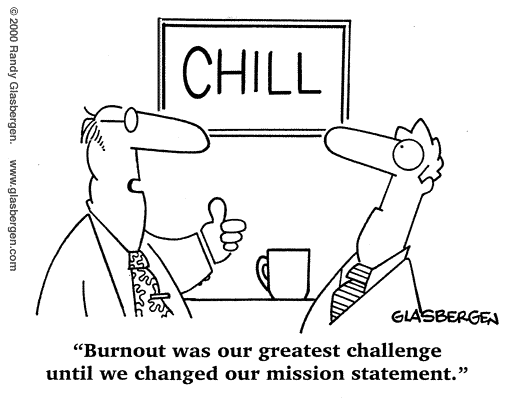

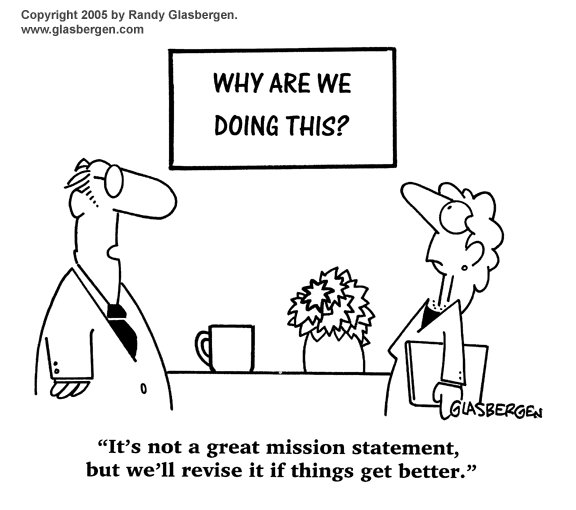
 A mission statement is no easy thing. Businesses struggle with this. Mission statements are prone to either state the obvious, or state nothing at all.
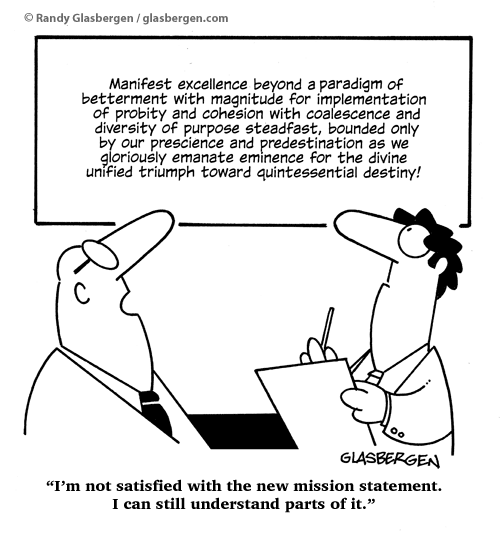
“Aspire to excellence.”These are too banal to provide any help. Alternatively, mission statements fall prey to incomprehensibility. One cartoon shows two business people looking at a draft proposal for their mission statement – and some of the language evokes religious themes, but its so convoluted. The statement says:
“Client-focused providers.”
“Aiming to exceed expectations.”
“Manifest excellence beyond a paradigm of betterment with magnitude of probity and cohesion with coalescence and diversity of purpose steadfast, bounded only by our prescience and predestination as we gloriously emanate eminence for the divine unified triumph toward quintessential destiny.”The one person is saying to the other:
“I’m not satisfied with the new mission statement. I can still understand parts of it.”And then there are the sorts that are loaded with generically meaningless buzzwords. Dilbert creator Scott Adams parodies these with the Dilbert Mission Statement Generator which churns out such samples as:
"We have committed to synergistically fashion high-quality products so that we may collaboratively provide access to inexpensive leadership skills in order to solve business problems"And:
"It is our job to continually foster world-class infrastructures as well as to quickly create principle-centered sources to meet our customer's needs"And:
"Our challenge is to assertively network economically sound methods of empowerment so that we may continually negotiate performance based infrastructures"Those are parodies. This one is real:
"The New Ventures Mission is to scout profitable growth opportunities in relationships, both internally and externally, in emerging, mission inclusive markets, and explore new paradigms and then filter and communicate and evangelize the findings."Businesses are not congregations, and congregations are not businesses. We aren’t even a nonprofit business. Yet we have in common that we are complex organizations that have a lot of different things going on, and it's hard to sum up all those things in any way that provides meaningful guidance. So what often results is either banal or incomprehensible.
I have been asking the members of my congregation -- the Unitarian Universalist Fellowship of Gainesville -- since last September: "Why are we here? Why do we gather at UUFG and contribute our resources to its support?" You all have been really sweet about all chipping in to pay my bills for the last six years, put a roof over my head, pay for health insurance for my family, and that’s awfully nice of you, but what exactly is it with which you’d like me to help you? What is it with which we’d like to help and be helped by each other?
More clarity on what we’re trying to do here – so we can help each other do it – and I can add what I can – would feel good.
* * * * *
This is part 3 of 6 of "Mission: Impossible"
Next: Part 4: "Need Clarity? Name the Change?"
Previous: Part 2: "Authority and Mission"
Beginning: Part 1: "Theology and a TV Spy Show"
2012-06-05
Authority and Mission
Unlike the sort of central-yet-hidden authority that issues the missions in "Mission: Impossible," for us, Unitarian Universalists, the authority is: (a) each other; (b) our history, our tradition, our principles, and our sources; (c) our individual consciences.
For all our emphasis on (c) our individual consciences, we know the individual conscience needs some help. The individual conscience is subject to fooling itself, subject to all the self-deceptions of our defense mechanisms. So we come together to double- and triple-check our perceptions and opinions. We come to help individual conscience get a wider perspective, place the individual conscience in a relationship of accountability – a relation in which we give an accounting of ourselves to others and thereby become seen. And we come together because sometimes in life individual conscience is simply at its wit’s end.
Grief and loss are headed your way. If they are not with you right now, they are headed your way: the death of parents, or spouse – sometimes of a child. A Buddhist sutra says:
So yes our authority is the individual conscience. It is also each other, our Unitarian Universalist tradition, history, theology, and values – our practices and teachings and support network to temper, deepen, and expand that individual conscience.
 How do we do that? On what shall we get to work in order that the tradition, teachings, and values of Unitarian Universalism can come to life, find embodiment in our doing, and thereby work their magic of nurturing spiritual maturity in us?
Good question.
It brings us back to "mission." A really clear mission is an attractive thing. Part of the appeal of the "Mission: Impossible" show is the clarity of the mission. Go in, rescue the hostage, depose the dictator, retrieve the nuclear materials, foil the assassination. It feels good to know exactly what you’re trying to do.
Clarity of mission is also part of the appeal of sports. You’re on a mission to win the game, and the rules specify exactly how to do that. The great American philosopher William James once remarked:
A group of people gathered together as a congregation are not on some undercover espionage mission. Nor are they gathered in order to emerge victorious over other congregations at Church-league Softball (though some of them do seem to regard that as a main, if not their sole, purpose).
For what does a Unitarian Universalist congregation congregate? Articulating a clear and helpful statement of mission is no easy thing.
* * * * *
This is part 2 of 6 of "Mission: Impossible"
Next: Part 3: "Scylla of Banality, Charybdis of Incomprehensibility"
Previous: Part 1: "Theology and a TV Spy Show"
For all our emphasis on (c) our individual consciences, we know the individual conscience needs some help. The individual conscience is subject to fooling itself, subject to all the self-deceptions of our defense mechanisms. So we come together to double- and triple-check our perceptions and opinions. We come to help individual conscience get a wider perspective, place the individual conscience in a relationship of accountability – a relation in which we give an accounting of ourselves to others and thereby become seen. And we come together because sometimes in life individual conscience is simply at its wit’s end.
Grief and loss are headed your way. If they are not with you right now, they are headed your way: the death of parents, or spouse – sometimes of a child. A Buddhist sutra says:
“All that is dear to me and everyone I love are of the nature of change. There is no way to escape being separated from them.” (Upajjhatthana Sutta, Angutara Nikaya 5.57)Meanwhile, my individual conscience has spent its life thinking about other things, will never see grief coming, has no idea by itself how to cope with significant loss. To learn to find peace with all of life, even the difficult and painful parts, individual conscience needs the resources of a community embodying a tradition – a tradition of practices and texts and the habits of using them to make meaning even when all meaning seems to be gone.
So yes our authority is the individual conscience. It is also each other, our Unitarian Universalist tradition, history, theology, and values – our practices and teachings and support network to temper, deepen, and expand that individual conscience.

Good question.
It brings us back to "mission." A really clear mission is an attractive thing. Part of the appeal of the "Mission: Impossible" show is the clarity of the mission. Go in, rescue the hostage, depose the dictator, retrieve the nuclear materials, foil the assassination. It feels good to know exactly what you’re trying to do.
Clarity of mission is also part of the appeal of sports. You’re on a mission to win the game, and the rules specify exactly how to do that. The great American philosopher William James once remarked:
But what fun would that be? So the rules spell out the context and the boundaries, and what you have to do and may not do in order for getting the ball over the goal line to count."The aim of a football-team is not merely to get the ball to a certain goal (if that were so, they would simply get up on some dark night and place it there)." (James, Pragmatism)
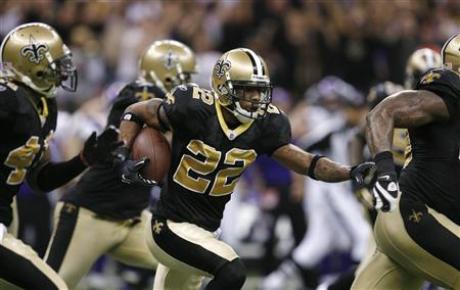
A group of people gathered together as a congregation are not on some undercover espionage mission. Nor are they gathered in order to emerge victorious over other congregations at Church-league Softball (though some of them do seem to regard that as a main, if not their sole, purpose).
For what does a Unitarian Universalist congregation congregate? Articulating a clear and helpful statement of mission is no easy thing.
* * * * *
This is part 2 of 6 of "Mission: Impossible"
Next: Part 3: "Scylla of Banality, Charybdis of Incomprehensibility"
Previous: Part 1: "Theology and a TV Spy Show"
2012-06-04
Theology and a TV Spy Show
Remember the "Mission: Impossible" TV series? This'll spark the memory, maybe:
The original TV series ran from 1966 to 1973, then another two seasons in the late 80s, then there were four movies starring Tom Cruise. The basic premise starts to get elaborated beyond recognition in the later movies; let’s just look at the TV show that started it.
Dan Briggs, later Jim Phelps, is the head of a super-secret government agency ("Impossible Missions Force" -- IMF), and is often given secret anonymous covert missions to attempt; quite often they are unmasking of criminals or the rescuing of hostages. He picks his team depending on which tasks need to be done. The mission must be carried out in entire secrecy, often relying on high-tech equipment and elaborate deceptions. It’s all very shadowy, and dangerous, yet appealing.
The organization that oversees the IMF is never revealed. The agents seem American, be we don’t even know if they work for the US government, or some other country.
You remember that tape player? Almost every episode began with the leader of the IMF – the Impossible Missions Force -- getting the assignment from a hidden tape recorder and an envelope of photos and information that explained the mission. The tape would begin “Good morning, Mr. Phelps.” It would explain the situation, and then introduce the mission with the words, “Your mission, Jim, should you decide to accept it...."
Then it would say:
It was such a memorable device. It captured our imaginations with the idea of being on mission that there was no record of. That envelop had some photos and some information in it, but there was no written description of the mission – just that tape . . . and we all saw what happened to the tape.
You’re on this mission, you have this job to do, some important role to play in the order of things – yet you can’t tell anybody, there’s no evidence of what you’re doing, and if you get caught, the secretary – whoever that is – will disavow any knowledge.
You may be wondering what any of this has to do with religion.
Well…
You are acting out the instructions of an invisible authority, who has clearly spoken to you – but nobody else. You have no way of even proving the existence of this authority. You just have a handful of followers who are prepared to believe what you tell them about the mission, and will join you in carrying it out. You and your followers have unusual talents and rather magical technology. You work miracles – you do things that are . . . impossible.
Kinda sound familiar?
I imagine Jesus walking the hills around Jerusalem, humming to himself the "Mission: Impossible" theme.
And then there’s that bit about, “your mission, should you decide to accept it.” There is a central power, but it gives you a choice whether to follow it. It’s up to you whether to have faith in that authority and accept the mission.
So. What mission -- especially, what "impossible" mission -- have you chosen to accept?
* * * * *
This is part 1 of 6 of "Mission: Impossible"
Next: Part 2: "Authority and Mission"
The original TV series ran from 1966 to 1973, then another two seasons in the late 80s, then there were four movies starring Tom Cruise. The basic premise starts to get elaborated beyond recognition in the later movies; let’s just look at the TV show that started it.
Dan Briggs, later Jim Phelps, is the head of a super-secret government agency ("Impossible Missions Force" -- IMF), and is often given secret anonymous covert missions to attempt; quite often they are unmasking of criminals or the rescuing of hostages. He picks his team depending on which tasks need to be done. The mission must be carried out in entire secrecy, often relying on high-tech equipment and elaborate deceptions. It’s all very shadowy, and dangerous, yet appealing.
The organization that oversees the IMF is never revealed. The agents seem American, be we don’t even know if they work for the US government, or some other country.
You remember that tape player? Almost every episode began with the leader of the IMF – the Impossible Missions Force -- getting the assignment from a hidden tape recorder and an envelope of photos and information that explained the mission. The tape would begin “Good morning, Mr. Phelps.” It would explain the situation, and then introduce the mission with the words, “Your mission, Jim, should you decide to accept it...."
Then it would say:
"You have carte blanche as to methods and personnel. As always, should you or any of your team be caught or killed, the Secretary will disavow any knowledge of your actions. This tape will self-destruct in five seconds. Good luck, Jim."Then smoke would rise from the tape.
It was such a memorable device. It captured our imaginations with the idea of being on mission that there was no record of. That envelop had some photos and some information in it, but there was no written description of the mission – just that tape . . . and we all saw what happened to the tape.
You’re on this mission, you have this job to do, some important role to play in the order of things – yet you can’t tell anybody, there’s no evidence of what you’re doing, and if you get caught, the secretary – whoever that is – will disavow any knowledge.
You may be wondering what any of this has to do with religion.
Well…
You are acting out the instructions of an invisible authority, who has clearly spoken to you – but nobody else. You have no way of even proving the existence of this authority. You just have a handful of followers who are prepared to believe what you tell them about the mission, and will join you in carrying it out. You and your followers have unusual talents and rather magical technology. You work miracles – you do things that are . . . impossible.
Kinda sound familiar?
I imagine Jesus walking the hills around Jerusalem, humming to himself the "Mission: Impossible" theme.
And then there’s that bit about, “your mission, should you decide to accept it.” There is a central power, but it gives you a choice whether to follow it. It’s up to you whether to have faith in that authority and accept the mission.
So. What mission -- especially, what "impossible" mission -- have you chosen to accept?
* * * * *
This is part 1 of 6 of "Mission: Impossible"
Next: Part 2: "Authority and Mission"
2012-06-02
Saturdao 22
Dao De Jing, verse 14a16 translations.
1. James Legge:
We look at it, and we do not see it, and we name it 'the Equable.'2. Archie Bahm:
We listen to it, and we do not hear it, and we name it 'the Inaudible.'
We try to grasp it, and do not get hold of it, and we name it 'the Subtle.'
With these three qualities, it cannot be made the subject of description; and hence we blend them together and obtain The One.
Its upper part is not bright, and its lower part is not obscure.
Ceaseless in its action, it yet cannot be named, and then it again returns and becomes nothing.
Since what is ultimate in Nature cannot be seen with one’s eyes, it is spoken of as invisible.3. Frank MacHovec:
Since it cannot be heard with one’s ears, it is called inaudible.
Since it cannot be grasped in one’s hands, it is thought of as intangible.
But not even all three of these together can adequately describe it.
Nature did not originate in beginnings, and will not reach its goal in endings.
Rather it acts unceasingly, without either absolute beginnings or final endings.
If we cannot describe it intelligibly, this is because it is beyond our understanding.
Looked for it cannot be seen; it is invisible. Listened for it cannot be heard; it is inaudible. Reached for it cannot be touched; it is intangible. These three are beyond analysis; these three are one.4. D.C. Lau:
It rises, like the sun, but does not illuminate; it sets; like the sun, but does not darken. Without beginning, without end, infinite, indefinable.
What cannot be seen is called evanescent;5. Gia-Fu Feng:
What cannot be heard is called rarefied;
What cannot be touched is called minute.
These three cannot be fathomed
And so they are confused and looked upon as one.
Its upper part is not dazzling;
Its lower part is not obscure.
Dimly visible, it cannot be named
And returns to that which is without substance.
Look, it cannot be seen – it is beyond form.6. Stan Rosenthal:
Listen, it cannot be heard – it is beyond sound.
Grasp, it cannot be held – it is intangible.
These three are indefinable;
Therefore they are joined in one.
From above it is not bright;
From below it is not dark:
An unbroken thread beyond description.
It returns to nothingness.
“Experiencing the Mystery”7. Jacob Trapp:
The Dao is abstract, and therefore has no form,
it is neither bright in rising, nor dark in sinking,
cannot be grasped, and makes no sound.
“The Elusive, the One”8. Stephen Mitchell:
It appears to us,
Yet it is invisible;
Speaks to us,
Yet is inaudible;
Touches us,
Yet is intangible.
It is the Elusive, the One.
In endless continuity
it embraces both Being and non-Being.
Look, and it can't be seen.9. Victor Mair:
Listen, and it can't be heard.
Reach, and it can't be grasped.
Above, it isn't bright.
Below, it isn't dark.
Seamless, unnamable,
it returns to the realm of nothing.
We look for it but do not see it; we name it “subtle.”10. Michael LaFargue:
We listen for it but do not hear it; we name it “rare.”
We grope for it but do not grasp it; we name it “serene.”
These three cannot be fully fathomed.
Therefore, they are bound together to make unity.
Of unity, its top is not distant, its bottom is not blurred.
Infinitely extended and unnameable,
It returns to nonentity.
“Look for It, you won’t see It: It is called ‘fleeting’.11. Peter Merel:
Listen for It, you won’t hear It: It is called ‘thin’.
Grasp at It, you can’t get It: It is called ‘subtle’.”
These three lines are about something that evades scrutiny.
Yes, in it everything blends and becomes one.
Its top is not bright
Its underside is not dim.
Always unnameable, It turns back to nothingness.
"Mystery"12. Ursula LeGuin:
Looked at but cannot be seen - it is beneath form;
Listened to but cannot be heard - it is beneath sound;
Held but cannot be touched - it is beneath feeling;
These depthless things evade definition,
And blend into a single mystery.
In its rising there is no light,
In its falling there is no darkness,
A continuous thread beyond description,
Lining what does not exist;
“Celebrating Mystery”13. Wang Keping:
Look at it: nothing to see.
Call it colorless.
Listen to it: nothing to hear.
Call it soundless.
Reach for it: nothing to hold.
Call it intangible.
Triply undifferentiated,
it merges into oneness,
not bright above,
nor dark below.
Never, oh! never
can it be named.
It reverts, it returns
to unbeing.
You look at it but can not see it;14. Ames and Hall:
It is called the imageless.
You listen to it but can not hear it;
It is called the soundless.
You touch it but can not find it;
It is called the formless.
These three cannot be further inquired into,
For they are the inseparable One.
The One is not bright when it is up,
And not dark when it is down.
Infinite and indistinct, it cannot be named,
Thus reverting to a state of non-thingness.
Looking and yet not seeing it15. Yasuhiko Genku Kimura:
We thus call it “elusive.”
Listening and yet not hearing it
We thus call it “inaudible.”
Groping and yet not getting it
We thus call it “intangible.”
Because in sight, sound, and touch it is beyond determination
We construe it as inseparably one.
As for this “one” --
Its surface is not dazzling
Nor is its underside dark.
Ever so tangled, it defies discrimination
And reverts again to indeterminacy.
Looked at but not seen, it is thus called the invisible,16. Addiss and Lombardo:
Listened to but not heard, it is thus called the inaudible,
Reached for but not grasped, it is thus called the intangible:
These three are beyond the reach of sense and reason,
Yet in the moment of kosmic union,
They merge in spiritual awareness as the Universal One.
There is no above that is bright, nor below that is dark,
But only the infinite, forever indefinable, always reverting to nothingness.
Searching but not seeing, we call it dim.* * * * *
Listening but not hearing, we call it faint.
Groping but not touching, we call it subtle.
These three cannot be fully grasped.
Therefore they become one.
Rising it is not bright; setting it is not dark.
It moves all things back to where there is nothing.

It is constant encounter with nothing at all.
Stare at a single spot until you can't see it anymore.
The eye moves half a degree, and there it is again.
So things appear waiting for you to see through them,
Then they appear again when the mind moves half a degree in any discriminating direction:
bright, dark, above, below, pleasant, unpleasant.
They appear again and wait to be seen through again.
See them and see through them at the same time?
(Like seeing both the duck and the rabbit simultaneously -- only more like seeing duck, rabbit, no-duck, and no-rabbit all at once)
Thus do you enchant the ordinary business of the day.
* * *
See: Saturdao Index
2012-06-01
Macaroons or a Frontal Lobe?
The Person You Work For: Your Future Self
 Unlike Mr. Possum, here, I'm betting you've got some self-restraint. You may think you don't have much, but as the animal kingdom goes, humans have a lot. Is that a good thing? Part of you, I imagine, would like to dispense with all that self-restraint and eat so much you couldn't move. This part of you imagines that, in defiance of your self-restraining part, you would "regret nothing."
And yet . . .
The fact is, you spend a large part of your life and energy on behalf of someone else: the future self that you will become. Psychology professor Daniel Gilbert notes:
“We go easy on the lard and tobacco, smile dutifully at yet another of our supervisor's witless jokes, read books like this one when we could be wearing paper hats and eating pistachio macaroons in the bathtub, and we do each of these things in the charitable service of the people we will soon become. We treat our future selves as though they were our children, spending most of the hours of most of our days constructing tomorrows that we hope will make them happy. Rather than indulging in whatever strikes our momentary fancy, we take responsibility for the welfare of our future selves, squirreling away portions of our paychecks each month so they can enjoy their retirements on a putting green, – jogging and flossing with some regularity so they can avoid coronaries and gum grafts, -- enduring dirty diapers and mind-numbing repetitions of The Cat in the Hat so that someday they will have fat-cheeked grandchildren to bounce on their laps.” (Stumbling on Happiness, 2006, xiii-xiv)And even if you’ve reached that retirement, even if the fat-cheeked grandchildren are all grown, you’re still spending large portions of your day trying to take care of your future self – fretting and working for the sake of somebody else.

I haven't read a study on this, or seen any government statistics, so I'm just speculating here, but my guess is that over 90% of all dead Americans spent their entire lives and went to their graves without ever once eating pistachio macaroons in the bathtub while wearing a paper hat. What's up with that? That possum isn't wearing a paper hat because, well, he's a possum. Marsupials don't have such a refined aesthetic sensibility as you and I have. (And he's not in the bathtub because that's not where the food was. Duh.) But he sure was into every pistachio macaroon -- and every other baked good -- he could find.
That Growth on the Front of Your Brain
Why would you work so hard for someone else -- even if this taskmaster will have the same name as you (and maybe even the same mortgage)? You’d have to have some kind of large growth on the front of your brain. Actually, you do. It's that frontal lobe.Here's how it happened:
“The first brains appeared on earth about 500 million years ago, spent a leisurely 430 million years or so evolving into the brains of the earliest primates, and another 70 million years or so evolving into the brains of the first protohumans. Then something happened – no one knows quite what, but speculation runs from the weather turning chilly to the invention of cooking – and the soon-to be-human brain experienced an unprecedented growth spurt that more than doubled its mass in a little over two million years.... A disproportionate share of the growth centered on a particular part of the brain known as the frontal lobe, which, as the name implies, sits at the front of the head, squarely above the eyes.” (Gilbert 10)Our brains are a lot like other primate brains -- and even like marsupial brains -- in most regards. The biggest difference is that massive frontal lobe we got. This lobe pushed the low, sloping brows of our ancestors forward to become our sharp vertical brows.
What does this frontal lobe do – besides keep our hats (paper and otherwise) on? The frontal lobe is where we create our future in our imaginations, allowing us to act today on behalf of someone else: the future self we will become.
All animals make predictions about the immediate, local, personal, future. For instance, they smell a predator and predict that they should run and hide. Only humans think about what they'll be doing tomorrow. With this capacity to project the future, we go on to wonder about other future things:
“the annual rate of inflation, the intellectual impact of postmodernism, the heat death of the universe, or Madonna's next hair color” (Gilbert 6).And the consequences of too many pistachio macaroons -- a thought which evidently never darkened the neurons of Mr. Possum.
As a candidate running to unseat the incumbent of the last 2,000 millennia might ask: "Are you better off than you were two million years ago?" Would we be happier if we weren't so enslaved to our future selves and carpe diemed ourselves a few more paper hats?
* * *
This is part 4 of 6 of "Happy."
Next: Part 5: "Curse of the Frontal Lobe"
Previous: Part 3: "Reality vs. 'Should Be'"
Beginning: Part 1: "Having Everything You Want"
2012-05-31
Spiritual But Not Religious
Dear SBNR (Spiritual But Not Religious) person,
Lillian Daniel, the minister at First Congregational Church (UCC) in Glen Ellyn, Illinois, has gotten some attention for waxing somewhat snarky about you. Have you seen her remarks? Her briefer, snider piece is here, and the longer piece is here. Give them a look and see what you think.
I, too, sometimes meet you, and you tell me you are "spiritual but not religious." One difference between Rev. Daniel and me is that she runs into you on airplanes -- which, for me, seems to be the place for running into Baptist assistant pastors, Presbyterian organists, and Methodist youth directors. I run into you more often in church. It doesn't occur to me, as it does to Daniel, to suppose that you think you are sharing "some kind of daring insight . . . bold in its rebellion." I think you know that you're part of a hefty crowd. Daniel is encountering SBNRs who, apparently, don't go to church (or synagogue, temple, mosque, sangha, etc.), whereas my SBNRs are often in church. When you've told me you were "spiritual but not religious," you might have meant to convey to me any of a number of highly variable possibilities: (a) "You might have noticed I don't attend that often. Don't expect me to." or (b) "I disagreed with something in your sermon." -- or, sometimes, most perplexingly, (c) "I just love being a Unitarian Universalist; I'm so glad to be a part of this thing that isn't a religion."
Also like Rev. Daniel, I hear regularly from folks who say they see God in sunsets, or experience the divine in the woods, or on a beach. I think that's great. In fact, ecospirituality is central to my spirituality, and I offer a service of Ecospiritual Practice -- usually outdoors in a wooded setting -- once a month (check it out: click here.) I have to tell you, though, I think Daniel is right to point out that we need to have a community of accountability if we're going to learn, grow, and deepen our spirituality.
At the same time, I also think you're right to be wary of the kind of religious institution that demands uncritical acceptance of authority, where "faith" means "just believe what the authority figure tells you to believe, and pray what the authority figure tells you to pray." This sort of religious institution is nothing like my church -- and it's nothing like Lillian Daniel's church. (I've heard her preach, and she described something of her congregation -- plus, I went to a UCC seminary myself where we were taught that the function of authority is to guide critical engagement, not demand uncritical allegiance. Indeed, the joke I heard from a UCC fellow seminarian was that UCC stands for "Unitarians Considering Christ." Of course, I wouldn't tell Daniel this joke lest I become the subject of a sarcastic column about how tired and bored she is of UU ministers who tell that joke thinking they're saying something devastatingly witty.) Indeed, fewer and fewer churches match the picture of a church that you seem to carry around in your mind.
You're right to recognize that truth is within us. You're right to reject anything that would turn over the authority of your individual conscience to an external source.
But that's only half the story. The truth is within you all right. It's in all of us. And so is a lot of self-deceived ego.
We don't need authoritarian, ask-no-questions, do-as-I-say church. We do need communities of accountability for sharpening and deepening our religious insights, for calling us on our stuff, for holding up the mirror so we can see ourselves when we hit those places -- as we inevitably do on the spiritual path -- where we can't tell the difference between genuine wisdom and the ego's love for deluding itself with a story about how wise we are. As Daniel put it:
In the longer piece, Daniel tells about a man who tells her:
Number two: If nature is your grounding, where are you going/growing from that grounding? As Daniel asks:
So, dear SBNRs: Let me say that you are off to a wonderful start. I'm delighted with the spiritual satisfactions that you are finding. I suspect you'll find that your "S" won't be very deep, won't extend very well beyond its immediate stimulus, and won't equip you so well for the hard times of grief and loss and stress, without some "R." I hope you're on a path that will eventually lead from "SBNR" to "S and R," whether the "R" is Christianity, Hinduism, or Religious Humanism. You're off to a great start. Whenever you're ready to think about a little more depth and critical engagement in your "S," come talk to me. I can help. In fact, come talk to me anyway. I like hearing about how great it felt to be on that beach watching that sunset. I know that a number of religious leaders, like Rev. Daniel, are bored and irritated with you. Sorry about that. As my colleague, Rev. Kathy Schmitz, has said:
Yours faithfully,
Meredith
Lillian Daniel, the minister at First Congregational Church (UCC) in Glen Ellyn, Illinois, has gotten some attention for waxing somewhat snarky about you. Have you seen her remarks? Her briefer, snider piece is here, and the longer piece is here. Give them a look and see what you think.
I, too, sometimes meet you, and you tell me you are "spiritual but not religious." One difference between Rev. Daniel and me is that she runs into you on airplanes -- which, for me, seems to be the place for running into Baptist assistant pastors, Presbyterian organists, and Methodist youth directors. I run into you more often in church. It doesn't occur to me, as it does to Daniel, to suppose that you think you are sharing "some kind of daring insight . . . bold in its rebellion." I think you know that you're part of a hefty crowd. Daniel is encountering SBNRs who, apparently, don't go to church (or synagogue, temple, mosque, sangha, etc.), whereas my SBNRs are often in church. When you've told me you were "spiritual but not religious," you might have meant to convey to me any of a number of highly variable possibilities: (a) "You might have noticed I don't attend that often. Don't expect me to." or (b) "I disagreed with something in your sermon." -- or, sometimes, most perplexingly, (c) "I just love being a Unitarian Universalist; I'm so glad to be a part of this thing that isn't a religion."
Also like Rev. Daniel, I hear regularly from folks who say they see God in sunsets, or experience the divine in the woods, or on a beach. I think that's great. In fact, ecospirituality is central to my spirituality, and I offer a service of Ecospiritual Practice -- usually outdoors in a wooded setting -- once a month (check it out: click here.) I have to tell you, though, I think Daniel is right to point out that we need to have a community of accountability if we're going to learn, grow, and deepen our spirituality.
At the same time, I also think you're right to be wary of the kind of religious institution that demands uncritical acceptance of authority, where "faith" means "just believe what the authority figure tells you to believe, and pray what the authority figure tells you to pray." This sort of religious institution is nothing like my church -- and it's nothing like Lillian Daniel's church. (I've heard her preach, and she described something of her congregation -- plus, I went to a UCC seminary myself where we were taught that the function of authority is to guide critical engagement, not demand uncritical allegiance. Indeed, the joke I heard from a UCC fellow seminarian was that UCC stands for "Unitarians Considering Christ." Of course, I wouldn't tell Daniel this joke lest I become the subject of a sarcastic column about how tired and bored she is of UU ministers who tell that joke thinking they're saying something devastatingly witty.) Indeed, fewer and fewer churches match the picture of a church that you seem to carry around in your mind.
You're right to recognize that truth is within us. You're right to reject anything that would turn over the authority of your individual conscience to an external source.
But that's only half the story. The truth is within you all right. It's in all of us. And so is a lot of self-deceived ego.
We don't need authoritarian, ask-no-questions, do-as-I-say church. We do need communities of accountability for sharpening and deepening our religious insights, for calling us on our stuff, for holding up the mirror so we can see ourselves when we hit those places -- as we inevitably do on the spiritual path -- where we can't tell the difference between genuine wisdom and the ego's love for deluding itself with a story about how wise we are. As Daniel put it:
Being privately spiritual but not religious just doesn't interest me. There is nothing challenging about having deep thoughts all by oneself. What is interesting is doing this work in community, where other people might call you on stuff, or heaven forbid, disagree with you. Where life with God gets rich and provocative is when you dig deeply into a tradition that you did not invent all for yourself.If I'm serious about spiritual depth, I need the humility to place myself in a relation of accountability to a long and rich tradition -- a tradition of many people who have wrestled with what I'm wrestling with, who have, like me, been fooled into thinking they "got it" and "had arrived" and "were as holy or enlightened as it's possible to be," but who eventually came, through connection with a community of fellow spiritual travelers, to see through that delusion to a deeper wisdom.
In the longer piece, Daniel tells about a man who tells her:
"I worship nature. I see myself in the trees and in the cicadas. I am one with the great outdoors. I find God there. And I realized that I am deeply spiritual but no longer religious."Number one: If being in the woods is a spiritual experience for you, then please do make sure you get out in the woods a lot. Maybe you do. But I have met people who say the "great outdoors" is their religion, and when I ask them when was the last time they were out in it, they have to think, and then they say something like, "about six months ago." Ecospirituality is wonderful, vital, and important. But like every spirituality, you've got to practice it. Daily, in some form. Weekly, in a more extensive and immersive form.
Number two: If nature is your grounding, where are you going/growing from that grounding? As Daniel asks:
"God is in the sunset? Great, I find God there too. But how about seeing God in cancer? Cancer is nature too."Daniel doesn't mention what her own theology of cancer is. But if you're using spirituality to turn your back on pain and suffering, or numb it with the aesthetic bliss of sunsets, then not only are you not religious, but you're only half spiritual. The spiritual path calls for facing and embracing the cancer too. If you find beauty, wonder, and divinity in the woods, that's a wonderful starting place. Now use that grounding to move toward seeing beauty and wonder in people, buildings, kitchen appliances, traffic jams, toxic waste dumps -- and cancer. Spirituality is about working out our peace with all of life, not just the pretty nature scenes. For that, you need the resources of a community that embodies a tradition of practices and texts and the habits of using them to make meaning.
So, dear SBNRs: Let me say that you are off to a wonderful start. I'm delighted with the spiritual satisfactions that you are finding. I suspect you'll find that your "S" won't be very deep, won't extend very well beyond its immediate stimulus, and won't equip you so well for the hard times of grief and loss and stress, without some "R." I hope you're on a path that will eventually lead from "SBNR" to "S and R," whether the "R" is Christianity, Hinduism, or Religious Humanism. You're off to a great start. Whenever you're ready to think about a little more depth and critical engagement in your "S," come talk to me. I can help. In fact, come talk to me anyway. I like hearing about how great it felt to be on that beach watching that sunset. I know that a number of religious leaders, like Rev. Daniel, are bored and irritated with you. Sorry about that. As my colleague, Rev. Kathy Schmitz, has said:
Snarky, derisive behavior and eye-rolling may sell better, but it does not represent our best selves and it does not represent either community or religion at its best. It certainly doesn’t represent religious community at its best. (click here)I have to warn you that, whatever religious community you may hook up with, it's going to spend a lot of its time not being "religious community at its best." That's part of the challenge, part of the practice ground for working out your peace with all of life, even the difficult parts. It's worth it. For all their flaws and pettiness -- indeed, partly because of all their flaws and pettiness -- they'll help you see yours. My congregation continues to help me see mine.
Yours faithfully,
Meredith
2012-05-29
The Church We Need Now
Yesterday's Lake Chalice looked at some aspects of Europe. Jeremy Rifkin's description of Europe -- a continent imbued with ecospiritual wisdom where almost everyone is a part of Civil Society Organization that functions like the best possible church -- is provocative. It's a picture worth looking at, even as we must also recognize its distortions. Europe does have strands of the sort of orientation that Rifkin describes, and those strands are a bit thicker than in the US, yet much of day-to-day life is essentially similar. As the US frets about immigration issues, so does Europe -- and European xenophobia about Muslim immigrants is not so different, qualitatively or quantitatively, from US xenophobia about Hispanics. It's not clear that Europe is terrific at celebrating cultural diversity while mitigating assimilationist pressures, nor that the US is much worse at either. Moreover, what Rifkin sees as homey and congenial emphasis on community relationships would feel to many Americans -- as it does to some Europeans -- like a stifling pressure to conform. If honoring and celebrating cultural diversity is a desideratum, what is the optimal level of cultural mobility (the ability of an individual to choose a cultural, or any, identity other than the one they were born into) for a society?
The European example does not, alas, provide us with a final answer on the best way for our postmodern world to address human needs for faith community and spiritual fitness. Given Europe's very low attendance at traditional Catholic and Protestant churches, any of several different hypotheses might be argued:
 (And what are "faith community and spiritual fitness needs"? See the earlier posts in this "Ecclesiology" series, as well as the "Spiritual Practice" series that begins here.)
Religion came to early humans as both a blessing and a curse. Faith community provided a feeling of connection, of at-home-ness, of being with our people, and in a world that made sense, just where we belonged. This blessing made early communities cohesive, and that cohesiveness proved essential to survival. At the same time, the US-ness of tribal identification also entailed a THEM-ness of antipathy toward those outside one's community. We need the blessing today as much as ever: overcoming alienation with community belonging and overcoming stress and greed with greater spiritual awakening. At the same time, we need forms of religion that minimize the concomitants of tribalism: intolerance and distrust of outsiders. The situation in Europe offers us some clues, but no ultimate blueprint.
 "Ecclesiology" is the branch of theology that deals with the origin of the church, the church's proper role in human life, what it is needed for, and what form it should take (governance, leadership, organizational structure) to best meet its purpose. This Lake Chalice series on ecclesiology has been looking at the light that anthropology and evolutionary psychology shed on the purpose and challenge for "the church" -- broadened to include any form of faith community -- in the 21st century. From the standpoint of biotheology -- that is, an approach to religious questions grounded in and integrated with our understanding of ourselves as revealed in the biological sciences -- what sort of ecclesiology is called for? A relatively new clarity is available to us now about the need and value of faith community, but we are just beginning to discern some clues about what forms of faith community best amplify religion's blessing and best mitigate its curse.
Seeing the origin of religion, it’s easy to see how religion can become evil – how the yearning for a shared story becomes a commitment to absolutes. But the future holds to us the possibility of expanding the circle. We can learn to take our sense of US-ness that evolution wired into us, and keep expanding it until it takes in . . . well, everything. And there is no THEM left.
Just as nature wired into us a need for faith community, so it wired into us a propensity for going further with that capacity. Our inherited structures that made us able to bind together for war are available to be appropriated to connect us to live in peace and justice, without domination, or mastery, or hegemony. What evolution created for one purpose can now be put to a new purpose. This is nature’s method of transcendence, and the history of life on this planet is full of examples.
Mammalian forelimbs turned into bat wings – or, going another direction, into dolphin fins. Insect antennae turned into mandibles. A jaw bone in dinosaurs, fish, and reptiles was appropriated and made into an auditory bone in mammals. An ancestor of wasps and bees had an ovipositor (egg-laying tube) that was appropriated and made into a stinger. Before there were land animals, certain fish developed a swim bladder, which they could fill with gas, usually air. This allowed the fish to stay at a given depth without expending energy on swimming. The swim bladder probably was, in some species, also helpful for stability, and maybe also as a resonating chamber to produce or receive sound. The swim bladder evolved into the lung of the earliest lungfish – and from there into the lungs of land animals. Something that evolved for one purpose or set of purposes (buoyancy, stability, sonic resonance) was appropriated for a very different purpose (breathing air). A device for staying at a given depth in water turned into the essential step for moving onto land!
Structures that served one purpose get put to very different purposes. Happens all the time. The fact that we evolved with a given structure or tendency does not obligate us to continue the purpose for which that structure or tendency evolved. Genetic evolution is under no such constraint; if it were, then swim bladders would never have turned into lungs, and we’d all still be fishes.
Building upon its inheritance, the lungfish transcended that inheritance and became a new thing on this earth. Bats and dolphins, mandibular and stinging insects, mammalian auditory systems -- and, one way or another, ultimately every complex feature of every species -- built upon its inheritance to transcend that inheritance and become a new thing on this earth.
 Let us do likewise. Transcend our inheritance: put the wiring that enabled cohesive war-fighting to a new use, building peace. The wiring that finds such comfort and delight in the company of friends, the wiring that gets active during spiritual experience, orients us to live in peace within our group. That same wiring is available for being universalized beyond our group. With a little training of the neural structures of social orientation that are already there, we can keep expanding our perceived circle of "us" until there is no “them.” Building upon our inheritance, we can transcend that inheritance and become a new thing on this earth.
Our spiritual perception can plumb more deeply, can see more than just what selective pressures once needed our ancestors to see. My awareness can be trained to know, more thoroughly than cognition alone can know, that all humans are I, all sentient beings are I; all bugs and plants, all amoebas, paramecia, bacteria, and fungi are I; all rocks and dirt, rivers and oceans; air and fire; sun, moon, and stars are I.
Church, huh? What is it good for? “Arms to hold us when we falter. A circle of healing. A circle of friends. Someplace where we can be free.” And strength that joins our strength to do the work of building “a land that binds up the broken, where the captive go free, where justice shall roll down like waters, and peace like an everflowing stream.”
What is it good for? Absolutely everything.
* * *
This is part 5 of 5 of "Ecclesiology: What Is Church Good For"
Previous: Part 4: "How's Europe?"
Beginning: Part 1: "Church! Huh! What Is It Good For?"
Audio (with some nice slides) of an edited excerpt of an earlier version of "Ecclesiology." Thanks to Shelby Havens for putting together the slides and creating this Youtube video:
The European example does not, alas, provide us with a final answer on the best way for our postmodern world to address human needs for faith community and spiritual fitness. Given Europe's very low attendance at traditional Catholic and Protestant churches, any of several different hypotheses might be argued:
- Europeans are not meeting their faith community and spiritual fitness needs -- and that's good. Europe is doing much better than the US on measures of social health, which shows that faith community and spiritual fitness aren't really all that important.
- Europeans are not meeting their faith community or spiritual fitness needs -- and that's bad. This failure is connected with various social problems and anomie in Europe. (Or: Europeans' civic lives partly meet their religious needs, but a more robust attention to communities and practices cultivating the spiritual values would do them good.)
- Europeans are meeting their faith community and spiritual fitness needs through a spiritually imbued civic life -- and that's good. That's why Europe is doing so well on measures of social health.
- Europeans meet faith needs through civic life -- and that's bad. This kind of community formation is harmful to what Europeans most need -- more respect for individual autonomy and less tribal loyalty.

Religion came to early humans as both a blessing and a curse. Faith community provided a feeling of connection, of at-home-ness, of being with our people, and in a world that made sense, just where we belonged. This blessing made early communities cohesive, and that cohesiveness proved essential to survival. At the same time, the US-ness of tribal identification also entailed a THEM-ness of antipathy toward those outside one's community. We need the blessing today as much as ever: overcoming alienation with community belonging and overcoming stress and greed with greater spiritual awakening. At the same time, we need forms of religion that minimize the concomitants of tribalism: intolerance and distrust of outsiders. The situation in Europe offers us some clues, but no ultimate blueprint.
Religion Must Now Transcend Its Origins

Seeing the origin of religion, it’s easy to see how religion can become evil – how the yearning for a shared story becomes a commitment to absolutes. But the future holds to us the possibility of expanding the circle. We can learn to take our sense of US-ness that evolution wired into us, and keep expanding it until it takes in . . . well, everything. And there is no THEM left.
Just as nature wired into us a need for faith community, so it wired into us a propensity for going further with that capacity. Our inherited structures that made us able to bind together for war are available to be appropriated to connect us to live in peace and justice, without domination, or mastery, or hegemony. What evolution created for one purpose can now be put to a new purpose. This is nature’s method of transcendence, and the history of life on this planet is full of examples.
Mammalian forelimbs turned into bat wings – or, going another direction, into dolphin fins. Insect antennae turned into mandibles. A jaw bone in dinosaurs, fish, and reptiles was appropriated and made into an auditory bone in mammals. An ancestor of wasps and bees had an ovipositor (egg-laying tube) that was appropriated and made into a stinger. Before there were land animals, certain fish developed a swim bladder, which they could fill with gas, usually air. This allowed the fish to stay at a given depth without expending energy on swimming. The swim bladder probably was, in some species, also helpful for stability, and maybe also as a resonating chamber to produce or receive sound. The swim bladder evolved into the lung of the earliest lungfish – and from there into the lungs of land animals. Something that evolved for one purpose or set of purposes (buoyancy, stability, sonic resonance) was appropriated for a very different purpose (breathing air). A device for staying at a given depth in water turned into the essential step for moving onto land!
Structures that served one purpose get put to very different purposes. Happens all the time. The fact that we evolved with a given structure or tendency does not obligate us to continue the purpose for which that structure or tendency evolved. Genetic evolution is under no such constraint; if it were, then swim bladders would never have turned into lungs, and we’d all still be fishes.
Building upon its inheritance, the lungfish transcended that inheritance and became a new thing on this earth. Bats and dolphins, mandibular and stinging insects, mammalian auditory systems -- and, one way or another, ultimately every complex feature of every species -- built upon its inheritance to transcend that inheritance and become a new thing on this earth.

Our spiritual perception can plumb more deeply, can see more than just what selective pressures once needed our ancestors to see. My awareness can be trained to know, more thoroughly than cognition alone can know, that all humans are I, all sentient beings are I; all bugs and plants, all amoebas, paramecia, bacteria, and fungi are I; all rocks and dirt, rivers and oceans; air and fire; sun, moon, and stars are I.
Church, huh? What is it good for? “Arms to hold us when we falter. A circle of healing. A circle of friends. Someplace where we can be free.” And strength that joins our strength to do the work of building “a land that binds up the broken, where the captive go free, where justice shall roll down like waters, and peace like an everflowing stream.”
What is it good for? Absolutely everything.
* * *
This is part 5 of 5 of "Ecclesiology: What Is Church Good For"
Previous: Part 4: "How's Europe?"
Beginning: Part 1: "Church! Huh! What Is It Good For?"
Audio (with some nice slides) of an edited excerpt of an earlier version of "Ecclesiology." Thanks to Shelby Havens for putting together the slides and creating this Youtube video:
2012-05-28
How's Europe?
 |
| Jeremy Rifkin |
Our world, however, is no longer the one for which religion was originally such a crucial adaptation. Many of us belong in various ways to a number of "tribes" -- and our survival does not depend on cohesive loyalty with just one. High levels of religiosity now correlate with low levels of social health and well-being by such measures as homicides, juvenile and early adult mortality, STD rates, teen pregnancies, abortions, and imprisonment rates.
Europe scores lower than the US on measures of religiosity and higher than the US on measures of social health and well-being. In Europe, a lot fewer people are in prison and a lot fewer people are in church. This begs the question: How do Europeans meet the need for moral and cohesive community, interconnection, and transcendence?
Jeremy Rifkin's book, The European Dream, contrasts Europe's with America's dream of unbounded consumeristic indulgence.
“The European Dream emphasizes community relationships over individual autonomy, cultural diversity over assimilation, quality of life over the accumulation of wealth, sustainable development over unlimited material growth, deep play over unrelenting toil, universal human rights and the rights of nature over property rights, and global cooperation over the unilateral exercise of power.” (Rifkin 3)Wow. That's my agenda. Those are the values I try to preach, with my lips and my life. It's a very Unitarian Universalist agenda. Rifkin's book gives the impression the whole continent of Europe is like one big Unitarian Universalist congregation with 455 million members.
Rifkin says the European dream is to
“connect the human race to a new shared story, clothed in the garb of universal human rights and the intrinsic rights of nature – what we call a global consciousness.... What becomes important in the new European vision of the future is personal transformation rather than individual material accumulation. The new dream is focused not on amassing wealth but, rather, on elevating the human spirit. The European Dream seeks to expand human empathy, not territory...For Europeans, freedom is not found in autonomy but in embeddedness. To be free is to have access to a myriad of interdependent relationships with others.” (7, 8, 13)

“We are on the cusp of the third great stage in human consciousness – the stage where we make a self-aware choice to re-participate with the body of nature....European intellectuals, scientists, and visionaries...increasingly view the world as an indivisible living entity deserving of respect and care....The Earth is a living organism made up of interdependent relationships and...we each survive and flourish by stewarding the larger communities of which we are a part. The solution to our dilemma lies in integrating the life instinct and death instinct in a new unity....We can't really begin to live until we first accept the fact that one day we will die. How do we come to terms with our own death and make the choice to live? By making a self-aware decision to leave the death instinct behind, to no longer seek mastery, control, or domination over nature, including human nature, as a means of fending off death. Instead, accept death as part of life and make a choice to re-participate with the body of nature. Cross over from self to the other, and reunite in an empathic bond with the totality of relationships that together make up the Earth's indivisible living community....The life instinct can be rekindled only by really living life, and living life means deep participation in the life of the other that surrounds us.”If religion is, as Unitarian Universalist minister Forest Church says, our response to the twin realities of being alive and having to die, then Rifkin is describing a religion when he speaks of learning to live by accepting the fact of death and seeking not mastery or domination, but re-participation with nature, reuniting in an empathic bond with the totality of relationships. Truly “living life,” he said, “means deep participation in the life of the other that surrounds us.”
That's what we Unitarian Universalists preach, and what we try to practice. It's our faith.
Relatively few Europeans darken the doorstep of their local church or synagogue. They form other CSOs: Civil Society Organizations: not-for-profits and non-governmental organizations. Civil society is a third socio-political force, co-equal with market commerce and government. For Europeans, it seems, CSOs are basically church.
“The civil society is the meeting place for reproducing culture in all of its various forms. It is where people engage in 'deep play' to create social capital and establish codes of conduct and behavioral norms....In a globalized economy of impersonal market forces, the civil society has become an important social refuge. It is the place where people create a sense of intimacy and trust, shared purpose and collective identity. The civil society sector is the antidote to a world increasingly defined in strictly commercial terms.” (Rifkin 234-35, 238)

In Europe, there seem to be ways of doing Unitarian Universalism without calling it that. In the US, however, Unitarian Universalism happens to be the place to be to affirm our connectedness, feed our spirits, and build a land of peace, justice, and reverence for earth.
* * *
This is part 4 of 5 of "Ecclesiology: What Is Church Good For?"
Next: Part 5: "The Church We Need Now"
Previous: Part 3: "When Religion Goes Bad"
Beginning: Part 1: "Chuch! Huh! What Is It Good For?"
Subscribe to:
Posts (Atom)