2012-07-19

The Wound that Cuts Through Every Human Heart

Primary sociopaths. Secondary sociopaths. What about you and me (assuming neither of us is sociopathic)?

Aleksandr Solzhenitsyn said:
"If only there were evil people somewhere insidiously committing evil deeds, and it were necessary only to separate them from the rest of us and destroy them. But the line dividing good and evil cuts through the heart of every human being. And who is willing to destroy a piece of his own heart?"
Again with the evil-and-must-be-destroyed idea! Still, there's an important point here. If we drop the concept "evil" and replace it with "sociopath," the implication (an implication which yesterday's Lake Chalice fostered and which today we shall seek to correct) is that we need only make appropriate arrangements for dealing with sociopaths. Yet there is something -- something that Solzhenitsyn calls "evil" -- which "cuts through the heart of every human being." If we seek a liberal theology of theodicy, then an understanding of sociopathy, however accurate and compelling, is incomplete. We must also name the tendency to unmindfulness to which all flesh (and spirit) is heir.

Scott Peck's book on evil -- People of the Lie: The Hope for Healing Human Evil -- speaks of the opposite of "evil" as mental health. His notion of mental health seems to me to encompass spiritual health as well. He defines mental health as:
“an ongoing process of dedication to reality at all costs.”
Peck
We are ever called to an ongoing process of dedication to reality at all costs. The reality to which we are called to dedicate ourselves is that we are interconnected, all made up of the same stuff. Dedication to that reality means practicing to keep that truth ever before us. The people for whom Peck uses the word "evil" are people who obscure from themselves, in one way or another, a clear view of reality. And that tendency to obscure reality from ourselves does, as Solzhenitsyn put it, cut through the heart of every one of us.

As I read the case studies that Scott Peck presented, I noticed that the people he called "evil" were deficient in two connected and overlapping areas in their way of relating to other people. They lacked sincere gratitude, and lacked any clear sense of personal responsibility. When things go well, the patients Peck describes seem to believe they did it all themselves. And when things go awry, it’s always someone else’s fault. These patients, as I see them, are suffering from a sense of division. They feel separated from the world, they have a definite divide between an always-virtuous “me,” and an often-thwarting “out there.”

I believe that the very act of calling them evil perpetuates exactly the same false divide. Buddhists say “drop those attachments that are distorting your perception – and see things exactly as they are.” This isn’t easy. It is, just as Peck says, an ongoing process of dedication to reality at all costs. With that dedication to wholeness comes gratitude and humility -- the salve (thence, salv-ation) for healing that wound cutting through every human heart.

Morn, in Nashville
If we drop the concept evil, it doesn’t mean that harmful actions disappear. We have to respond to actions that harm, whether those actions result from intent or from negligence. Our response must include:
“mindfulness concerning the ways we ourselves and those around us dehumanize others, perpetuate evil by categorizing others as less than human.” (Rev. Mary Katherine Morn, who was once my minister, back in Nashville, TN)
We cannot stand for spiritual wholeness while demonizing those who lack realization of that wholeness. We must celebrate and be aware. Celebrate the whole of creation. Be aware of the constantly surrounding beauty and love, and cultivate gratitude and humility.

We must do this. Whatever else we may do to respond to that which would negate celebration and awareness, we must also do this: celebrate the whole of creation, and be aware of the constantly surrounding beauty and awe.

Amen.

* * *
This part 6 of 6 of "Theodicy: Addressing Evil"
Previous: Part 5: "Answer Evil with Justice and Community"
Beginning: Part 1: "The Evil Thought-Stopper"

2012-07-18

Answer Evil with Justice and Community

Assuming we can avoid the "evil-and-must-be-destroyed" mindset, what is the best response to sociopaths?

For primary sociopaths, as part of the genetic package that equips them to occupy the niche in our world that they do, along with an inability to have the “social emotions that normally contribute to behavioral motivation and inhibition,” they also are “high on novelty-seeking, low on harm-avoidance, and low on reward-dependence.” They’re thrill-seekers – looking for high levels of physiological arousal – perhaps because that’s the only way to feel alive in a reality where they can’t pick up on anybody’s feelings but their own. You put all that together, and you can see where the Charles Mansons and the Jeffrey Dahmers come from.

Primary sociopaths can’t empathize, but they can reason. They can calculate their own self-interest. Suggests sociologist Linda Mealey:
"The appropriate social response is to modify the criminal justice system in ways that increase the costs of antisocial behavior, while simultaneously creating alternatives to crime which could satisfy the psychopysiological arousal needs.” (Mealey, L. [1995]. The sociobiology of sociopathy: An integrated evolutionary model. Behavioral and Brain Sciences 18 [3]: 523-599. See here.)
When we say increase the costs of antisocial behavior, remember that research indicates that increasing the probability of being caught is the primary deterrent. Increasing the severity of the punishment itself does almost nothing. When we speak of alternatives that could satisfy the psychophysiological arousal needs, we’re talking about finding these people appropriate jobs. They don’t empathize, but they often get quite good at pretending to, so they can make good novelists, screenplay writers, talk-show hosts, and disk jockeys.

randomly chosen talk-show host
Sociopaths also seek high levels of excitement, so they can make good stunt men, explorers, race-car drivers, and sky-diving exhibitionists.

Let’s find a way to use the gifts they have, instead of labeling them evil. Find a productive use for them, and they won’t have to use destructive outlets.

The secondary sociopaths call for a different strategy. Here we can aim to reduce the carrying capacity of the “cheater” niche. For secondary sociopaths:
“The appropriate social response is to implement programs which reduce social stratification, anonymity, and competition, intervene in high-risk settings with specialized parent education and support; and increase the availability of rewarding, prosocial opportunities for at-risk youth.” (Mealey)
In other words, we need justice, we need community, we need cooperation-fostering frameworks, we need education, and fair opportunity.

We don’t need the word or the concept, “evil.”

There’s also a spiritual reason for dropping the concept. When I invoke the concept “evil,” I draw a line, and put myself on one side – because no one ever thinks they themselves are evil – and some other part of creation on the other side. It divides the whole, and what our spirits long for is connection with the whole: all of creation, the earth, the stars, and the grasses, and the rivers – including the water bugs that dissolve frog innards, and people who vote differently from us, and even sociopaths, and Charles Manson and Jeffrey Dahmer. Our spirits long to be made whole.

Ultimately, as an early Taoist text says, “life and death are one, right and wrong are the same.” The same. Seeing this frees one from handicaps and fetters. With spiritual healing we perceive the vast whole as deeply good, and every part of creation is an integral and necessary part.

* * *
This is part 5 of 6 of "Theodicy: Addressing Evil"
Next: Part 6: "The Wound that Cuts Through Every Human Heart"
Previous: Part 4: "Primary Sociopaths and Secondary Sociopaths"
Beginning: Part 1: "The Evil Thought-Stopper"

2012-07-17

Primary Sociopaths and Secondary Sociopaths

The social evolution of humankind has been a gradual process of working out social arrangements to allow us to escape from the prisoner's dilemma created when each of us is on our own to pursue our own self-interest -- social arrangements, that is, that allow for greater and greater levels of cooperation. Setting up a police force and a legal system, for example, is one step toward working out the conundrum. Establishing outside enforcement allows us to make contracts with some reassurance that we aren’t being suckered: there’s a system to enforce compliance.

In human evolutionary history, it turns out that about 2 percent of us will find noncooperation a viable strategy. There’s a social contract, and these are the people who cheat on the social contract. Around 2 percent. This is what research indicates is the equilibrium point. About two percent is usually the carrying capacity of the “cheater” niche in our social ecology. If the number of cheaters falls to much less than 2 percent, then the rest of us get very trusting and naïve, and we become a population ripe for con men and various ne’er-do-wells to have a field day with us, running roughshod over our trusting ways. In such a context, being a noncooperator has a high pay-off, which breeds more noncooperators. As the number of noncooperators goes up, the rest of us become increasingly aware of the threat. We put up our guard; we put energy into protecting ourselves from scams, and catching and prosecuting criminals. Then the benefit-to-risk balance doesn't favor noncooperation so much, and the number drops again. It settles into an equilibrium.

I’m not so much talking about modern society, but across the millions of years of human evolution, there tends toward an equilibrium at around 2 percent of the population noncooperating – that is, being sociopaths. And if sociopathy is your strategy, then it helps you carry out that strategy if you are genetically unable to empathize.

The reason we have sociopaths is that for millions of years that niche has been there for a small percent of the human population – a niche where anti-social behavior is a successful strategy for staying alive and having offspring. As a result, the human genome produces a small percentage of folks genetically equipped to occupy that niche. These are the “primary sociopaths” -- born genetically unable to empathize. They can feel the basic emotions – such as anger, fear, sadness, disgust, surprise, joy, acceptance, and anticipation – but cannot feel what are called the social emotions. They don’t experience love, or guilt, or shame, or remorse.

Linda Mealey,
1955 - 2002
The genetic tendency to sociopathy is normally distributed – it’s not a simple on-off switch, all-or-nothing. Next to the primary sociopaths on the bell curve are people who might or might not fall into the sociopath strategy, depending on whether the environment teaches them that’s their best bet. These are the “secondary sociopaths.”
“Secondary sociopaths are not as gentically predisposed to their behavior; rather, they are more responsive to environmental cues and risk factors, becoming sociopathic ‘phenocopies’ or ‘mimics’ when the carrying capacity of the ‘cheater’ niche grows.” (Sociologist Linda Mealey. See here.)
We could call these people evil – implying that there’s an imperative to destroy them. But once we understand sociopathy, we can begin seeing other alternatives.

* * * * *
This is part 4 of 6 of "Theodicy: Addressing Evil"
Next: Part 5: "Answer Evil with Justice and Community"
Previous: Part 3: "From Evil to Sociopathy"
Beginning: Part 1: "The Evil Thought-Stopper"

2012-07-16

An Assignment for the Week

Dear Friends, if you are inclined to accept assignments from Lake Chalice, then Lake Chalice has an assignment to suggest for you this week.

For today and for each of the next six days:

Record in your journal incidents you notice of "market creep" -- examples of the the market and market values impinging into areas that were once less commonly matters of buying and selling.

For orientation to this assignment, take a look at Michael Sandel, "What Isn't For Sale," Atlantic Monthly, 2012 April. (See here.)

If you don’t keep a journal, please consider starting one. Journaling is one of five foundational spiritual practices for giving a solid foundation to your spiritual life and support for whatever your primary spiritual practice may be. (For Lake Chalice on journaling, see here; for Lake Chalice's series on spiritual fitness and the five foundational practices, begin here.)

Where in your life do you notice market creep? The changes in the last 30 years happened slowly, without a deliberate decision that we wanted the market in so many aspects of our lives. They happened in tiny increments that we didn’t notice at the time. So let me ask you to simply start noticing.

Where do you notice buying and selling of things that didn’t used to be bought and sold, of things that maybe shouldn’t be bought and sold?

Where do you notice that interests of stockholders are exerting a subtle influence on what is going on.

Try keeping count of how many commercials for a political candidate, or for a prescription drug, you see.

Write down also how you feel about this. Maybe some instances are positive. Maybe other instances are not.

What enterprises did you have contact with, in the course of your day, that just might be appropriate for "we, the people," to do collectively: through our city, county, state, or national governments?

What enterprises would better be carried out through nonprofit organizations?

If you feel like it, share what you notice as a comment to this post. Or just hold it in your awareness.

2012-07-15

From Evil to Sociopathy

If we just dropped the concept, "evil," what would replace it?

"Biotheology" explores ways that biology and evolution and science can shed light on the traditional issues and questions of theology. A biotheology of theodicy looks to biology and medicine to shed light on human proclivities for doing harm. Of the conceptual space occupied by "evil," the largest area could be replaced with “anti-social behavior.”

According to the Diagnostic and Statistical Manual of Mental Disorders (DSM IV), the standard reference work in the mental health field, sociopathy is a pervasive pattern of disregard for and violation of the rights of others as indicated by any three or more of the following seven:
  • failure to conform to social norms with respect to lawful behaviors as indicated by repeatedly performing acts that are grounds for arrest;
  • deceitfulness, as indicated by repeated lying, use of aliases, or conning others for personal profit or pleasure;
  • impulsivity or failure to plan ahead;
  • irritability and aggressiveness, as indicated by repeated physical fights or assaults;
  • reckless disregard for safety of self or others;
  • consistent irresponsibility, as indicated by repeated failure to sustain steady work or honor financial obligations;
  • lack of remorse, as indicated by being indifferent to or rationalizing having hurt, mistreated, or stolen from another.
I think we do wrong if we fail to try to understand. This is not a matter of justifying harmful behaviors. It’s a matter of seeing what’s really going on so that we can make some response more effective than a blind urge to destroy.

Why are there sociopaths? There are sociopaths because sociopathy is and has been a successful strategy for a certain percent of the population -- i.e., there's a niche for the sociopath in the ecology of human society. It takes a lot of empathetic skill for the cooperation and coordination it takes to develop, design, build, and fuel a truck. But once it's built, there's space for a "free rider" to hop on. That's the sociopath's niche.

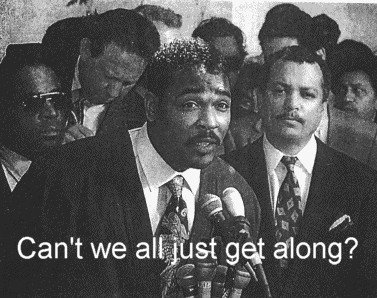
To unpack this a bit, let us put to ourselves the question Rodney King asked: "Can’t we all just get along?"

The answer, Rodney, is that we don’t want to get taken advantage of. Throughout our dealings with one another, we constantly face what are called prisoner’s dilemma situations. The classic prisoner’s dilemma gets its name from a scenario in which two prisoners, captured after being in cahoots with each other on some crime, are in separate rooms, each faced with deciding whether to keep mum or turn state’s evidence and rat on their partner. Betraying their partner is in their self-interest, but if they each betray the other, they’ll both be convicted. The overall benefit to the two prisoners combined is highest when they both keep mum – but if one goes out on a limb (keeps mum) for the other, and the other turns state's evidence, then the one who kept mum gets the maximum sentence while the fink gets off scot-free. The strategy of each pursuing their self-interest leads them to an outcome which is not in their self interest.

The social world presents us with analogous situations: we’ll all be better off if we cooperate with each other, but often we’re rightfully hesitant to cooperate because we can be taken advantage of, suckered, conned, exploited.

Why can’t we all just get along? Because we’re trapped in this prisoners’ dilemma.

Cooperation is inherently difficult and risky. Yet proto-humans and humans have been slowly developing ways to provide us with the protections we need in order to cooperate. As our cooperation has grown more extensive and elaborate, we inevitably created space for the free riders and "cheaters on the social contract."

* * *
This is part 3 of 6 of "Theodicy: Addressing Evil"
Next: Part 4: "Primary Sociopaths and Secondary Sociopaths"
Previous: Part 2: "Evil and Must Be Destroyed"
Beginning: Part 1: "The Evil Thought-Stopper"

2012-07-14

Saturdao 25

Dao De Jing, verse 15b

16 translations.

1. James Legge:
The skilful masters (of the Dao) in old times [were],…
vacant like a valley,
and dull like muddy water.
Who can (make) the muddy water (clear)?
Let it be still, and it will gradually become clear.
Who can secure the condition of rest?
Let movement go on, and the condition of rest will gradually arise.
They who preserve this method of the Dao do not wish to be full (of themselves).
It is through their not being full of themselves
That they can afford to seem worn and not appear new and complete.
2. Archie Bahm:
Regarding digging ditches: the steeper you slope their sildes, the sooner they will wash down.
Regarding muddy water: the more you try to stir the dirt out of it, the murkier it gets
What, then, should we do in order to clear the muddy water? Leave it alone and the dirt will settle out by itself.
What, then, must we do in order to achieve contentment? Let each thing act according to its own nature, and it will eventually come to rest in its own way.
Those who fully comprehend the true nature of existence do not try to push thing to excess.
And because they do not try to push things to exceeds, they are able to satisfy their needs repeatedly without exhausting themselves.
3. Frank MacHovec:
“The Dao of the Ancients”
The ancient followers of Dao [were]…
Receptive, like an inviting, open valley; friendly, like muddied water, freely mixing.
Who can make sense of a world like cloudy water? Left alone and still, it becomes clear. Should this stillness be maintained? Moving hastily will surely could it again. How then can one move and not become coulded? Accept Dao and achieve without being selfish; being unselfish one endures the world’s wear, and needs no change of pace.
4. D.C. Lau:
Of old he who was well versed in the way was…
Vacant like a valley;
Murky like muddy water.
Who can be muddy and yet, settling, slowly become limpid?
Who can be at rest and yet, stirring, slowly come to life?
He who holds fast to this way
Desires not to be full.
It is because he is not full
That he can be worn and yet newly made.
5. Gia-Fu Feng:
The ancient masters were…
Hollow, like caves.
Opaque, like muddy pools
Who can wait quietly while the mud settles?
Who can remain still until the moment of action?
Observers of the Dao do not seek fulfillment.
Not seeking fulfillment, they are not swayed by desire for change.
6. Stan Rosenthal:
“The Manifestation of the Dao in Man”
The sage of old:…
He was courteous like a visiting guest, and as yielding as the springtime ice.
Having no desires, he was untouched by craving.
Receptive and mysterious, his knowledge was unfathomable, causing others to think him hesitant.
Pure in heart, like uncut jade, he cleared the muddy water by leaving it alone.
By remaining calm and active, the need for renewing is reduced.
7. Jacob Trapp:
“The Wise Man of Old”
The Ancient Sage was…
Open, receptive, like a valley.
Turbid water he lets be,
Slowly to clear.
A person in great turmoil,
He helps by standing by.
His patience avails.
Embracing Dao, he guards against
The conceit of being full.
Knowing his hunger and his need,
He is never sated, ever renewed.
8. Stephen Mitchell:
The ancient Masters were…
Receptive as a valley.
Clear as a glass of water.
Do you have the patience to wait
till your mud settles and the water is clear?
Can you remain unmoving
till the right action arises by itself?
The Master doesn't seek fulfillment.
Not seeking, not expecting,
she is present, and can welcome all things.
9. Victor Mair:
Those of old who were adept in the Way were…
muddled as turbid waters;
expansive, as a broad valley.
If turbid waters are stilled, they will gradually become clear;
If something inert is set in motion, it will gradually come to life.
Those who preserved this Way did not wish to be full.
Now,
Simply because they did not wish to be full,
they could be threadbare and incomplete.
10. Michael LaFargue:
The Excellent shih of ancient times [were]…
all vacant space, like the Valley
everything mixed together, like muddy water.

Who is able, as muddy water,
by Stilling to slowly become clear?
Who is able, at rest,
by long dawn-out movement to slowly come to lfie?
Whoever holds onto this Dao
does not yearn for solidity.
He simply lacks solidity, and so
what he is capable of:
Remaining concealed, accomplishing nothing new
.
11. Peter Merel:
“Enlightenment”
The enlightened [are]…
Broad as a valley,
Seamless as muddy water.
Who stills the water that the mud may settle,
Who seeks to stop that he may travel on,
Who desires less than what may transpire,
Decays, but will not renew.
12. Ursula LeGuin:
“People of power”
Once upon a time people who knew the Way were…
Empty, like valleys.
Mysterious, oh yes, they were like troubled water.
Who can by stillness, little by little
make what is troubled grow clear?
Who can by movement, little by little
make what is still grow quick?
To follow the Way
is not to need fulfillment.
Unfulfilled, one may live on
needing no renewal.
13. Wang Keping:
He who was adept at practicing the Dao in antiquity:…
He was open and expansive, like a great valley;
He was merged and indifferent, like muddy water.
Who could make the muddy gradually clear via tranquility?
Who could make the still gradually come to life via activity?
(It was nobody else but him.)
He who maintains the Dao does not want to be overflowing.
It is just because he does not want to be overflowing
That he can be renewed when worn out.
14. Ames and Hall:
Those of old who were good at forging their way (dao) in the world:…
So murky, like muddy water;
So vast and vacant, like a mountain gorge.
Muddy water, when stilled, slowly becomes clear;
Something settled, when agitated, slowly comes to life.
Those who prize way-making do not seek fullness;
It is only because they do not want to be full
That they are able to remain hidden and unfinished.
15. Yasuhiko Genku Kimura:
“The Embodiment of the Dao Eternal”
The ancient masters are…
As empty as an open valley,
As inclusive as turbid waters.
Who could keep still until turbid waters become clear of their own accord?
Who could stay calm until still waters become alive of their own accord?
Those who embody the Dao do not desire to extend themselves to the fullest.
for, the Dao is balance,
and there is no fullest, no extreme.
Therefore, through balance, they refill their essence
and renew their life force forevermore.
16. Addiss and Lombardo:
The ancients who followed Dao [were]…
Blank,
Like uncarved woor.
Open,
Like a valley.
Mixing freely,
Like muddy water.
Calm the muddy water,
It becomes clear.
Move the inert,
It comes to life.
Those who sustain Dao
Do not wish to be full.
Because they do not wish to be full
They can fade away
Without further effort.
* * * * *
Stillness to let the muddy water clear.
Comfort the afflicted.
Empty out.
Calm action, arising of itself, to stir the complacent to life.
Afflict the comfortable.
Empty out, empty out.

* * * * *
See Saturdao Index.

2012-07-13

Evil and Must Be Destroyed

Sometimes people cause harm to other people. Sometimes we do so in truly horrible ways. Why do we do it? Do we do it because some – or maybe all – of us are evil?

That answer stops further inquiry. So I'm going to say I think we could get along better without the concept "evil." The concept does more harm than good. That’s not the same thing as saying I think there’s no such thing as evil. Both affirming a concept’s instantiation, and denying it, are ways of holding on to the concept. I’m saying this particular concept – evil – can just be dropped.

If we call some one "evil," we have dismissed that person. We’ve given ourselves something that feels like an explanation. It actually explains nothing at all, but because we have the illusion of explanation, it can serve to stop us from digging further into the matter. In fact, any further exploration of the matter can be met with outright hostility: "you’re not justifying what they do are you? They’re evil, end of story, nothing further to understand!"

"Evil" has become a word we use when we have become afraid of understanding. When we hate something so much that we become afraid that if we understood it, we wouldn’t be able to hate it anymore, then we call it "evil." Calling it evil is a strategy designed to prevent understanding, so that the hatred we covet will not be threatened.

If something is evil, it is not to be understood -- it is only to be destroyed. In fact, the word “evil,” and the phrase “must be destroyed” go together. “It is evil and must be destroyed,” was once the stuff of Saturday morning cartoon dialog.

In the 1989 film, Steel Magnolias, Ouiser (Shirley Maclaine) rebukes her friend Clairee (Olympia Dukakis), and tells her, “you are evil and must be destroyed.” It was a funny line. Since then a lot of things have been designated as “evil and must be destroyed.”

Interested in the popular culture’s tendency to link the concept evil with an imperative to destroy, I turned to my trusty internet search engine, and typed in the phrase “evil and must be destroyed.” I read the claim that 40% of the population believes that liberals are evil and must be destroyed. On a Star Wars blog, I read that the Sith are evil and must be destroyed. On historyexplained.org, we read that the United States has historically, in effect, insisted that dictators are evil and must be destroyed. On a web site devoted to a recently popular TV show about a vampire slayer, I read: “Buffy’s new roommate irons her jeans. Clearly she is evil and must be destroyed.”

Evil and must be destroyed?
Cincinnati, the font Papyrus, bacon-wrapped jalapeno thingies, sweet popcorn, the University of Wisconsin at Milwaukee, the handvac, the mainstream media, Newt Gingrich, Lady Gaga, dogs, cats, wasps, inheritance, derivatives, emulators, cartels, college football’s Bowl Champion Series, and everyone who isn’t part of Glenn Beck’s army of God have all been publically declared, by someone, “evil and must be destroyed.”

“Evil” and “must be destroyed” seem to be pretty tightly connected in the popular mind.

Destroying might be the best response to an invasive plant species like buckthorn in Minnesota or ardisia here in Florida, but it is rarely the best response to any of the human behaviors that get called evil.

If we just drop the concept of evil, what will replace it?

* * *
This is part 2 of 6 of "Theodicy: Addressing Evil"
Next: Part 3: "From Evil to Sociopathy"
Previous: Part 1: "The Evil Thought-Stopper"

2012-07-12

The Evil Thought-Stopper

What is evil? What are we saying when we call something "evil"?

LoraKim and I lived in Minnesota for one year, 2000-2001. There is an invasive species of plant there called “buckthorn.” There was a member of the Rochester, Minnesota congregation who had made it his mission to combat the prolific encroachment of this bush. I heard from him how buckthorn was pushing out native plants, displacing habitats for native animals, upsetting the prairie ecology of the region, and how great lengths have to be taken to kill it or it will spring right back. “Buckthorn is evil,” he said. He looked like he meant it.

Or consider this. There is a certain sort of water bug that swims up under small frogs and injects a virulent poison that dissolves the living frog from the inside, allowing the bug to suck out the nutrients, leaving only an empty skin floating in the water. Do you kinda want to call that evil?

Evil has been a regularly invoked concept in US foreign policy. Ronald Reagan called the Soviet Union the Evil Empire. In 2002, President Bush named Iran, Iraq, and North Korea an “Axis of Evil.” Remember that? Andrew Marlatt was prompted to write a satirical news piece:
“Bitter after being snubbed for membership in the ‘Axis of Evil,’ Libya, China, and Syria today announced they had formed the 'Axis of Just as Evil,' which they said would be way eviler than that stupid Iran-Iraq-North Korea axis. . . . Elsewhere, peer-conscious nations rushed to gain triumvirate status in what became a game of geopolitical chairs. Cuba, Sudan, and Serbia said they had formed the Axis of Somewhat Evil, forcing Somalia to join with Uganda and Myanmar in the Axis of Occasionally Evil, while Bulgaria, Indonesia and Russia established the Axis of Not So Much Evil Really As Just Generally Disagreeable. Canada, Mexico, and Australia formed the Axis of Nations That Are Actually Quite Nice But Secretly Have Nasty Thoughts About" the US. (Full column: see here.)
In traditional theology, the problem of evil is one of the thorniest issues. If God made everything, didn’t God make evil, too – and if so, why? She gave us free will – but she’s omniscient, so she knows how we’ll use our free will. Why did she make us that way? (There are a lot of different ways to be good. We'd still have free will if we used it only to choose among various ways of being good. We can all have free will without anybody being evil.) "Theodicy" is the field of theology that aims to address the problem of evil and reconcile God's omnibenevolence, omniscience, and omnipotence with the occurrence of evil in the world.

Just because we are religiously liberal doesn’t mean that we, too, don’t wrestle with what evil is, and why. We may not frame the issue in the traditional way, but theodicy -- the challenge to offer some accounting of evil -- is an issue for everyone.

So what is evil? Let's first notice the way the concept is invoked.

I was working as a hospital chaplain in North Carolina in 2001 when terrorists flew hijacked 747s into New York’s Twin Towers. At the next morning's gathering of the hospital’s five chaplains and our supervisor, I said I wished I understood better what might lead someone to fly an airplane into a building. One of my colleagues asked, “You do believe in evil don’t you?”

I stammered, “sure,” but the truth is I don’t know whether I do or not. I have a hard time with “believe in” questions. I can tell you what I believe -- well, sometimes -- but I have harder time with what I believe in. Do I believe in God? Do I believe in evil? Do I believe in peanut butter? Basically, I don’t believe in believing in.

I do notice that the word, the concept, “evil” is often a thought-stopper. I see it used to stop thought. We say something’s evil, and we’re off the hook to look into the matter any more deeply. "It’s evil – what more do you need to know? End of story." End of thinking.

* * *
This is part 1 of 6 of "Theodicy: Addressing Evil"
Next: Part 2: "Evil and Must Be Destroyed"

2012-07-11

Free Will, Responsibility, and Florida Gators

A news item this morning has me thinking about responsibility and free will.

On Monday, Kaleb Langdale, 17, was swimming in the Caloosahatchee River west of Lake Okeechobee when an alligator bit off his arm below the elbow. Wildlife officers found and killed the alligator. They retrieved the arm, but doctors were not able to reattach it.

Jorge Pino, spokesman for the Florida Fish and Wildlife Conservation, explained:
"We found the alligator that was responsible."
Really? Yeah, we know what he means -- but what he means isn't what he said. We don't hold reptiles responsible. We may try holding dogs and cats responsible -- which seems to work better for dogs than for cats -- and maybe, in a pinch, other mammals or birds -- but holding wild gators responsible is silly.

The gator that bit Kaleb Langdale is pulled from
the water after it was killed.
Wildlife officers hunted down the poor creature and killed it. But this is not punishment or retribution or any other form of "holding responsible." Aside from wanting to retrieve the arm, just in case it could be reattached, killing the gator is purely an act of preventive public safety, not punishment. We know that alligators who have attacked a human are more likely to do so again, so we remove the danger. Holland builds dykes to keep out the high water, but they don't holding the sea responsible for the flooding it may cause.

Humans, on the other hand, we do hold responsible, by and large. When we administer the death penalty to humans (however misguided, ineffective, and actually counterproductive this may be), it is a part of our practices of holding responsible.

Why do we hold humans, and not flood waters or wild critters, responsible? Sometimes we explain this by saying humans have free will, and the other beings or things don't.

This has never been a very good explanation, and lately it has been getting worse and worse. On the human side, brain science is discovering more and more conditions "beyond the person's control" that cause erratic behavior.

Take, for example, the 1966 shootings by Charles Whitman at the University of Texas. He killed 13 and wounded 32. It turns out Whitman's brain had a tumor the diameter of a nickel.
This tumor, called a glioblastoma, had blossomed from beneath a structure called the thalamus, impinged on the hypothalamus, and compressed a third region called the amygdala. The amygdala is involved in emotional regulation, especially of fear and aggression. (Atlantic Monthly: see here.)
In what sense can Whitman be said to have "chosen" to shoot the people he shot? The right sort of tumor in the right sort of place, and any one of us will feel an overwhelming compulsion to violence.

And on the nonhuman animal side, we have been learning that the decision-making circuitry in animal brains is so similar to ours that if there's "free will" somewhere in the human brain, then it's also there in any mammal -- and, basically, any vertebrate -- brain.

Either because humans don't have free will, or because, if we do, then other animals have it, too, it won't work to say Charles Whitman had free will but the gator that bit Kaleb Langdale didn't.

"Free will" is a conceptual quagmire, and if our institutions of responsibility-holding depended upon free will, then those institutions wouldn't stand. Fortunately, they don't depend upon free will.

The practices of holding each other responsible stand on their feet. Whether you have free will or don't, it turns out that holding you responsible for your actions influences those actions in socially salutary ways -- sometimes. Not always: no amount of moralizing would have fixed Charles Whitman's brain or restrained his behavior. But the practices of holding responsible are effective enough, on enough of us, to make those practices worth keeping around -- again, whether we have free will or not.

So the legal system in 1966 held Whitman responsible -- and we don't hold wild gators responsible -- because holding the human responsible is a part of our imperfect but better-than-nothing system for regulating our conduct with each other. With humans, we presume that the rhetoric of responsibility will find some purchase (even if we know that every once in a while it won't). With wildlife, though, a concept of their responsibility is not helpful in guiding our relations with them.

2012-07-10

Environmental Optimism, Pessimism, and Hope

From the Mailbag:

Dear Lake Chalice:

Many of the issues you listed in your post of Jun 26 (greenhouse gases, deforestation, water pollution, overfishing, wetland destruction, desertification) are temporary ill effects that humankind will correct as we gain wealth and power over our environment.

Human waste no longer flows through the streets of Philadelphia (or any other major city in the developed world). We have cleaned up the air and rivers in Pittsburgh, and fish have returned to the Thames in London. East of the Mississippi, most of the forests of pre-Columbian times have been restored -- much greater than 100 years ago. (A major reason for that has been our development of other resources. Oil wells and cars take much less acreage needed for the harvests for firewood or pastures for horse and oxen.)

As our society became richer, we were able to afford the luxury of protecting the Commons -- and did so.

So, I am an optimist that we will solve global problems of deforestation, overfishing, fertilizer runoff creating dead zones in river deltas, ocean pollution, and so on. Whether fluoro-carbons were as bad for the ozone layer as predicted or not, they are essentially banned worldwide. It will take better global cooperation, but I am optimistic we'll handle those problems.

Global climate change is another matter entirely. The climate will change! It has been changing for the entire Earth's history, especially in the last 100,000 during the last phase of human evolution. The preponderance of evidence points to accelerating change, and the vast majority of scientific opinion is that mankind has been a major factor.

So I predict floods, droughts, storms, warming of many regions (and possible cooling of others). I suspect the ocean rise estimate of 18-to-59 cm (7 to 23 inches) you quoted for the end of this century is optimistic. It may be much more.

Climate change will occur, and there is nothing that can be done to stop it. Go ahead and pass your carbon tax laws if it makes you feel better. They will have negligible impact and will be mostly counter-productive. There is no way the rich countries will willingly go back 30 or 50 years in their standard of living, and -- even if they did -- there is no way the populations of the developing countries will be denied their rights to strive to become rich.

My recommendation is to increase wealth, foster technology and international trade, try to bring clean water and basic education to poor countries, and make the world's population better able to deal with change.

-Warmly

Dear Warmly,

Lake Chalice is happy to hear that human waste no longer flows through the streets of Philadelphia. Your optimism about many of the environmental issues is, we note, paired with pessimism about the climate. Lake Chalice recommends neither optimism nor pessimism, but hope.

Lake Chalice is with you in celebrating the human capacity to avert apparently looming catastrophes. Some of our favorite examples:
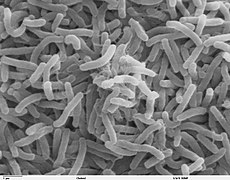
Cholera bacteria
  • In 1832, cholera epidemics terrified us. Cholera victims went from perfectly healthy to collapsed, shriveled, and dead in a matter of hours. German poet Heinrich Heine wrote, "It was like the end of the world," -- and many people thought it was.
  • In 1967, William and Paul Paddock's Famine 1975 was a bestseller. It was full of detailed scientific data and reasoning confidently proving that worldwide famine would strike in about eight years.
  • The next year, Paul Ehrlich’s The Population Bomb predicted huge die-offs from outstripping our food supplies. 65 million Americans will die of starvation between 1980 and 1989, Ehrlich predicted,and by 1999 the US population will have declined to 22.6 million.
  • In 1970, Harvard biologist George Wald predicted that civilization will end within 15 or 30 years unless immediate action is taken against problems facing [humanity].
  • In the same year, Life magazine reported that: "By 1985, air pollution will have reduced the amount of sunlight reaching earth by one half."
  • In 1987, fears of AIDS spreading through heterosexual contact led Oprah Winfrey to tell her audience that "research studies now project that one in five heterosexuals could be dead from AIDS at the end of the next three years. That’s by 1990. One in five."
None of those dire predictions came anywhere close to realization. Also included on the "problems we had the ability and the will to solve" list would be the ones you mention:
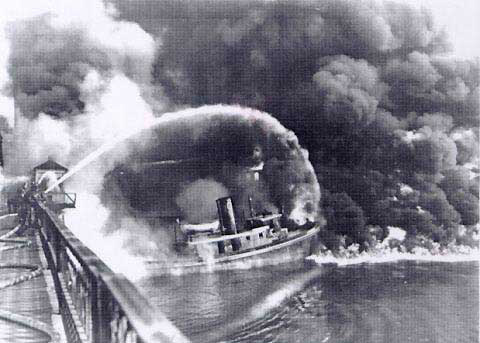
Firefighters battle the Cuyahoga River fire of 1969
  • Urbanization from the middle ages through the 18th century exceeded the capacity of cities to handle the sewage of their burgeoning populations. Human waste ran in the streets. Eventually, municipalities figured out how to build sewage systems. Whew!
  • The SOx, NOx, and particulates that make smog were a much bigger concern in US and European cities 40 years ago. Those cities now have much cleaner air. Twenty years ago Mexico City was the most polluted city on the planet, according to the UN -- and today it has air quality equivalent to Los Angeles.
  • A number of rivers, including London's Thames, were once dead. Cleveland's Cuyahoga River actually caught fire in 1969. Today, someone fishing in these rivers might actually catch something. Lake Erie, which Time magazine declared a "giant cesspool" in 1969, had vast dead zones and oil slicks. Massive clean-up efforts succeeded and the Lake today is alive and fishy, its beaches open for recreation.
  • In the 1970s we had concern about chlorofluorocarbons (CFCs) diminishing our ozone layer which shields us from skin-cancer-causing ultraviolet radiation. In 1978, the US, Canada, and Norway banned CFCs. Europe joined in the ban in the mid-80s, and by 1996 the treaty banning CFCs was joined by 160 countries. In 2003, scientists announced that depletion of the ozone layer had slowed significantly. It will continue to diminish for a while because CFCs take 50 to 100 years to break down in the atmosphere. Final recovery of the ozone layer is expected to take another century or so -- but we're on our way.
  • US reforestation is occurring, though it's a bit premature to say that "forests of pre-Colombian times have been restored." The pre-Coloumbian forests were "old-growth" -- which matters because old-growth forests provide the maximum level of bio-diversity including homes to a number of rare, threatened, and endangered species. Old-growth forests east of the Mississippi River got down to 1.2 million acres, now scattered over 88 parks, preserves, and natural areas (over half of that area is in the Appalachian-Blue Ridge forests of Virginia, North Carolina, and Tennessee). Since the hardwood forests of the eastern US take 150-500 years to develop old-growth characteristics, we can't honestly say we have, to date, restored any of the old-growth forestation of pre-Columbian times. Our reforested areas are, however, slowly getting there. In terms of total forest area in the US: the estimate is that in 1630, 46 percent of the land area of the present US was forested. By 1907, it was down to 34 percent. Today, 33.2 percent is covered -- looks like it's been on the upswing, though, at least in the last 20 years.
These successes give us grounds for hope -- though we wouldn't say optimism. While air quality in Western cities is much improved, India and China are another story. We may hope that Asia will clean up its air as North Atlantic countries did, but who knows whether they will?

Optimism may induce complacency. These past successes at recovering (partly, anyway) from environmental degradation are no guarantee of similar recovery in the future. We cannot sit back and assume that just because we got sewage out of the streets, cleaned up our air and water, banned CFCs, and planted some more trees, we will therefore automatically reverse global deforestation, desertification, overfishing, the remaining forms of pollution of lakes and rivers, ocean dead zones, and loss of wetlands.

Aldo Leopold
1887 - 1948
The successes took a lot of work from a lot of people. What progress we have seen is the fruit of an increased environmental consciousness -- a consciousness which often, though not always, includes a recoiling in horror at such phrases as "power over our environment" (preferring, instead, a notion of "harmony with our environment"). This increased environmental consciousness required generations of nature writers, ecophilosophers and ecotheologians: figures such as Emerson, Thoreau, Darwin, Charles White, Richard Jefferies, John Muir, John James Audubon, Aldo Leopold, Edward Abbey, Rachel Carson, Joanna Macy, Thomas Berry, and Sally McFague. We needed generations of readers reading these writings and discussing them with others. We needed activists forming organizations like the Nature Conservancy, the Sierra Club, Earth Justice, and Greenpeace.

You mention economic and technological factors, noting that "as our society became richer, we were able to afford the luxury of protecting the Commons -- and did so," and that we were able to slow down deforestation because oil and cars began meeting our energy and transportation needs, thus freeing the acreage that would have had to be denuded for firewood and horse and oxen pastures.

Those factors of economic and technological development are certainly important. Humans have to be able to afford an attitude change in order to make an attitude change. People who worry that their children may not be fed are not inclined to worry that their grandchildren may not have pristine forests in which to have experiences of aesthetic bliss. Some level of wealth is necessary. Technologies that provide environment-protecting alternatives within the means of our wealth are also often necessary. But these things are not sufficient. We also need the aforementioned writers, readers, discussants, activists, supporters, and organizations. We need, that is, the apparatus of moral development, not merely the apparatus of economic and technological development. Economic-technological development may facilitate moral development, but doesn't make it inevitable.

Each of us has an active responsibility, we believe, to engage with social and political processes of change to ensure that "affordability of attitude change" and "technological capacity to support attitude change" turns into actual attitude change as soon as possible and on the widest possible scale. To meet this responsibility, we need hope, to know that success is possible, rather than optimism, to lull us with the delusion that success is inevitable.

Progress on reversing damage to tropical forests, wetlands, oceans, etc., will, as you say, "take better global cooperation." The question for each of us to ask ourselves, then, is: "And what am I doing to ensure that cooperation happens? What am I doing to develop and extend the consciousness of the Earth's ecological health as the primary ethical, aesthetic, and spiritual value?" The stronger and more widely shared that consciousness, the more deeply felt our eco-connections, the sooner and more secure will be the global cooperation we need.

Concerning climate change, your optimism turns to pessimism. Lake Chalice is afraid that you are probably right about the dire consequences headed our way and that cannot be averted. Environmentalist writer Bill McKibben shares your sense that it is too late to avert massive disruptions from climate change. He has noted that when we speak of this issue, it’s common to invoke grandchildren. "Preserve the planet for the sake of our grandchildren," we say. However, says, McKibben:
Forget the grandkids; it turns out this was a problem for our parents.
Lake Chalice, following Kwame Appiah, had suggested that future generations would find it hard to forgive us for our climate-altering habits -- but maybe those future generations will blame our parents instead!

Your recommendation is "to increase wealth, foster technology and international trade, try to bring clean water and basic education to poor countries, and make the world's population better able to deal with change."

Lake Chalice thinks these sound like good things. We note that greater equality in wealth distribution is more important than greater total wealth. (See the series, "Our Spirits Long to Be Made Whole," which begins here.) We also continue to believe that, along with basic education to poor countries, further development and extension of ecological consciousness, in both wealthy and poor countries, will help. Lake Chalice also wishes to recall what we noted in our post from 2011 May 15:
The Ecospiritual Challenge is to choose neither despair nor defense, but new community. This is a spiritual challenge because the courage to face reality exactly as it is comes from spiritual discipline. Our capacity to hold our world in love, whatever may come -- and I do mean whatever may come -- is developed in spiritual practice and in spiritual community. And where love is, fear and sadness are not.

The new Earth will rely much more on local food, and on organic farming that doesn't use huge quantities of fossil fuel for its fertilizers, its pesticides, it’s machinery, or its product transportation. Food will cost more -- which is not a big problem since food has for many years now been ridiculously cheap, partly because of agriculture subsidies and fossil fuel industry subsidies (which also subsidize the type of agriculture that intensively relies on fossil fuels). The new Earth will rely more on locally-produced energy -- solar panels and solar water heating on your own house, and windmills in your yard -- because transmission across power lines loses efficiency over many miles. We'll also use the internet and connecting tools like Skype instead of flying and driving places.

To sustain us in the new Earth we need the very thing that sustained many of us on the old Earth: a spirituality of connectedness with this earth, of reclaiming a way of living lightly, carefully, gracefully on this delicate home, rituals and practices and ways of thinking that nurture attention, and calm delight in the simple beauties of life.

Wanting stuff makes us stressed, and being stressed makes it harder to step back from our desires for a larger perspective. We need some help to break out of that cycle, to prepare our hearts as well as minds for the new kind of life that will be required on our new planet. Ecotheologians can speak to our deepest needs for connection, harmony with our world, for the beauty of natural objects and natural terrain, and, by making ourselves clearer to ourselves, they fortify us to live by the values that we most yearn to live by but that keep getting buried under the daily demands of life.

Yours faithfully.

* * * * *
Lake Chalice welcomes your letters. Letters used in Lake Chalice posts have been revised and adapted, and appear without attribution.

2012-07-09

The Meat of the Matter

A friend mentioned to me yesterday that her online voyages had encountered philpapers.org, for philosophy papers. She typed in my name and discovered my sole publication as an academic philosopher: an essay from 17 years ago called "Neither Absolutism Nor Relativism." (You can see the first page here.)

After some rummaging around, I located a copy of the article. It seems that not only did I think that both absolutism and relativism shared a false assumption, but a variety of other seeming-opposites similarly derived from a shared error:
"foundations" vs. "culturally-influenced intuitions"
"correspondence with reality" vs. "internal coherence"
"representation of the way the world really is" vs. "descriptions useful for a purpose"
"objectivity" vs. "intersubjectivity"
"moral reality" vs. "human-created systems of values"
"essentialism" vs. "anti-essentialism"

All of these supposed oppositions collapse. The participants on both sides of these arguments have been confused, I said. There was, however, something that they really were disagreeing about. I called it "convergentism" vs. "anti-convergentism." 

I realize that I'm still working on collapsing oppositions -- while at the same time seeking to recognize and honor real differences of perspective.

"Supernatural" and "Not supernatural," for instance. The term "supernatural" originated in about 1520 within a very specific context of Catholic theological development. There was a very specific concept of "laws of nature" which the 16th-century theologians then distinguished from that which is not subject to the laws of nature. The rest of the world -- along with pre-16th-century-Europe -- simply didn't draw this distinction between "laws of nature" and "events not subject to laws of nature." Outside the context of a shared sense of what "natural" is, it makes no sense to either affirm or deny belief in the supernatural.

I can't quite tell what to make of "materialism" -- sometimes proferred as a way to do the job for which "anti-supernaturalism" fails. The work in quantum physics has made "matter" seem far stranger than any "immaterialist" theory.

I once reflected in a sermon along lines that seemed rather materialist to one of my listeners. "You speak as if we were mere meat," he told me after the service.

What's mere about meat? What could be more awesome and wondrous than that there is something, rather than nothing? And that somehow this something is expanding at the speed of light -- and consists of 4 basic forces and 12 basic particles? And that, in amazing and mysterious ways, they make atoms, which in equally amazing and mysterious ways make molecules? And that some of these molecules formed into such shapes that they made copies of themselves? And that life developed with specialized parts like muscle tissue?

Every electron is ultimately a field that extends through the whole universe. How much more then, the sinew of my body?

2012-07-07

Saturdao 24

Dao De Jing, verse 15a

16 translations.

1. James Legge:
The skilful masters (of the Dao) in old times,
with a subtle and exquisite penetration, comprehended its mysteries,
and were deep (also) so as to elude men's knowledge.
As they were thus beyond men's knowledge,
I will make an effort to describe of what sort they appeared to be.
Shrinking looked they like those who wade through a stream in winter;
irresolute like those who are afraid of all around them;
grave like a guest (in awe of his host);
evanescent like ice that is melting away;
unpretentious like wood that has not been fashioned into anything;
2. Archie Bahm:
In primitive times, intelligent men had an intuitively penetrating grasp of reality which could not be stated in words.
Since their instinctive beliefs have not been recorded for us, we can only infer them from old sayings which have come down to us.
Regarding caution when crossing a stream in winter: the more nervous you are, the more likely you are to slip and fall.
Regarding suspicion of enemies: the more you fear others, the more they will be afraid of you.
Regarding courtesy as a guest: the longer you stay, the more you become indebted to your host.
Regarding melting ice: the more you do to prevent it from melting, the quicker it melts.
Regarding making furniture: the more you carve the word, the weaker it gets.
3. Frank MacHovec:
“The Dao of the Ancients”
The ancient followers of Dao: so wise, so sublte, so profound, so deeply understanding that they were themselves misunderstood. They must therefore be described:
Cautious, like crossing a stream in midwinter; observant, like moving in fear through hostile land; modest, retiring like ice beginning to melt; dignified, like an honored guest; genuine, like natural, untouched wood;…
4. D.C. Lau:
Of old he who was well versed in the way
Was minutely subtle, mysteriously comprehending,
And too profound to be known.
It is because he could not be known
That he can only be given a makeshift description:
Tentative, as if fording a river in winter,
Hesitant, as if in fear of his neighbors;
Formal like a guest;
Falling apart like the thawing ice;
Thick like the uncarved block;
5. Gia-Fu Feng:
The ancient masters were subtle, mysterious, profound, responsive.
The depth of their knowledge is unfathomable.
Because it is unfathomable,
All we can do is describe their appearance.
Watchful, like men crossing a winter stream.
Alert, like men aware of danger.
Courteous, like visiting guests.
Yielding, like ice about to melt.
Simple, like uncarved blocks of wood.
6. Stan Rosenthal:
“The Manifestation of the Dao in Man”
The sage of old was profound and wise;
like a man at a ford, he took great care, alert, perceptive and aware.
Desiring nothing for himself, and having no desire for change for its own sake, his actions were difficult to understand.
Being watchful, he had no fear of danger; being responsive, he had no need of fear.
7. Jacob Trapp:
“The Wise Man of Old”
The Ancient Sage was profound,
Simple, yet subtle beyond description.
One could say of him only that he was
Cautious, like one crossing a wintry stream;
Watchful, like one not to be taken from ambush;
Modest, like one who is everywhere a guest;
Self-effacing, like ice beginning to melt;
Genuine, like a piece of uncarved wood;
8. Stephen Mitchell:
The ancient Masters were profound and subtle.
Their wisdom was unfathomable.
There is no way to describe it;
all we can describe is their appearance.
They were careful
as someone crossing an iced-over stream.
Alert as a warrior in enemy territory.
Courteous as a guest.
Fluid as melting ice.
Shapable as a block of wood.
9. Victor Mair:
Those of old who were adept in the Way
Were subtly profound and mysteriously perceptive,
So deep they could not be recognized.
Now,
Because they could not be recognized,
One can describe their appearance only with effort:
hesitant, as though crossing a stream in winter;
cautious, as though fearful of their neighbors all around;
solemn, as though guests in someone else’s house;
shrinking, as ice when it melts;
plain, as an unhewn log;
10. Michael LaFargue:
The Exellent shih of ancient times
Penetrated into the most obscure,
the marvelous, the mysterious.
They had a depth beyond understanding.
They were simply beyond understanding,
the appearance of their forceful presence:

Cautious, like one crossing a stream in winter
timid, like one who fears the surrounding neighbors
reserved, like guests
yielding, like ice about to melt
unspecified, like the Uncarved Block
11. Peter Merel:
“Enlightenment”
The enlightened possess understanding
So profound they can not be understood.
Because they cannot be understood
I can only describe their appearance:
Cautious as one crossing thin ice,
Undecided as one surrounded by danger,
Modest as one who is a guest,
Unbounded as melting ice,
Genuine as unshaped wood,
12. Ursula LeGuin:
“People of power”
Once upon a time
people who knew the Way
were subtle, spiritual, mysterious, penetrating,
unfathomable.
Since they’re inexplicable
I can only say what they seemed like:
Cautious, oh yes, as if wading through a winter river.
Alert, as if afraid of the neighbors.
Polite and quiet, like houseguests.
Elusive, like melting ice.
Blank, like uncut wood.
13. Wang Keping:
He who was adept at practicing the Dao in antiquity
Was subtly profound and penetrating, too deep to be understood.
As he was beyond people’s cognitive capacity,
I can only describe him arbitrarily:
He was cautious, as if walking across a frozen river in winter;
He was vigilant, as if being threatened by an attack on all sides;
He was solemn and reserved, like a visiting guest;
He was supple and pliant, like ice about to melt;
He was broad, like the boundless sea;
He was vigorous, like the untiring blowing wind;
He was genuine and plain, like the uncarved block;
14. Ames and Hall:
Those of old who were good at forging their way (dao) in the world:
Subtle and mysterious, dark and penetrating,
Their profundity was beyond comprehension.
It is because they were beyond comprehension
That were I forced to describe them, I would say:
So reluctant, as though crossing a winter stream;
So vigilant, as though in fear of the surrounding neighbors;
So dignified, like an invited guest;
So yielding, like ice about to thaw;
So solid, like unworked wood;…
15. Yasukio Genku Kimura:
“The Embodiment of the Dao Eternal”
The ancient masters are wondrously subtle and profoundly penetrating.
The depth of their being is unfathomable and beyond comprehension.
As their depth is unfathomable and beyond comprehension,
Only their appearance can be incompletely described:
The master is as alert as a person fording a winter stream.
As careful as a person watchful of his surroundings,
As respectful as a thoughtful guest,
As flowing as meling ice,
As plain as an unhewn log,
16. Addiss and Lombardo:
The ancients who followed Dao:
Dark, wondrous, profound, penetrating,
Deep beyond knowing.
Because they cannot be known,
They can only be described.
Cautious,
Like crossing a winter stream.
Hesitant,
Like respecting one’s neighbors.
Polite,
Like a guest.
Yielding,
Like ice about to melt.
Blank,
Like uncarved wood.
* * * * *
Shrinking, irresolute, grave, evanescent, unpretentious, cautious, observant, modest, dignified, genuine, tentative, hesitant, formal, falling apart, thick, watchful, alert, courteous, yielding, simple, perceptive, aware, responsive, self-effacing, careful, fluid, shapable, solemn, plain, timid, reserved, unspecified, undecided, unbounded, polite, elusive, blank, vigilant, broad, supple, pliant, vigorous, reluctant, solid, respectful, flowing.
Combining all of these in one coherent and graceful character.
I do not say: Be like that.
I say: Notice that you are.
And if a shameful memory should happen to intrude,
I say: Notice that you were like that even then.

* * * * *
See Saturdao Index.

2012-07-06

Environmentalism and Religion

"There is a long journey from the head to the heart, and an even longer journey from the heart to the hands."
-His All Holiness Bartholomew, Eastern Orthodox Patriarch, speaking at the conference on "Environment, Ethics, and Innovation" in Heybeliada, Turkey, 2012 Jun 18-20.

When it comes to the environment destruction the "anthropocene age" is wreaking on the planet, our collective head doesn't know everything, but it knows enough. The engagement of the heart is catching on among more and more people like me (who love to read and write about the need to protect the environment -- while sitting in my air-conditioned house which the last electric bill said was only the 8th-most efficient house in our neighborhood). The journey from heart to hands is, indeed, long.

And this is where the environmental movement needs to get religion -- and religion needs to get environmental. The great world religious traditions have understood for centuries that knowing what is right is not the same thing as living it, and they have worked out approaches for helping us close that gap. Truthfully, they aren't all that great. Hence, the apostle Paul:
"I do not understand my own actions. For I do not do what I want, but I do the very thing I hate....I can will what is right, but I cannot do it. For I do not do the good I want, but the evil I do not want is what I do." (Romans 7: 15-19)
Still, the contemplative practices, the rituals, and the faith communities developed in both the east and west are our best hope for getting from head to heart to hands.

New scientific attention to the consequences of, and the conditions that encourage, altruism, forgivness, gratitude, and empathy has been yielding results supporting religious teachings centuries, and even millennia, old. These qualities are -- and are not -- matters of choice: pretty much the same way that healthy muscle tone is, and is not, a matter of choice. You can't just hear a particularly inspirational sermon one day and decide that, henceforth, you are going to be kind, compassionate, forgiving, and peaceful -- anymore than you can watch a video of an inspirational Jack LaLanne (RIP) talk and decide that, henceforth, you will have developed muscles. What you CAN do, however, is be inspired to begin doing the exercises. It takes exercises to develop the muscles -- and the willpower involved is the willpower to keep doing the exercises.

Likewise, it takes exercise to develop the muscles of the spiritual virtues (altruism, compassion, equanimity, abiding joy and peace). You can't will yourself to be nice and kind. The willpower involved is the willpower to keep doing the exercises that, over time, slowly develop the virtues. The spiritual virtues are based in physiology just as much as muscle health is. There are new neural pathways that must be developed if we are going to consistently traverse the long journey from head to heart to hands.

The ancient religions, when they aren't ignoring key portions of their own wisdom traditions, have a lot to say about how to do those exercises. New scientific findings are telling us a bit more about how to train ourselves to be spiritually fit.

To survive as a species, we will need to make the journey from thoughts to actions -- either:
(1) to stop and reverse environmental damage and restore healthy planet-wide ecosystems; or
(2) to find a way to live together in the coming hard times without wiping each other out in resource wars.

It's probably too late for #1. Hard times, resulting from human impact on our planet, are coming -- and, in many ways, are already here. (See Bill McKibben, Eaarth.)

To manage ourselves -- to learn to live peacefully and cooperatively under conditions of diminished carrying capacity -- will require cultivation of the spiritual virtues.

We develop the muscles for action on behalf of peace and justice by exercising them: a little action today helps prepare us for larger, more sustained, more thoroughgoing actions later.

We also develop the muscles by learning to recognize, monitor, and regulate the reactions of our ego-defense mechanisms. Those mechanisms serve good purposes -- but they work overtime and get us into trouble. In fact, they get us into pretty much all the trouble that human history has recorded. The spiritual virtues I mentioned (kindness, equanimity, etc) amount to this ability for self-awareness to recognize, monitor, and regulate the ego-defense reactions. Joy and peace are our natural condition when the occlusions of our ego-defenses are cleared. "Know thyself," beseech the wise ones from Buddha to Socrates and on. For the cultivation of self-awareness, try a foundation of five practices:

1. Study. Read the wisdom literature, scripture, spiritual writings, poetry. At least 15 mins. a day.

2. Journaling. Learn to know yourself by seeing what your write about what is on your heart. Ask, "Where has my heart been during the last 24 hours?" and then start writing. Minimize self-editing. Just keep the pen moving. One day a week, simply list things from the preceding week for which you are grateful. 15 minutes a day.

3. Silence. And stillness. Find a posture for sitting that will allow you to remain comfortably motionless for 15 mins a day. Bring your attention to the sensations of breathing in and breathing out. Every time you notice that your mind has drifted away from that attention, make a note to yourself that you have drifted away, then return all your attention to the breathing. Over time, you learn a lot about yourself by this daily exercise of noticing where your mind tends to wander to.

4. Group. Get together with sympathetic others to share and reflect on your spiritual paths. The group should meet at least monthly. Weekly is better.

5. Resolve for mindfulness. Noticing where your mind wanders off to isn't just for the 15 mins/day silence exercise. Throughout the day, when you notice that your mind is dwelling in the future or in the past, bring it back to where you are right now.

Peace be with you. And, thus, with us all.

2012-07-05

Higgs boson and on anon.

"The world might not change, but my world certainly has."
- Lisa Randall, theoretical physicist, Harvard University,
commenting on yesterday's Higgs boson announcement.

The recent apparent discovery of the Higgs boson has "changed the world" for physicists. How about for the rest of us?

Religion's job -- one of them -- is to provide a story that helps us make sense of our self and our world. The thing is: a lot of religious stories are rather fixed. The world may go through a renaissance, a birth of science, an age of reason (17th and 18th centuries), an industrial revolution (19th century), and emerge into a postmodern information age, but some religious stories are barely revised. I don't say that such religious stories grow disconnected from life -- for every detail of life is colored by spiritual awareness, whether that awareness is tied to an old and fixed story or not. Still, a fixed story is, for better and for worse, impervious to the march of knowledge.

A key characteristic of liberal religion is that it is integrative. As new knowledge emerges -- in physics, biology, ecology, brain sciences, psychology, sociology, economics, or anything -- liberal religion looks to integrate that knowledge into human spiritual life.

If we can tell a story about Noah and the flood, or Arjuna's realization on the battlefield, or Mohammed receiving the Koran, or Bodhidharma sitting in a cave for nine years, and integrate that story into our spiritual understanding, can we also integrate into our spiritual lives a story about a Higgs boson? The Higgs boson has, after all, been called "the God particle," so you'd think there might be some religious significance in the discovery.

When I say, our "spiritual lives," let's take, for now, as our operational definition, this graphic circulating on Facebook:


How will discovery of the Higgs boson help with these 12 qualities? Perhaps you are imagining that we will now be able to make a ray gun that will zap people with Higgs bosons thereby imbuing them with these traits. No, that ain't gonna happen. Besides, the question here isn't what, if anything, can be done with Higgs bosons, but what, if anything, can be done with knowledge about Higgs bosons.

A single episode -- the story of Joseph's brothers selling him into slavery, or of Prince Siddhartha venturing beyond the palace walls to encounter sickness, old age, and death -- does not a religious tradition make. Single episodes, by themselves, don't do much to evoke any of the 12 "symptoms of spiritual awakening." Rather, such episodes are parts of much greater narratives that, in combination with spiritual practice, sometimes facilitate emergence of those symptoms.

The Higgs boson discovery is, like the boson itself, a tiny particle. The discovery is a small part of much larger story about our universe that has been unfolding since, roughly, the mid-1600s.

The narrative tradition of a religion often includes, as part of the package for facilitating making sense of ourselves and our lives, some account of what sort of world this is. For liberal religion, we look to science for large portions of this account. Thus, we understand that ours is a universe of forces, particles, and force-particles.

1. Ours is a universe of four basic forces.
(a). Gravity. This pulls objects toward each other with a force proportional the mass of the objects and inversely proportional to the square of the distance between them.
(b). Electromagnetism. This is the force in magnets and electricity. Light, being a form of electromagnetic radiation, is a form of this force.
(c). Strong. This holds protons and neutrons together, and doesn't seem to do much of anything else.
(d). Weak. This force is responsible for atomic decay, radiation, and, inside stars, allows hydrogen atoms to fuse to become helium, producing light and heat in the process.

2. Ours is a universe of 12 basic particles.
(a). Six quarks: up, down, strange, charm, top and bottom. Two up quarks and one down quark make a proton. Two down quarks and one up quark make a neutron.
(b). Six leptons: the electron, electron neutrino, muon, muon neutrino, tau and tau neutrino.

3. Ours is a universe that also has bosons. Bosons are the "force-particles" -- particles that carry force. Bosons include:
(a). Photons, which carry the electromagnetic force.
(b). W and Z bosons, which carry the weak force.
(c). Gluons, which carry the strong force. Gluons hold together the up and down quarks that make the protons and neutrons.

What's missing? Listed are bosons for three forces. What about the fourth force? What about gravity? Theory -- that is, the "standard model" of physics -- would hold that there must be a boson to carry the gravity force. Is this where the news about the Higgs boson comes into the picture? Almost, but not quite.

The Higgs boson is not the boson that carries gravity. Rather, the boson that carries gravity is called the graviton. Gravitons are hypothetical entities that are very unlikely to ever be observed. (Because the interaction between gravitons and matter is so extremely low, even a detector with the mass of Jupiter placed in close orbit around a neutron star would observe only one graviton in 10 years -- and it would be impossible to distinguish from a background neutrino.)

While the graviton carries the gravitational force between two masses, the Higgs boson actually gives the objects their mass. Gravitational force comes from the interaction of a gravitational field with an object's mass. The graviton makes the gravitational field, and the Higgs boson makes the mass. The graviton, we might say, carries gravity -- which the Higgs boson receives.

Or, put it this way:
"The Higgs boson is associated with a field, called the Higgs field, theorized to pervade the universe. As other particles travel though this field, they acquire mass much as swimmers moving through a pool get wet, the thinking goes. "The Higgs mechanism is the thing that allows us to understand how the particles acquire mass," said Joao Guimaraes da Costa, a physicist at Harvard University." (Fox News Article: see here).
The Higgs boson, like all the bosons, is a "carrier." Photons carry electromagnatism, gluons carry the strong force, and Higgs bosons carry mass.

What does any of this have to do with letting things happen instead of making them, smiling, connection, "overwhelming episodes of appreciation," spontaneity, moment-by-moment enjoyment, etc.? Why are you reading about the Higgs boson on a minister's blog instead of a physicist's?

Wonder

The sense of mystery and wonder is central to religious and spiritual experience. For millenia of human history, it has been the role of priests and shamans to say, "There is a world beyond the world of our ordinary experience -- very different, yet more real. There's something fundamentally illusory about the world of our senses." Now it is the role of scientists to (also) tell us that.

The news about Higgs bosons is an invitation to wonder. It is a piece of a much larger story telling us that everything that happens is interactions of four forces and 12 particles, mediated by a handful or so of "force-particle" carriers. That's a very different reality from what our unaided senses represent to us. Awareness of this gap between reality and ordinary perception may, if we let it, help us to let go of our attachments, our worries, our judgments of self and other -- all of which are based on perceptions which, finally, are not real.

If you're interested in cultivating those 12 symptoms of spiritual awakening, there are a number of practices you might try. Taking some time to teach yourself some quantum physics could well be a helpful supplementary practice for a life of dwelling in the mystery.

Whether you understand what physicists are saying about the Higgs boson very well, pretty well, a little bit, or not at all, it is an invitation to profoundly experience the irreducible mystery and weirdness (in both its old and its modern meanings) of this reality we inhabit -- because -- here's the thing -- the better we understand the science, the deeper the mystery is revealed to be.

To have a quality of mystery infusing our life with inner peace, the liberal religious path calls for active, dynamic mystery rather than passive, static mystery. My sense of mystery is active when it spurs me to action to study and explore, rather than passively note. The mystery, when actively engaged, is dynamic: deepening and widening the more we grapple with it.

Wonder Beyond Wonder

One of religion's jobs, as I said, is to provide stories that help us make sense of ourselves and our world. Narrative and metaphor are the stuff of which our psyches are made, the stuff of which all our illusions of understanding are composed. The basic story of physics tells of particles, forces, carriers, mediators, fields, and objects acquiring "mass much as swimmers moving through a pool get wet."

Or both. At the same time, if science does move and
inspire you, you might still understand neither
science nor yourself. But inspiration is always
a good start on the path.
This physics story is a tale of mysterious reality, yet physics points also toward a deeper, storyless, mystery. The "particles" we're talking about are not particles. The forces are not forces, fields are not fields, and mass itself isn't anything like what we imagine. For professional physicists, these words even cease to be words in the usual way. They are, instead, terms in a mathematical language. Each term's meaning consists in the places it occupies in various interlocking equations, and those meanings resist translation into the narrative and metaphor on which human brains rely for (our illusions of) understanding. Thus there is, in contemporary physics, a powerful call to humility. (Humility isn't mentioned in the above graphic on "12 Symptoms of Spiritual Awakening" but which easily could have been and is, I think, an implied correlate of many or all of those symptoms.)

Time, for instance. Our brains, built to understand through narrative and metaphor, can't help but wonder what was "before" the Big Bang. In the physicist's equations, though, time is a relation between events. No events, no time. No time, no "before." Mathematically, no problem. "But that makes no sense," says the narrative brain which generates (what feels like) understanding. The need for story cannot be met, for there can be no story without events in chronological relation.

The best that story can do is point to its own inherent falsity and thereby point toward the truth that cannot be said. The best that words can do is usher toward silence.
"Our work is just beginning."
- Meenakshi Narain, physicist, Brown University,
commenting on yesterday's Higgs boson announcement.